We're looking for collaborators to help build Bharat Icons.
Our mission is to create a high-quality knowledge base by collecting, verifying, and organizing information from reliable sources across the internet about indian personalities.
We're especially looking for:
• People passionate about Bharat's culture and history
• Students
• UPSC aspirants
• Anyone who enjoys researching and organizing information
If you'd like to contribute to an open knowledge initiative and help preserve and showcase India's rich heritage, we'd love to hear from you.
Interested? Send me a DM.
We offer a small payment for quality contributions as a token of appreciation.
#BharatIcons #OpenSource #History #IndianCulture #UPSC #Research
Read the full story of Bhogilal Pandya with curated images, rare facts, timeline events, videos, quotes, articles, and social buzz. You can also contribute more details to your favourite icon to make their profile even more interesting.
https://t.co/2TVgdsE9BA
🎉 Today we commemorate the Birth Anniversary of "Bhogilal Pandya"
About:
1. In 1938, Bhogilal Pandya was elected President of Seva-sangh, an organization spanning Dungarpur, Udaipur, Jaipur, and Jaisalmer, focusing on tribal welfare and education of poor village students.
2. 🌟 Between 1948 and 1956, he served simultaneously as Rajasthan's industrial minister and minister of temples, shaping policies in a newly independent state.
3. Pandya pioneered efforts to improve the lives of the Bhil tribal community, a marginalized group in Rajasthan, by mobilizing social reforms and education initiatives through Seva-sangh during the 1940s.
4. In 1969, he became Chairman of the Rajasthan Khadi Board, leading the promotion of indigenous hand-spun cloth until 1977, reinforcing Gandhian economic ideals in the post-independence era.
5. 🌟 On 3 April 1976, the Government of India awarded Bhogilal Pandya the Padma Bhushan, the nation's third-highest civilian honor, for his extensive social service in Rajasthan.
6. His leadership extended beyond politics into grassroots community service, directing efforts that spanned four major Rajasthan regions and focused on tribal rights and rural education.
Awards🏅:
Padma Bhushan (1976)
🙏 Join us in remembering and celebrating the life and contributions of Bharat Icons.
#BhogilalPandya #BharatIcons
@RajCMO
Read the full story of P. Susheela with curated images, rare facts, timeline events, videos, quotes, articles, and social buzz. You can also contribute more details to your favourite icon to make their profile even more interesting.
https://t.co/RJrRBr5Wcm
🎉 Today we commemorate the Birth Anniversary of "P. Susheela"
About:
1. In 1951, P. Susheela recorded her debut song for the Telugu film "Kannatalli," marking the start of a career that would span over six decades with more than 17,000 recorded songs across Indian languages.
2. 🌟 In 1969, she became the first female playback singer to win the National Film Award for Best Female Playback Singer for the Tamil film "Uyarndha Manidhan," with the song "Naalai Intha Velai."
3. By the late 1960s and 1970s, she was the dominant female voice in Tamil cinema, singing classic hits for films like "Pava Manippu," "Palum Pazhamum," and "Uthama Puthiran," cementing her place in South Indian cinema.
4. 🎼 Trained under violin maestro Dwaram Venkataswamy Naidu at Maharaja’s Music College, Vizianagaram, she earned a first-class diploma from Andhra University, blending classical rigor with cinematic appeal.
5. Susheela’s voice is noted for its crystal-clear diction and precision in over a dozen languages including Telugu, Tamil, Kannada, Malayalam, Hindi, Sanskrit, and even foreign languages like English.
6. 🎤 In 1961, she sang all six songs for the Tamil-dubbed version of "Mughal-e-Azam" titled "Akbar," a rare instance where Tamil songs of a Hindi blockbuster became memorable despite the film’s commercial failure in Tamil Nadu.
7. Her family was musically inclined: her brother Ramachandra Rao sang Kannada evergreen "Doni Sagali," and her niece Sandhya Jayakrishna debuted with A. R. Rahman in "Iruvar."
Awards🏅:
Padma Bhushan (2008)
🙏 Join us in remembering and celebrating the life and contributions of Bharat Icons.
#PSusheela #BharatIcons
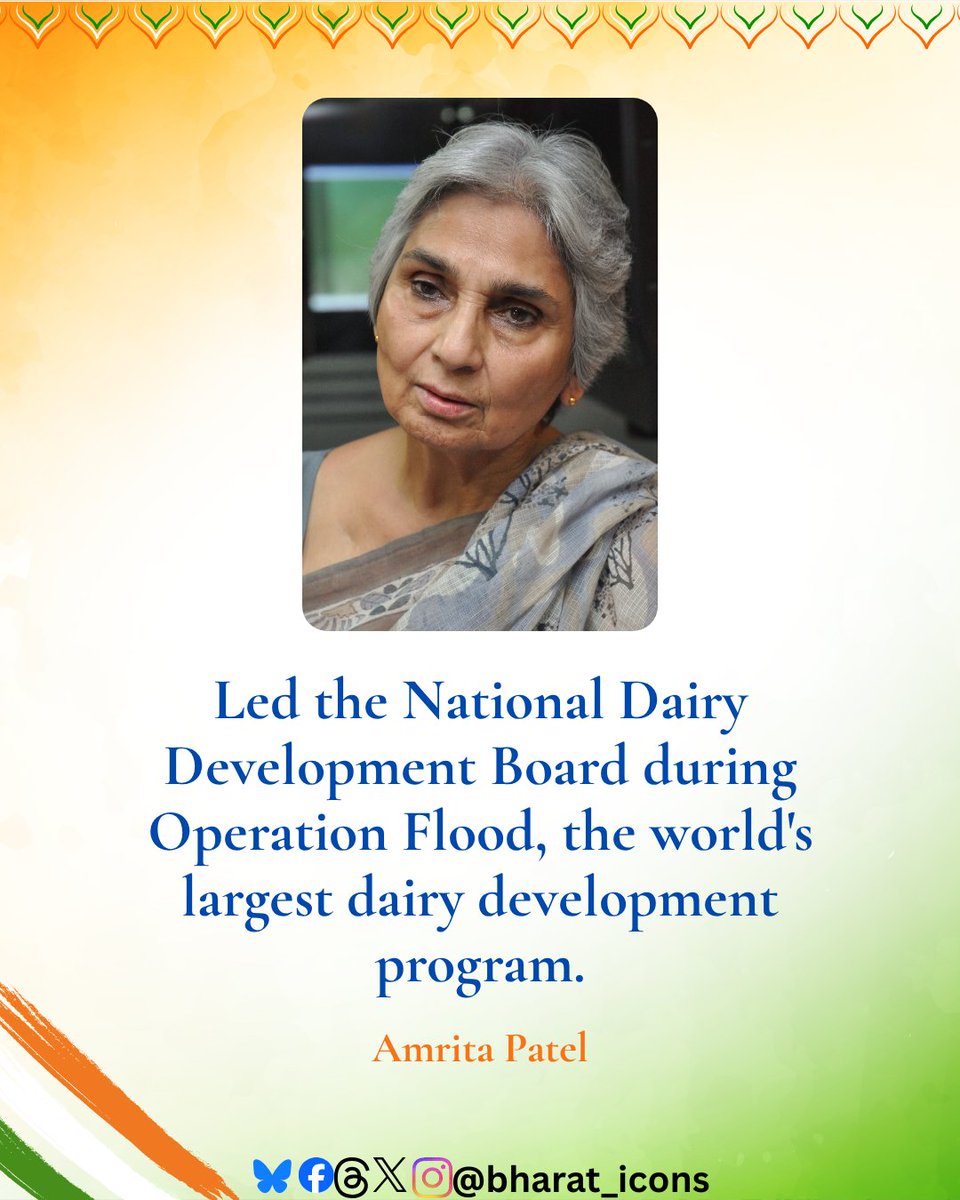
Read the full story of Amrita Patel with curated images, rare facts, timeline events, videos, quotes, articles, and social buzz. You can also contribute more details to your favourite icon to make their profile even more interesting.
https://t.co/QSOVqKJ5H9
🎉 Today we commemorate the Birth Anniversary of "Amrita Patel"
About:
1. In 1965, Amrita Patel began her career at Amul in Anand, Gujarat, training directly under Verghese Kurien, the architect of India's dairy revolution.
2. 🌟 From 1998 to 2014, she led the National Dairy Development Board (NDDB), overseeing Operation Flood, which connected over 10 million dairy farmers through nearly 95,000 village dairy cooperative societies.
3. In 2001, she was awarded the Padma Bhushan for her role in transforming India into the world's largest milk producer, a feat partly credited to her leadership at NDDB.
4. She chaired Mother Dairy, Delhi, and represented India internationally at the International Dairy Federation and FAO, sharing India’s cooperative dairy model globally.
5. 🌱 Beyond dairy, Patel chaired the Foundation for Ecological Security and the Sardar Patel Renewable Energy Research Institute, linking sustainable energy and ecology with rural development.
6. She served on the boards of the Reserve Bank of India and NABARD, influencing financial policies for rural agriculture and cooperative sectors.
7. 🏆 In 1997, she was named International Person of the Year by the World Dairy Expo, highlighting her global stature in dairy development.
Awards🏅:
Padma Bhushan (2001)
🙏 Join us in remembering and celebrating the life and contributions of Bharat Icons.
#AmritaPatel #BharatIcons
@NDDB_Coop@Amul_Coop@MotherDairyMilk@NABARDOnline
Read the full story of K. G. Ramanathan with curated images, rare facts, timeline events, videos, quotes, articles, and social buzz. You can also contribute more details to your favourite icon to make their profile even more interesting.
https://t.co/39zKYuRCTy
🎉 Today we commemorate the Birth Anniversary of "K. G. Ramanathan"
About:
1. 🎓 In 1942, K. G. Ramanathan completed his master's degree in mathematics at Loyola College, Chennai, under the influence of Jesuit priest and mathematician Rev Fr. C Racine, linking him to the legacy of French mathematician Élie Cartan.
2. In 1948, Ramanathan arrived at Princeton's Institute for Advanced Study, where he worked with Hermann Weyl and Carl Siegel, and famously sang Tyagaraja's Carnatic songs to his neighbor Albert Einstein.
3. 📚 By 1951, after earning his PhD under Emil Artin and Carl Siegel, Ramanathan returned to India to join TIFR, where he began assembling a dedicated number theory group.
4. From 1951 to 1985, Ramanathan was a key figure at the Tata Institute of Fundamental Research in Mumbai, nurturing Indian mathematicians and delving into both published and unpublished works of Srinivasa Ramanujan.
5. 🏆 In 1965, he was awarded the Shanti Swarup Bhatnagar Prize, marking his rising stature in Indian mathematical sciences.
6. For over 30 years, Ramanathan served on the editorial board of Acta Arithmetica, shaping the field of number theory through international scholarly review.
7. 🎖 In 1983, he received the Padma Bhushan, recognizing his sustained influence on mathematical research and education in post-independence India.
Awards🏅:
Padma Bhushan (1983)
🙏 Join us in remembering and celebrating the life and contributions of Bharat Icons.
#KGRamanathan #BharatIcons
@TelanganaCMO@TIFRScience
Read the full story of Rai Krishnadasa with curated images, rare facts, timeline events, videos, quotes, articles, and social buzz. You can also contribute more details to your favourite icon to make their profile even more interesting.
https://t.co/aNwY5srtEX
🎉 Today we commemorate the Birth Anniversary of "Rai Krishnadasa"
About:
1. In 1920, Rai Krishnadasa established Bharat Kala Bhavan within Banaras Hindu University, transforming a small collection into a comprehensive museum preserving India's art heritage.
2. 🎨 By the 1950s, under his stewardship, Bharat Kala Bhavan amassed thousands of artifacts spanning Indian sculptures, textiles, and paintings, becoming a key repository for post-independence cultural identity.
3. In 1980, the Government of India awarded Rai Krishnadasa the Padma Vibhushan, marking a rare honor for an art historian and museum founder from Uttar Pradesh.
4. 📚 His writings throughout the mid-20th century documented lesser-known regional art traditions, linking archival research with field collections in Uttar Pradesh and beyond.
5. Rai Krishnadasa's leadership at Bharat Kala Bhavan coincided with a critical era when Indian museums transitioned from colonial collections to national cultural institutions.
6. 📜 He curated exhibitions that showcased Indian art's diversity, influencing how universities integrated visual culture into academic study post-
1947.
7. By the late 1970s, Bharat Kala Bhavan under his directorship stood as a model university museum in India, blending scholarship with public engagement.
Awards🏅:
Padma Vibhushan (1980)
🙏 Join us in remembering and celebrating the life and contributions of Bharat Icons.
#RaiKrishnadasa #BharatIcons
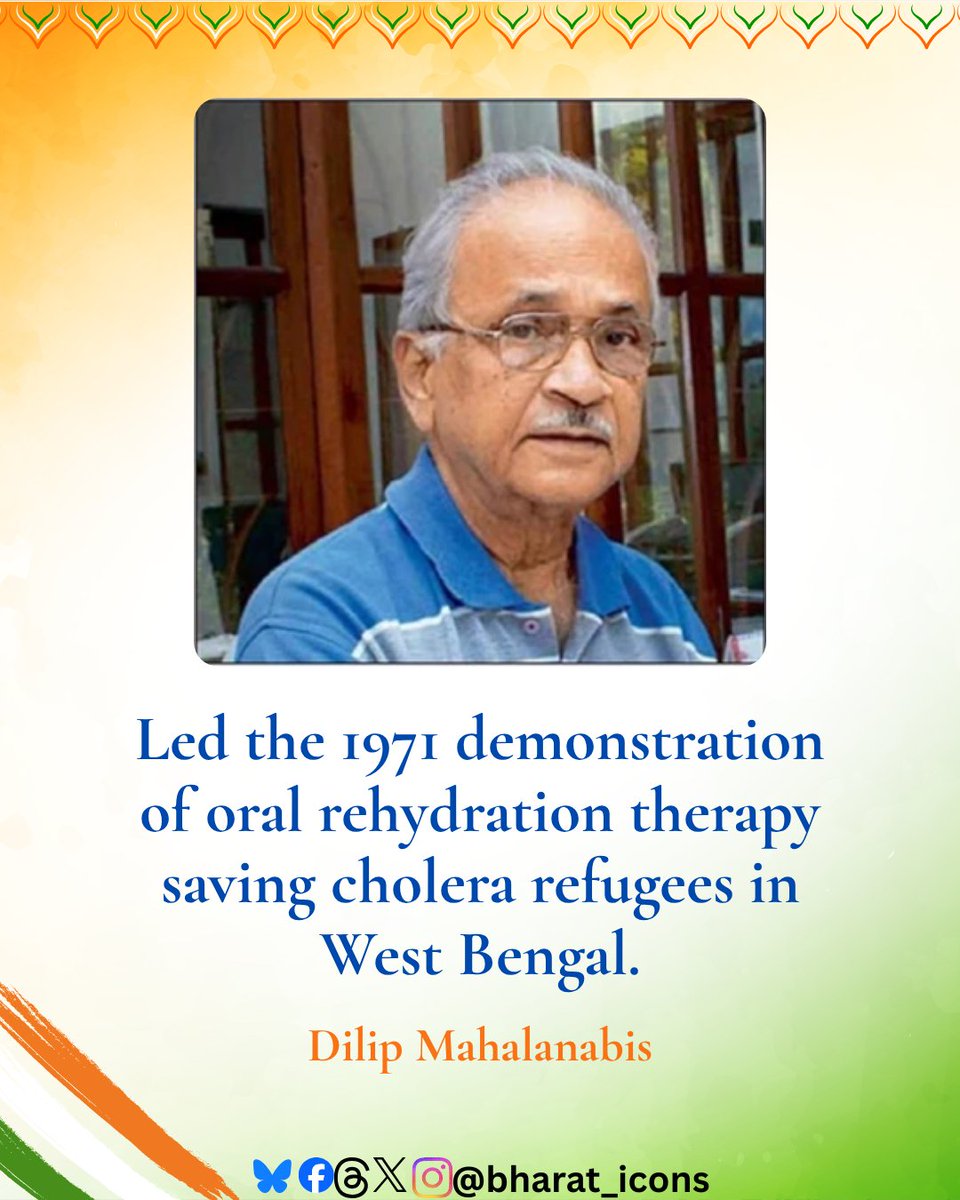
Read the full story of Dilip Mahalanabis with curated images, rare facts, timeline events, videos, quotes, articles, and social buzz. You can also contribute more details to your favourite icon to make their profile even more interesting.
https://t.co/SQuUn4YnfP
🎉 Today we commemorate the Birth Anniversary of "Dilip Mahalanabis"
About:
1. In 1971, at a small treatment center in Bongaon near the India-East Pakistan border, Dr. Dilip Mahalanabis and his team managed to save thousands of cholera-affected Bangladeshi refugees with only 16 beds but a revolutionary oral rehydration solution.
2. 🌍 Starting in 1966, Mahalanabis researched oral rehydration therapy at Johns Hopkins University International Center for Medical Research and Training in Kolkata, focusing on combating fatal diarrhoeal diseases.
3. 💉 During the Bangladesh Liberation War refugee crisis, conventional intravenous fluids were scarce, so Mahalanabis devised a simple, homemade saline-glucose solution that slashed cholera mortality from 30% to under 3% in camp patients.
4. Between 1975 and 1979, Mahalanabis extended his cholera control expertise by working with the WHO in Afghanistan, Egypt, and Yemen, adapting oral rehydration strategies to diverse outbreaks.
5. 🏥 In 1983, he was appointed to the WHO's Diarrhoeal Diseases Control Programme, where he influenced diarrhoeal disease management policies worldwide for over five years.
6. At Kolkata’s National Institute of Cholera and Enteric Diseases, Mahalanabis continued his clinical and research work, linking field experience with laboratory science to improve treatment protocols.
Awards🏅:
Padma Vibhushan (2023)
🙏 Join us in remembering and celebrating the life and contributions of Bharat Icons.
#DilipMahalanabis #BharatIcons
Read the full story of B. N. Suresh with curated images, rare facts, timeline events, videos, quotes, articles, and social buzz. You can also contribute more details to your favourite icon to make their profile even more interesting.
https://t.co/ctrS0GYmIM
🎉 Today we commemorate the Birth Anniversary of "B. N. Suresh"
About:
1. 🌌 In 1969, B.N. Suresh joined ISRO just days before its formal founding, placing him among the pioneers who shaped India's first indigenous satellite launch vehicle under Dr. A.P.J. Abdul Kalam’s leadership.
2. Born in a small Kannada-medium village school in Andagar near Sringeri, Karnataka, Suresh defied rural limitations by earning his master’s in mechanical engineering from IIT Madras in 1969 and later a PhD in control systems from Salford University in
1978.
3. 🚀 Between 2003 and 2007, as director of Vikram Sarabhai Space Centre (VSSC) in Thiruvananthapuram, he oversaw critical advancements including the Space Capsule Recovery Experiments (SRE), pivotal to India’s reusable spacecraft ambitions.
4. He was the founding director of the Indian Institute of Space Science and Technology (IIST), holding the position until 2010, shaping the institute that now produces India’s specialized space scientists and engineers.
5. 🏆 Suresh received the Padma Shri in 2002 and the Padma Bhushan in 2013, reflecting recognition of his sustained role in evolving India’s launch vehicle technology and aerospace research management.
6. After retirement from ISRO, he served as Vikram Sarabhai Distinguished Professor at ISRO Headquarters for five years and contributed as professor at IIT Mumbai and MIT Manipal, bridging academia and space research.
7. 📚 Suresh co-edited and co-authored key ISRO histories like "From Fishing Hamlet To Red Planet" and "Ever Upwards: ISRO in Images," documenting the technical and human stories behind India’s space missions.
Awards🏅:
Padma Bhushan (2013), Padma Shri (2002)
🙏 Join us in remembering and celebrating the life and contributions of Bharat Icons.
#BNSuresh #BharatIcons
@isro@iitmadras
Read the full story of M. C. Setalvad with curated images, rare facts, timeline events, videos, quotes, articles, and social buzz. You can also contribute more details to your favourite icon to make their profile even more interesting.
https://t.co/GsKC1acwDI
🎉 Today we commemorate the Birth Anniversary of "M. C. Setalvad"
About:
1. In 1950, Motilal Chimanlal Setalvad was appointed the first Attorney General of independent India, a role he held for 13 years during the nation's formative legal years.
2. 🌍 From 1955 to 1958, he chaired the inaugural Law Commission of India, creating the blueprint for future legal reforms and advising the government on crucial legislation.
3. In 1961, Setalvad became the first Chairman of the Bar Council of India, shaping the professional regulation of lawyers across the country.
4. ⚖️ Setalvad played a pivotal role in the Radcliffe Tribunal, which in 1947 defined the contentious borders between India and Pakistan amidst Partition chaos.
5. His legal expertise extended to international arenas, representing India in complex United Nations proceedings on Kashmir during the early years of the conflict.
6. 🏅 Awarded the Padma Vibhushan in 1957, Setalvad was recognized by the Government of India for his contributions to law and justice.
7. Coming from a legal lineage in Bombay, he was the son of Chimanlal Harilal Setalvad and set a standard for legal ethics and independence in the judiciary.
Awards🏅:
Padma Vibhushan (1957)
🙏 Join us in remembering and celebrating the life and contributions of Bharat Icons.
#MCSetalvad #BharatIcons
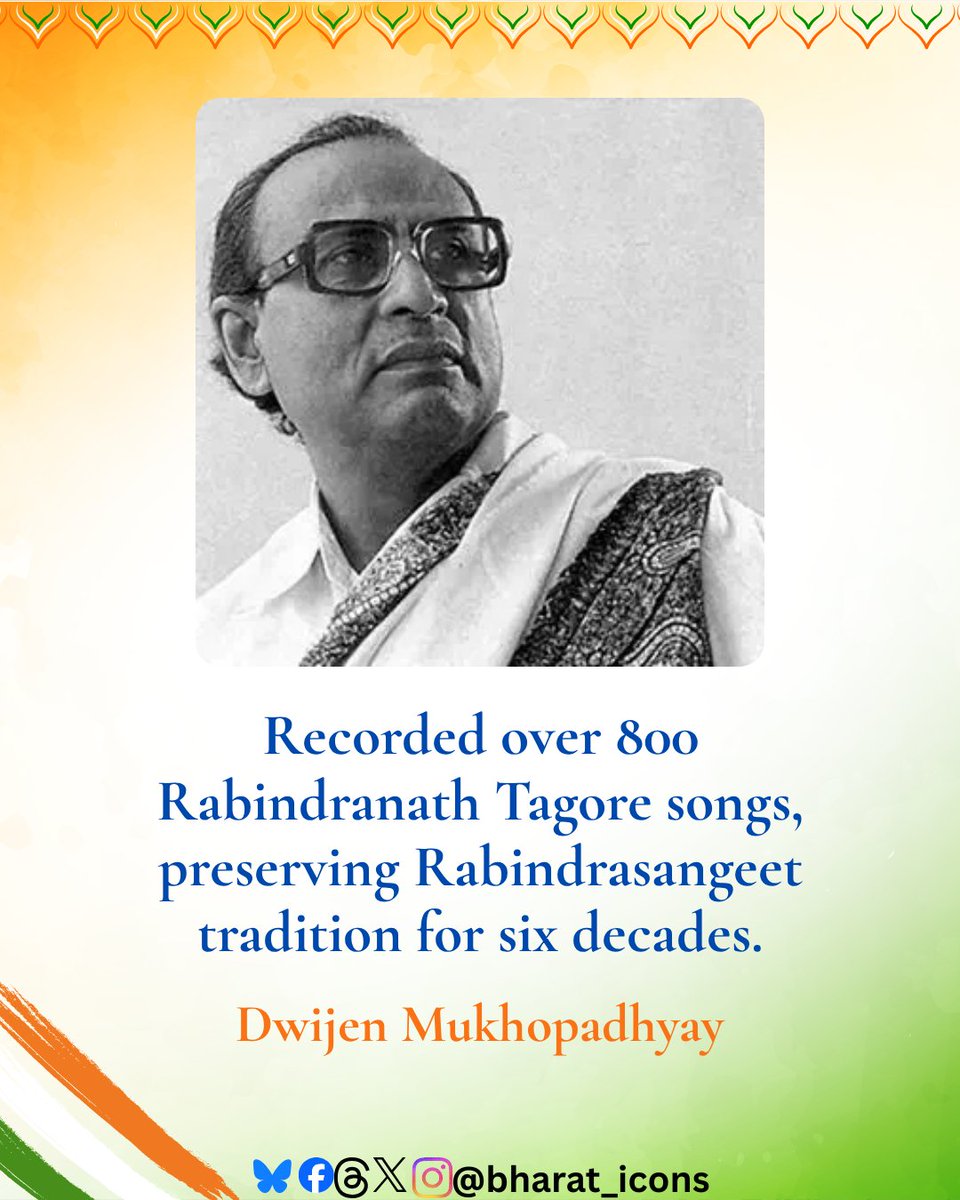
Read the full story of Dwijen Mukhopadhyay with curated images, rare facts, timeline events, videos, quotes, articles, and social buzz. You can also contribute more details to your favourite icon to make their profile even more interesting.
https://t.co/lNd2xkjifM
🎉 Today we commemorate the Birth Anniversary of "Dwijen Mukhopadhyay"
About:
1. 🎙️ In 1944, Dwijen Mukhopadhyay made his professional singing debut, stepping onto the stage during a turbulent era of Indian history just before independence, marking the start of a career spanning over six decades.
2. By 1945, he had recorded his first Bengali basic songs with Megaphone Record Company, and a year later, he became a recognized artist for All India Radio, expanding his influence across Bengal and beyond.
3. 🎼 His collaboration with Salil Chowdhury in the late 1940s birthed iconic Bengali songs like "Shyamal Barani Ogo Konya" and "Klanti Name Go," blending folk and film music amidst the Indian People's Theatre Association cultural movement.
4. In 1956, Mukhopadhyay took his music to the icy heights of Ladakh, performing for Indian soldiers, a rare instance of cultural morale boosting on the frontline during post-independence tensions.
5. 🌍 As a member of the Indian Cultural Delegation, he toured the Soviet Union and Eastern Europe, bringing Bengali Rabindrasangeet to audiences in Poland, Romania, Czechoslovakia, Bulgaria, and Yugoslavia, during the Cold War era when cultural exchange was politically charged.
6. 🎥 Mukhopadhyay's voice and music graced Bengali films such as 'Kshudita Pashan' (1960) and 'Sandhya Raag' (1977), working with musical giants like Ustad Ali Akbar Khan and Pandit Ravi Shankar, anchoring Tagore’s songs in cinema.
7. He lent his voice to the famed All India Radio Mahalaya broadcast with the devotional song 'Jaago Durga,' a tradition that signals the start of Durga Puja festivities in Kolkata every year.
Awards🏅:
Padma Bhushan (2011), Sangeet Natak Akademi Award (2010)
🙏 Join us in remembering and celebrating the life and contributions of Bharat Icons.
#DwijenMukhopadhyay #BharatIcons
Read the full story of Salim Ali with curated images, rare facts, timeline events, videos, quotes, articles, and social buzz. You can also contribute more details to your favourite icon to make their profile even more interesting.
https://t.co/VpqDP4AFfk
🎉 Today we commemorate the Birth Anniversary of "Salim Ali"
About:
1. In 1908, an 11-year-old Salim Ali accidentally shot a yellow-throated sparrow with his toy airgun near Bombay, a moment that shifted his fascination from sport shooting to bird study under the mentorship of W. S. Millard at the Bombay Natural History Society.
2. 🌿 From 1947 onwards, Salim Ali led systematic bird surveys across India, collaborating with Sidney Dillon Ripley to produce the ten-volume Handbook of the Birds of India and Pakistan, a monumental effort published starting in
1961.
3. In 1957, Ali successfully petitioned the Indian government to establish the Bharatpur bird sanctuary (now Keoladeo National Park), transforming a hunting ground into a protected haven for migratory birds.
4. 🦜 Awarded the Padma Bhushan in 1958 and later the Padma Vibhushan in 1976, Salim Ali used these honors to secure government support for conservation projects and scientific research in ornithology.
5. In the 1970s, Ali's intervention prevented the destruction of Kerala's Silent Valley, advocating for the preservation of its unique tropical rainforest ecosystem before environmental conservation became a widespread movement.
6. 📻 Between 1941 and 1985, Salim Ali delivered over thirty-five radio talks to popularize bird watching and conservation, emphasizing the economic and ecological importance of birds to everyday listeners across India.
Awards🏅:
Padma Bhushan (1958), Padma Vibhushan (1976)
🙏 Join us in remembering and celebrating the life and contributions of Bharat Icons.
#SalimAli #BharatIcons
@CMOMaharashtra