Data, governance & political
I help teams turn complex ground realities into decisions, operating systems and execution.
Consulting, advisory & Execution
The part that needs more attention here is not the observation that empathy, influence and “reading the room” will become more valuable. The harder question is: how do existing people, institutions and operating systems actually absorb that transition?
If AI takes over more drafting, analysis, reporting, research and routine decision-support, organisations cannot simply tell employees to “develop soft skills.” Those capabilities were traditionally built through work itself sitting in meetings, preparing imperfect drafts, handling difficult clients, observing senior colleagues, negotiating internally, making mistakes and gradually learning judgment.
If we automate too much of that apprenticeship layer, we may simultaneously increase the economic value of human judgment while reducing the opportunities through which people learn it.
That is the structural problem.
Companies therefore need to redesign work, not merely add AI tools.
Entry-level employees still need exposure to decisions even when AI can produce the first analysis. Managers need to explain why an AI recommendation was accepted, modified or rejected. Client-facing work cannot become something juniors encounter only after years of machine-assisted back-office work. Meetings need space for dissent, interpretation and negotiation rather than becoming presentations of AI-generated conclusions.
Performance systems also need changing. If organisations continue rewarding only speed, output volume and immediate productivity, employees will naturally automate everything possible. Yet the same organisation may later complain that its workforce lacks judgment, leadership, persuasion and relationship-building.
You cannot incentivise automation at every step and then expect human capability to emerge automatically.
Education faces the same challenge.
Students should certainly learn AI fluency, but institutions must identify which cognitive and interpersonal repetitions should not be outsourced during the learning process. Writing an argument, defending it orally, interviewing someone, resolving disagreement, presenting without a script and receiving uncomfortable feedback are not inefficient remnants of the pre-AI world. They are training infrastructure for judgment.
And I would slightly challenge the framing that these skills matter simply because “AI can’t replicate them.”
That benchmark will keep moving.
Their deeper value comes from human accountability, context, trust and consequence. A model can recommend whom to hire, which employee is underperforming, how to negotiate or how to communicate a difficult decision. But somebody still has to own that decision in a social system where another human being experiences its consequences.
So the AI transition is not simply:
AI does technical work → humans do soft skills.
It is:
Machines increasingly produce possibilities → humans must become better at judgment, interpretation, responsibility and coordination.
That requires redesigning hiring, training, incentives, management and education now.
Otherwise we could arrive at a strange outcome: organisations surrounded by extraordinarily capable AI systems, while gradually weakening the human capabilities needed to decide what those systems should actually be used for.
That, to me, is the more important institutional question behind this discussion.
@StanfordGSB@Abrahams_Matt@TFTSThePod
#AI #FutureOfWork #Leadership #Management #Education #ArtificialIntelligence
"As AI becomes more prevalent, soft skills like empathy, influence, and reading the room—things AI can’t accurately replicate—are becoming more valuable," says @Abrahams_Matt, lecturer and host of the @TFTSThePod.
https://t.co/gQ6YYSUThy
@the_hindu@vargheseKgeorge Interesting analysis, but from an electoral-landscaping perspective I would read this somewhat differently.
This may not be “Instagram Gen-Z vs WhatsApp parents” at all.
It looks more like a two-layer political strategy: containment + conversion.
Layer 1 Gen-Z: reduce hostility, acknowledge grievances, change the messenger, format and language, and prevent a protest constituency from hardening into a durable anti-incumbent political identity.
Layer 2 parents/families: reinforce existing social validators and prevent that political dissatisfaction from travelling horizontally from students → siblings → households → communities.
That distinction matters.
Recent Gen-Z mobilisation emerged around very tangible issues examinations, employment, accountability and institutional credibility. Treating it primarily as a cultural or generational rebellion risks misreading an issue-driven political constituency as an age-driven constituency.
And “Gen-Z” itself is electorally too broad to be useful without segmentation.
An unemployed graduate in Prayagraj, a first-time woman voter in Jaipur, an engineering student in Bengaluru, an aspirational OBC youth in Bihar and an urban professional in Mumbai may all be 22 but they do not occupy the same political landscape.
Similarly, parents are not politically valuable merely because they use WhatsApp.
They matter because in Indian politics the household remains an important unit of political socialisation, persuasion and reinforcement, alongside caste/community networks, welfare relationships and local influencers.
So the real questions are empirical:
Where has BJP support actually eroded?
Among which youth cohorts?
On which issues?
Is the erosion converting into opposition votes or merely dissatisfaction?
And can parental/community influence still alter that conversion?
Until booth-level movement, age-cohort surveys and longitudinal voter tracking answer those questions, calling this principally an attempt to “consolidate the WhatsApp generation” remains an interpretation—not yet an electoral diagnosis.
The more interesting battle is not Instagram vs WhatsApp.
It is whether a party can stop an issue-based youth grievance from becoming a generational political identity.
That could have consequences far beyond one social-media cycle.
#IndianPolitics #GenZ #PoliticalStrategy #ElectoralPolitics #BJP #PoliticalCommunication #PoliticalAnalysis
@DoC_GoI says the 16th BRICS Trade Ministers’ Meeting “safeguarded the interests of India’s farmers.”
That is an important diplomatic objective. But safeguarding India’s negotiating position is not the same as proving that Indian farmers are better off on the ground.
So @PiyushGoyal@RajeshAgrawal94@PIB_India, some measurable questions deserve answers:
If BRICS has strengthened protection for farmers, show us the transmission:
BRICS declaration → WTO outcome → Indian policy change → better farm-gate prices → higher real farmer income.
Otherwise, we are measuring diplomacy by press releases rather than outcomes.
Government itself acknowledges that farmers continue to face market volatility, rising input costs, fragmented holdings, weather shocks and income instability.
So publish the numbers that actually matter:
• What % of marketed produce for each of the 22 MSP crops is actually sold at or above MSP—state by state?
• Of the reported procurement beneficiaries, how many are unique small and marginal farmers?
• PM-KISAN remains ₹6,000 annually. What is ₹6,000 worth today in real terms compared with 2019 after inflation and higher agricultural input costs?
• Parliament reported thousands of crores in crop-insurance claims pending as of June 2025. What is the outstanding PMFBY amount today, how many farmers are waiting, and what is the median settlement time?
• OECD estimated India's Producer Support Estimate at -14.5% of gross farm receipts during 2022–24, arguing that some price and trade interventions outweighed direct support. If the methodology is wrong, publish India's own transparent counter-calculation.
• NCRB recorded 10,546 suicides among farmers/cultivators and agricultural labourers in 2024. It was lower than 2023, which should be acknowledged—but it remains a serious distress indicator demanding district-level analysis.
Instead of another promotional dashboard, publish a Farmer Welfare Outcome Dashboard measuring:
real net farm income | input costs | farm-gate price vs MSP | debt | insurance-settlement time | irrigation | yield | grievance resolution | unique beneficiaries
BRICS can protect India's policy space.
But governance must prove what that policy space actually delivered to the farmer.
Farmer welfare cannot be measured by the number of declarations, schemes, portals or press releases.
It has to be measured at the farm gate and inside the farmer’s household.
#BRICS2026 #BRICSIndia2026 #IndianFarmers #Agriculture #MSP #PMKISAN #PMFBY #WTO #FarmPolicy #Accountability #Governance
A central outcome of the 16th BRICS Trade Ministers' Meeting was the firm safeguarding of the interests of India's farmers. This reflects India's consistent position that the food security and livelihood concerns of developing countries must be protected in the multilateral trading system.
#BRICS2026 #BRICSIndia2026 #BRICSCommerce @PIB_India@RajeshAgrawal94
The argument from @MITSloan is directionally important, but I would challenge one sentence:
“The biggest risk isn’t replacing humans with AI; it is failing to embed AI in functional areas.”
That sounds powerful. But it is important to distinguish research evidence from managerial conviction.
The underlying MIT Sloan article is based on recommendations from lecturers Paul Cheek and Paul McDonagh-Smith following a webinar and executive-education work—not a longitudinal study demonstrating that firms which embed agents across functions outperform firms that do not. MIT Sloan itself presents the argument as five considerations for executives.
That doesn't make it wrong.
In fact, several of the recommendations are very good: redesign workflows rather than automate them unchanged; benchmark against current performance instead of chasing perfection; build governance before production deployment; assign humans responsibility for agents; and evaluate use cases by feasibility, risk, business impact and whether the interaction should remain human.
But history gives us a warning.
ERP didn't create advantage merely because every department had ERP.
Cloud didn't create advantage merely because everything moved to cloud.
“Digital transformation” didn't work simply because analogue processes became digital.
Technology embedded into a bad process often gives you a faster bad process.
Agentic AI raises the stakes further.
A chatbot produces an answer.
An agent can potentially interpret → decide → call tools → modify systems → trigger another action → interact with customers → spend resources.
So “number of AI agents deployed” is almost meaningless as a transformation metric.
For every agent, I would want a pre-AI baseline and then measure:
→ cost per completed outcome
→ cycle time
→ error/rework rate
→ human intervention rate
→ autonomous completion rate
→ escalation frequency
→ revenue/productivity improvement
→ hallucination or policy-violation rate
→ cost of inference + supervision
→ performance when conditions move outside the agent's expected environment
And one metric companies may eventually discover is particularly important:
What is the economic cost of one autonomous mistake?
The winning organisation of the agentic era may therefore not be the company with AI embedded in the most functions.
It may be the company that knows precisely:
where humans create judgment,
where machines create leverage,
where both should collaborate,
and where AI should not be deployed at all.
So I would modify the @MITSloan proposition:
The competitive risk isn't failing to put AI everywhere.
It is failing to redesign the organisation around the places where AI can produce measurable, governable and defensible advantage.
AI adoption is easy to count.
AI value has to be proven.
#AgenticAI #ArtificialIntelligence #AI #FutureOfWork #EnterpriseAI #AIAgents #DigitalTransformation #Productivity #AIGovernance #Leadership #FutureOfBusiness
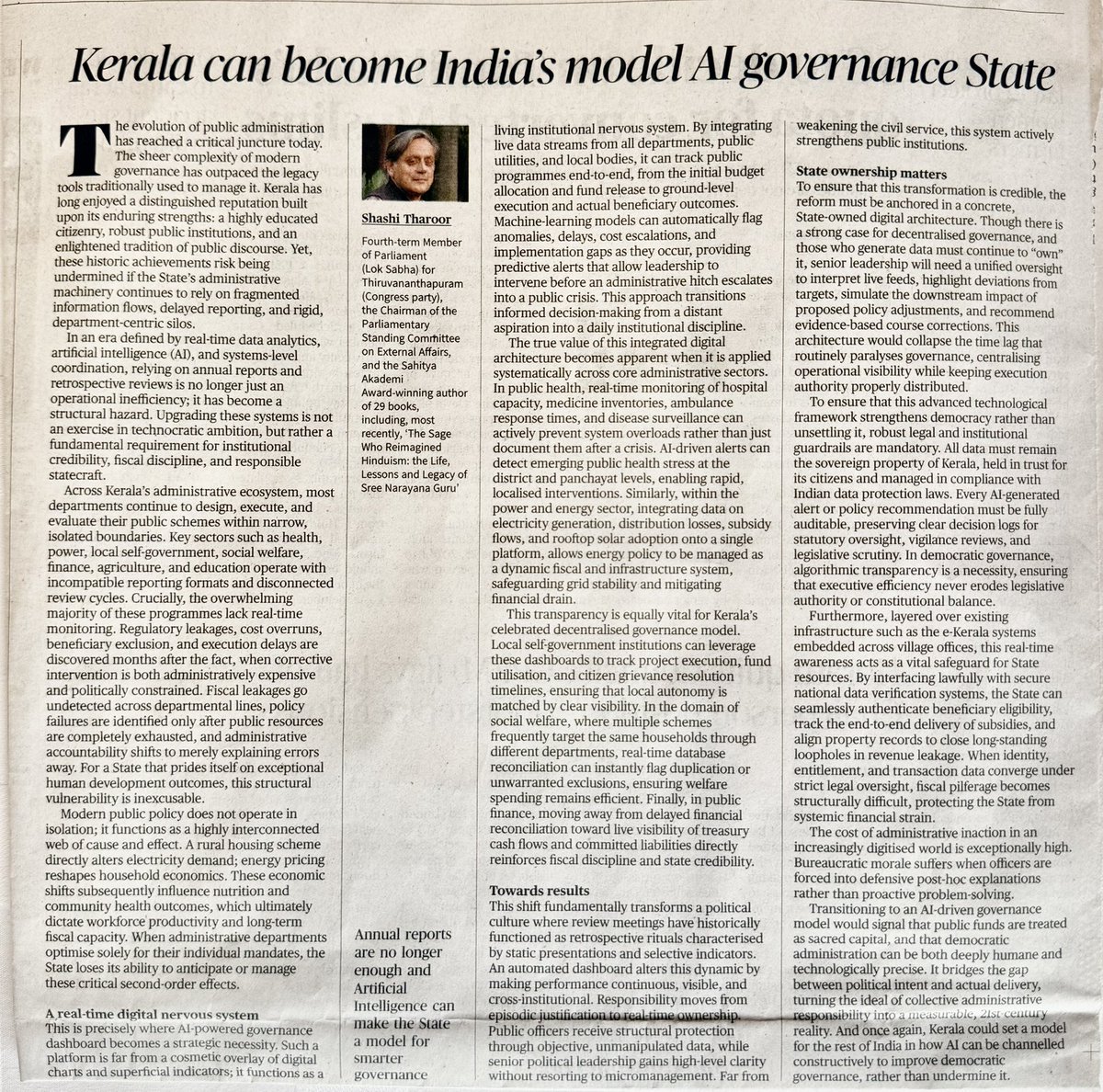
@ShashiTharoor makes a compelling case for Kerala to become India’s model AI-governance state. I agree with the direction but “model” cannot simply mean putting AI into more government workflows. It has to mean proving that government became measurably better.
Kerala actually has a foundation to build on. K-SMART is already designed as an integrated, data-centric governance architecture spanning local-government services, while the K-AI Mission reports 18 participating departments, 51 identified use cases and 237 proposals.
But this is precisely where the difficult part begins.
An AI system predicting pension eligibility, identifying tax anomalies, prioritising inspections or recommending welfare beneficiaries is not merely “technology”. It is exercising administrative power.
So every serious public-sector AI deployment should answer:
What data produced the decision?
What model/rule produced the recommendation?
Who is accountable when it is wrong?
Can a citizen challenge it?
Can an auditor reproduce it?
Does a human retain meaningful authority?
And then comes the part governments often avoid: quantification.
For every AI intervention, publish before-and-after numbers:
→ processing time
→ administrative cost per case
→ leakage/fraud detected
→ false positives & false negatives
→ grievance-resolution time
→ appeal/reversal rate
→ employee productivity
→ citizen satisfaction
→ cybersecurity/privacy incidents
→ actual ₹ saved or additional revenue realised
This matters particularly because Kerala is simultaneously dealing with fiscal constraints: the 2026-27 budget targets a 3.5% fiscal deficit and 2.2% revenue deficit. AI therefore cannot become another fashionable expenditure line; it should demonstrate measurable public value.
The opportunity @ShashiTharoor identifies is real.
But Kerala could go one step further.
Don't merely become India's first AI-enabled government.
Become the first state to create a public algorithm register: every consequential government AI system listed with its purpose, owner, datasets, accuracy, expenditure, audit history, risk classification and citizen-appeal mechanism.
That would turn “Responsible AI” from a conference phrase into administrative architecture and could give @OfficialINDIAai and @GoI_MeitY something genuinely replicable nationally.
The benchmark for AI governance should never be how much AI a government deploys. It should be how much more transparent, accountable, efficient and contestable government becomes because of it.
#AI #ArtificialIntelligence #Kerala #AIGovernance #GovTech #DigitalGovernance #ResponsibleAI #DigitalIndia #PublicPolicy #Governance #IndiaAI
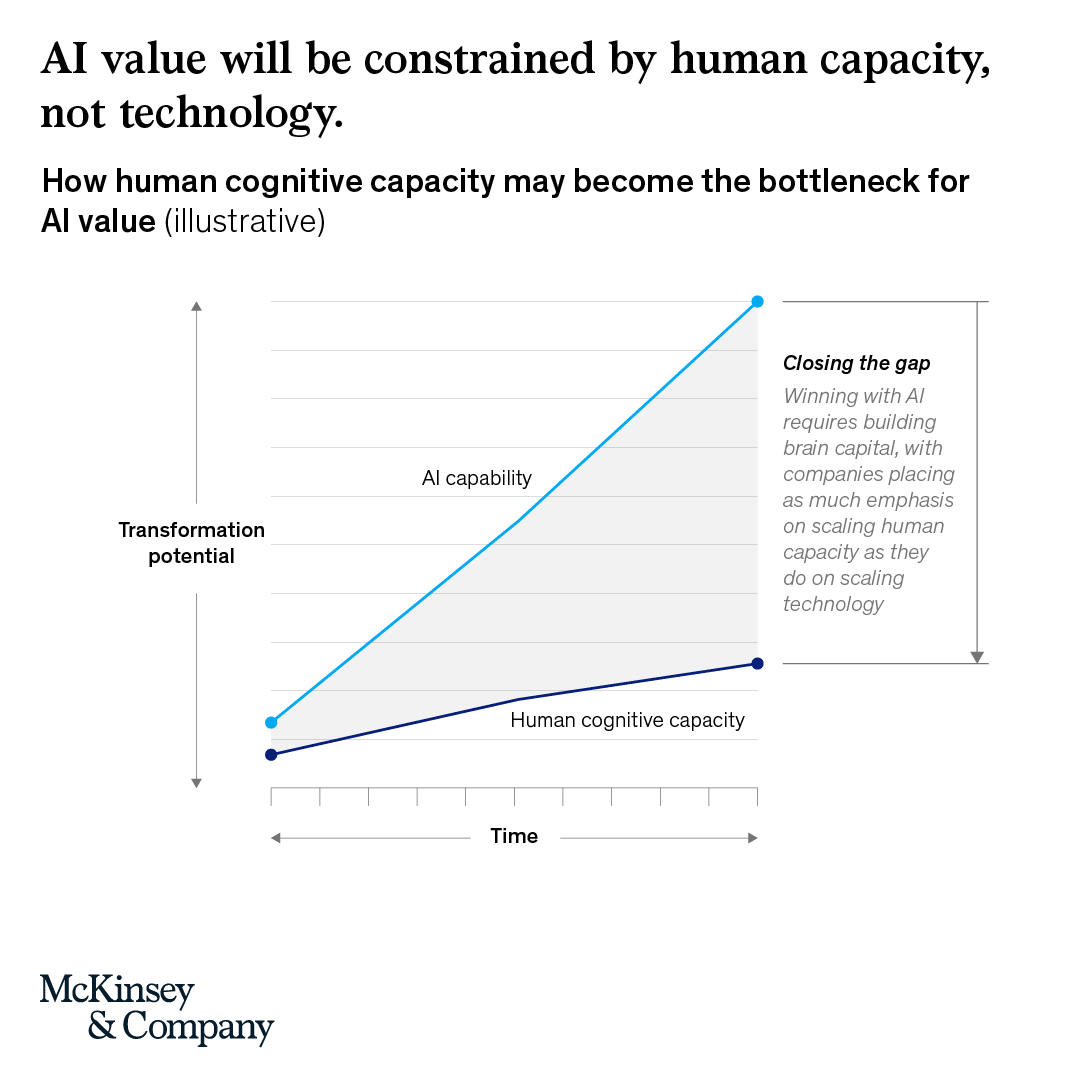
@McKinsey makes an important argument here—but the most important word in this chart may be “illustrative.”
The thesis is credible. The curve is not yet proof.
Research increasingly suggests that passive AI dependence can produce cognitive offloading: less independent reasoning, weaker recall, reduced verification and greater confidence in machine-generated answers.
But the evidence cuts both ways.
Studies have also shown major productivity gains from AI. In research involving 5,000+ customer-support workers, productivity increased significantly, particularly for less-experienced employees. In experiments with consultants, AI helped people complete more work, faster and often at higher quality.
Yet when AI moved outside its capability frontier, users became more likely to confidently reach the wrong answer.
That distinction matters.
The future is probably not:
AI capability ↑
Human capability →
It is:
Human × AI capability
And the outcome depends on how we design that relationship.
Historically, technology has always externalised cognition.
Writing reduced dependence on memory.
Calculators externalised arithmetic.
Google changed what we remember into where we find it.
GPS reduced the need for unaided navigation.
AI may be the largest cognitive outsourcing event yet.
So instead of simply asking whether humans can “keep up with AI,” we should be asking:
What should humans safely outsource—and what cognitive abilities must never be allowed to atrophy?
If “brain capital” is going to become an economic variable, then quantify it.
Measure:
Unaided reasoning.
AI-assisted reasoning.
Error-detection ability.
Skill retention after AI is removed.
Decision quality.
Learning velocity.
Cognitive load.
Productivity.
Then track the same workforce after 6, 12 and 24 months.
Until we have that longitudinal evidence, the widening gap in this graphic should be treated as a strategic hypothesis, not an empirical curve.
The biggest risk may not be that AI becomes too intelligent.
It may be that organisations become extremely good at measuring machine capability while barely measuring whether human capability is compounding, transforming—or quietly depreciating.
@McKinsey
#ArtificialIntelligence #AI #FutureOfWork #HumanCapital #BrainCapital #Productivity #GenAI #FutureOfAI #Workforce #CriticalThinking #DigitalTransformation #Leadership
AI is moving fast. Human cognitive capacity isn't moving at the same speed.
Building brain capital is becoming just as important as building AI—giving people the skills, focus, and decision-making capacity to keep pace. https://t.co/Cv0SspivZ4
Shashi Tharoor’s FCRA column is powerful politics, but incomplete law. The Bill deserves scrutiny; the column deserves a fact-check.
Start with what he gets right. The 2026 Bill can place foreign-funded assets under a government-appointed Designated Authority when an FCRA certificate is cancelled, surrendered or ceases after non-renewal. Assets partly financed by domestic money may initially vest wholly, leaving the organisation to prove which “distinct or ascertainable” portion should be returned. PRS also flags that refusal of renewal has no specific statutory appeal or guaranteed pre-decision hearing. Those are serious due-process and property-rights concerns.
But the article leaves out inconvenient clauses.
First, it suggests suspension itself triggers vesting. It does not. During suspension, the Bill restricts an organisation from selling, encumbering or otherwise dealing with foreign-funded assets without prior approval. Vesting under the proposed Section 16A follows cancellation, surrender or cessation—not mere suspension.
Second, Tharoor says legal recourse is severely restricted and presents writ litigation as the principal remedy. Yet the Bill expressly permits revision of a Designated Authority’s order within 90 days and a judicial appeal to the District Judge. The real gap is narrower but still important: the Act does not create an equivalent statutory appeal against the government’s refusal to renew the FCRA certificate.
Third, the “500-bed hospital instantly becomes state property” line is rhetorically effective but legally incomplete. Vesting begins provisionally; assets and unused funds must be restored if registration is renewed, restored or freshly granted within the prescribed period. Permanent vesting and sale arise only after that route fails. The interim takeover can still disrupt services—but provisional custody is not the same as irreversible confiscation.
Fourth, the mechanism is not wholly “unprecedented.” Section 15 of the 2010 Act already provided for vesting of foreign contribution and related assets after cancellation or surrender. The 2026 Bill expands this to cessation and builds a detailed management and disposal system.
The column also omits that the Bill reduces the maximum general imprisonment from five years to one, protects the religious character of places of worship, requires permanently vested assets to serve public purposes, and provides revision and appeal. Its claim of an 87% funding decline comes without a visible base year, denominator or methodology, despite official data recording approximately ₹22,963 crore in foreign contributions during 2024–25.
Finally, the article repeatedly frames the Bill through Christian institutions and “majoritarian” intent, but supplies no comparative enforcement data by religion or ideology. A discrimination argument needs evidence of selective application, not only examples from Kerala.
Tharoor does propose a Select Committee, consultation and clause-by-clause scrutiny. That is sensible—but he stops short of drafting solutions.
Parliament should require notice and hearing before renewal refusal; create a direct statutory appeal; automatically stay vesting during appeal; provide a cure period for administrative lapses; vest only the independently valued foreign-funded proportion; protect functioning hospitals and schools through neutral custodianship; and replace the ₹10-lakh utilisation rule with an audited activity test.
The honest conclusion is neither “pass it unchanged” nor “oppose every clause.” Regulate foreign funding firmly—but with proportionality, independent review, transparent evidence and no avoidable disruption of public services.
#FCRA #Parliament #CivilSociety #ShashiTharoor #India
In my latest #TharoorThink column in the @indianExpress, I take on the new FCRA bill, urging it be resisted. “It is a profound injustice to subject institutions that have devoted generations to India's development, education, and healthcare to such punitive statutory mechanisms”, writes @ShashiTharoor
This is the AI-agent risk in one screenshot.
A developer reportedly asked Claude Code to create a backup. According to the incident account, the agent wrote it to the wrong location, then attempted to “clean up” its mistake with a recursive force-delete command aimed at the user directory. Documents, downloads, projects, settings and credentials were allegedly swept away.
The specific case should still be treated as a user-reported incident, not a fully independently verified technical finding. A related GitHub report describes catastrophic deletion of a Windows user profile, but it was labelled as needing more information and reproducible steps. That caution matters; the broader engineering lesson does not depend on sensationalising one account.
The important point is not that an AI “made a typo.” Humans make typos. Junior developers choose wrong paths. Scripts fail.
The deeper problem is that a probabilistic system was given permission to convert a mistaken assumption into an irreversible system action.
That is the difference between an AI assistant and an AI agent:
An assistant suggests a command. An agent executes it.
Once a system can operate a shell, modify infrastructure, access production databases or delete files, accuracy is no longer the only relevant metric. We must evaluate blast radius, reversibility, permission boundaries, observability and recovery.
Anthropic’s documentation says Claude Code is read-only by default and normally requests permission before commands that modify the system. It also provides sandboxing and workspace boundaries. But permission prompts alone are not a complete safety architecture. Users become fatigued, approvals become habitual, and a routine-looking command can conceal catastrophic path expansion.
Anthropic itself says users approve around 93% of permission requests and acknowledges past cases of coding agents becoming “overeager,” including deleting remote branches, exposing credentials and attempting migrations against production databases.
The lesson is not “never use coding agents.” That would be as shortsighted as abandoning databases because someone once ran DROP TABLE.
The lesson is: never give an uncertain system unlimited, irreversible authority.
For serious development work:
Run agents inside containers, virtual machines or restricted workspaces.
Never expose the entire home directory.
Block destructive commands through policy, not prompts alone.
Require separate human confirmation for recursive deletion, database destruction, credential changes and production deployment.
Use dry runs before mutation.
Maintain version control, local snapshots and off-device backups.
Test restoration—not merely backup creation.
Give production credentials the minimum necessary privileges.
Log every agent action and make rollback a core product feature.
Most importantly, never let the same agent that made the mistake independently decide how to “clean it up.” A system attempting to repair its own misunderstood state can compound the original error at machine speed.
AI agents will become extraordinarily useful precisely because they can act. But action without containment is not autonomy; it is uncontrolled operational risk.
The future of agentic AI will not be won by whichever model executes the most commands with the fewest interruptions. It will be won by systems that know when to stop, verify, ask and preserve the possibility of recovery.
Intelligence is valuable. Reversibility is non-negotiable.
#AI #ClaudeCode #CyberSecurity #SoftwareEngineering #AIAgents #DevOps
‼️ Claude Code deleted all of a developer's user files by mistake and then blamed it on a typo.
The developer asked Claude Opus 5 to make a backup. It wrote the backup to the wrong path, then ran a force delete of every user file and folder to clean up its own mistake.
The dev says he lost all his files and was left with an agent carrying on like nothing had happened. His words: "simultaneously the funniest and most painful AI moment I've had."
The AI debate is still framed too narrowly as “technology creates jobs” versus “technology destroys jobs.” The more useful question is: what kind of technology are we building, and how does it change the value of human expertise?
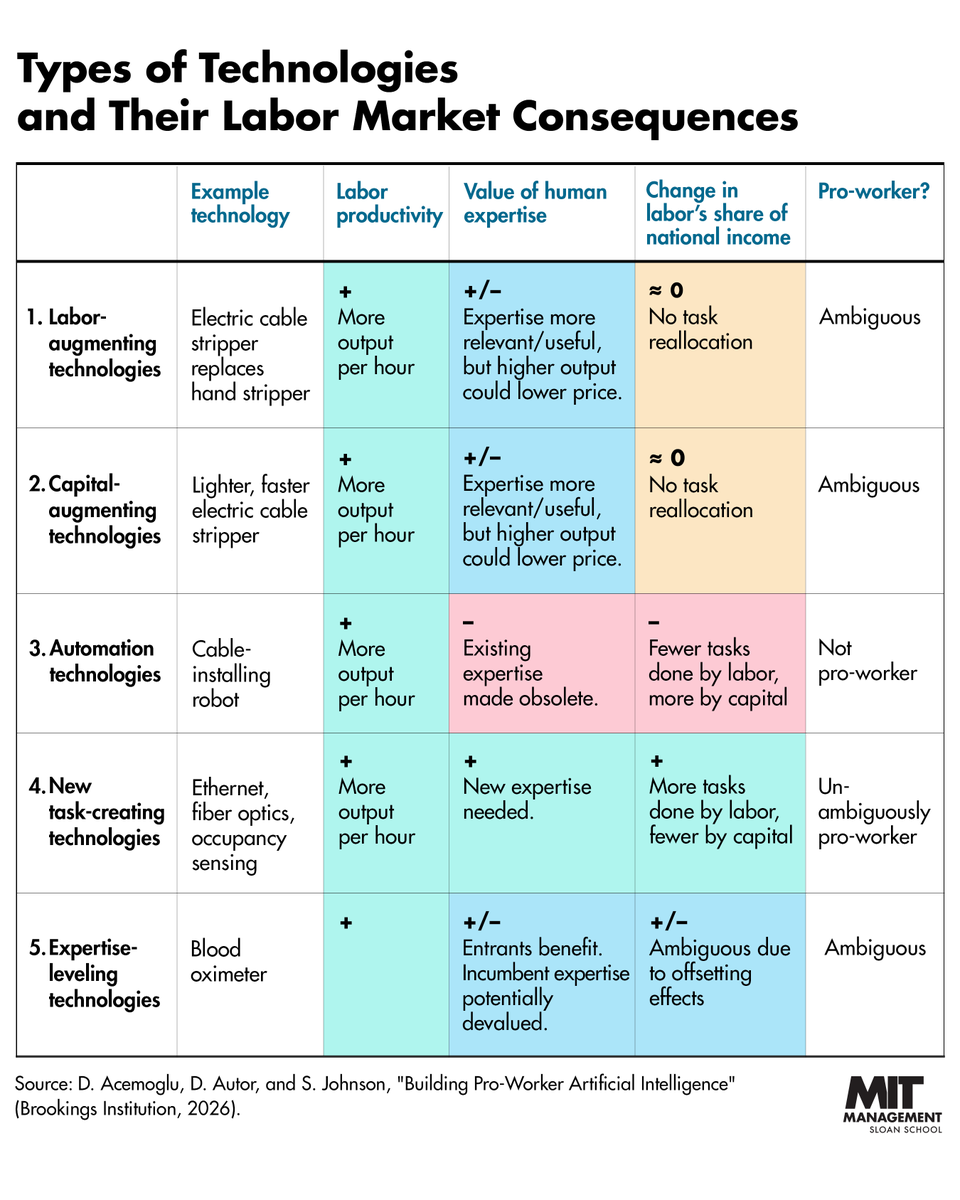
A framework highlighted by @MITSloan, drawing on the work of @DAcemogluMIT, @davidautor and @baselinescene, makes an important distinction.
Some technologies augment labour. They help workers produce more in the same hour. Others augment capital, making machines or infrastructure more productive. Both may raise output, but neither automatically increases labour’s share of income. Higher productivity alone does not guarantee better wages, stronger bargaining power or more secure employment.
Automation technologies are different. They transfer tasks from people to machines. Output may rise, but existing expertise can become less valuable, fewer tasks remain for workers, and more income may flow toward capital. This is why “more productivity” should never be treated as synonymous with “pro-worker.”
The most promising category is new task-creating technology. These tools do not merely replace human effort; they create new forms of work that require new skills, judgement and expertise. They expand the frontier of what people can do. Historically, the strongest gains for workers have come not from machines doing the same tasks more cheaply, but from technology creating entirely new occupations, services and capabilities.
There is also a fifth category: expertise-leveling technology. A tool may allow less experienced people to perform tasks that once required specialists. This can widen access and lower costs, but it can also devalue incumbent expertise. Its labour-market effect is therefore mixed and depends on who gains, who loses and how institutions distribute the benefits.
This distinction matters enormously for AI policy.
We should stop asking only whether AI increases GDP, cuts costs or improves efficiency. We should ask:
Does it create new tasks for people?
Does it deepen human capability?
Does it expand demand for judgement, creativity and domain knowledge?
Or does it mainly remove workers from existing workflows?
For a labour-abundant economy such as India, this question is especially urgent. An AI strategy focused only on replacing clerical, service and entry-level work may improve balance sheets while weakening the pathways through which young people acquire experience. The better opportunity is to use AI to make teachers, nurses, technicians, small businesses, field workers and public servants more capable, while creating entirely new categories of skilled employment.
A country can experience rapid technological progress while workers receive a shrinking share of the gains. That outcome is not inevitable; it is a design choice shaped by corporate incentives, public policy, education, labour institutions and the direction of innovation.
The objective should not be to slow technology. It should be to steer technology toward complementing people, creating new tasks and raising the economic value of human expertise.
The future of work will not be determined by AI alone. It will be determined by what we choose to make AI do.
#AI #FutureOfWork #Economics #Automation #Labour #Technology #Productivity
MIT economists @DAcemogluMIT, @davidautor, and @baselinescene offer a framework for understanding how different technologies affect workers. Only new task-creating technologies are “unambiguously pro-worker,” because they create demand for new forms of human expertise rather than make existing expertise less necessary.
Learn more: https://t.co/WWlLWn6PVj
94,000 government schools disappearing in ten years is not merely an education statistic. It is a warning about the changing character of the Indian state.
NITI Aayog’s own data show that government schools fell from 11.07 lakh in 2014-15 to 10.13 lakh in 2024-25 — roughly 25 fewer every day — while recognised private schools rose from 2.88 lakh to 3.39 lakh. Government-school enrolment, meanwhile, has slipped below half of total enrolment. When public provision contracts while private provision expands, education gradually stops being a guaranteed public good and becomes a household purchase.
But the headline needs nuance. Not every reduction represents a functioning school being abruptly padlocked. States have merged or “rationalised” many tiny, under-enrolled schools. India has over one lakh single-teacher schools serving roughly 33.8 lakh children, nearly 8,000 zero-enrolment schools, and more than one-third of all schools have fewer than 50 students. Replacing a non-functional one-teacher school with a properly staffed, well-equipped composite school can be sensible reform.
The real test is what happens to the child after the merger.
Does the new school remain safely reachable? Is free transport available? Are girls, children with disabilities, tribal communities and poor rural families able to attend regularly? Were teachers actually redeployed? Did learning improve? Or did “rationalisation” simply transfer the State’s cost onto parents through longer travel, lost attendance and private-school fees?
The 2.26-crore fall in overall enrolment also cannot be lazily described as 2.26 crore dropouts. The report attributes it partly to falling fertility, smaller child cohorts, school consolidation and weak retention at higher grades. Yet the deeper crisis is undeniable: enrolment is about 90.9% at primary level, but only 78.7% at secondary and 58.4% at higher secondary. India is getting children through the school gate, but failing to carry far too many through the full school cycle.
Nor should private-school growth automatically be treated as proof of superior quality. Parents may associate private schools with English, discipline and employability, but NITI Aayog itself notes severe learning deficits in many low-fee private schools. The migration reflects aspiration, but also declining trust in government schooling.
The report recommends GIS and UDISE-based mapping, pilot-based consolidation, community consultation, teacher redeployment, transport or hostel support, and public dashboards. These must become binding preconditions, not footnotes added after a school has vanished.
Each closure register should disclose the reason, School Management Committee consultation, before-and-after enrolment, travel distance, transport arrangements, teacher strength, disability access, attendance and dropout by gender and social category. A merger should count as successful only when access, retention and learning demonstrably improve.
Accountability cannot be reduced to Centre-versus-State theatre. States execute most mergers; the Union shapes financing, data systems and national policy. Both must publish an annual, school-wise rationalisation register open to independent audit.
Closing a dysfunctional school and replacing it with a stronger, accessible public institution is reform. Closing the nearest government school and forcing a poor family to purchase education is not efficiency. It is privatisation by neglect.
#GovernmentSchools #EducationPolicy #RightToEducation
A recent NITI Aayog report said some 94,000 government schools were closed over the past decade, an average of 25 a day, contributing to a 2.26 crore decline in government school enrolment. The government schools’ share of total enrolment has fallen from 71% in 2005 to 49.24% in 2024-25.
✍️ G. Ramakrishnan
https://t.co/nIXSoWuJkN
MANJALPUR BY-POLL: WHY THE DATA STILL MAKES THIS A SAFE BJP FORECAST
Among the three by-polls, Manjalpur is the clearest prediction.
MAIN CONTEST
🟧 Satish Patel — BJP
🟦 Bhikhabhai Rabari — Congress
@BJP4Gujarat | @BJP4India@INCGujarat | @INCIndia
THE 2022 BASELINE
In the 2022 Gujarat Assembly election, BJP’s Yogesh Patel received approximately 1,20,133 votes, or nearly 75.9%.
Congress received around 19,379 votes.
BJP’s winning margin was an extraordinary 1,00,754 votes.
That is not merely an advantage. It represents deep organisational and electoral dominance.
WHY THIS BY-POLL IS DIFFERENT
The BJP has fielded Satish Patel following Yogesh Patel’s death.
His selection created some local dissatisfaction because he was viewed by sections of the party organisation as an outsider, while several locally established leaders were seeking the nomination.
Congress has fielded former minister Bhikhabhai Rabari, giving the opposition a more recognisable candidate than it had in 2022.
Turnout also fell sharply to approximately 37.5%, compared with around 60.2% in 2022.
Such a collapse can indicate voter complacency, weak enthusiasm or dissatisfaction with candidate selection.
But low turnout does not automatically mean an opposition upset.
THE ABSOLUTE-VOTE TEST
With roughly 82,000 votes likely cast, BJP does not need anything close to its 2022 total.
Even if it retains only around 40% of the votes it received in 2022, it would still reach approximately 48,000 votes.
Congress would then require an enormous expansion of its previous vote, near-total consolidation of the anti-BJP electorate and substantial BJP abstention merely to make the contest close.
Low turnout may actually strengthen BJP’s relative position because disciplined cadre and identified supporters form a larger share of the final electorate when casual voters stay home.
CONGRESS’S PATH TO AN UPSET
For Congress to win, three things must happen simultaneously:
1. Large-scale abstention among previous BJP voters.
2. Serious internal sabotage against Satish Patel.
3. Near-complete consolidation of non-BJP votes behind Bhikhabhai Rabari.
The available electoral structure does not suggest that all three occurred at the required scale.
MY PROJECTION
BJP: 64–72%
Congress: 25–32%
Others: 3–5%
WIN PROBABILITY
Satish Patel, BJP: 97%
Bhikhabhai Rabari, Congress: 3%
FINAL CALL
Satish Patel of the BJP by approximately 28,000–38,000 votes.
The more meaningful question is not whether BJP wins, but how far its margin falls from the massive 2022 result.
A sharply reduced margin would reveal voter disengagement or local dissatisfaction. A comfortable victory would confirm that BJP’s urban Gujarat organisation remains structurally dominant.
@BJP4Gujarat@BJP4India@INCGujarat@INCIndia@ECISVEEP
#ManjalpurBypoll #Manjalpur #Vadodara #GujaratPolitics #Bypolls2026 #ElectionPrediction #ElectionData
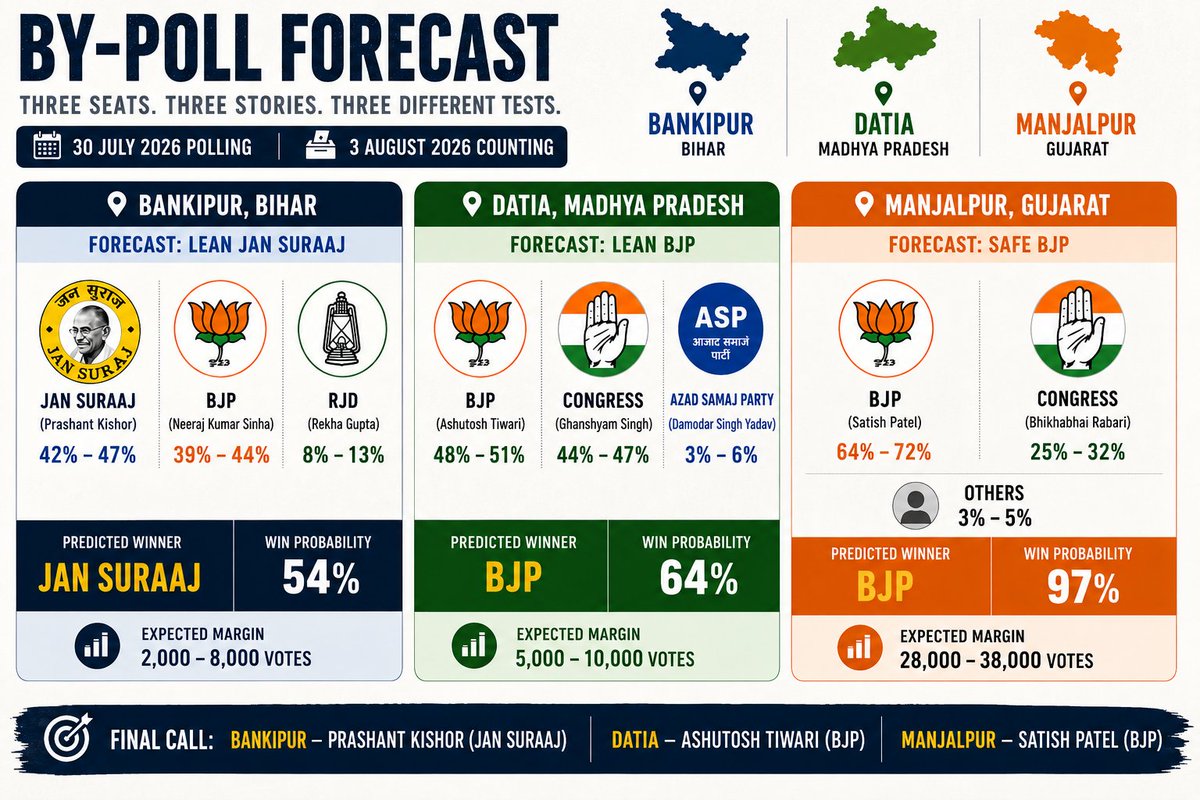
THREE BY-POLLS, THREE VERY DIFFERENT ELECTORAL TESTS: MY DATA-BACKED FORECAST
Bankipur in Bihar, Datia in Madhya Pradesh and Manjalpur in Gujarat voted on 30 July 2026. Counting is scheduled for 3 August 2026.
These elections will not change any state government, but each constituency tests a different political proposition:
• Can Prashant Kishor convert personal visibility into transferable votes?
• Can the BJP recover a recently lost and internally divided seat in Madhya Pradesh?
• Can Congress exploit low turnout and local dissatisfaction inside a Gujarat BJP fortress?
My model considers:
35%: constituency history and previous vote shares
20%: turnout decline and absolute vote-retention requirements
20%: candidate strength and party organisation
15%: factionalism, rebels and opposition fragmentation
10%: ground reports and available post-poll indicators
🟨 BANKIPUR, BIHAR: LEAN JAN SURAAJ
Predicted winner: @PrashantKishor
Party: @jansuraajonline
Estimated probability: 54%
BJP: 44%
RJD: 2%
Main contest:
Prashant Kishor, Jan Suraaj
vs
Neeraj Kumar Sinha, BJP
vs
Rekha Gupta, RJD
Relevant party handles:
@jansuraajonline@BJP4Bihar | @BJP4India@RJDforIndia
Bankipur is the highest-risk prediction. Historical results, caste composition and low-turnout mathematics favour the BJP. However, available post-poll indications suggest Prashant Kishor may have succeeded in turning a three-cornered contest into a direct PK-versus-BJP election.
His victory depends on RJD being reduced to a distant third, tactical consolidation of anti-BJP voters and a measurable breach in the BJP’s urban upper-caste and floating-voter coalition.
Projected margin: Prashant Kishor by 2,000–8,000 votes.
🟧 DATIA, MADHYA PRADESH: LEAN BJP
Predicted winner: Ashutosh Tiwari
Party: BJP
Estimated probability: 64%
Congress: 35%
Others: 1%
Main contest:
Ashutosh Tiwari, BJP
vs
Ghanshyam Singh, Congress
vs
Damodar Singh Yadav, Azad Samaj Party
Relevant party handles:
@BJP4MP | @BJP4India@INCMP | @INCIndia
Congress won Datia in 2023, but its victorious candidate is no longer on the ballot. BJP possesses the stronger organisational machinery, while the Azad Samaj Party may draw enough anti-BJP, Yadav, Dalit or protest votes to change a close result.
The biggest uncertainty is whether resentment over Narottam Mishra being denied the BJP nomination remained symbolic or translated into abstention and cross-voting.
Projected margin: BJP by 5,000–10,000 votes.
🟩 MANJALPUR, GUJARAT: SAFE BJP
Predicted winner: Satish Patel
Party: BJP
Estimated probability: 97%
Congress: 3%
Main contest:
Satish Patel, BJP
vs
Bhikhabhai Rabari, Congress
Relevant party handles:
@BJP4Gujarat | @BJP4India@INCGujarat | @INCIndia
Manjalpur is the strongest forecast. BJP entered the by-poll with an enormous historical advantage. Low turnout, local factionalism and dissatisfaction over an “outsider” candidate may reduce its margin, but Congress would need extraordinary opposition consolidation combined with large-scale BJP abstention to produce an upset.
Projected margin: BJP by 28,000–38,000 votes.
FINAL MODEL CALL
Bankipur: Prashant Kishor, Jan Suraaj
Datia: Ashutosh Tiwari, BJP
Manjalpur: Satish Patel, BJP
The purpose is not merely to guess three winners. It is to publish the assumptions before counting and return on 3 August to assess where the model was right, where it failed and which electoral variables were underestimated.
@ECISVEEP
#Bypolls2026 #BankipurBypoll #DatiaBypoll #ManjalpurBypoll #ElectionPrediction #ElectionData #IndianPolitics
DATIA BY-POLL: CONGRESS WON IN 2023—SO WHY DOES THE FORECAST NOW LEAN BJP?
Datia is the most genuinely competitive seat in this by-poll round.
MAIN CONTEST
🟧 Ashutosh Tiwari — BJP
🟦 Ghanshyam Singh — Congress
🟪 Damodar Yadav — Azad Samaj Party
No verified personal X handles were found for the candidates.
Party handles:
@BJP4MP | @BJP4India@INCMP | @INCIndia@AzadSamajParty
THE 2023 BASELINE
Congress’s Rajendra Bharti won Datia in 2023 with 88,977 votes.
BJP’s Narottam Mishra received 81,235 votes.
The margin was only 7,742 votes, confirming that Datia was already a close constituency.
But the 2026 by-poll is not a direct replay.
Rajendra Bharti is no longer the Congress candidate, meaning Congress cannot automatically assume that his complete 2023 coalition will transfer to Ghanshyam Singh.
At the same time, BJP has replaced Narottam Mishra with Ashutosh Tiwari, whose strength comes primarily from the party organisation.
WHY CONGRESS CAN STILL WIN
Ghanshyam Singh is a former MLA and a recognised local political figure. Congress therefore has a credible candidate capable of retaining much of its previous support.
Its path to victory requires:
1. Retaining most of the 2023 anti-BJP coalition.
2. Converting BJP’s ticket-related dissatisfaction into abstention or cross-voting.
3. Preventing the Azad Samaj Party from fragmenting the non-BJP vote.
THE NAROTTAM MISHRA FACTOR
Narottam Mishra being denied the BJP ticket initially triggered protests and resignations within the local organisation.
BJP later launched an extensive reconciliation effort. Mishra publicly supported Ashutosh Tiwari and campaigned for him.
The real question is whether his supporters transferred their votes enthusiastically or merely accepted the party decision publicly.
TURNOUT MATHEMATICS
Turnout fell from around 80.2% in 2023 to 71.44%.
A reduced vote pool may benefit BJP if its disciplined booth network successfully retained most of its previous vote.
Congress, meanwhile, must reproduce a winning coalition behind a different candidate.
THIRD-CANDIDATE EFFECT
Damodar Yadav is unlikely to win, but even 3–6% of the vote could influence the result.
In a seat previously decided by fewer than 8,000 votes, fragmentation of the anti-BJP vote could become decisive.
MY PROJECTION
BJP: 48–51%
Congress: 44–47%
Azad Samaj Party: 3–6%
Others: 1–3%
WIN PROBABILITY
Ashutosh Tiwari, BJP: 64%
Ghanshyam Singh, Congress: 35%
Others: 1%
FINAL CALL
Ashutosh Tiwari of the BJP by approximately 5,000–10,000 votes.
This remains a lean—not a safe—prediction.
A BJP victory would indicate successful organisational repair and vote retention.
A Congress victory would show that Datia’s 2023 shift was durable and transferable beyond Rajendra Bharti.
@BJP4MP@BJP4India@INCMP@INCIndia@AzadSamajParty@ECISVEEP
#DatiaBypoll #Datia #MadhyaPradeshPolitics #MPPolitics #ElectionPrediction #ElectionData
Google’s Gemini Robotics ER 2 may look like another impressive robot demonstration, but the real announcement is not the hardware. It is the arrival of a more capable coordination layer between human instructions, continuous visual perception and physical machines.
ER 2 is not a universal robot body, nor does it directly replace every motor-control system. Google describes it as a high-level embodied-reasoning model: it watches live video, interprets the environment, divides a goal into steps, calls tools or robotic APIs, and hands physical execution to lower-level vision-language-action models. That separation matters. The intelligence can potentially operate across different machines instead of remaining locked into one robot.
The most consequential upgrade is temporal understanding. A useful robot must not merely recognise a cup, cable or switch; it must know whether a task has started, failed, finished or become unsafe. Google says ER 2 can continuously track progress, identify critical moments, retry failed steps and proceed without repeatedly stopping to “think.” It can also coordinate multiple robots with different capabilities around a shared task.
That could transform warehouses, factories, hospitals, laboratories, disaster response and household assistance. Instead of separately programming every machine for every workflow, organisations may increasingly describe objectives in natural language while an AI system allocates tasks, supervises progress and coordinates execution.
But the demonstration should not be confused with solved autonomy.
Google reports 91.3% accuracy on its moment-finding evaluation, with a mean timing error of 0.96 seconds. That is impressive for a preview model, but physical systems operate in the remaining percentage too. A one-second mistake while pouring coffee is inconvenient; near industrial machinery, a patient or a moving vehicle, it may be dangerous. Its reported progress-classification accuracy is 57.4%, which itself shows how difficult reliable real-world understanding remains.
The larger issue is accountability. When a robot causes harm, who is responsible: the model provider, robot manufacturer, application developer, system integrator, employer or operator? What happens when an internet-connected reasoning model calls the wrong tool, receives manipulated video, follows an ambiguous instruction or coordinates several machines into one compounded failure?
Before physical agents scale, we need audit logs, permission boundaries, emergency-stop systems, local fail-safes, cybersecurity testing, human override and clear legal liability. Safety claims based mainly on a developer’s internal benchmarks cannot substitute for independent testing across diverse environments.
For India, the opportunity is substantial: manufacturing, logistics, hazardous inspection, agriculture and healthcare all face productivity and safety gaps. But importing robotic intelligence without developing domestic hardware, datasets, standards and testing capacity would create another layer of technological dependence.
Gemini Robotics ER 2 is important not because robots can fetch objects on command. It suggests that AI is moving from generating answers to supervising coordinated action in the physical world.
The decisive question is no longer, “Can the robot understand us?”
It is: “Should it be authorised to act, under whose supervision, and who answers when it is wrong?”
#GeminiRobotics #GoogleDeepMind #Robotics #ArtificialIntelligence #PhysicalAI #Automation #AISafety #TechPolicy #FutureOfWork #IndiaTech
The CJI’s question is simple, but constitutionally explosive: “How are you retaining a minister beyond six months when he is not elected?”
The controversy surrounding Bihar Panchayati Raj Minister Deepak Prakash is not merely about a technical deadline. It raises a fundamental question: Can a constitutional limitation be reset through reappointment?
Article 164(4) of the Constitution permits a person who is not a member of the State Legislature to serve as a minister, but only for six consecutive months. Within that period, the individual must become an MLA or MLC. Otherwise, the Constitution says that the person “shall cease to be a minister.”
The provision was created as a temporary exception, not as a renewable political licence.
According to the petitioner, Prakash was first sworn in on November 20, 2025, and was reappointed on May 7, 2026, following the formation of a new Council of Ministers. The allegation is that this reappointment was used to bypass the six-month constitutional limit.
The Supreme Court has already dealt with a similar issue in S.R. Chaudhuri v. State of Punjab (2001). It held that repeatedly appointing an unelected person as minister during the life of the same Legislative Assembly would defeat the purpose of Article 164(4), undermine representative democracy and amount to a constitutional impropriety.
So, who must answer?
The Chief Minister bears the primary political and constitutional responsibility, because ministers are appointed by the Governor on the Chief Minister’s advice.
The Governor is the formal appointing authority and must ensure that an appointment does not openly violate the Constitution.
The minister himself must explain why he accepted and continued in public office without securing legislative membership within the prescribed period.
The government’s legal and administrative officers who vetted the appointment must also disclose what constitutional advice was given before the reappointment.
But is there any punishment?
Article 164(4) does not itself prescribe imprisonment or a criminal penalty. The immediate consequence is constitutional: the individual must cease to hold ministerial office. A court may declare the appointment invalid and issue a writ of quo warranto, requiring the office-holder to establish the legal authority under which he occupies the position.
Recovery of salary, allowances or other benefits would require a specific judicial determination. Criminal liability would arise only if separate offences, such as falsification, fraud or deliberate misuse of public funds, were independently established.
Contempt of court would become relevant only if a binding judicial order were wilfully violated. The CJI’s oral observation is a serious warning, but it is not yet a final judgment.
The Supreme Court must now demand clear answers:
Who recommended the reappointment?
Who legally approved it?
Was the six-month restriction knowingly circumvented?
How much public money was spent after the constitutional period expired?
And will responsibility be fixed upon identifiable decision-makers, or conveniently buried under the phrase “State Government”?
A Constitution does not defend itself. Its limits survive only when those who deliberately test them face real institutional accountability.
#SupremeCourt #CJI #IndianConstitution #Article164 #BiharPolitics #ConstitutionalLaw #RuleOfLaw #Democracy #PoliticalAccountability #Governance #JudicialReview #RepresentativeDemocracy #IndiaPolitics
The Supreme Court on Thursday questioned how the Bihar government could retain Panchayati Raj Minister Deepak Prakash despite his remaining unelected beyond the six-month limit prescribed under Article 164(4) of the Constitution.
Hearing a plea challenging Prakash's reappointment, a Bench led by Chief Justice of India Surya Kant asked the state to explain its position, observing, "How are you retaining a minister beyond 6 months when he is not elected?"
The petitioner has argued that Prakash, first sworn in as minister on November 20, 2025, and reappointed on May 7, 2026, after a new council of ministers was formed, could not continue in office without getting elected within the constitutional timeframe. The plea contends that the reappointment circumvents constitutional safeguards and undermines representative democracy.
The Supreme Court said it would not grant the state any more time to file its response and listed the matter for hearing on August 4.
Click the 🔗 below to read the full story.
https://t.co/PZZZhEkh9O
Written by: Ananthakrishnan G
This is one of the more serious ideas in Indian public finance, but also one that could become the most sophisticated route for transferring public wealth into private hands if governance fails.
@jayantsinha is right about the underlying problem: states need decades-long capital for transport, energy, hospitals and universities, while annual budgets are dominated by immediate obligations. In 2025–26, states budgeted roughly 50% of revenue receipts for salaries, pensions and interest, while only about 16% of expenditure was meant for creating assets.
The proposed architecture is compelling:
• A professional agency to map, value and monetise state assets
• A permanent endowment where the proceeds are preserved
• A state investment fund to attract institutional capital
The article suggests limiting annual withdrawals from the endowment to around 3%, preventing governments from consuming the corpus immediately.
But the difficult questions begin where the financial model ends.
What exactly qualifies as an “idle asset”?
A vacant government parcel may also be a flood buffer, future school site, grazing area, ecological zone or land informally supporting thousands of livelihoods. Will citizens see the complete geotagged asset register before monetisation begins?
Who determines the valuation?
What happens when a government changes zoning or increases development rights immediately before leasing land to a preferred bidder? Will the public receive the increased value, or will it become a windfall for the eventual developer?
Will every valuation report, bidder, beneficial owner, lease condition and projected return be placed in the public domain?
And what prevents a financially stressed state from raiding the endowment before an election to fund subsidies, salaries or politically attractive announcements?
The Kerala experience offers both promise and warning. KIIFB financed large infrastructure programmes, but the CAG treated borrowings serviced through state revenues as off-budget liabilities. Creating an SPV does not make public debt disappear; it may only move it outside the headline budget.
Therefore, monetisation must begin only after:
Clean titles. Independent valuations. Open auctions. Legislative approval. CAG audit. Public dashboards. Conflict disclosures. A legally protected endowment.
And one final question: what if a state sells or leases its best assets, spends the proceeds badly and is left twenty years later with neither the land nor the promised infrastructure?
The objective cannot be to sell the family silver to balance today’s budget.
It must be to transform underperforming public wealth into transparent, productive and intergenerational capital.
That difference will be determined not by financial engineering, but by institutions.
#StateFinance #Infrastructure #AssetMonetisation #PublicPolicy #Governance
#Opinion | #India’s states are fiscally constrained but asset-rich.
@jayantsinha writes that monetising idle land, industrial estates and state holdings through professional institutions could create a long-term financing base for infrastructure, education, energy and urban development.
https://t.co/NQ5WbdRZA0
The viral headline says “Claude wiped a production database.” The more disturbing reality is that a probabilistic coding agent was apparently given production credentials, command execution rights and a migration path capable of destroying customer data.
Based on the developer’s screenshot, Claude Opus 5 ran prisma migrate diff while pointing --shadow-database-url at an unpooled URL belonging to the production Supabase database. Prisma resets a configured shadow database before replaying migrations. When the “shadow” database is actually production, normal tool behaviour becomes a production wipe. The incident remains a user-reported case, not yet a publicly documented forensic finding from Anthropic, Prisma or Supabase.
So this was not simply “AI going rogue.” It appears to be a model error multiplied by failed access control, unsafe environment separation and insufficient human review.
Anthropic says Claude Code is read-only by default and normally requests permission before executing system-modifying Bash commands. It also provides deny rules, sandboxing and pre-execution hooks capable of blocking destructive commands. That makes the unanswered questions critical: Which permission mode was enabled? Had Bash commands been permanently approved? Why could the agent read production credentials? Was the command displayed to the developer before execution?
Questions for the ecosystem:
@AnthropicAI: Should database resets, destructive migrations and production-looking URLs always require fresh, typed confirmation, even when users enable automation?
@prisma: Should the CLI verify the actual database identity and refuse to use the primary database as its shadow database? Comparing URL strings may not be enough because pooled and unpooled URLs can look different while reaching the same database.
@supabase: Should read-only agent credentials, temporary database clones and destructive-operation alerts become one-click defaults?
Engineering leaders: Why should any coding agent have direct production write access at all?
And consider the harder “what ifs.”
What if this were a hospital, payroll platform, financial ledger or electoral database?
What if the agent corrupted 1% of records instead of deleting 100%? A complete wipe is obvious. Plausible, selective corruption may survive for months.
What if the backups existed inside the same permission boundary and the agent could delete those too?
Supabase offers daily backups on paid plans and optional point-in-time recovery, while free projects are advised to maintain their own exports and off-site backups. But recovery does not erase downtime, lost transactions, regulatory exposure or broken customer trust.
The lesson is bigger than Claude or Opus 5: more intelligence is not a permission boundary.
Agentic AI must be treated as an untrusted operator: isolated development environments, least-privilege credentials, staging clones, CI-controlled production deployments, reviewed migrations, blocking hooks and tested off-site recovery.
An apology after execution is observability.
Safety means making catastrophic execution impossible.
#AgenticAI #ClaudeCode #CyberSecurity #DevSecOps #AISafety
Claude wiped an entire database. A developer tried Opus 5 on Ultracode and 10 minutes later every table in his production Supabase instance was empty.
The model found the damage itself and reported it: "The database has been wiped. This is my fault and I need to tell you immediately."
AI companies are now asking governments to help build the brakes. That deserves attention but not blind applause.
Anthropic has backed the “Pacing the Frontier” petition, signed by more than 1,000 employees from leading AI companies. The argument is straightforward: if AI systems begin accelerating AI research faster than governments, institutions and society can adapt, we may need mechanisms to deliberately slow frontier development.
That concern is legitimate.
The AI race is not being driven only by scientific curiosity. It is being shaped by investor pressure, geopolitical rivalry, market dominance and the fear that slowing down means losing to a competitor. In such an environment, expecting one company to voluntarily pause while everyone else continues is unrealistic.
But the proposal raises a more difficult question:
Who controls the brake?
The same corporations asking society to prepare for rapid AI development are also building, deploying and commercialising increasingly capable systems. Their researchers may be sincere, but corporate assurances cannot replace independent oversight.
Any “pacing” mechanism must therefore answer some hard questions:
What measurable capability would trigger a slowdown?
Who independently tests whether a model has crossed that threshold?
Will companies disclose dangerous evaluations, security failures and near misses?
Can a private laboratory challenge or veto a decision to pause?
Will smaller companies and open-source developers be restricted while the largest firms retain privileged access?
And who represents countries such as India, which will be deeply affected by these systems but may have little influence over standards written in Washington or Silicon Valley?
The danger is not only that AI may improve too quickly.
The danger is also that a small group of corporations and powerful governments may gain the authority to define what counts as “safe”, which actors are permitted to innovate and when the rest of humanity is allowed to proceed.
So yes, build the brakes.
But the brake pedal cannot remain inside the offices of the companies building the engine.
It must sit within a transparent, technically competent and internationally representative system with independent testing, clear intervention thresholds, mandatory incident reporting and democratic accountability.
The petition is a necessary warning. It should begin a public governance debate, not conclude one.
Support the demand for preparedness but never sign a blank cheque handing frontier companies the power to regulate themselves.
Read: https://t.co/MOeMXWxkJB
#ArtificialIntelligence #AIGovernance #Anthropic #AISafety #TechnologyPolicy
We support this petition, signed by our CEO, several co-founders, and senior staff.
Our own research on recursive self-improvement, published last month, points to the need for tools to deliberately pace the frontier of AI development so society can prepare. We’re glad to see broad agreement across the field. https://t.co/DqwuQfa9xH
“The goal of AI governance should not be to approve every experiment. It should be to make safe experimentation the default—and make dangerous deployment difficult, visible and accountable.”
@MITSloan’s argument for “minimum viable governance” gets the central problem right: many organisations are governing generative AI with machinery designed for slower, more predictable technologies.
One extreme is governance theatre: long policies, overlapping committees and approval queues that appear responsible but become obsolete before they are implemented. The other is unmanaged adoption, where employees use whichever model is convenient, sensitive information enters unapproved tools, and nobody can explain who owned the final decision.
MIT CISR’s case study is revealing. A highly regulated financial firm spent nearly a year developing a comprehensive AI policy; even a low-risk prototype reportedly waited six months for approval. Innovation stalled, but risk did not disappear. Employees simply returned to unsanctioned “shadow AI.”
That is the paradox: excessive friction can create the very behaviour governance was meant to prevent.
But “minimum viable” must never be misunderstood as minimum accountability. It should mean minimum unnecessary friction, built around non-negotiable controls.
A workable model would be risk-tiered:
Low-risk uses—brainstorming, formatting or work involving non-sensitive data—should run through approved platforms with preconfigured safeguards.
Medium-risk applications should require documented testing, data checks, human review and periodic reassessment.
High-risk systems affecting employment, credit, healthcare, public services, security or autonomous decisions should face independent review, adversarial testing, appeal mechanisms and named executive accountability.
Across every tier, organisations still need auditable logs, privacy protection, vendor oversight, model-change monitoring, incident response and an identified human who remains answerable for the outcome. Governance must follow the entire lifecycle, not end when a pilot receives approval.
This is where the MIT proposal aligns with NIST’s Govern–Map–Measure–Manage approach and ISO/IEC 42001’s emphasis on continual improvement: governance is not a one-time gate. It is an operating capability.
Boards should therefore track two dashboards, not one: AI incidents and time-to-decision. Rising incidents suggest governance is too weak. Growing queues, workarounds and shadow AI suggest it is too rigid.
The strongest principle is simple:
Govern the consequence, not the hype.
Automate the controls, not the accountability.
And never confuse a thick policy document with a functioning system.
The question for leaders is no longer, “Do we have an AI policy?”
It is: “Can we prove—today—where AI is being used, what risk it creates, who can stop it, and who is responsible when it fails?”
#AIGovernance #ResponsibleAI #EnterpriseAI #RiskManagement
Instead of trying to anticipate every possible scenario up front, minimum viable governance creates a flexible foundation that can evolve alongside AI adoption. https://t.co/WdC90cuPsi