🧵 India’s ethanol dream was a quiet policy push—until car and bike owners began flooding social media with complaints of poor mileage and engine trouble.
I’ve been reporting on the story long before it hit the headlines. Here’s what I found. ⬇️
#Ethanol#ethanolpetrol
BREAKING: Fake photos of e-waste trucks showed “bright daylight” 29 minutes after sunset -- and one recycler admitted adding “a few clouds”.
Indian tax authorities have faulted Haier, Godrej and Blue Star, for failing to detect that one of their recyclers was fabricating records. They used its compliance certificates to meet green goals.
India has been concerned about fake compliance certificates, and the case has alarmed the industry.
Haier, Godrej & Boyce and Blue Star "admitted that they had not independently verified the actual collection, transportation, receipt, dismantling or recycling of the e-waste", which is necessary to claim tax credits, the notice added.
"The foundational activity of procurement, receipt and processing of e-waste itself is not established."
Officials say the three companies wrongly claimed $714,000 in tax credits as the recycling work was never actually done by vendor https://t.co/QNeoKugl7w With @Nikunj_Ohri
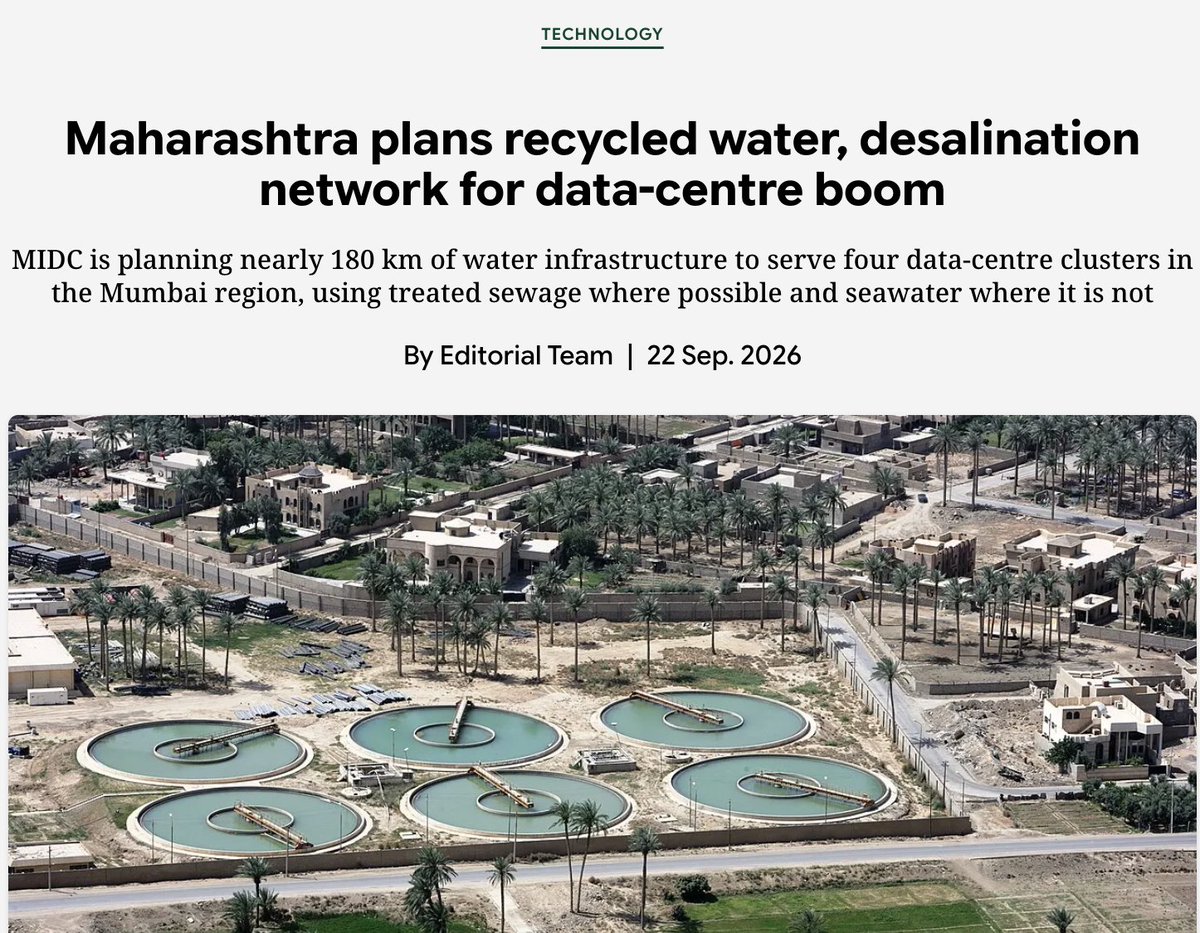
CarbonCopy's latest article has found that Maharashtra is planning a water supply network for its growing data-centre industry, combining treated sewage and desalinated seawater.
Read here: https://t.co/0GAmKxAr0g
The Election Commission of India is under fire like never before.
The SIR has struck 13 crore names off draft rolls, putting the EC at the centre of intense public debate over its role in deciding who gets to vote — and who doesn’t.
HOWEVER, what nobody knew: through that same period, some of the sharpest questions were being asked from inside.
Out today, after months of work. Our #ExpressInvestigation 🧵
(1/10)
India’s data-centre boom needs water. @carboncopyinfo has new details on @midc_india’s plans to secure water for its growing data-centre industry.
Four proposed clusters in the Mumbai region could require 874 million litres a day.
https://t.co/mB7jC4vZS7
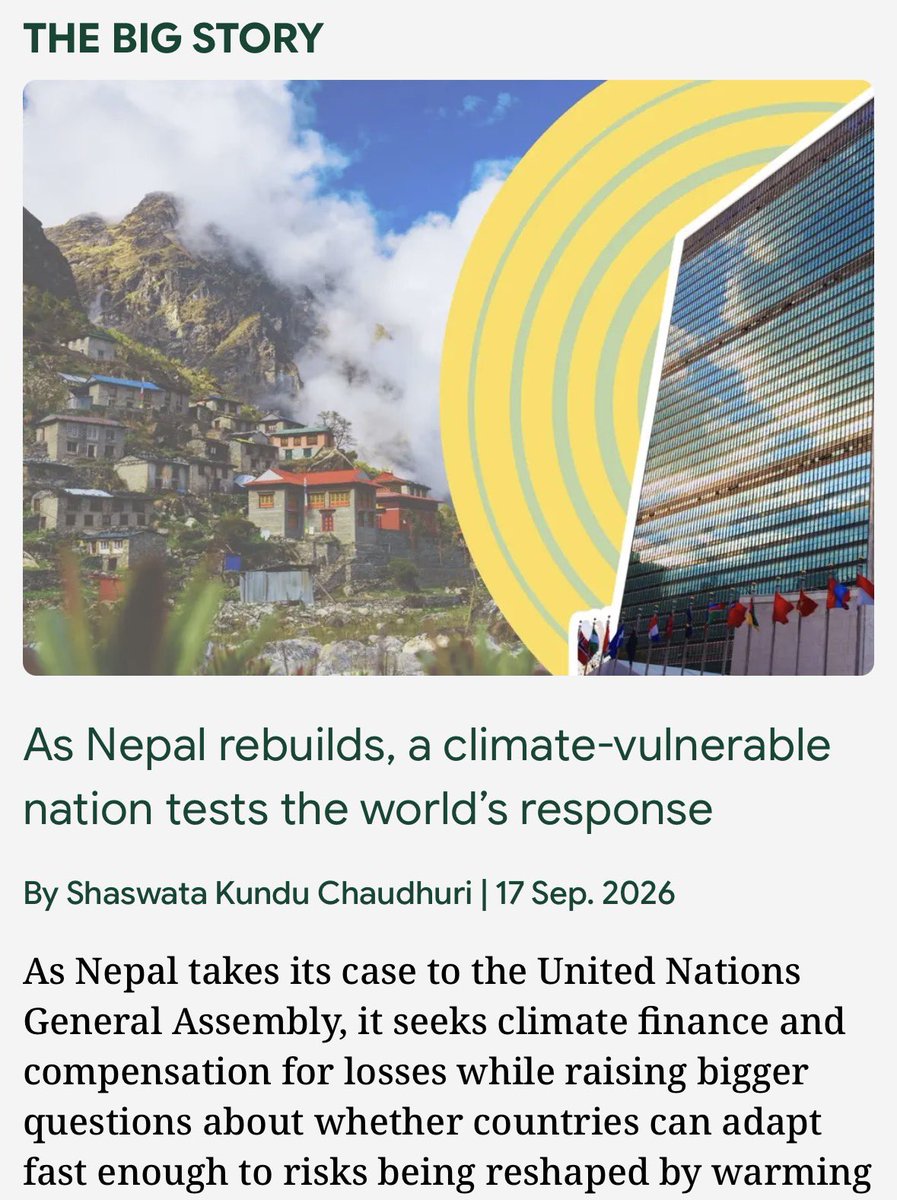
Nepal heads to @UNGABloxburg with a Q for the Global South: who pays when climate disasters overwhelm countries that contributed little to global warming?
@carboncopyinfo examines Nepal’s Loss and Damage fight and the science behind the disaster.
https://t.co/u4vyYdc3AF
The most expensive part of a hospital bill may never touch the hospital at all.
A patient admitted for care has no way of knowing whether the price on a medical consumable reflects its actual cost or a markup fixed long before it ever reached the ward. That gap in information is, at its core, a public health issue.
A survey of hospital consumables in Maharashtra found an IV infusion set with a trade price of ₹11.05 carrying a printed MRP of ₹325 ; a markup of 2,841%. A syringe procured at ₹6.75 carried an MRP of ₹57.20. A catheter procured at ₹29.41 carried an MRP of ₹310.
These are not elective purchases. Patients cannot compare prices, seek alternatives, or question a number printed on a box while receiving care and the MRP itself is often fixed upstream by manufacturers and distributors, disconnected from the trade price by a wide, unexplained margin. The result is a system where the party bearing the cost has the least information to evaluate it.
The regulatory gap is structural: scheduled medicines are capped under the Drugs (Prices Control) Order, 2013. Most medical devices and consumables are not leaving both the pricing and the information around it almost entirely unmonitored.
A review of these findings and clear guidelines on the permissible gap between trade procurement price and declared MRP have been recommended to the Department of Pharmaceuticals and the NPPA ; a step toward closing not just a pricing gap, but the information gap patients are left to bear alone.
#PublicHealth #GoodGovernance #Leadership #TukaramMundhe
https://t.co/Ye9CVzr8qU
How Climate Change is Eroding India's Biocultural Heritage
Climate change is unraveling the delicate relationship between biodiversity, culture and Indigenous knowledge across India, and experts say conservation must protect all three. I write @carboncopyinfo https://t.co/Kif9DhdQsb
Why Should Indians Pay to Raise PhonePe’s Valuation?
The government has taken the first step towards allowing fees on UPI transactions.
Initially, the proposed Merchant Discount Rate (MDR)—a fee charged for processing digital payments—may apply only to merchants receiving payments above ₹2,000.
But the Finance Ministry’s September 14, 2026 notification creates a wider concern: since the law is changed, the government could extend charges to more categories of UPI and RuPay debit-card transactions through notifications—without returning to Parliament.
Who gains immediately?
PhonePe could be the biggest beneficiary.
The Walmart-owned company processes around 45% of UPI transactions. It was valued at $12 billion in 2023 but paused its India IPO in March 2026 after its estimated valuation reportedly fell below $10 billion.
Even a share of MDR revenue could add billions of dollars to its IPO valuation.
PhonePe and Google Pay together process more than 80% of UPI transactions. Amazon and other foreign platforms are also expanding.
India has already given American technology companies extraordinary access to UPI—a publicly funded payment infrastructure built by Indian institutions and banks.
These platforms receive massive transaction volumes and valuable insights into the spending behaviour of hundreds of millions of Indians.
Why should Indian consumers finance them?
India could instead impose an annual participation fee—perhaps $100 million—on each dominant foreign platform benefiting from UPI. Yet the government appears ready to shift the cost to merchants, who will eventually pass it on to consumers.
The change also seems aligned with a US grievancess against India’s UPI, Rupay card which hurt business of American Visa and Mastercard in India.
The pattern is difficult to ignore.
In July, the government relaxed FDI rules for foreign e-commerce companies—read Amazon—although only for exports. America may want this opening be extended to domestic sales.
India must not accept unreasonable demands that weaken successful Indian public infrastructure and transfer value from Indian consumers to American corporations.
UPI is one of India’s greatest digital achievements. It should remain a no-cost public good—not become a revenue stream for foreign technology giants.
#BRICS brings climate risk into a wider development framework spanning energy,food security, critical minerals, supply chains, trade, finance and resilience.
But the bigger challenge is financing, writes @archchaudhary
🔗https://t.co/ibKxGbWWaJ
EXCLUSIVE: Flood-hit Nepal will ask wealthier countries and global agencies for financial help this week, arguing they should contribute to the $5 billion needed for initial rebuilding as the disaster shows how climate change has hit poor countries that did little to cause it. Reporting with @ChagantiSingh and @imgsharma
https://t.co/Z4TXji2w86
Nepal’s disaster is a warning about climate risks that cross borders. As BRICS leaders gather in New Delhi, can middle powers step in when the international climate process cannot match their speed and scale?
https://t.co/XNPjL3a6oF
Interview with Nepali climate negotiator on how the govt is handling rescue & relief in the aftermath of the disastrous flooding & the kinds of international support it seeks, incl from climate loss & damage fund + clarification about a recent controversy https://t.co/0TbitL4LDP
This is one of the most exhaustive pieces I have worked on, an attempt to put a human face on the rising climate crisis in the #Himalayas.
Over the past one week, I have travelled through building rubble, devastated settlements and holding centres in some of the worst-affected parts of #Nepal. The scale of the humanitarian crisis is difficult to fathom. But beneath the debris is a much larger story.
Glaciers are retreating. Permafrost is degrading. Glacial lakes are expanding. Ice loss across the Hindu Kush Himalaya is accelerating at an alarming rate. And now, unstable hanging glaciers and ice-rock systems - among the least monitored and hardest mountain hazards to predict - are adding another layer of risk.
I have tried to piece together the complex science behind these changes, the widening technological gap in monitoring and early warning, and the human cost of a warming Himalayas.
One issue that particularly stands out is SERVIR, a programme that helped provide critical satellite data, technology and analytical capacity for disaster risk reduction in the region. Its funding was cut after the Trump administration dismantled @USAID support, leaving an important gap at a time when the risks are increasing.
The programme was delivering critical capabilities at roughly $1 million a year. The estimated reconstruction bill from Nepal’s latest disaster alone is now around $5 billion. That contrast says something about our priorities.
It is far cheaper to detect danger in the mountains than to rebuild after the mountains come crashing down.
Story link:
https://t.co/MDTkJO3ixJ
@NewIndianXpress@UNFCCC@UNDP@UNEP@WorldBankGroup@LossandDamage@FillTheFund@icimod@AntoJoseph@santwana99@ACJIndia
Nepali diplomat Raju Pandit Chhetri tells me there was "confusion" & "tweaking" in foreign minister's interview on Nepal seeking compensation for the floods from China, India & the US. He added "Nepal has not changed its views on climate responsibility of developed countries."
On 26 August, a massive ice-rock avalanche triggered a powerful debris flow that swept through Nepal’s Rasuwa.
Join @azam_mf, @UlkaKelkar, @hridayeshjoshi moderated by @BhaskerTripathi for a talk on new generation of Himalayan hazards.
Register here: https://t.co/baq10qxqrI
ICYMI @mrajshekhar did a phenomenal story on data centres boom in India and the energy-water-heat nexus associated with it: https://t.co/oBO2SvICXT
Tomorrow, we discuss the concerns behind the boom.
Registration link: https://t.co/DmmxoqLSzc
@BhaskerTripathi@carboncopyinfo
EXCLUSIVE -
"पूरे हिमालय को केवल रियल एस्टेट की तरह देखना सबसे बड़ी भूल है!" देश की प्रसिद्ध पर्यावरणविद सुनीता नारायण के साथ, हिमालयी आपदाओं और पर्यावरण संकट पर हृदयेश जोशी की यह खास और बेबाक बातचीत। पूरे वीडियो का लिंक - https://t.co/2KV9RGQs7x
⏰ 𝐖𝐞𝐛𝐢𝐧𝐚𝐫 𝐀𝐥𝐞𝐫𝐭
India's AI ambitions are accelerating demand for data centres.
Join us to discuss what that means for electricity, infrastructure and the energy transition.
Registration link below.
Join CarbonCopy for the live webinar for deep dive into India’s AI Boom, data centre expansion, and energy grid with @mrajshekhar and @shreya_jai.
The session will be moderated by @BhaskerTripathi Tripathi followed by an audience QnA.
Register here: https://t.co/nJOus1jcKP
Join CarbonCopy for the live webinar for deep dive into India’s AI Boom, data centre expansion, and energy grid with @mrajshekhar and @shreya_jai.
The session will be moderated by @BhaskerTripathi Tripathi followed by an audience QnA.
Register here: https://t.co/nJOus1jcKP
The Government's warning on EV cybersecurity.
Read the full story here: https://t.co/8JD1SzxsTw
Subscribe to the Clean Mobility Shift Newsletter to stay ahead of the conversations shaping India's electric future: https://t.co/hpLgqIpFs2