“The modern world is the only one among civilizations to have created a world in which ugliness and triviality are commonplace and in which they appear shamelessly as the "serious" and the "reality.”
—Frithjof Schuon
From Kishtwar to Doda, Jammu and Kashmir’s monsoons are turning deadlier by the year. This is not only a Himalayan story -- it is a story about who pays, downstream and across generations, when a fragile mountain range is developed faster than it can bear, and about a security conversation that still has almost nothing to say about ecology. The region’s own traditions once knew how to build with the mountain rather than against it. It’s time development policy relearned that lesson and looked at what Bhutan, Nepal and Switzerland have already done.
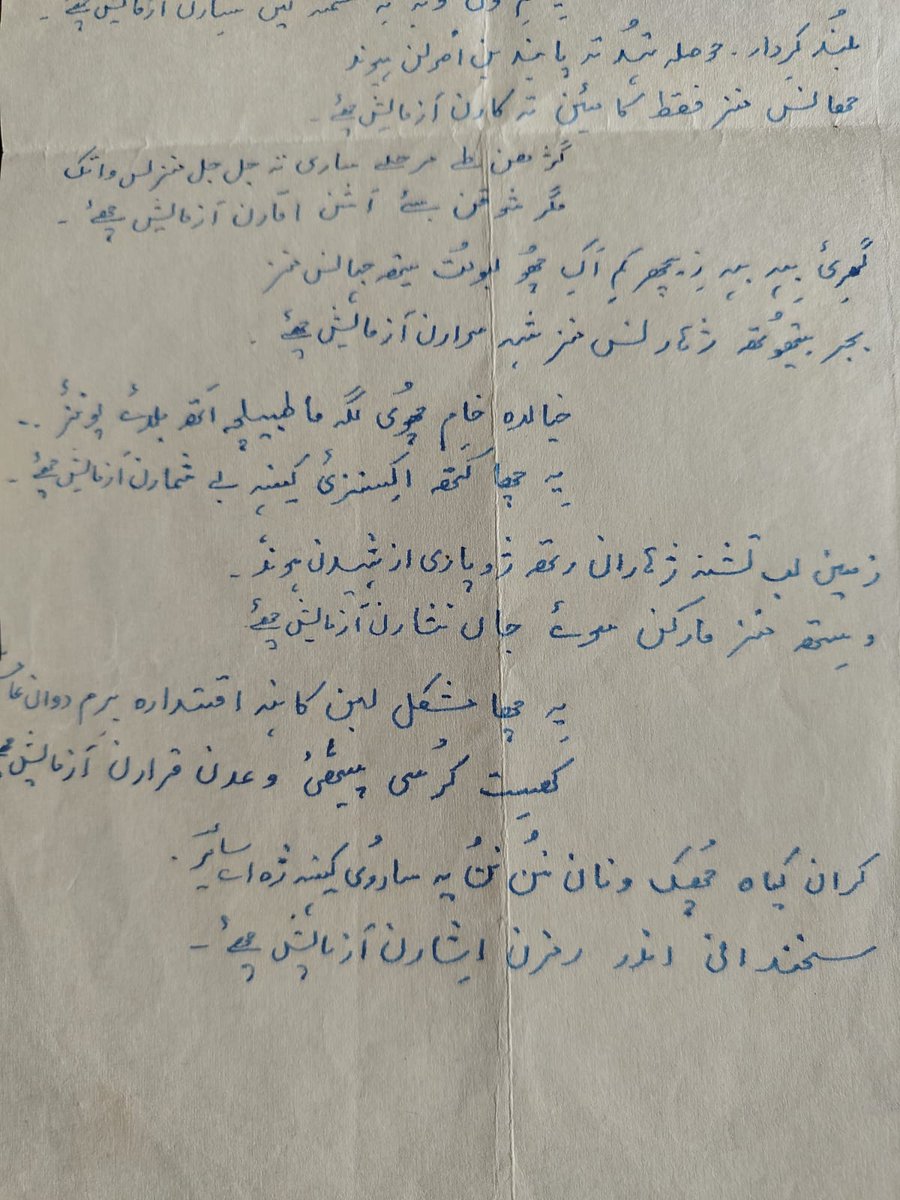
Finally found this one poem of Saair.
یہ چھا مشکل لبن کانہہ اقتدارہ برم دوان عوامن
کھست کرسی پیٹھی وعدن قرارن آزمایش چھے
transl.
How arduous it is to claim power, beguiling the masses,
Seated firm upon the throne, their forgotten promises, a trail, a test.
Jantar Mantar 2026 protests can best be read as a case of political development: the relationship between mobilization and institutionalization central to the literature on order in changing societies. Rising participatory demand, transmitted through a horizontally networked public sphere, could easily have outpaced institutional capacity and produced instability. Instead, it was absorbed: exam reforms were announced, task forces constituted, an amendment bill introduced through the legislature, and ministerial resignation secured, demand converted into authoritative output rather than left to fester.
This is the input-output cycle of a political system functioning as theorized: interest articulation met with policy adjustment and personnel accountability. It also illustrates the classical distinction between legitimacy and effectiveness, in that legitimacy is sustained not by electoral mandate alone but through continuous, demonstrated responsiveness.
The digital dimension of this episode deserves separate comparative attention. Political communication, long treated in the literature as a discrete function performed by identifiable structures, namely party organs, the press, and broadcast media, here dissolved into a diffuse, decentralized network in which citizens themselves performed the functions of articulation and transmission simultaneously. This displaces the older gatekeeping model of mass communication, in which a limited set of institutions mediated between citizen and state, with a horizontal structure in which no single actor controls framing or timing. The analytic consequence is significant: political communication becomes continuous rather than episodic, compressing the interval between articulation and response to near instantaneity, and thereby intensifying the demands placed on institutional capacity to process input without lag.
The comparative payoff is sharpest across the Line of Control, where structurally demand-inputs meet coercive suppression rather than institutional processing. This is the diagnostic line between systems stabilized by institutionalized responsiveness and those held together by force alone.
#neetissue
Since 1947,generals in Pindi have never lost an election because they never really ran in one. A civilian facade up front, the army's boot behind it, and that same script is playing out in POK today: Rangers on the streets, internet cut, live rounds turned on protesters, the Joint Awami Action Committee banned, dissenters jailed under "anti-terror" laws for demanding their own rights. And still Islamabad postures as human rights conscience at the global forums, lecturing others while gagging occupied Gilgit-Baltistan at home. Outsourcing blame to a neighbor doesn't erase the record next door. Occupation doesn't need a mirror to hide behind.
PAKISTAN: Reacting to reports that security forces used lethal force against protesters in Rawalakot, Pakistan-administered Jammu and Kashmir, on the first day of the regional election, Isabelle Lassee, Amnesty International’s Acting Regional Director for South Asia, said:
“The disturbing reports emerging from Rawalakot are consistent with the Pakistani authorities’ long history of unlawful violence against protesters in Jammu and Kashmir. A prompt, independent, and transparent investigation must be ordered into the security forces’ use of force against protesters. So long as an internet and mobile services blackout remains in place, it will severely impede the independent verification of the full extent of the situation on the ground. We urge the Pakistani authorities to restore all communications access and allow media and independent observers into the area.”
Read more: https://t.co/ChHRDvCdyH
Every political utterance is an act of distribution disguised as description. Speech allocates one claim over another and wounds by default. Silence alone distributes nothing, and so wrongs no one unfairly. Silence alone stands outside this economy of exchange; it is the singular sign that signifies without conscripting a casualty.We live inside what might be called a discourse deficit: a condition in which words, having been overissued, no longer carry the value they claim to represent. In such a discourse, more speech is not communication — it is debasement.
Each new statement corrodes the ones before it, until language itself becomes a currency no one will accept at face value. Here, truth and trust have become the twin casualties and a public has learned to read silence more literally than speech, because silence has not yet betrayed it.
#KashmirPolitics.
This Resignation invites two possible readings. One treats it as an admission of institutional failure – proof that something in governance broke down. The other treats it as evidence of institutional function — proof that the system remains answerable to those it governs. Both readings carry some truth, and a mature political culture does not need to choose between them; it can hold the failure and the correction as two parts of the same process.
What matters, ultimately, is not that failure occurred — no system of governance, democratic or otherwise, is exempt from that but whether the system possesses a mechanism to respond to it without indefinite deferral. Democratic government is distinguished less by the absence of error than by the presence of a working feedback loop between citizen and state, one that can, under sufficient pressure, produce real consequences.
Whether this particular moment is judged as too little, too late, or entirely sufficient will depend on where one stands politically and that disagreement is itself unremarkable, even healthy. What should be less contested is the underlying principle: that an office answerable to public sentiment, however imperfectly and however belatedly, is functioning as a democracy is meant to function. That is not a small thing, whatever one makes of the specifics.
#NEETExamIssue
Whether you support the Gen-Z protests or not, condoning sexually explicit abuse is wrong.
Women using it doesn't make it empowering, funny, or legitimate.
If male protesters targeted female leaders with the same language, would we tolerate it?
Abuse isn't political critique. It must be called out everywhere.
Students are asking for fairness, transparency, and a system that rewards merit. Those demands deserve to be heard with the seriousness they merit.
What made this movement stand out in its early days was the maturity with which students conducted themselves. It was a powerful reminder that determined voices do not need disorder to be effective.
As the movement grows, it is important that it remains led by students and guided by their concerns. Political leaders of every ideology may choose to express support, but the movement should never become a stage for political point-scoring or partisan narratives. The focus must remain on educational reforms, institutional accountability, and protecting the future of millions of aspirants.
When the spotlight shifts from students to politics, everyone loses, especially the students whose future is at stake.
To all the students leading this movement for educational reform “don’t let your voice be hijacked by partisan agendas or political theatre”.
This movement belongs to every student who believes in fairness, transparency, merit and not to any political ideology.
Protect its integrity and Stay focused on the cause that brought you together.
#cjp
@Cockroachisback
“Those who might be tempted to give way to despair should realize that nothing accomplished in this order can ever be lost, that confusion, error and darkness can win the day only apparently and in a purely ephemeral way, that all partial and transitory disequilibrium must perforce contribute towards the greater equilibrium of the whole, and that nothing can ultimately prevail against the power of truth.”
~René Guenon, The Crisis of the Modern
#Mulakat
This is where the deeper argument of Mulakat lives. Simply being Kashmiri, simply living as a Kashmiri in the fullest sense of that inheritance, is itself the answer to more than 30 years of imported, proxy-driven narrative. Because being Kashmiri has never meant belonging to one faith to the exclusion of others; it has meant being indigenous to a shared valley and a shared coexistence, in which difference was never historically a cause for conflict but an occasion for celebration — Eid observed alongside Shivratri, Kashmiri Pandit cousins and Kashmiri Muslim cousins keeping one another’s festivals as naturally as their own, a single cultural fabric woven from more than one thread. The proxy narrative that arrived from across the border required Kashmiris to forget this, to relearn their own home as a place of fixed and hostile categories. Simply refusing that forgetting — simply continuing to live as a Kashmiri has always lived, in coexistence rather than suspicion is itself a quiet but total rejection of everything that narrative was built to achieve.
https://t.co/nPoBBAOCng
@Anikaa_Nazir@JkSYSF@jasib_shabir@SheikhS84706612@GlobalKashmir_@OfficeOfLGJandK@DCBaramulla
Shri Shivanand Rohit Raina delivering his address during "Mulaqaat – Interfaith Dialogue for Harmony", organized by @JkSYSF Foundation in the august presence of Hon'ble @OfficeOfLGJandK Shri @manojsinha_ Ji at Dak Bungalow Ground, #Baramulla.
The programme witnessed an overwhelming public response, with thousands of people from diverse communities participating in a shared commitment to peace, interfaith harmony, mutual respect, and the vision of a united and prosperous #Jammu & #Kashmir.
@PMOIndia@HMOIndia
When humanity comes first, every faith becomes a bridge rather than a barrier.
Mr. Dalbir Singh Sodhi's address was a heartfelt call to embrace unity, uphold shared values, and work together for a more peaceful and inclusive future.
#Kashmir@PMOIndia@HMOIndia@OfficeOfLGJandK #Mulaqaat
The future belongs to societies that educate minds, encourage dialogue, and reject hatred."
Prof. Tariq Ahmad Chalkoo highlighted how wisdom, understanding, and collective responsibility are essential for nurturing lasting peace and harmony.
#Kashmir@PMOIndia@HMOIndia@OfficeOfLGJandK
Peace is not built by ignoring our differences, but by respecting them.
Mr. Ashish John shared a thoughtful message on the importance of compassion, dialogue, and mutual respect in strengthening the bonds that unite our society.
#Kashmir#Mulaqat@PMOIndia@HMOIndia@MEAIndia@OfficeOfLGJandK@UNinIndia
Deeply saddened by the martyrdom of Head Constable Ashiq Hussain, who laid down his life while performing security duties during the Amarnath Yatra in Anantnag. His sacrifice in the line of duty will not be forgotten. Such cowardly terror attacks on the brave men who protect us cut deep, but they will never break our resolve against terrorism. My heart goes out to the grieving family in this moment of unbearable loss. We stand firmly, unwaveringly, with our security forces.