@EliasBiz I'm trying to fight model provider lock-in. Pi durable with cloudflare durable objects as a DIY setup (cheap, working well, but still quite a lot of tech to deal with)
Ampcode's orbs or https://t.co/24wGZClsnX are two other options if I'd rather just pay than tinker.
@_pi0_ Be interested to get more insight on your process to around reviewing code for so many packages and guardrails to keep agents in check. And security. Basically everything 😅
I’ll explain the new Pro 200 plan differently, before I start live tweeting from DevDay on things that are going out!
Today we are going to ship a number of things that increase what you can do across the Plus and Pro plans. A lot of compute is online for this increase. As we increase the floor, we are changing the relative difference between plans to be
Plus = 1X
Pro 100 = 5X
Pro 200 = 10X
and we are reopening subscriptions for Pro 200 (we had paused it). If you have an existing plan you will keep the 20X multiplier for a bit and also receive a lot of additional credits because we know changes are hard even if it means that everyone will get more in the end.
😞 My oss projects are download 2.3M/week with 29K gh stars.
I was immediately accepted to Claude for open source.
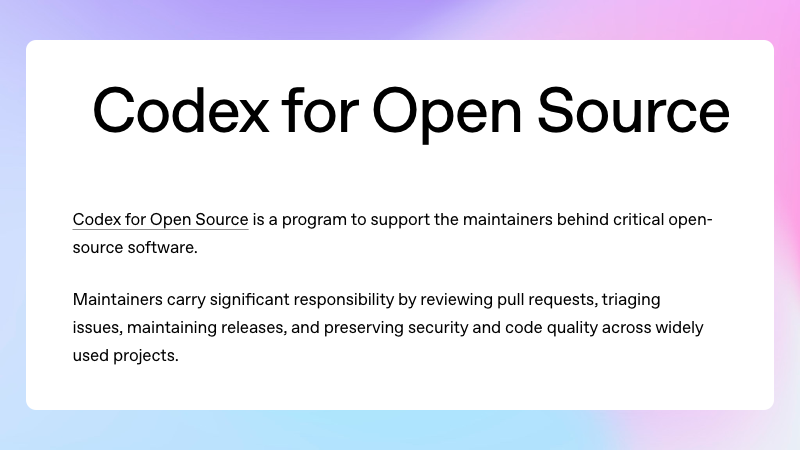
I've never heard back from Codex for open source.
Hell froze over: announcing FormKit for React.
Secretly framework-agnostic since inception, today we’re open sourcing the most popular Vue form library…for React.
Why is this a big deal?
1. Forms are still hard. We (the creators of FormKit) thought form libraries were no longer necessary, given the trajectory of coding agents. It turns out we were wrong, and we learned this the hard way. Need repeating conditional fields nested 3 layers deep inside a dynamic component, with accessibility, validation, internationalization, and backend error placement? Turns out coding agents aren’t great at that. It’s table stakes for FormKit.
2. Single component. This matters more than you would think, but FormKit doesn’t ship lots of different components each with its own props. Instead, it has a single one: <FormKit type="any-input-type-here"> and unified props. This was done to provide a better DX to human engineers. It makes it easy to spot when a given component was part of the form’s data structure vs a presentational component. It turns out this matters even more to coding agents than humans. No matter where your coding agent is, whenever it sees “FormKit” it immediately knows “oh, that’s part of the form’s data”.
3. No plumbing. FormKit doesn’t require any manual data collection, event listening, or state tracking. It does all this for you on a heavily tested, framework agnostic, self-assembling graph. The only code your agent needs to write is declarative templates and submission handlers that respond to the state.
4. Dense colocation. FormKit’s syntax happens to be ideal for coding agents; nearly everything you need to know about a given input is *on* the input:
<FormKit
type="text"
name="email"
label="Email address"
help="How should we get ahold of you?"
validation="required|email"
/>
Colocation dramatically improves the efficacy of coding agents.
5. DOM. FormKit, unlike most form frameworks in React, renders the actual DOM. This also increases colocation and best practices, meaning your coding agent is far more likely to produce consistent and high-quality output that looks and acts the way its supposed to.
6. Schema. FormKit’s own inputs are not written using Vue or React — instead, FormKit has its own render schema — think of it like an AST for the DOM — and you can modify it on the fly. It’s not very human-friendly to write, but it turns out most models are already pretty well trained on FormKit’s schema. Want your inputs to look a bit different on one form than another? No problem, your coding agent can easily make those changes *without* modifying the JSX structure at all. Oh, and any inputs you create for Vue work with React and vice versa.
7. Plugins. FormKit leans into the unstructured tree graph hard. The graph doesn’t just collect data, it also passes down configuration and plugins. Want one form to work a bit differently than another one? No problem — just add a plugin to the top of that form or group and its children will all receive that feature. You can even mass assign props and configuration this way.
Of course, FormKit has been solving these exact issues for a long time, but it wasn’t until we started using it on our own projects with coding agents that we realized what a huge advantage it is.
With so many people using coding agents with React, it made sense to unveil FormKit for what it has always been — a completely framework-agnostic form framework that happens to unlock your coding agents.
➡️ https://t.co/jTsViHTo20