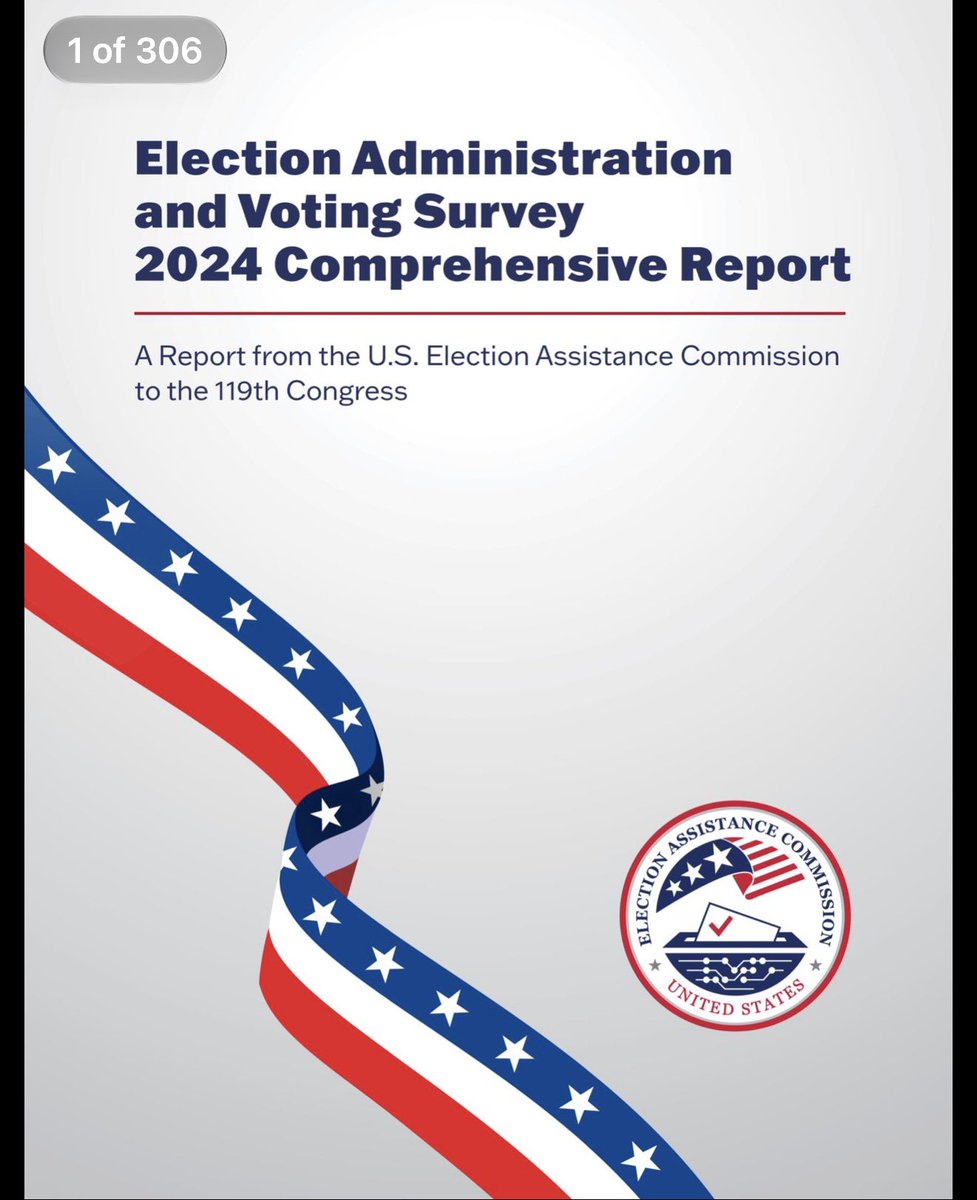
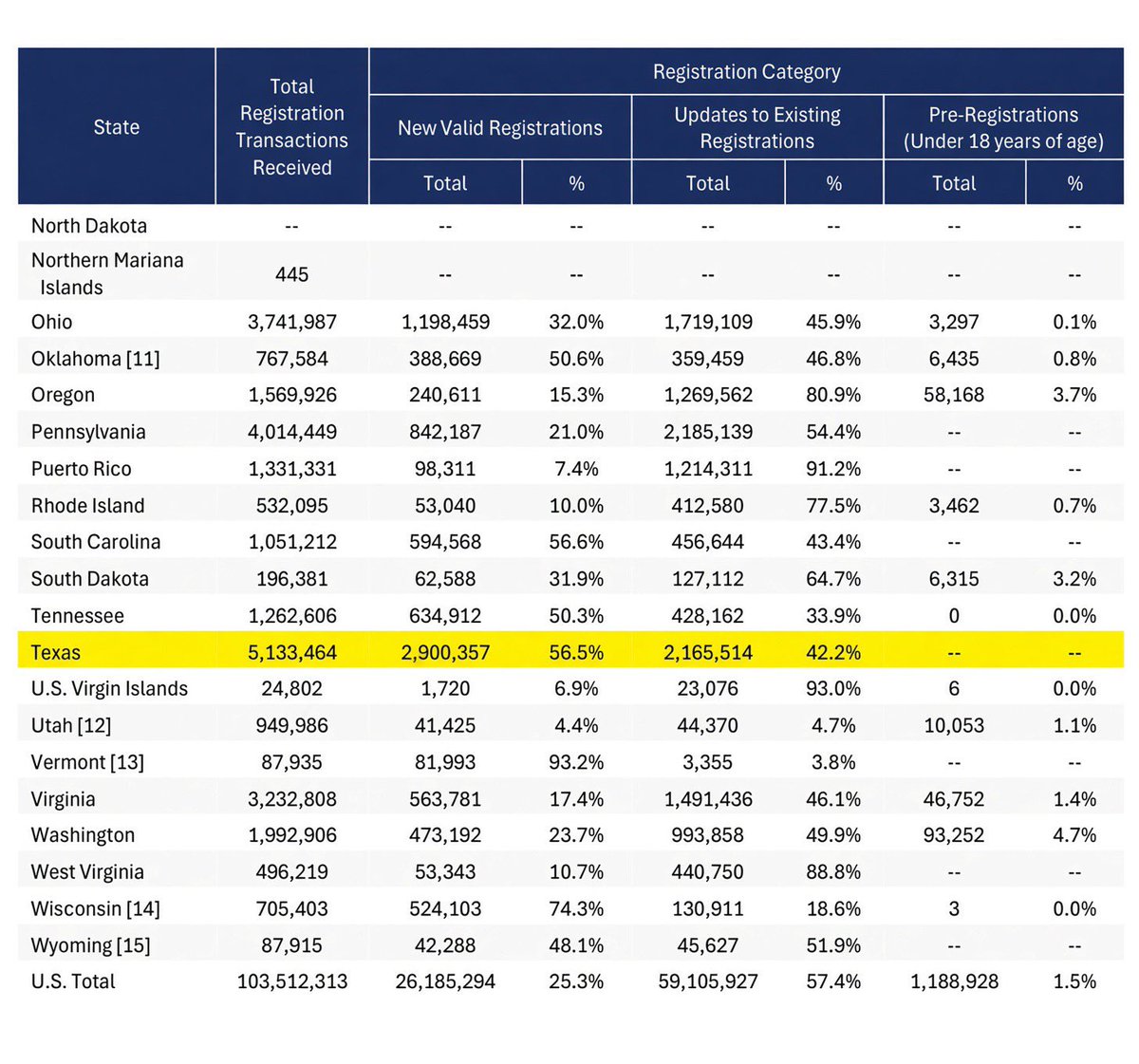
HOLY CR*P 🚨 Official Election Administration and Voting Comprehensive Report buried all the way on page 193 of the document shows Texas processed 2,900,357 new valid voter registrations between 2022-2024 without proof of citizenship
Documented proof of citizenship like birth certificate, passport and naturalization papers is not required at the time of voter registration in Texas
56.5% of Texas voter registration were classified as “new valid registrations.”
This is extremely suspicious that 55% of Texas voter registrations were “new”
40 reps do not believe the government should be entrusted with the regulation of political cartoons.
Rest assured, if this bill is signed into law, it will be used by incumbents to weaponize the judicial system against their opponents.
I strongly oppose HB 366 by former Speaker Phelan. This bill seeks to throw activists in JAIL for making political memes. This bill is motivated by emotion, not policy. Watch my questions to the author below. #txlege
PART 3: How to Invest in the Era of the Mar-a-Lago Accords (Institutional Edition)
The Trump 2.0 economic framework—driven by Bessent, Miran, and others—is not political theater. It’s a coordinated realignment of U.S. fiscal, trade, and capital strategy. For institutional allocators, this marks a potential regime shift in how risk is priced and capital is deployed.
Here’s how to think about positioning:
1. Watch Sovereign Duration Exposure
Trump’s proposed issuance of ultra-long bonds (e.g., century bonds) to foreign allies may flatten the curve—but not without volatility. Institutions should reassess:
•Long-duration sovereign holdings
•FX sensitivity tied to shifting dollar policy
•Allocation to short/intermediate credit and floating-rate structures
2. Fiscal Sovereignty Will Influence Capital Flows
As market access and defense cooperation are tied to alignment, expect repricing of geopolitical risk. Consider:
•Re-weighting sovereign exposure based on alignment with U.S. objectives
•Adjusting EM allocations vulnerable to capital outflows
•Tracking bilateral over multilateral capital relationships
3. U.S. Industrial and Resilience Themes Will Be Capitalized
The strategy favors domestic infrastructure, defense, and onshoring. Allocate to:
•U.S.-centric industrials, logistics, and manufacturing equities
•PE and VC targeting automation, reshoring, and critical supply chains
•Real assets tied to strategic inputs: housing, water, minerals, energy
4. Energy Policy Will Shift Investment Priorities
Energy independence is a pillar of affordability and security. Allocators should explore:
•Fossil fuels, nuclear, and domestic energy infrastructure
•Transitional energy strategies backed by stable tax credit regimes
•Resource funds linked to minerals key to defense and semiconductors
5. Private Credit Will Be a Strategic Lever
Regulatory reform on community banks and Basel rules could expand private lending. Institutions should:
•Allocate to non-bank credit and lending platforms with U.S. borrower focus
•Support specialty finance strategies navigating policy change
•Monitor public-private vehicles using private capital as an accelerant
6. Sovereign Wealth Dynamics Could Enter U.S. Markets
If a U.S. sovereign wealth mechanism is formalized, it may shape long-term flows. Watch for:
•Monetization of federal assets (land, leases, agency stakes)
•Co-investment frameworks aligned with infrastructure and innovation
•Structured programs creating institutional partnerships
7. Global Benchmarks May Diverge from Performance
Passive global exposures may underperform in a realigned world. Active strategies should focus on:
•Sectors with policy tailwinds and regulatory alignment
•Custom indices or mandates focused on national competitiveness themes
•Reducing reliance on indices blind to geopolitics and trade fragmentation
8. Volatility Isn’t the Risk—It’s the Environment
This regime accepts short-term disruption to restore long-term control. Allocators should:
•Prepare for FX instability and capital rebalancing between regions
•Monitor sovereign spreads tied to political misalignment
•Develop macro overlays beyond traditional diversification models
Final thought:
The Mar-a-Lago Accords aren’t just a policy roadmap—they’re a structural reset. Institutions that reposition capital toward alignment, resilience, and sovereign policy will outperform those anchored in the inertia of the old global
PART 4: What the Mar-a-Lago Accords Mean for the American Household
Trump’s economic strategy—known as the Mar-a-Lago Accords—is not just about rebalancing global trade. It’s about reshaping everyday life in America—what you pay at the grocery store, how secure your job is, and whether your wages can actually support a family.
This week could be the most consequential yet. The plan is bold—but it comes with calculated risks.
1. Grocery prices and inflation: short-term risk, long-term reward
As tariffs rise on imported goods—especially from countries like China—consumers may feel near-term pressure on certain items: produce, household goods, and packaged food, especially where global supply chains haven’t yet adjusted.
But the strategy doesn’t stop there. The Trump team is betting that lower energy prices, simplified regulations, and domestic production will ultimately offset those pressures. If successful, it means:
•Lower food distribution and fuel costs
•Less vulnerability to foreign supply shocks
•Price stability through energy independence
2. Wages vs. cost of living: closing the gap
This plan targets a fundamental issue: wages haven’t kept up with rising living costs. While inflation hit double digits post-COVID, real income gains didn’t follow for most Americans.
By reshoring industrial jobs, increasing investment in energy and logistics, and easing the burden on small lenders, the administration aims to:
•Create better-paying jobs across more regions
•Drive wage growth in non-college sectors
•Ease pressure on household budgets by reducing input costs
3. Made-in-America may cost more—but mean more
Let’s be honest: some imported goods may get more expensive. But the trade-off is supply chain security, job creation, and national independence.
This plan reintroduces friction in the name of fairness. And in the long run, reshoring production could stabilize prices, boost domestic manufacturing, and reduce dependence on unstable global actors.
The historical precedent:
Major economic resets have always come with volatility. After WWII, the Bretton Woods system triggered short-term disruption as the world adjusted to new currency rules and trade flows.
Similarly, the shift to the neoliberal order in the 1980s brought deindustrialization and asset repricing as capital went global.
Now, we’re entering a new phase—one where national interest, not global efficiency, is driving the agenda. It’s a shift from “just-in-time” to “just-in-case”—and it’s happening quickly.
The world is already responding:
We’re not waiting for global buy-in—other countries are adjusting now.
•Italy, Mexico, Canada, and Israel are aligning their trade and security postures with U.S. interests.
•Domestic and foreign companies are pouring capital into U.S. manufacturing: semiconductors, energy, EVs, defense, and more.
•And the old USMCA workaround, where Chinese goods were re-routed through Canada or Mexico to avoid tariffs? It’s being closed. The new framework pegs tariff rates to behavior, not geography.
The message is clear: you’re either aligned with U.S. trade policy—or you’re paying to get in.
Bottom Line:
For American households, this plan represents a path to reclaiming affordability, stability, and real wage growth.
Yes, there will be friction. Yes, the headlines may sound aggressive.
But if executed with discipline, this strategy could rebalance the economy in favor of working families—for the first time in decades.
It’s not a quick fix. It’s a full reset. And the stakes this week couldn’t be higher
FACT CHECK:
🚨🚨🚨
Here’s @KamalaHarris on video saying she supports BANNING FRACKING!
“There’s no question I’m in favor of banning fracking.” — @KamalaHarris
Why is she now lying and saying she doesn’t support banning fracking?
Kamala is a LIAR!
Cc: @TeamTrump@ABC
Some say @DAKimOgg endorsing Senator Cruz is surprising.
Can’t Comment Colin is anti-law enforcement and cares more about protecting criminals than our communities. DA Ogg rightfully put party politics on the back burner and supports Senator Cruz because she knows he is the candidate fighting to keep Texans safe.
Nothing is surprising about that.
“Happy Juneteenth folks, it’s the day when Blacks in Texas learned that they were free, June 19, 1865 in Galveston.
But what does today mean?
It’s the day when Blacks found out that the first Republican President had signed the Emancipation Proclamation freeing them from the physical bondage of the Democrat Party. It was two years later, on July 4th 1867, that 150 of those same Black men met in Houston and established the Republican Party of Texas. The Democrats, in response, established the Ku Klux Klan.
Today, the Democrats are economically enslaving Blacks and have turned inner city communities into modern plantations of welfare and economic dependence.
Juneteenth is a celebration of why the Republican Party was established in 1854, the abolition of slavery. Only a flaming incompetent idiot would give the party of the jackass any credit for Juneteenth.”
~ Allen West
If Dade Phelan refuses to pass Senate Bill 6, an emergency bill in response to lawsuits filed against the 13 Amendments just approved by voters, the property tax cuts, teacher retirement checks, and 11 other Amendments could be delayed a year or more. Five days are left in session, but Dade falsely says he doesn't have time to pass these bills. All he has to do is call the House back at any moment or, if needed, suspend House rules to pass these bills on Tuesday.
Call Dade Phelan's office this weekend or Monday at 512-463-1000 and leave a message to pass these important bills. Tell him you want your property tax cut now and to take care of our retired teachers. Contact your local House member as well.