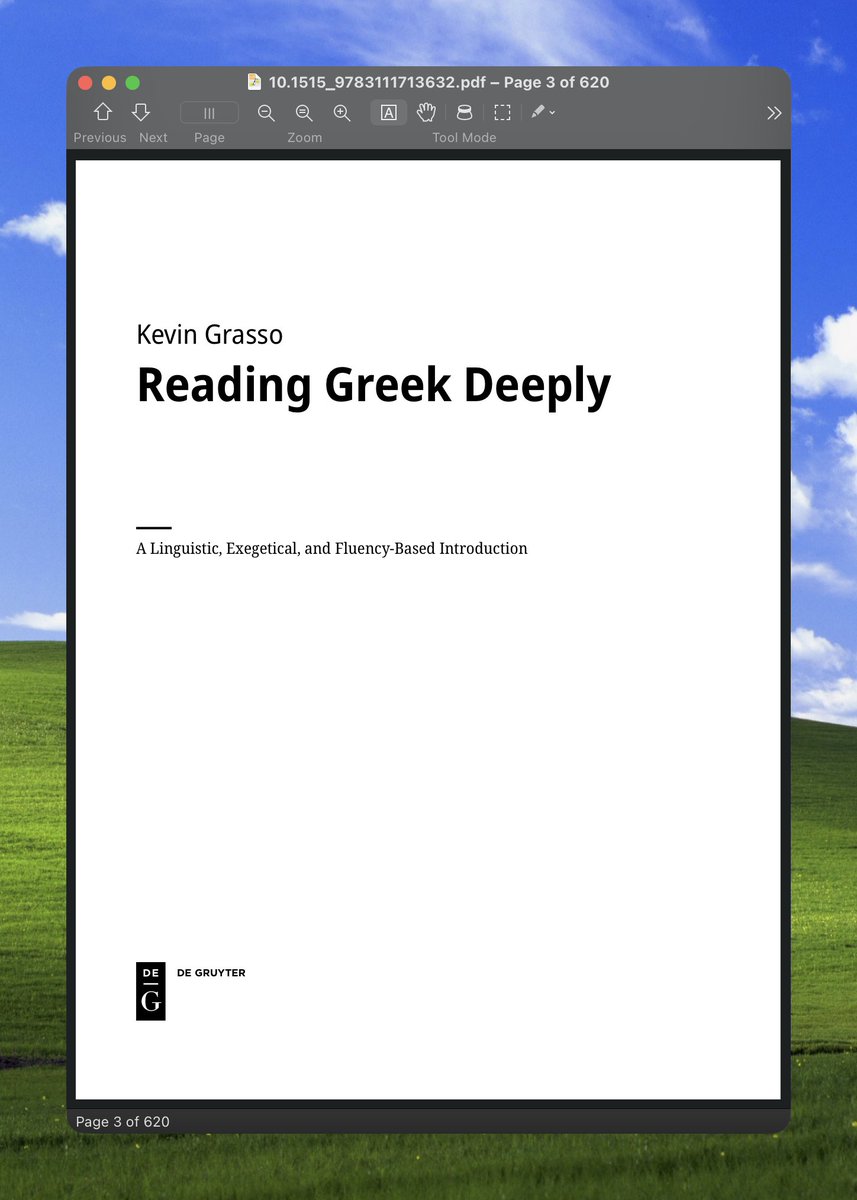
It's here!
Download your free copy of Kevin Grasso's new Greek textbook at https://t.co/FOKvPAbSjT
Reading Greek Deeply: A Linguistic, Exegetical, and Fluency-Based Introduction is published by De Gruyter Brill.
The online PDF is free and open-access, and print copies are available for purchase directly from De Gruyter: https://t.co/zbxuLfz26P.
And that's not all folks: We are launching an interactive course version of the textbook complete with quizzes and exams - which you can access free here: https://t.co/WKqcIbRgFX.
In tandem, we are releasing a searchable Greek grammar wiki that is built on the bones of the textbook. Access the wiki here: https://t.co/xQ2bAS0yy8.
We hope the textbook and related resources will be useful in your pursuit of fluency in Koine Greek and a deeper understanding of the New Testament.
You may ask: why yet another Greek grammar in the crowded world of excellent Greek textbooks?
A few reasons:
(1) INTEGRATED WITH BIBLINGO
While it stands alone, this textbook also serves as the perfect companion to the Greek lessons in the Biblingo app. It is designed to provide a way for Biblingo learners to dive deeper into the grammar of Greek. Those of you who use Biblingo have already been using much of this material in draft form inside the app lessons.
(2) APPLICATION OF LINGUISTICS
This textbook seeks to apply the latest research in linguistics to the study of NT Greek.
Linguist Paul Kroeger (DIU) said: "The book models an integrated approach to linguistics and Biblical studies, illustrating some of the ways in which each tradition can benefit from the insights of the other."
(3) MARRIAGE OF METHODOLOGIES
With this project, Kevin aims to synthesize the best of varying approaches to learning Greek.
Greek professor @smehorn (HCU) says of the textbook: "I recommend it heartily to any students and especially teachers of Greek who are seeking to bridge the gap between living-language approaches and traditional grammar instruction.
4. UNIQUE INTEGRATION OF EXEGESIS
Rather than relegating exegesis to the later stages of learning Greek, this textbook integrates exegetical practice early and often.
New Testament scholar @jasonstaples said, "The interspersed exegetical sections are also of value on their own even beyond the demonstration of methods, making robust and sometimes novel cases for strong readings, though not all will agree with every conclusion. Highly recommended."
This textbook is adaptable for:
- Seminary and university classrooms (covers a typical 4 semesters of Greek)
- High-school study (can span 4 years of study)
- Self-study (serves as a fantastic complement to Biblingo)
Learn more at https://t.co/FOKvPAbSjT.
Biblingo's biggest sale of the year starts now.
Snag Biblingo plans at their lowest price plus get free stuff shipped to your house with every annual or lifetime subscription.
Planning for Christmas? Check out our Christmas gift boxes and gift the joy of rediscovering Scripture in the original languages.
Check out the deals at https://t.co/L6o6vVJoL7.
If you haven't listened yet, check out Disciple Dojo @jamesmichael7's chat with Kevin discussing the new textbook and...other topics:
https://t.co/aaWSYhzs1g
The ONLY way to become fluent in a language is to use the language.
You don't learn to play violin in music theory class. Instead, you learn through hours and hours of practice. You can play the violin extremely well while knowing minimal music theory, and you can be a professor in music theory without being able to play the violin at all.
In the same way, learning *about* Greek and Hebrew will not teach you the languages. You need to use them.
That's not to say that theory and practice aren't synergistic. Being able to play an instrument gives you intuitions about how good music sounds without the theory, but theory can still help you refine and perfect what your intuitions are telling you.
Reading a text closely in a foreign language is much the same. Developing fluency gives you intuitions about what the text is saying, and as these intuitions are honed, the meaning of the text opens up more easily without analysis - just like you are (hopefully) not parsing and analyzing every word of this paragraph to decipher its meaning. However, when the understanding of a text is truely ambigous or obscure, employing a robust grammatical theory can help you resolve the ambiguity.
There's some truth here. Translation committees deserve a lot of deference, and most "the Greek really means" posts are bad. But the argument has a few problems and oversimplifies the challenges involved in Bible translation.
First, there's no "aggregate" where the top five disagree. For example, in Rom 7:25, the NIV renders σάρξ as "sinful nature", but the ESV says "flesh". The reader has to choose which "plain reading" to go with. How do you do that without knowledge of Greek or Hebrew?
Second, the committees themselves say "it might not mean that." Every "Or..." footnote in a Bible translation flags their own text as one defensible option, but acknowledges there are other viable options.
Third, the consensus also moves. ESV (2011) Gen 3:16: "Your desire shall be for your husband." ESV (2016): "Your desire shall be contrary to your husband." A committee's English is its best current judgment, open to the kind of argument "it doesn't mean that" makes.
Fourth, a committee decides on the English wording, not every conclusion a reader draws from it. "The plain reading of my translation" is not the same thing as the translation itself. It's an interpretation, and that interpretation is often what's under dispute.
In the spirit of Reformation Day, it's worth noting that Protestants have historically read in translation but settled disputes in the original languages. Luther put it this way:
"A simple preacher, to be sure, is in possession of so many clear passages and texts from translations that he can know and teach Christ, lead a holy life and preach to others. But to interpret Scripture, to treat it independently, and to dispute with those who cite it incorrectly, to that he is unequal; that cannot be done without languages." (To the Councilmen of All Cities in Germany).
I can confidently make two guarantees:
-I know less about Greek and Hebrew than any average pastor.
-I will never encounter a man who knows more than the aggregate understanding of the contributors to the too five Bible translations.
My point is that no rando on social media will overturn the plain reading of my English translation of Scripture. (Based not only on that point of contention, but upon the balance of Scripture)
“It doesn’t mean that” won’t work here.
It's here!
Download your free copy of Kevin Grasso's new Greek textbook at https://t.co/FOKvPAbSjT
Reading Greek Deeply: A Linguistic, Exegetical, and Fluency-Based Introduction is published by De Gruyter Brill.
The online PDF is free and open-access, and print copies are available for purchase directly from De Gruyter: https://t.co/zbxuLfz26P.
And that's not all folks: We are launching an interactive course version of the textbook complete with quizzes and exams - which you can access free here: https://t.co/WKqcIbRgFX.
In tandem, we are releasing a searchable Greek grammar wiki that is built on the bones of the textbook. Access the wiki here: https://t.co/xQ2bAS0yy8.
We hope the textbook and related resources will be useful in your pursuit of fluency in Koine Greek and a deeper understanding of the New Testament.
You may ask: why yet another Greek grammar in the crowded world of excellent Greek textbooks?
A few reasons:
(1) INTEGRATED WITH BIBLINGO
While it stands alone, this textbook also serves as the perfect companion to the Greek lessons in the Biblingo app. It is designed to provide a way for Biblingo learners to dive deeper into the grammar of Greek. Those of you who use Biblingo have already been using much of this material in draft form inside the app lessons.
(2) APPLICATION OF LINGUISTICS
This textbook seeks to apply the latest research in linguistics to the study of NT Greek.
Linguist Paul Kroeger (DIU) said: "The book models an integrated approach to linguistics and Biblical studies, illustrating some of the ways in which each tradition can benefit from the insights of the other."
(3) MARRIAGE OF METHODOLOGIES
With this project, Kevin aims to synthesize the best of varying approaches to learning Greek.
Greek professor @smehorn (HCU) says of the textbook: "I recommend it heartily to any students and especially teachers of Greek who are seeking to bridge the gap between living-language approaches and traditional grammar instruction.
4. UNIQUE INTEGRATION OF EXEGESIS
Rather than relegating exegesis to the later stages of learning Greek, this textbook integrates exegetical practice early and often.
New Testament scholar @jasonstaples said, "The interspersed exegetical sections are also of value on their own even beyond the demonstration of methods, making robust and sometimes novel cases for strong readings, though not all will agree with every conclusion. Highly recommended."
This textbook is adaptable for:
- Seminary and university classrooms (covers a typical 4 semesters of Greek)
- High-school study (can span 4 years of study)
- Self-study (serves as a fantastic complement to Biblingo)
Learn more at https://t.co/FOKvPAbSjT.
If you start with the new course from @LinguaDeoGloria , then follow up with https://t.co/kbqMMNxNya and watch @dailygreek and @DailySeptuagint everyday, and seriously commit to this path, you will be grateful you did by Halloween 2027 ☦️
Would you like to fast-track your way to reading the Bible in its original languages? That's what our online courses are designed to do: supercharge your learning process.
Our next round of classes begins next week.
Check em out: https://t.co/aI33k5EvfN.
@ASingeveryday Keep in mind that $30/month is our top-tier, all-inclusive plan. The more comparable plan to this "Biblical Greek" app (depending on what exactly it offers), for example, is probably our Greek-only "Learn" plan which is only $9/mo paid monthly, or $7.20/mo paid yearly.
@TheoApologetics No physical workbook - in a sense Biblingo is the workbook. We do have video lectures in the app which match the textbook lessons, and we may add lectures to cover the linguistics sections.
This looks amazing, #langtwt! 👀
Wonderful that it's free too, but I think I might also like to get the physical copy to go with my original language Bible! ☺️
Consistency.
It's the main thing successful language learners have in common. They took consistent steps in the right direction over an extended period of time. Biblingo gives you the "right direction," but you have to supply the consistency. And even the most disciplined among us struggle to form and maintain a learning habit.
That's one reason why our live courses exist. They provide a structure for the rhythm of your learning.
Biblingo user Cosima said that using the app: "I did a lesson here a lesson there and then stopped for a couple of weeks and then did several lessons a day. And also I just went ahead even if I wasn't sure if I really understood it. I thought okay, later it will make sense."
But with the live courses "it was completely different. Now I had a structure - every week a lesson. And I had to show up and prove that I understood everything. [The pressure] in this case was really, really very helpful. A huge difference."
If you want to quickly grow in your proficiency with the biblical languages, consider joining a Biblingo Live course beginning next week (November 1st). Learn more here: https://t.co/0dFb9F1NNw