November 6, 1861.
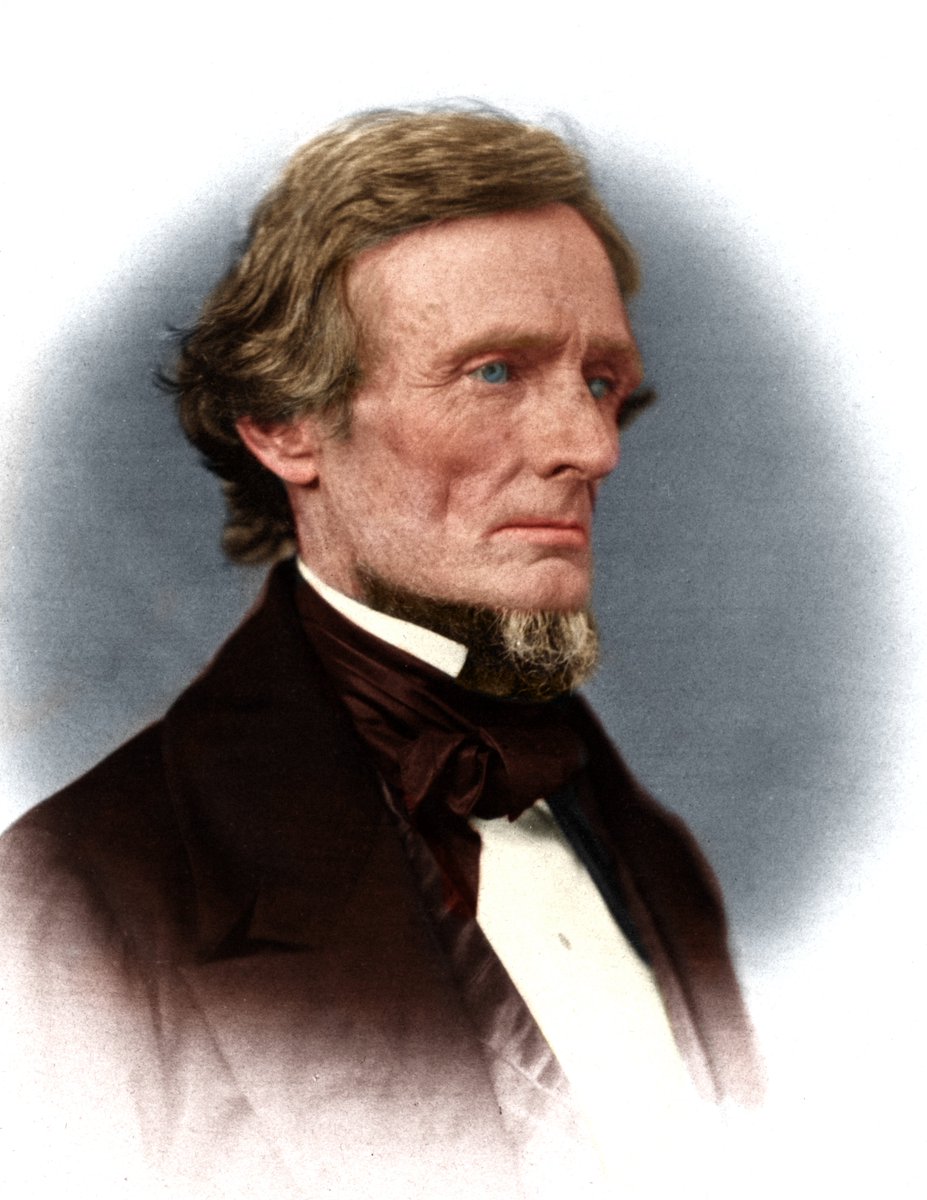
Jefferson Davis never wanted to be president of the Confederacy.
He was a West Point graduate who had spent his life wanting to be a soldier. As a young officer, he fell in love with Sarah Knox Taylor, daughter of his commanding officer, Zachary Taylor. Her father opposed the match, so Davis resigned from the army to marry her. Three months after the wedding, both of them caught malaria. She died. He survived, and for years afterward he barely left his Mississippi plantation.
He came back to public life slowly. In the Mexican War he led the Mississippi Rifles at the Battle of Buena Vista, held his ground against a much larger Mexican force, and was shot in the foot. He came home a hero. Later he served as a U.S. senator and as secretary of war.
When Mississippi seceded in January 1861, he stood up in the Senate and gave his farewell speech. Witnesses said he was ill and visibly heartbroken. He said he felt no hostility toward the people he was leaving and wished them well.
He hoped to command Mississippi's army. Instead, in February, a telegram told him he'd been chosen provisional president of the Confederacy. His wife Varina later wrote that he read it like a man reading his own death sentence.
On November 6, 1861, Confederate voters elected him to a full six-year term. He ran unopposed.
He was inaugurated on February 22, 1862, George Washington's birthday, standing beneath Washington's statue in Richmond. It poured rain.
The job broke him. He suffered from crippling facial pain, chronic illness, and an eye that had nearly gone blind. He worked himself to exhaustion and carried the blame for every defeat. In April 1864 his five-year-old son Joseph fell from a porch at the Confederate White House and died.
In April 1865 he fled Richmond. In May, Union cavalry captured him in Georgia. At Fort Monroe, guards put him in leg irons for a time, and he was kept in a cell under constant watch, with a lamp burning all night.
He was held for two years and never put on trial. When he was finally released on bail in 1867, the men who signed his bond included Horace Greeley, the abolitionist newspaper editor, and Gerrit Smith, who had once helped fund John Brown.
He never asked for a pardon. He spent his last years at Beauvoir, his home on the Mississippi coast, writing his account of the war. He died in 1889 at 81.
@NewsWire_US Well, I’ll be. Texas hadn’t elected a Democrat to the U.S. Senate since 1988, and South Carolina since 1998. But reckon folks oughta remember the South was once solidly Democratic. Political parties change, and Southern voters ain’t always voted the same way.
@RamrodPhoenix Christianity helped shape Dixie, no doubt about it. The Mayflower Compact of 1620 invoked God, and Southern churches shaped generations of our people. But Christianity began in first-century Judea, and its message was never limited to one race. History oughta be told straight.
@CarolinaMomma89 Lord have mercy, we’ve been hearin’ politicians holler that the other side’s gonna destroy America since the election of 1800, when Jefferson and Adams went at each other hammer and tongs. Two hundred and twenty-six years later, and Washington’s still runnin’ the same ol’ circus.
Here’s somethin’ folks forget. Back in 1798, Jefferson and Madison challenged federal power through the Kentucky and Virginia Resolutions. But even them two Founders disagreed on just how far a state could go. This argument over state sovereignty was brewin’ long before Lincoln ever set foot in Washington.
Now here’s what folks oughta remember. Lincoln won in 1860 with just 39.8% of the popular vote and wasn’t even on the ballot in ten Southern states. The Democratic Party had split clean in two, and Lincoln carried 180 electoral votes. Reckon that election showed just how divided this country already was.
@Partisan_12 Back in 1796, George Washington warned this country against gettin’ tangled up in foreign political attachments. Reckon Washington understood somethin’ them fellas in Congress done forgot. Ain’t a nation on this earth oughta come before the American people.
Folks can argue over the Confederacy till the cows come home, but history deserves more than slogans. Them soldiers had different reasons for fightin’, while the secession conventions made it mighty clear that protectin’ slavery was central to breakin’ up the Union. Southern history oughta be told whole.
@MarkAppel22 We don’t have those here in my area. Had a couple try and move in Nextdoor we eliminated the threat. That’s how true Southern Gentlemen handle business.