Anthropic Academy just dropped FREE AI courses that could replace a $10,000 degree.
$0. No catch. No gatekeeping.
Here are 6 AI courses that could separate you from everyone else in 2026:
���� This might be the blueprint for true general intelligence 😳
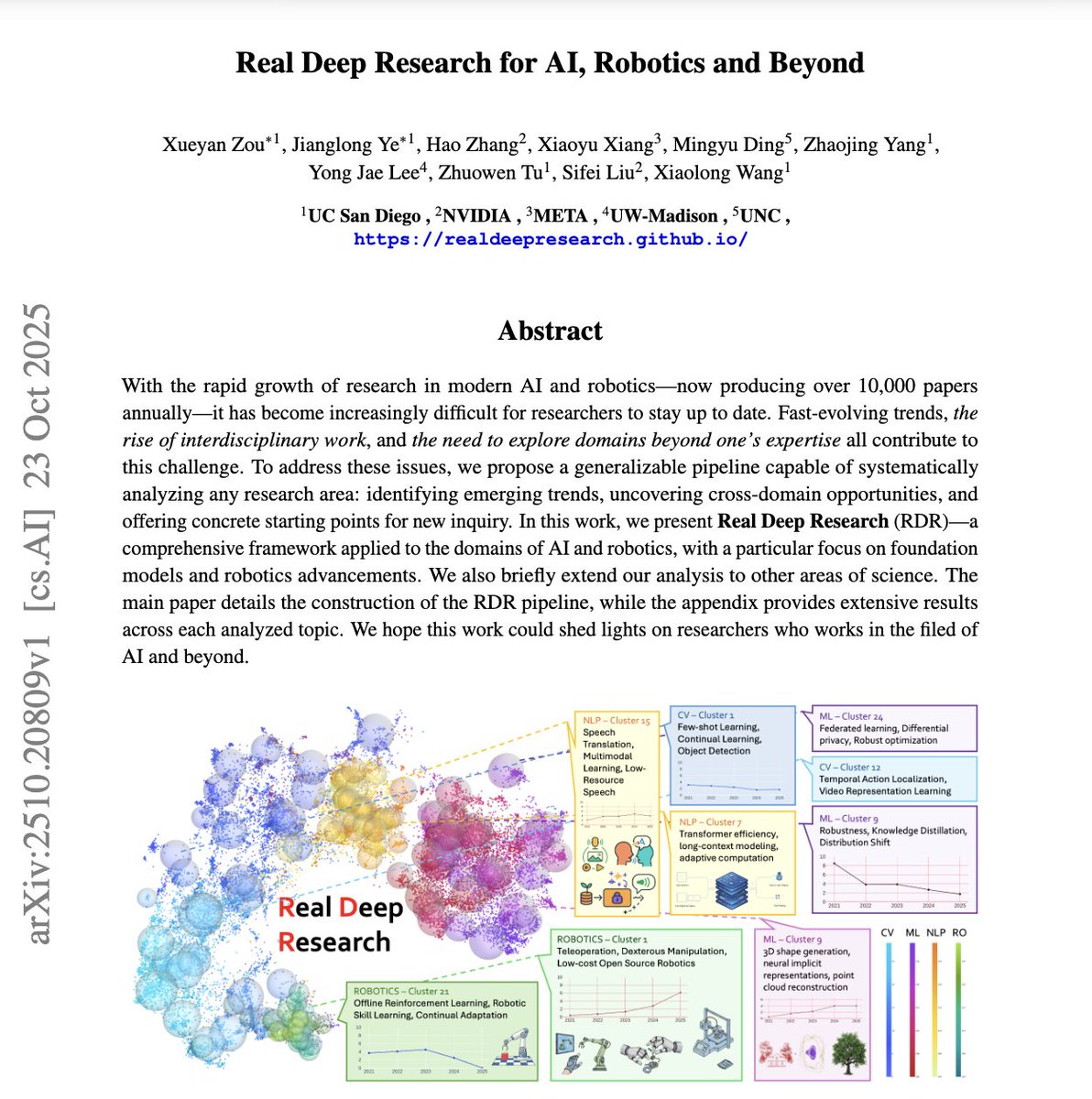
A new paper titled “Real Deep Research for AI, Robotics, and Beyond” redefines what “understanding” means for machines.
Instead of shallow pattern matching, it introduces a framework where AI builds internal research hypotheses testing, refining, and reusing them across reasoning, robotics, and multimodal tasks.
The results are insane:
→ Outperforms GPT-4 and Gemini 2.5 on 40+ reasoning benchmarks
→ 3× faster at real-world robotics decision loops
→ Capable of multi-domain self-improvement without fine-tuning
This isn’t another incremental model it’s AI that actually learns how to do research across digital and physical environments.
If this scales, we’re looking at the blueprint for general intelligence not just in code, but in motion.
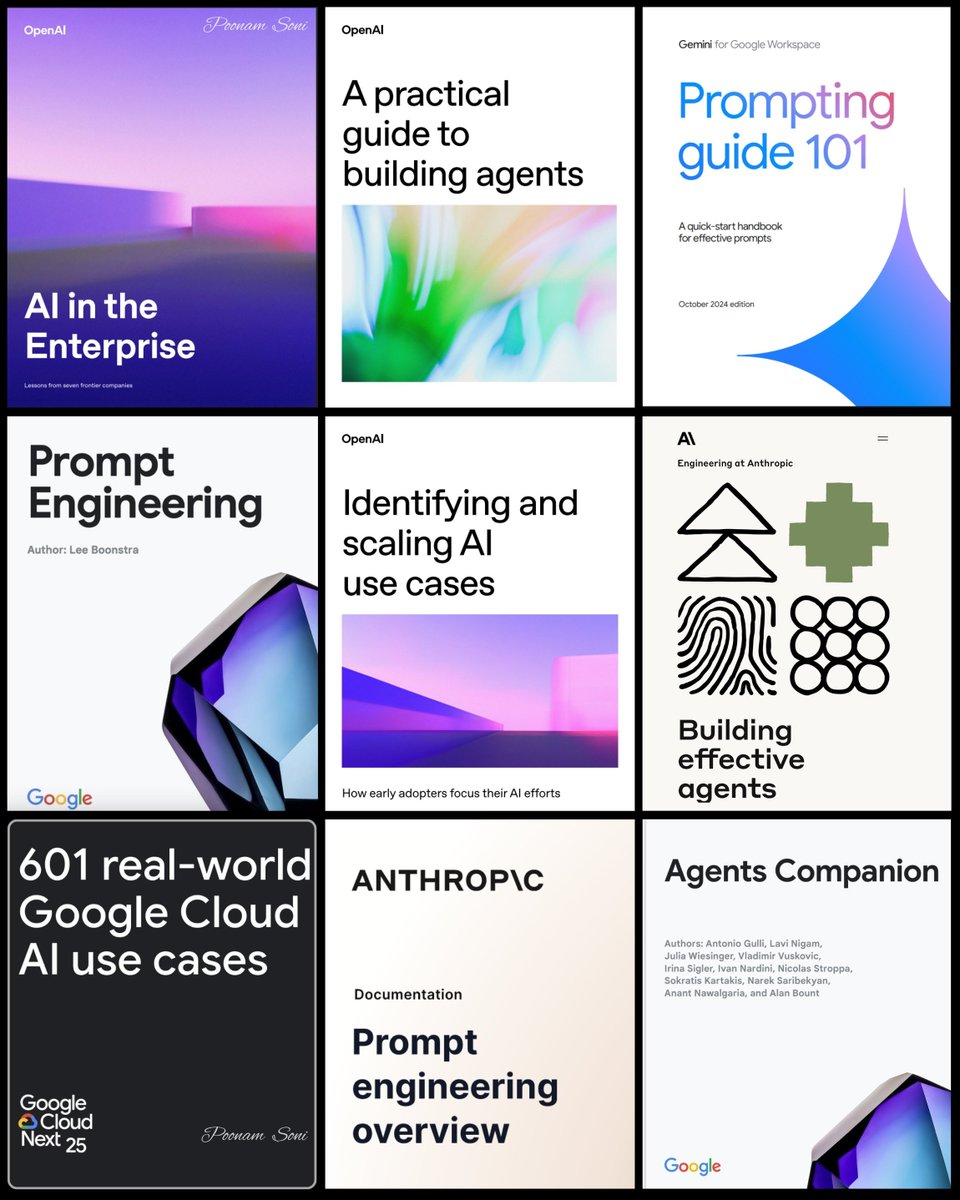
OpenAI, Google, and Anthropic just published guides on:
• Prompt engineering
• Building agents
• AI in business
• 601 AI use cases
9 of the best guides you can't miss:
Major preprint just out!
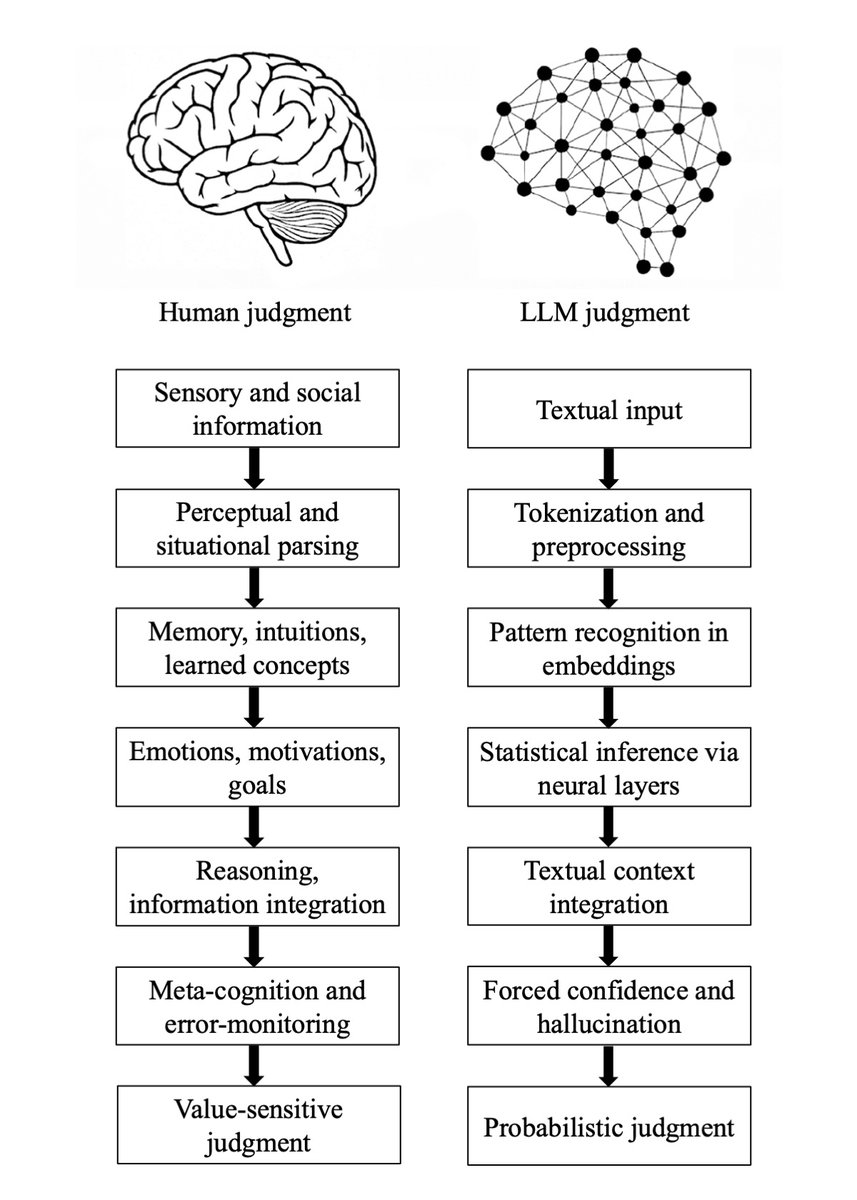
We compare how humans and LLMs form judgments across seven epistemological stages.
We highlight seven fault lines, points at which humans and LLMs fundamentally diverge:
The Grounding fault: Humans anchor judgment in perceptual, embodied, and social experience, whereas LLMs begin from text alone, reconstructing meaning indirectly from symbols.
The Parsing fault: Humans parse situations through integrated perceptual and conceptual processes; LLMs perform mechanical tokenization that yields a structurally convenient but semantically thin representation.
The Experience fault: Humans rely on episodic memory, intuitive physics and psychology, and learned concepts; LLMs rely solely on statistical associations encoded in embeddings.
The Motivation fault: Human judgment is guided by emotions, goals, values, and evolutionarily shaped motivations; LLMs have no intrinsic preferences, aims, or affective significance.
The Causality fault: Humans reason using causal models, counterfactuals, and principled evaluation; LLMs integrate textual context without constructing causal explanations, depending instead on surface correlations.
The Metacognitive fault: Humans monitor uncertainty, detect errors, and can suspend judgment; LLMs lack metacognition and must always produce an output, making hallucinations structurally unavoidable.
The Value fault: Human judgments reflect identity, morality, and real-world stakes; LLM "judgments" are probabilistic next-token predictions without intrinsic valuation or accountability.
Despite these fault lines, humans systematically over-believe LLM outputs, because fluent and confident language produce a credibility bias.
We argue that this creates a structural condition, Epistemia:
linguistic plausibility substitutes for epistemic evaluation, producing the feeling of knowing without actually knowing.
To address Epistemia, we propose three complementary strategies: epistemic evaluation, epistemic governance, and epistemic literacy.
Full paper in the first reply.
Joint with @Walter4C & @matjazperc
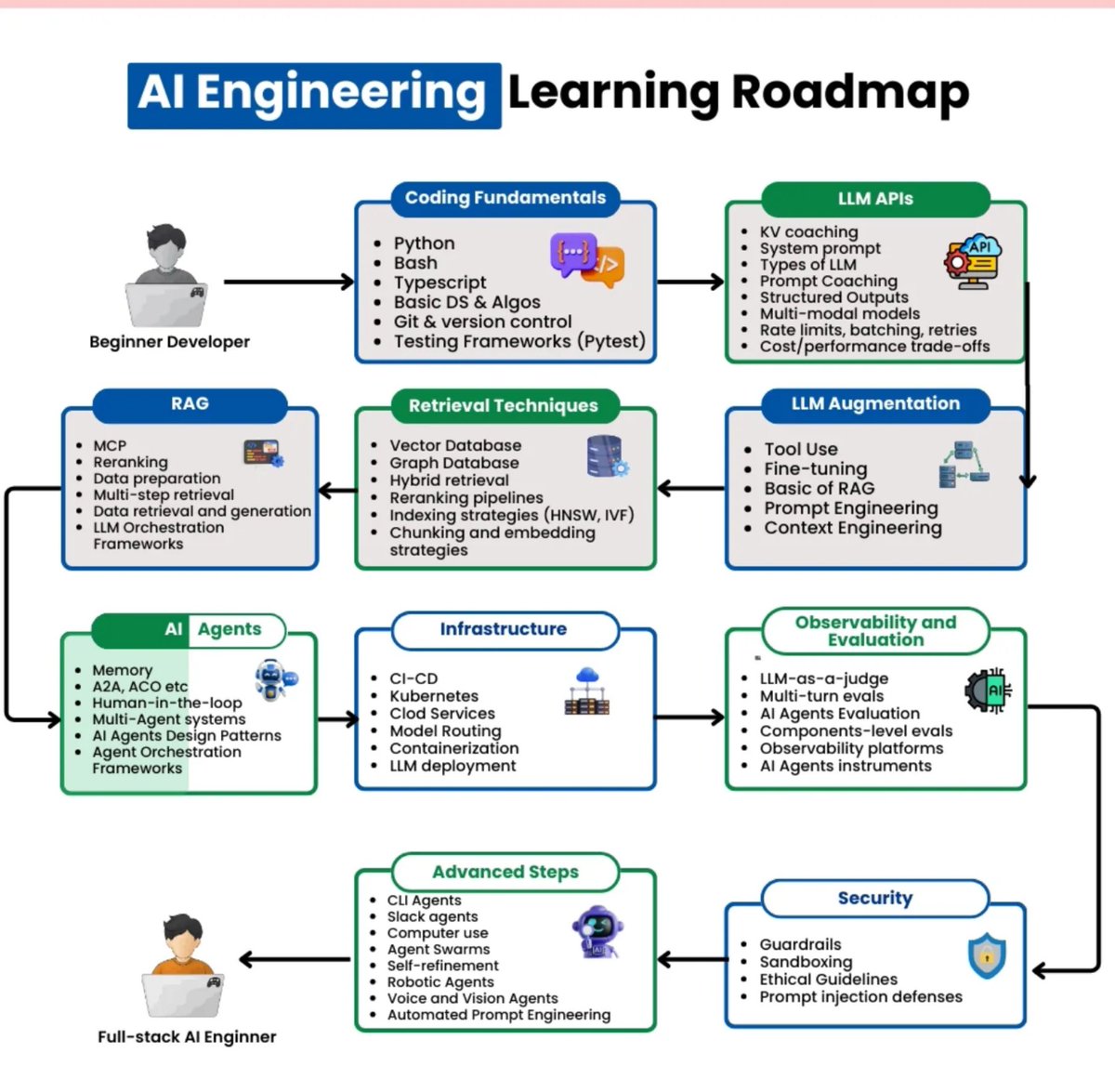
The biggest lie in AI is that "Prompts" are enough. Real systems need engineering, not magic. Google open-sourced the engineering layer you are missing
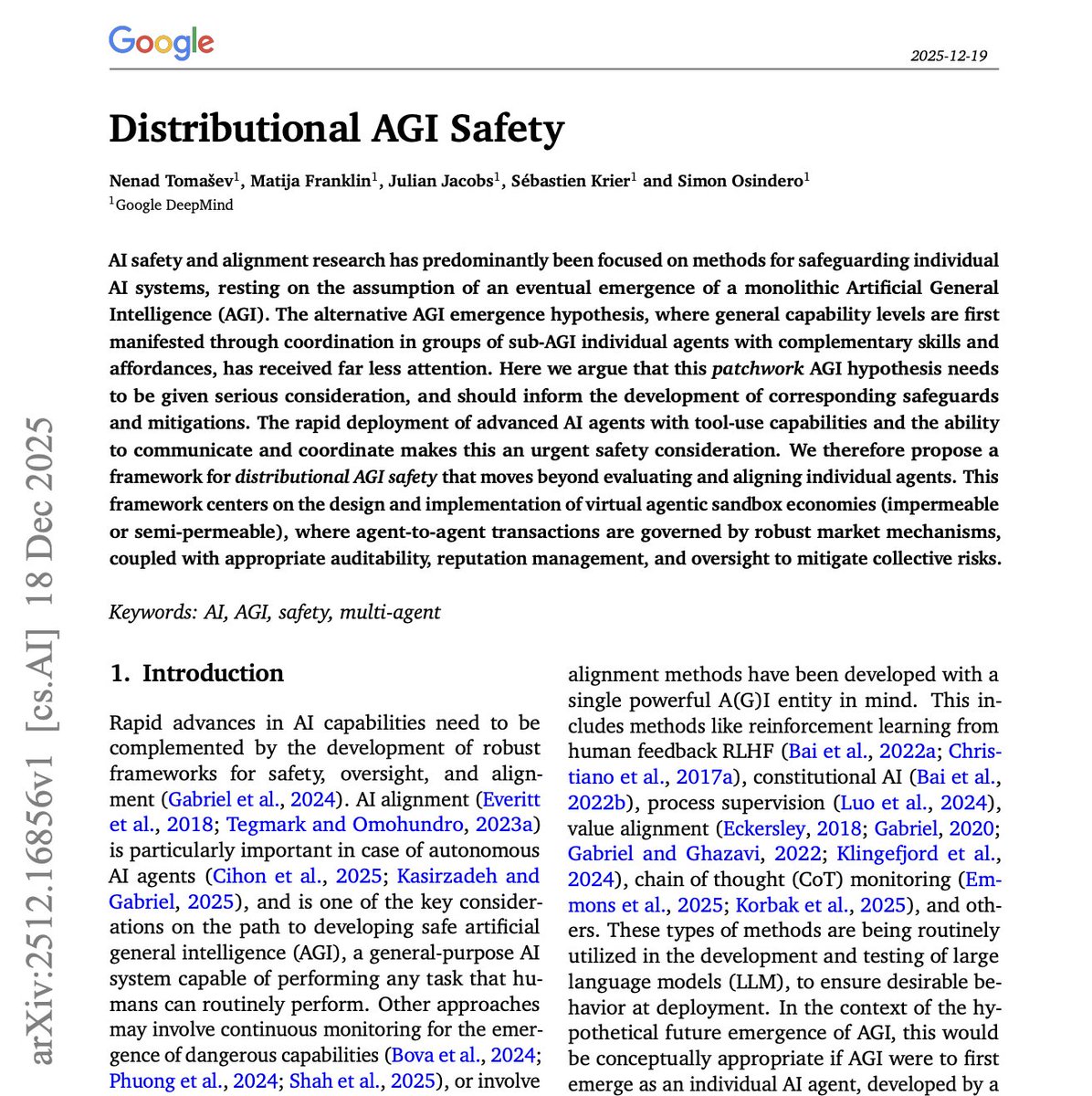
This DeepMind paper just quietly killed the most comforting lie in AI safety.
The idea that safety is about how models behave most of the time sounds reasonable. It’s also wrong the moment systems scale. DeepMind shows why averages stop mattering when deployment hits millions of interactions.
The paper reframes AGI safety as a distribution problem. What matters isn’t typical behavior. It’s the tail. Rare failures. Edge cases. Low-probability events that feel ignorable in tests but become inevitable in the real world.
Benchmarks, red-teaming, and demos all sample the middle. Deployment samples everything. Strange users, odd incentives, hostile feedback loops, environments nobody planned for. At scale, those cases stop being rare. They are guaranteed.
Here’s the uncomfortable insight: progress can make systems look safer while quietly making them more dangerous. If capability grows faster than tail control, visible failures go down while catastrophic risk stacks up off-screen.
Two models can look identical on average and still differ wildly in worst-case behavior. Current evaluations can’t see that gap. Governance frameworks assume they can.
You can’t certify safety with finite tests when the risk lives in distribution shift. You’re never testing the system you actually deploy. You’re sampling a future you don’t control.
That’s the real punchline.
AGI safety isn’t a model attribute. It’s a systems problem. Deployment context, incentives, monitoring, and how much tail risk society tolerates all matter more than clean averages.
This paper doesn’t reassure. It removes the illusion.
The question isn’t whether the model usually behaves well.
It’s what happens when it doesn’t — and how often that’s allowed before scale makes it unacceptable.
Paper: https://t.co/fA84LCt2fK