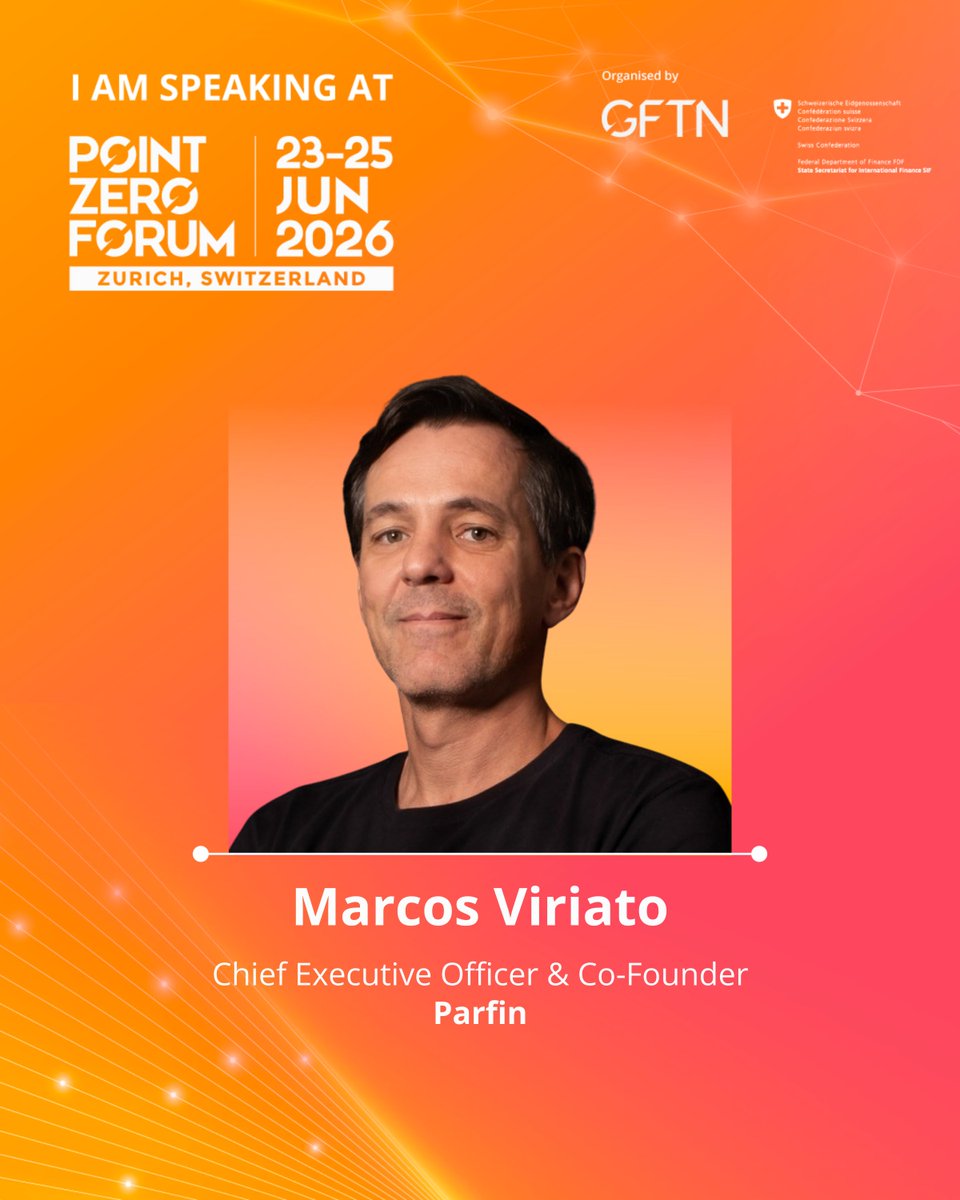
Next week I'll be in Zurich for Point Zero Forum, joining a roundtable convened by the BIS on tokenised financial markets with Banks, FMIs and Central Banks.
The topic couldn't be more timely: as tokenisation scales across platforms and jurisdictions, the hard questions are no longer about whether the technology works. They're about governance, interoperability, and what it takes to make tokenised markets trustworthy enough to support real systemic weight.
Three things I expect will dominate the conversation:
- Fragmentation is the biggest risk. More platforms, more chains, more jurisdictions liquidity fragments, settlement certainty erodes. The efficiency gains of tokenisation disappear if the infrastructure doesn't interoperate.
- Compliance can't be bolted on after the fact. The institutions getting this right built privacy, auditability, and controls into the infrastructure from day one. That design decision determines whether you can scale.
- Cross-border coordination is the hardest part. Domestic frameworks are advancing. But tokenised markets are inherently global, and that gap is where the BIS convening power matters most.
This is exactly the world @RaylsLabs is built for.
Regulatory clarity is becoming a competitive advantage.
As institutions explore digital assets at scale, transparency, compliance, and trusted infrastructure are no longer optional.
The publication of our MiCAR Whitepaper reflects Rayls' commitment to building within established frameworks while continuing to drive innovation.
A step toward enabling broader institutional participation in the digital asset economy 🤝
I’ve built a faucet that disburses 10 RLS and $0.10 USDr so people can play with the Rayls mainnet chain ahead of the Layerzero integration.
To use it: send a message to @rayls_faucet_bot in Telegram.
Have your wallet address ready.
Maximum 1 request per telegram user/wallet.
Enjoy!
We’re pleased to have @lagoon_finance joining Rayls as a launch partner.
Lagoon adds vault infrastructure to the Rayls ecosystem, enabling tokenised fund deployment, access control, fee management, and investor-facing reporting.
For Rayls, this matters because institutional asset managers need compliant infrastructure to launch and distribute yield products onchain.
Every time I come here, I'm reminded how far ahead Brazil is.
A regulatory framework that works. A live CBDC. Institutions not asking "should we" but "how fast can you onboard us."
That last question is the one we built Rayls to answer.
Great energy at @mmerge_io this year. See you all next year.
If you want to understand what Rayls is building and why, start here.
Clear vision. Institutional focus. Building what comes next featuring @petebidewell 🚆
Today I was in the London Blockchain Finance Summit with @Bybit_Official and @DeutscheBank, and when the audience asked "Which one is best for financial institutions: private chains or public chains?" I obviously had to say what I strongly believe in: a Hybrid model (hint: this is what Rayls is!)
At Rayls, we built our own consensus.
Today we’re open-sourcing RBFT (Rayls Byzantine Fault Tolerant) - a consensus client designed for fast finality, reliability, and institutional-grade performance on Rayls.
RBFT is part of our broader multi-consensus vision, giving the ecosystem more flexibility as Rayls grows.
Guys, I realised there are loads of legitimate questions being asked here, and lots of passionate views on Rayls, including misconceptions but also good feedback and suggestions.
So, as part of the push for more transparency, I am kicking off a weekly AMA every Thursday starting tomorrow at 1pm UTC.
Tomorrow, I would like to focus on the roadmap and one of our new consensus mechanisms that we are open sourcing called RBFT, but you are welcome to ask other questions too.
No filters. The only rule is: be respectful! We are all doing the best we can. Hope to see you there :)
@RaylsLabs