On most chains, your transaction fee goes to someone.
On Qubic, it goes to no one.
It is destroyed.
And the network is about to add another furnace.
Every smart contract execution: fee burned.
Every Oracle Machine call pulling outside data: burned.
And now Outsourced Computation, contracts acting beyond the chain, works the same way.
Each call costs a fee.
Each fee is removed from the Qubic supply forever.
Three burn mechanisms.
Zero of them optional.
All of them tied to real work.
This is the part people miss about Qubic:
Activity is not just traffic.
Activity is subtraction.
The ultimate goal: usage outburns emission, and the supply curve bends down.
That date is not set by anyone.
It's earned, one transaction at a time.
Once a smart contract can send an instruction off-chain, a wall comes down.
Qubic contracts have been stuck inside Qubic. Outsourced Computation lets them reach out.
Here is what that actually opens up, in plain terms. 🧵
The Qubic Community All Hands is back tomorrow.
Thursday, June 11 at 11:00 AM EDT | 3:00 PM UTC, live on X.
Incubation, Marketing, Core-Tech, Science, and Business Development are all presenting.
Five teams, one stream, questions answered live.
We have no unit of measurement for intelligence.
Not for humans. Not for machines.
We've been arguing about it for over a century.
Up to 45% of the benchmarks we use to evaluate LLMs contain leaked training data.
ARC-AGI-3 was built to fix that.
Humans solve 100% of it.
Frontier AI scores below 1%.
NIA Volume 10 breaks down the g factor, Chollet's framework, benchmark contamination, and what measuring machine intelligence actually requires.
Qubic does not outsource compute. It outsources computation.
One letter of difference. It changes everything, and it is the most misunderstood part of what launches July 29.
No, Qubic is not renting out processing power.
No, miners will not be running your LLM.
Renting compute is:
“Here is a pile of processing power. Do whatever you want with it.”
That is not this.
Outsourced Computation is narrow by design.
A smart contract decides on one authorized action.
“Move these funds.”
“Trigger this on Ethereum.”
One contract. One verified intent.
Nothing more.
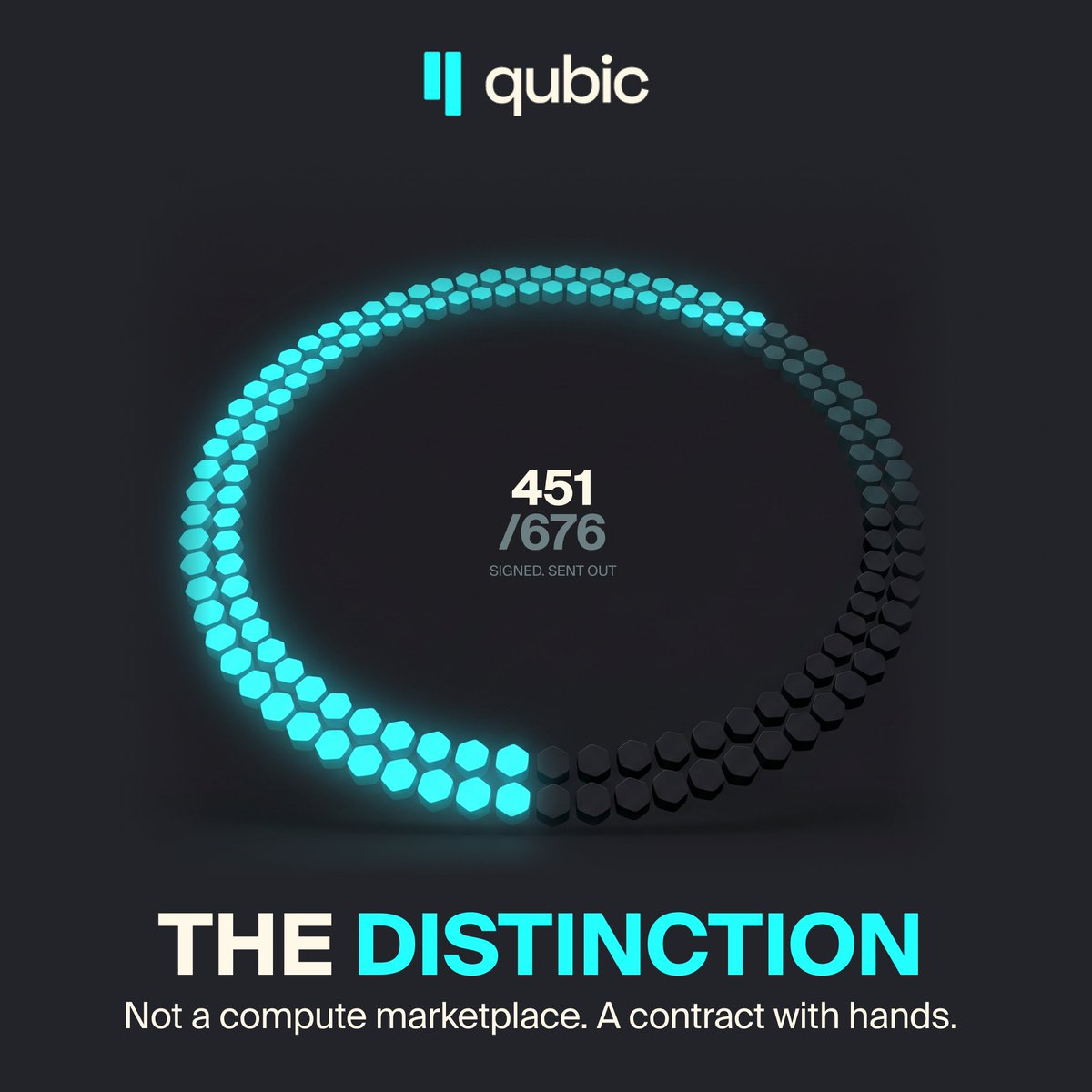
And nothing leaves the chain until 451 of the 676 Computors independently sign it.
The receiving system checks those signatures and knows the network actually approved the action.
Not one server.
Not a multisig of insiders.
Two-thirds of the network, every single time.
It is not a compute marketplace.
It is a smart contract reaching out with one instruction the whole network agreed to.
For years, a Qubic smart contract could think but it could not touch.
It could run any logic you gave it. But everything stayed trapped inside the chain.
It could not move a coin on another network.
It could not tell an outside system to do anything.
That changes in about 8 weeks.
Final piece of a three-part system. 🧵
Doge Mining Revenue Report | Epoch 215
Mining Sample: qMine ASIC Farm
Revenue per GH/s per day:
Mining DOGE + LTC via Qubic
→ $0.632 / GH/s
Mining LTC + DOGE on traditional pools
→ $0.402 / GH/s
That's +$0.230/day per GH/s.
57% more revenue on the same hardware.
Weekend project idea.
If you have ever wanted to actually mine Qubic instead of just reading about it, the Qubic Mining Academy just got a refresh, and it now walks you through pointing an ASIC miner at a Qubic pool for Dogecoin.
It is free and written in plain language. What the hardware is doing, how the pool works, where the rewards come from, and the settings that keep you from wasting power. No prior experience assumed.
The reason it is worth your Sunday: mining on Qubic is not busywork.
The same machine earning you rewards is doing real computation for the network.
You are not burning electricity to prove a point. You are putting it to use.
SpaceX filed to go public last month, and the paperwork is a useful tell about where the market is heading.
18,712 Bitcoin sitting on the balance sheet. A payments business growing inside X. A serious push into AI compute. Three bets on the same convergence the whole industry keeps talking about - crypto, AI, and infrastructure - now laid out in black and white for public investors to price.
But look at how it is built. Bitcoin treasury in one box. AI compute in another. Payments in a third. Three separate businesses stapled together under one roof, each to run on its own.
Qubic was designed the other way around. The mining that secures the network is the same computation that trains AI. There is no separation between a crypto operation and an AI operation, because Useful Proof of Work is a single mechanism that produces both at once.
The largest companies in the world are now spending billions to bolt these pieces together. Useful proof of work had them fused from day one.
In 1904 a psychologist noticed something strange in a classroom. The kids who were good at math were also good at music. And French. And almost everything else.
Skills that should have nothing to do with each other kept showing up together. He decided there was one hidden thing underneath all of it. He called it g.
That 120-year-old idea is now the sharpest way to see what is missing in ChatGPT. 🧵
Qubic smart contracts are about to be upgraded.
Our latest Tech on Deck AMA broke down Outsourced Computation: the system that lets smart contracts send authorized instructions off-chain and act on Bitcoin, Ethereum, or any external system.
451 of 676 computors must sign before anything leaves the chain.
Testnet mock: June 17
Mainnet mock: July 1
Go live: July 29
Every blockchain has to answer one question early: where do new coins come from, and how fast.
On Qubic, new QUs are released every week. Roughly a trillion of them.
A halving is the network’s way of deciding to slow that tap down.
There is a live vote on the next halving, closing this week.
Here is what it actually means, in plain terms. 🧵
A blockchain is basically a genius locked in a room with no windows.
Hand it a problem in writing and it will reason through it flawlessly, every time, forever.
But it cannot see out.
It does not know today’s Bitcoin price, who won last night’s football match, or whether a flight actually landed. Everything it knows has to already be inside the room.
That is a real limitation.
A contract that pays out the moment a flight is delayed is useless if it can never find out the flight was delayed.
Oracle Machines are the window.
They let a Qubic smart contract ask the outside world a question, get an answer the network checks and agrees on, then act on it.
Prices. Sports results. Sensor readings.
This is not a someday feature.
Oracle Machines are live, and already doing real work: validating Dogecoin mining shares for the network.
That workload recently climbed by up to 40x across a few epochs, and the system handled it without strain.
A contract that can read reality is worth far more than one stuck guessing.
Qubic can read it.
Tomorrow: Tech on Deck, the Qubic AMA with the core team.
Wednesday, June 3 at 11:00 AM EDT | 3:00 PM UTC, live on X.
The community voted for a raw technical session and that is exactly what this is.
Outsourced compute, algorithm updates, halving mechanics, network parameters, and an open floor for the questions you actually want answered.
No softballs. Straight to the builders.