The Alliance Thesis
For decades, consumer brands have obsessed over one question.
"How do we acquire more customers?"
I think we've been asking the wrong question.
The better question is:
"Who already has the customers we want?"
Every brand is sitting on something far more valuable than inventory, distribution or advertising budgets.
They're sitting on an audience.
A Starbucks isn't just a coffee chain.
It's an audience.
A pharmacy isn't just a place to buy medicines.
It's an audience.
A premium salon isn't just a beauty destination.
It's an audience.
A gym isn't just a fitness centre.
It's an audience.
A coworking space isn't just an office.
It's an audience.
Every one of these businesses has spent years earning trust, attention and customer relationships.
Somewhere else, another brand is spending crores trying to build access to that exact same audience.
That feels incredibly inefficient.
I call this The Alliance Thesis.
Its core belief is simple:
Every brand is an audience. Every audience is a growth opportunity.
The smartest consumer brands have already started embracing this shift.
Not as sponsorships.
Not as logo placements.
Not as one-off collaborations.
But as Strategic Brand Alliances.
Think about some of the most interesting examples around us.
• SuperYou × Starbucks — A high-protein snack brand reaching premium, health-conscious consumers inside one of India's most aspirational café chains.
• boAt × Swiggy Instamart / Blinkit — Making impulse purchases possible by embedding consumer electronics into quick commerce, meeting customers where convenience matters most.
• Wakefit × Chaayos cafés (campaign-led collaborations) — Bringing a home and comfort brand into everyday lifestyle spaces where its audience already spends time.
• Decathlon × Corporate Parks & Residential Communities — Instead of waiting for consumers to visit stores, Decathlon takes products directly into communities through fitness events and experiential activations.
• Tata 1mg × https://t.co/anbWvmoySP — Healthcare and fitness naturally complement each other because they serve the same consumer journey.
• Amul × Indian Railways — One of India's most enduring distribution alliances, placing trusted food products where millions of consumers already are.
• CRED × Premium Restaurants, Cafés & Retail Brands — Turning payments into discovery by creating an ecosystem of premium consumer experiences.
None of these alliances happened because the industries were similar.
They happened because the customers were.
That's the shift I find fascinating.
We're moving from a world where brands compete for attention...
...to one where brands collaborate around shared audiences.
I believe the next decade will belong to brands that stop thinking in categories and start thinking in ecosystems.
Brands that ask:
Where does my customer already spend time?
Which brands have already earned their trust?
Which experiences naturally complement ours?
How can we create more value together than we ever could alone?
This is the problem I'm solving for brands.
Not simply brokering introductions between brands.
But building frameworks that help brands discover, evaluate, design and scale Strategic Brand Alliances.
Because I don't think these opportunities should depend on who you know.
I think they should be systematic.
Repeatable.
Measurable.
And that's precisely why I built The Bazaar.
The Bazaar is, in many ways, an extension of The Alliance Thesis.
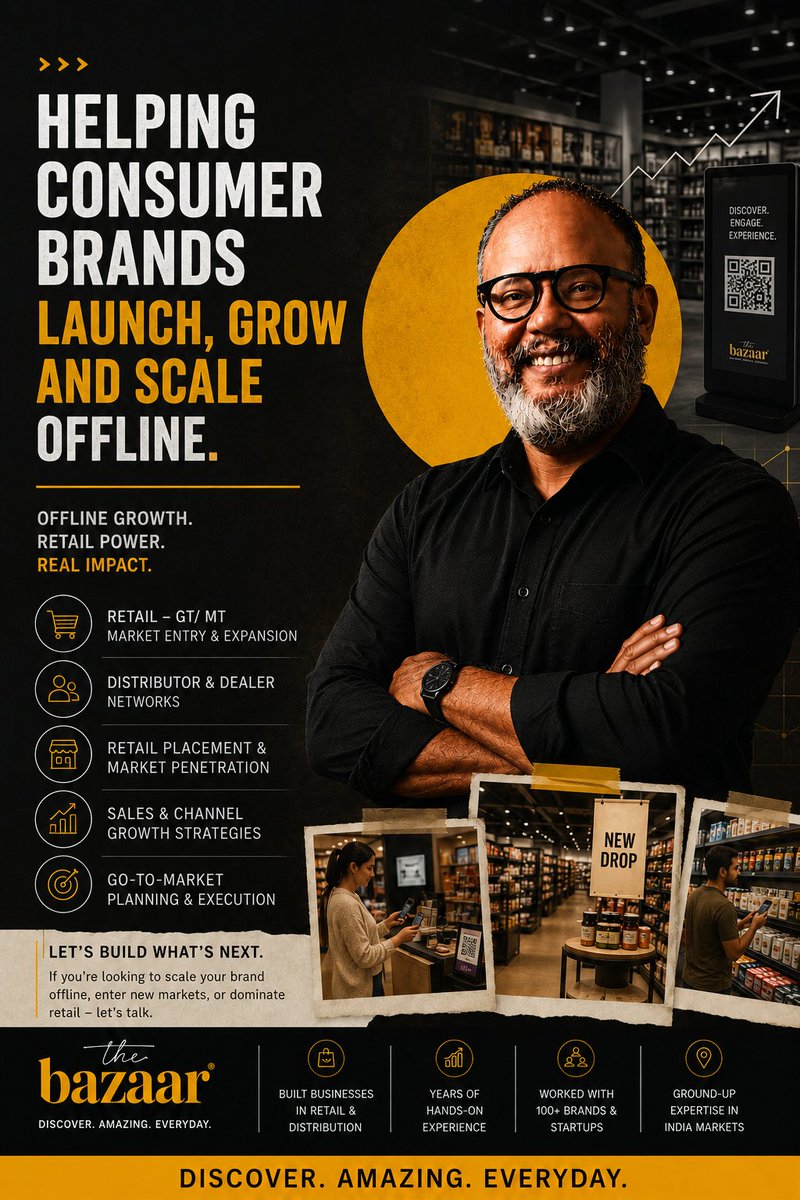
It's a platform designed to help consumer brands discover complementary businesses, unlock high-intent offline audiences, build meaningful strategic alliances, and measure the impact of those relationships.
Whether it's placing a nutrition brand inside pharmacies, a skincare brand inside salons, a fintech brand inside coworking spaces, or a wellness company inside premium cafés, the goal remains the same:
Help great brands grow by growing together.
Because I don't believe the future belongs to brands with the biggest advertising budgets.
I believe it belongs to brands with the strongest alliance networks.
Over the coming months, I'll be developing and sharing everything I'm learning through a series I'm calling The Alliance Thesis.
Frameworks.
Case studies.
Consumer behaviour.
Alliance Maps.
Brand ecosystems.
Practical playbooks.
Because I genuinely believe we're witnessing the birth of The Alliance Economy.
And I am building the operating system that powers it.
#TheAllianceThesis
#StrategicBrandAlliances #ConsumerBrands #GrowthStrategy #BusinessDevelopment #Retail #OfflineCommerce #BrandStrategy #PartnershipMarketing #TheBazaar #TheAllianceEconomy
The Future of Retail Growth
The brands that will win over the next decade won't necessarily have the biggest advertising budgets.
They'll have the best retail intelligence.
They'll know what happens after distribution.
They'll understand discovery.
They'll measure engagement.
They'll optimise every location.
They'll treat every store as a living growth channel instead of a static point of sale.
Distribution will always get your product into the building.
But discovery is what gets it into people's hands.
And that is where the real work begins.
What Happens After Your Product Gets on the Shelf?
Every founder dreams about this moment.
The first purchase order.
The first distributor.
The first retailer who agrees to stock your product.
The emails are sent.
The team celebrates.
Photos of stocked shelves are shared on LinkedIn.
And then...
Silence.
The product is on the shelf.
But nothing moves.
For decades, we've treated retail distribution as the finish line.
It isn't.
It's the starting line.
The moment your product enters a store, an entirely new set of problems begins. Problems that most businesses dramatically underestimate.
Because getting onto shelves and getting off shelves are two completely different businesses.
One is about distribution.
The other is about demand.
And demand is infinitely harder.
This Is The Problem We Built The Bazaar To Solve
The Bazaar wasn't built because retail lacked shelves.
It was built because retail lacked discovery.
Our belief is simple.
A product shouldn't become invisible the moment it reaches a store.
It should become more discoverable.
More interactive.
More measurable.
More attributable.
More valuable for both the brand and the retailer.
We help brands create sustained buzz around products inside the places where buying decisions actually happen.
Not through one-off campaigns.
Not through temporary activations.
But through an infrastructure that makes offline retail behave with the intelligence we've come to expect from digital.
Because the objective isn't simply to put products on shelves.
It's to make those shelves work harder.
The next billion-dollar opportunity for consumer brands isn't online.
It's making offline as intelligent, measurable and delightful as digital.
For decades, brands have mastered digital.
Clicks.
Impressions.
Attribution.
Personalization.
But the moment a customer walks into the real world, most of that intelligence disappears.
A retail shelf becomes invisible.
A sampling campaign becomes guesswork.
An activation becomes photos in a report deck.
We accepted this for years because there wasn't a better way.
So we built The Bazaar.
Our belief is simple: Every offline touchpoint should be measurable. Every interaction should be delightful.
Whether it's a pharmacy, salon, gym, café, college campus, coworking space or retail store, we transform physical spaces into intelligent brand experiences.
Not just with promoters.
Not just with activations.
With technology.
We add a digital intelligence layer to physical environments, enabling brands to:
• Launch products in the right markets.
• Capture valuable first-party customer data.
• Measure every customer interaction.
• Attribute engagement and conversions.
• Drive repeat purchases.
• Understand what works, where, and why.
Offline is no longer just a distribution channel.
It's a media channel.
It's a commerce channel.
It's a customer intelligence channel.
The Bazaar combines growth strategy, market expansion, retail execution, experiential activations and proprietary technology into one platform that helps consumer brands launch, grow and scale offline.
Because the future isn't about choosing between online and offline.
It's about giving the physical world the same intelligence, measurability and personalization we've come to expect from digital.
That's the future we're building.
#Retail #RetailMedia #OfflineCommerce #ConsumerBrands #FMCG #D2C #GrowthStrategy #MarketExpansion #RetailTech #FirstPartyData #CustomerExperience #BrandActivation #TheBazaar
STOP CALLING EVERYONE A DOP.
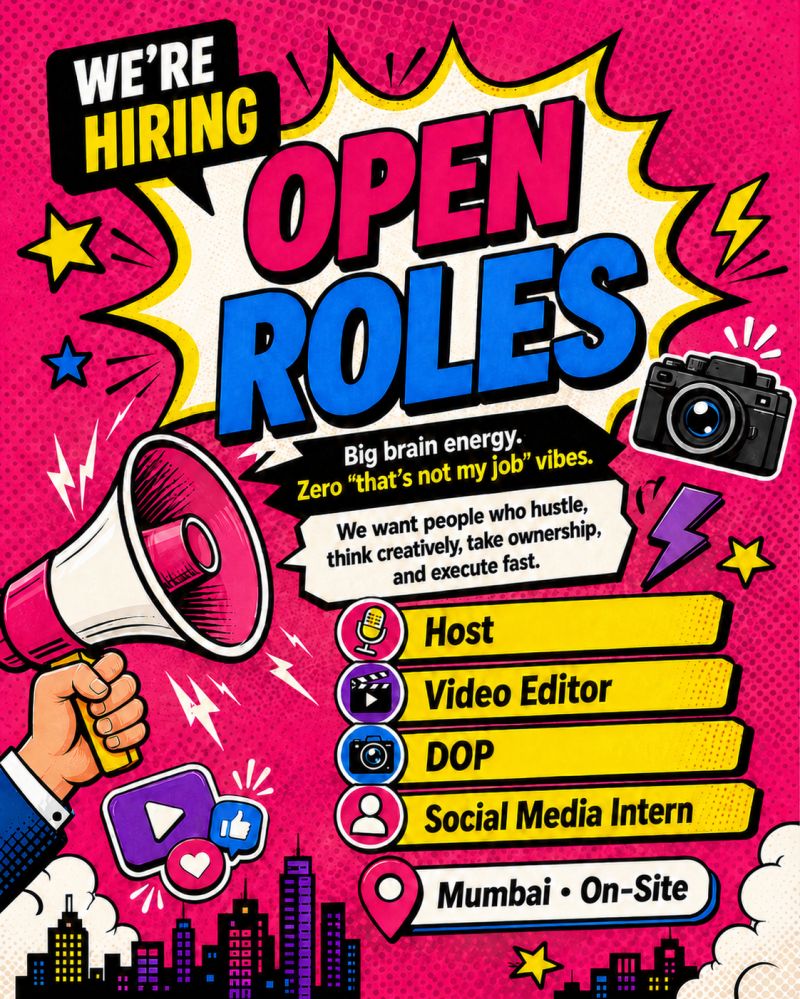
Every other hiring post today is looking for a Director of Photography.
Then you read the job description.
"Shoot reels. Edit videos. Add music. Animate captions. Manage social media. Own a camera."
You're asking for a videographer. Or a camera operator. Or a content creator.
Instead, you've advertised for a Director of Photography.
That's like needing a nurse—or at best a general physician—but putting out a vacancy for a neurosurgeon.
There's nothing wrong with being a videographer, a camera operator or a content creator. They are skilled professions in their own right.
But they are not Directors of Photography.
A DOP isn't someone who just owns a camera or puts "DOP" in their Instagram bio. It's a title earned through years- often decades - of assisting, learning, failing, observing and mastering one of the most demanding crafts in filmmaking.
A Director of Photography doesn't just shoot.
They create the visual language of a story.
They translate a director's vision into images.
They understand light, composition, movement, lenses, colour, production design, costumes, makeup, blocking and every visual decision that shapes how an audience feels.
The camera is simply the tool.
The craft is cinematography.
Some of the greatest DOPs don't even operate the camera themselves. Because operating a camera isn't the job.
Designing the image is.
Yet somewhere along the way, we've started calling everyone with a mirrorless camera or an iPhone, a Director of Photography.
Titles exist to recognize mastery.
You don't claim them.
You earn them.
And while we're at it, stop writing job descriptions asking for a DOP who can also edit, colour grade, create motion graphics, manage social media and deliver content calendars.
You're not hiring a Director of Photography.
You're trying to hire an entire production company for one salary.
This isn't directed at Voompla alone. They're simply the latest example I happened to come across. There are thousands of companies making the same mistake every single day. I don't think it's intentional - they probably just don't know any better.
But that's exactly why this needed to be said.
This isn't gatekeeping. It's about respecting a craft and a title that people spend decades earning.
Call people what they are. Respect every role.
And reserve the title Director of Photography for the people who've earned it.
Some titles should still mean something. And before you ask me why it matters, it's because I am a DOP.
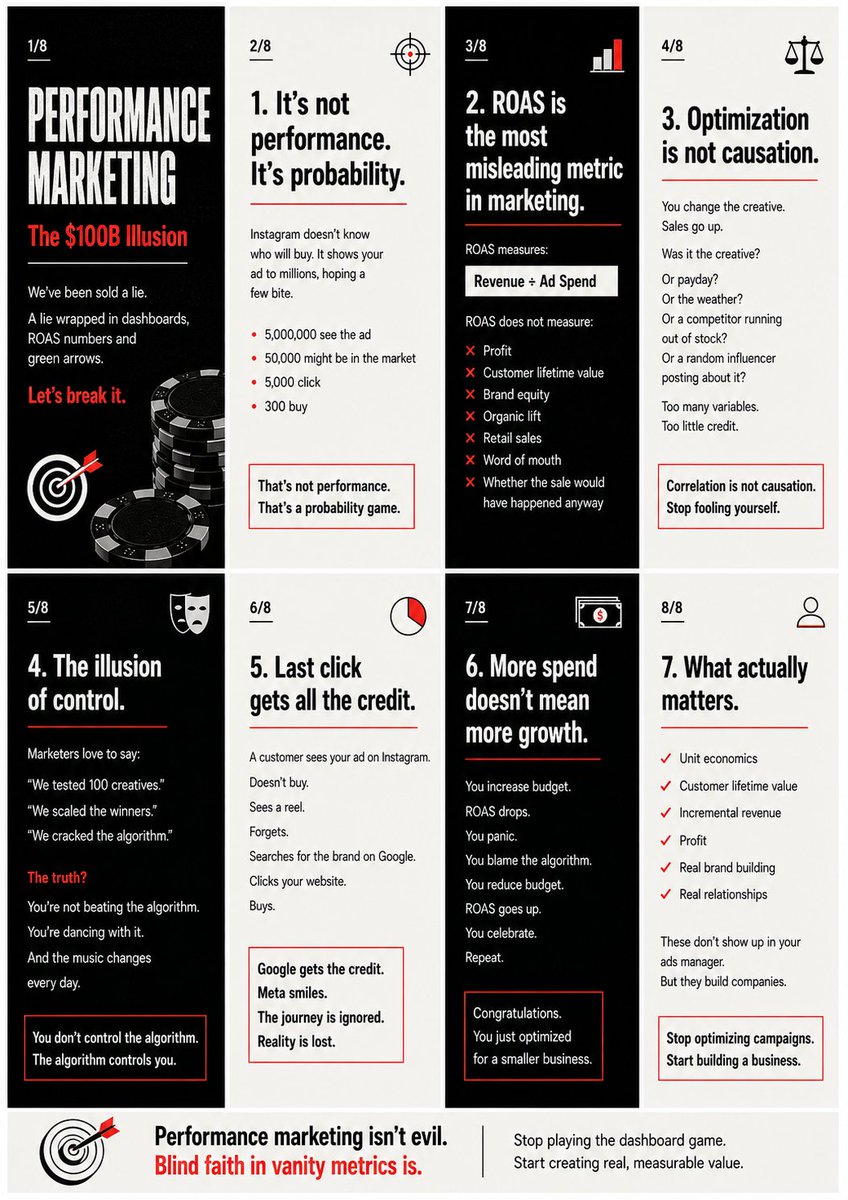
'You're not beating the algorithm, you're dancing with it,
And the music changes everyday'
Stop playing the dashboard game.
Start creating real, measurable value...
The biggest scam in modern marketing isn't fake followers.
It's ROAS.
Every agency proudly walks into a meeting saying: "We delivered a 4x ROAS."
Great. Now answer one question.
How many of those sales happened because of your ads?
Not because the customer already knew the brand.
Not because they searched for it later.
Not because a friend recommended it.
Not because they saw it in a store.
Not because they were going to buy it anyway.
Just because of your campaign.
Silence.
ROAS is one of the most misunderstood metrics in marketing.
It measures:
Revenue ÷ Ad Spend. That's it.
It doesn't measure:
Profit.
Customer lifetime value.
Brand equity.
Organic lift.
Retail sales.
Word of mouth.
Most importantly...
Incrementality.
A customer buys after seeing your ad.
Did your ad create the sale?
Or did it simply take credit for a sale that was already on its way?
Those are two completely different things.
The best marketers don't obsess over ROAS.
They obsess over one question:
"What sales would not have happened if we hadn't spent this money?"
That's incrementality.
And that's the metric that actually grows businesses.
Everything else is just a prettier dashboard.
#weekendmusings #debunking #performancemarketing