From flint stones to electricity.
From marcasite to megawatts.
World over, grids are getting old and struggling to meet demand from EVs, Data Centers and the oft-repeated “AI”.
India is no different. But India’s grid story is fascinating. Let me take you through it a 🧵
Japan is well known for aesthetics, packaging, service, and marketing. While India has one of the most diverse and under appreciated inventory of products anywhere in the world.
I propose India-Japan Institute of Manufacturing, Packaging and Marketing be setup funded by GoI with a low interest loan from Japan in various places in India.
Local small businesses must be encouraged to enroll and learn from the Japanese on service, efficiency, production, packaging, and marketing. They can also be sent to Japan to learn hands-on at a relevant place.
While Japan can train Indian students in these institutes, along with their Japanese language, to employ them in Japan as they face a manpower crunch.
It will be a win-win.
I don't think any country will be able to match local Indian products - from snacks to textiles to soaps - manufactured, packaged, exported, and marketed the Japanese way.
And it may have a positive effect on India's local economy too with better quality products and service for customers by small businesses.
@IndianEmbTokyo@JapaninIndia@PMOIndia
This is a view of India 🇮🇳 you could hardly have imagined ten years ago !
I have been traveling extensively in India and its is amazing to see how infrastructure is improving by the day:
* Trains are much more reliable and comfortable. Next year first high speed line will open.
* Airports are modern and new airports are coming up by the day - in Mumbai, greater Delhi and more.
* 25 Indian cities are constructing metros.
* Roads are drastically improving - both highways and may be most importantly the last mile connection to the hundreds of thousands of villages.
There is an old saying that if you want to get rich you should start by building a road. The infrastructure revolution in India is a marvelous step towards Viksit Bharat - the modern India.
Well done India!
Thanks @IAjitDoval_IND
btw anthropic's internal document on this literally said "we don't want it to be known that we are working on this.”
it was called project panama.
here's exactly what happened:
1: anthropic concluded that books were the cheapest way to build a world-class model because they gave claude curated facts, structured arguments, compelling stories, and writing “an editor would approve of.”
2: once anthropic decided it needed books at enormous scale, its first solution was piracy.
it downloaded 7m+ books from online libraries including libgen. the judge later wrote that although anthropic had legal ways to buy them, it chose piracy to avoid what dario amodei called the “legal/practice/business slog.”
3: that piracy created a massive legal risk.
so in february 2024, anthropic hired tom turvey, the former head of partnerships for google books, to find a legally safer way of obtaining “all the books in the world.”
4: turvey first contacted major publishers about licensing their catalogs.
those attempts didn’t produce agreements, so anthropic chose a route that required no publisher permission: buying millions of physical books through distributors and used-book retailers.
5: within about a year, anthropic spent tens of millions acquiring and scanning millions of books, including many rare and 1/1 titles. one vendor proposal targeted 500,000 to 2 million books in six months.
6: to scan that many books within months, the vendors physically dismantled them.
a hydraulic cutter removed each spine. the pages were trimmed to size, fed as loose sheets through high-speed industrial scanners, and converted into searchable PDFs. the paper remains were then sent for recycling.
7: these PDFs were fed into claude as training data.
the complete collection became a private, searchable anthropic library that the company planned to “store forever.” the scans aren’t available to the public and were never open-sourced.
International media in the last 30 days: "India Hunger strike", "protests in India", "Floods in India."
🇮🇳India in the last 30 days:
July 19, 2026: Indian Gen-Z team wins 4 gold medals (top rank) at International Chemistry Olympiad and medals at the International Biology Olympiad.
July 18, 2026: Young Indians working at Skyroot Aerospace successfully launch Vikram-1, India’s first privately developed orbital-class rocket, from Sriharikota, placing payloads into Low Earth Orbit.
July 17, 2026: PM Modi flags off India’s first indigenous hydrogen-powered passenger train (10-coach set) from Jind station, Haryana, on the Jind-Sonipat route as an inaugural service.
July 14, 2026: DRDO completes successful military field trials of an indigenous scalable fiber-based Quantum Key Distribution (QKD) system for secure strategic communications.
July 13, 2026: Lucknow-Kanpur Expressway (63 km), India’s first barrier-free expressway with satellite-based tolling, opens to traffic.
July 12, 2026: Young Indian team wins 5 gold medals at the 56th International Physics Olympiad (IPhO 2026) in Colombia, securing joint world #1 rank.
July 11, 2026: RM Rajnath commissions INS Mahendragiri, the sixth Project 17A stealth frigate, in Visakhapatnam (~75% indigenous content).
Early–mid July 2026: Vimag Labs (Bengaluru) secures its 5th Indian patent for the Virtual Magnet Synchronous Motor (VMSM), a software-defined rare-earth-free electric motor platform.
Early July 2026: ISRO announces plans for a new Satellite Earth Station campus near Ledo in Assam to strengthen space communication in the Northeast.
Early July 2026: IIT Gandhinagar team wins a grant for developing indigenous liquid cooling plates for AI data centres, EVs, and high-performance electronics.
June 26, 2026: Nuclear heat-based hydrogen production facility (copper-chlorine thermochemical cycle) commissioned at Kalpakkam using Fast Breeder Reactor process heat.
June 24, 2026: ISRO successfully conducts hot test of semi-cryogenic engine power head at 175 tonnes thrust level.
June 24, 2026: RDSO (with ARAI) successfully conducts full-scale crashworthiness testing of LHB coaches for enhanced passenger safety.
June 21, 2026: PM Modi commissions three indigenously built warships in Kolkata: INS Dunagiri (Project 17A stealth frigate), INS Sanshodhak (hydrographic survey vessel), and INS Agray (ASW shallow water craft).
June 15, 2026: DRDO successfully flight-tests the indigenous Long Range Land Attack Cruise Missile (LRLACM) from Odisha; all objectives met.
June 10–11, 2026: DRDO conducts successful Phase-2 Ballistic Missile Defence (BMD) trials and anti-ship missile tests, demonstrating capabilities against long-range ballistic threats including ICBM-class.
Mid-June 2026: India’s defence production reaches a record ₹1.78 lakh crore in FY 2025-26.
Mid-June 2026: Maiden flight of the indigenous C-295 military transport aircraft highlighted as a major self-reliance milestone in aviation (with 40 aircraft under production in India).
June 13, 2026: First batch of women cadets trained at NDA commissioned into the defence forces. Marking the start of an women empowered era in defence.
Everyone is talking about humanoid robots.
Almost nobody is talking about the companies that will actually make money from them.🧵
#manufacturing#India#vc
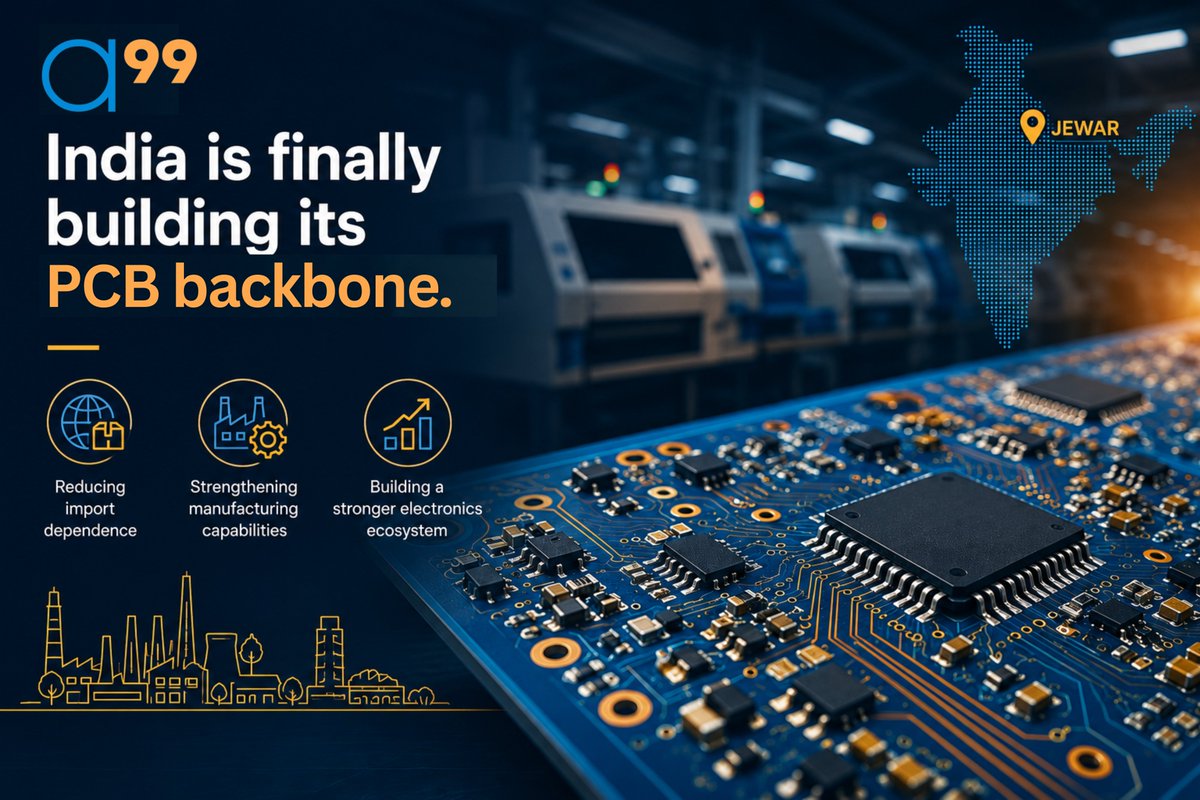
India is finally building its PCB backbone.
India imports nearly ₹40,000 crore worth of PCBs every year
and ₹6,700 crore is now being invested in new PCB and electronics manufacturing plants in Jewar, by Amber Enterprises and Ascent Circuits.
PCBs are at the heart of almost every electronic product - phones, EVs, medical devices, telecom equipment, industrial machines and more.
The more we manufacture them locally, the stronger our electronics ecosystem becomes.
Because Manufacturing works differently from software.
Every new factory creates demand for suppliers, machinery, materials, logistics, skilled talent and supporting infrastructure.
One investment creates many more.
That's how industrial ecosystems are built.
As India scales electronics manufacturing, the opportunity won't be limited to the companies making the final product.
It will extend across the entire manufacturing value chain.
At a99, we invest in early to growth stage manufacturing and infrastructure companies building that future. If you're building in this space, we'd love to hear from you.
#Manufacturing #India #PCB
What if the biggest AI opportunity isn't just in AI software?
Our Founder & Managing Partner, Vignesh Shankar, shares why power, cooling, transformers and the physical layer could define the next decade of investing, and what the US market is signalling for India.
Read more:
🔗https://t.co/jvJ5Z0TZIk
You can win in AI till you have the underlying Physical Layer. We @a99vc back companies building the data centers and industrial layers in the Physical AI side.
The companies that win the AI era won't all be building models.
Some will be building the power systems, data centres, and industrial applications those models run on.
That's a manufacturing story as much as a software story.
A recent Finshots podcast made this point and the investment implications for India are significant. 🧵
#manufacturing #india #vc
More than anything to add up to the manufacturing and infra push currently underway in the nation these skills are no brainers..an area like ship building needs 100000 welders already…i dont know if we have 100000 welding equipments in the country! Our thesis @a99vc is getting deeper and stronger with these inputs from the policy makers…and we have a told you so shrug to go with it ;)
The companies that win the AI era won't all be building models.
Some will be building the power systems, data centres, and industrial applications those models run on.
That's a manufacturing story as much as a software story.
A recent Finshots podcast made this point and the investment implications for India are significant. 🧵
#manufacturing #india #vc
@svembu Absolutely sir boring manufacturing and infra or industrial investments are the way forward for India .. we should look into to build the physical ai layer as well
India's capital goods output just grew 16% in a single month.
That's factories being built, machines being ordered, production lines being commissioned.
India's industrial decade isn't coming. It's here. 🧵
#Manufacturing#MakeinIndia#India
Rare earths and critical minerals are becoming the backbone of modern industrial power.🏭
India and the US just signed a strategic pact on critical minerals & rare earths
It has implications across semiconductors, EVs, clean energy, aerospace and defence.
A thread on why this matters and where the real gap is🧵
#CriticalMinerals #MakeInIndia #Manufacturing
I was listening to Illayaraja songs on my drive today and I realized a few things about Illayaraja and his music and why he probably is one of the greatest music directors of all time
1. The songs stay in your sub conscious memory even if you have listned to the song once, And if someone even mentions that song in passing, you remember the movie, the setting, the context, the tune everything, even if the movie had released before you were born.
OTOH you don't remember any of the songs made by Anirudh and other latest music directors
2. You will never tire of Illayaraja's songs. You can listen to them on the loop, and they still sound as amazing as they did when you listened for the first time. You never get tired of them
With today's song, as pulsating as they may be while you listen to them, you want to move on from them as quickly as possible.
3. Illayaraja ensured lyrics of a song got its due respect and position in the song. Which in turn inspired lyricists to give their best. They wrote songs with great depth and meaning, which were then elevated thru his music.
Thereforr most Illayaraja songs made you think and introspect
Today, lyrics are meant to be a background buzz, meant to be drowned by a cacophony of electronic noise and beats. So they lyricists have nowadays stopped trying. I mean what's the point of writing good lyrics, when all people care about are the beats.
4. Illayaraja never lost consistency. He was as good in 1976 as he was in 2016. He never lost his musical acumen and never sounded repetitive. Is there any music director who gave a diverse album like Hey Ram 24 years into his career? You already can't distinguish a Beast From a Vikram from a Jawaan of Ani in the 14th year of his career.
Truly Illayaraja is a maestro who was probably sent by God to make music so that plebians like us got some peace and happiness.
India's electronics manufacturing is scaling fast.⚡
But the soldering, welding, and precision assembly at the heart of it is still heavily dependent on imported automation equipment.
Productronica India 2026 just made that gap impossible to ignore. 🧵
#manufacturing #Industrials #india
Did you know that the U.S. defaulted on its sovereign obligations in 1971 when it unilaterally reneged on dollar-gold convertibility.
Russia defaulted in 1998 and 2022.
Argentina: 9 times since independence.
Pakistan: required IMF bailouts 23 times.
Greece defaulted in 2012.
And India? Zero defaults. Not even in 1991!
Yet Western investors classify India as "emerging risk" and call U.S. Treasuries the "risk-free rate."
This isn't risk analysis. This is cognitive bias a la Daniel Kahneman's book "Thinking, Fast and Slow". Humans systematically overweight culturally proximate information while underweighting statistical patterns that don't fit our mental models.
Western strategic planners trust Western partners not because the data supports it, but because the cultural markers feel familiar.
Three facts that challenge everything about how we assess partnership risk:
FACT 1: Across 5,000 years of recorded history, India has rarely waged wars of territorial conquest. Not in 3000 BCE when the Indus Valley Civilization had technological superiority. Not in 1000 CE when Indian mathematics and metallurgy exceeded Europe by centuries. Not in 2026 when it possesses nuclear weapons and the world's 4th-largest military. Not in 2047 when it projects to be a top-two economy.
Compare: China (annexed Tibet 1950, 14 territorial disputes, South China Sea expansion). Russia (Georgia 2008, Crimea 2014, Ukraine 2022). Europe (500 years of colonial conquest across three continents). U.S. (military interventions in 20+ countries since 1945).
This pattern is observable strategic behavior anchored in the Arthashastra, Kautilya's 2,300-year-old treatise arguing that short-term territorial expansion undermines the systemic conditions for sustained prosperity. The concept of "mandala" (circle of states) recognizes that each power's long-term interest depends on system equilibrium.
FACT 2: India has never defaulted on debt, treaties, or security guarantees since independence in 1947. The most revealing test: 1991 balance of payments crisis. Reserves fell to $1.2 billion = just three weeks of imports. Default appeared certain. Instead, India implemented painful reforms, honored every obligation. India didn't use political costs as an excuse to default. Commitments were kept.
This behavior isn't accidental. It's anchored in the Sanskrit concept of ṛṇānubandhaḥ, that obligations are metaphysically binding across time. The Mahabharata established 2,000 years ago that rulers who break commitments violate cosmic order and create systemic instability.
Philosophy became institutional architecture: investment-grade credit through multiple crises, $600B forex reserves (6th globally), zero defaults on government securities across 77 years.
FACT 3: During COVID-19, India exported 300 million vaccine doses to 110 countries while its own vaccination was incomplete. 96 countries received doses free through "Vaccine Maitri."
Meanwhile: U.S. ordered 1.2 billion doses for 330 million people (4x population). EU ordered 4.6 billion for 450 million (10x population). Canada ordered 400 million for 38 million people (10x population).
Western nations didn't begin international distribution until domestic targets were substantially met.
The distinction? India's Economic Survey 2020-21 quoted Sanskrit: "āpadā hi prāṇa rakṣā hi dharmasya prathama aṅkuraḥ" (in calamity, protecting life is the first duty). Not Indian life. Life in general.
This aligns with Vasudhaiva Kutumbakam (the world as one family), not as rhetoric but as policy. India supplies 60% of global vaccines and 20% of generic medicines normally, maintained production during its own constraints, built digital public infrastructure (UPI processes more transactions than all nations combined) and offers it open-source to developing countries.
WHY THIS MATTERS NOW:
Every CFO, sovereign wealth fund, and policymaker is asking: "Who can we depend on for the next 50 years?"
Ukraine shattered the illusion that economic integration prevents aggression. COVID exposed single-source dependencies. Taiwan reveals semiconductor concentration risk.
The global economy is re-optimizing from efficiency to trust.
But here's where Kahneman's research becomes critical: most strategic planners are making decisions using "System 1" thinking (fast, intuitive, pattern-matching based on cultural familiarity) rather than "System 2" thinking (slow, analytical, data-driven assessment of long-horizon behavioral patterns).
The result? Systematic mispricing of partnership risk.
Strategic planners face a choice:
- China: manufacturing efficiency + demonstrated willingness to weaponize interdependence (sanctions on South Korea over THAAD, Australia over COVID inquiry, Lithuania over Taiwan, Belt & Road debt traps in 60+ countries)
- Russia: resource access + repeated weaponization (invaded Ukraine despite economic integration, cut gas to freeze European cities)
- U.S.: innovation + extraterritorial enforcement (billions in fines on European banks for transactions legal in Europe, CLOUD Act overrides local privacy laws, "America First" tariffs hit Canada, Mexico, EU alongside rivals)
- India: 5,000-year track record of territorial restraint + zero defaults + systemic thinking during crises +
challenges (infrastructure gaps, bureaucratic complexity, uneven state capacity).
The question isn't perfection. It is: which risk profile aligns with 50-year partnership objectives when analyzed through System 2 rather than System 1 thinking?
THE UNCOMFORTABLE TRUTH:
If India's pattern suggests lower long-duration risk, why is trust in India still "emerging"?
Kahneman would predict exactly this outcome. Three cognitive biases at work:
1. **Availability bias:** We assess risk based on vivid, recent, culturally proximate information. NATO expansion incorporated Poland, Czech Republic, Hungary rapidly because they registered as "European." India's democracy, rule of law, English-language business environment gets discounted because cultural markers differ.
2. **Confirmation bias:** Western institutions have decades of frameworks built around current partnerships. New data contradicting established models gets filtered out rather than integrated.
3. **Status quo bias:** Existing relationships are comfortable. The U.S.-Europe alliance, U.S.-Japan partnership, Five Eyes intelligence sharing operate with established protocols. Structural change requires crisis-level disruption to overcome inertia.
The crisis arrived.
For boards evaluating long-term partnerships—semiconductors, pharmaceuticals, digital infrastructure, maritime security, critical minerals—India presents a risk profile worth systematic, System 2 analysis.
Because of demonstrated behavior across sufficient time horizons to be statistically meaningful.
In an era of fragmentation, weaponized interdependence, and trust deficits, historical patterns become predictive indicators.
Kahneman spent decades showing that intuitive judgments systematically diverge from statistical reality. Strategic partnership assessment is no exception.
The question is: Are we assessing risk based on data, or based on what feels familiar?
In the 21st century, power matters. But trust may matter more.
And trust should be measured by track record, not by cultural proximity.