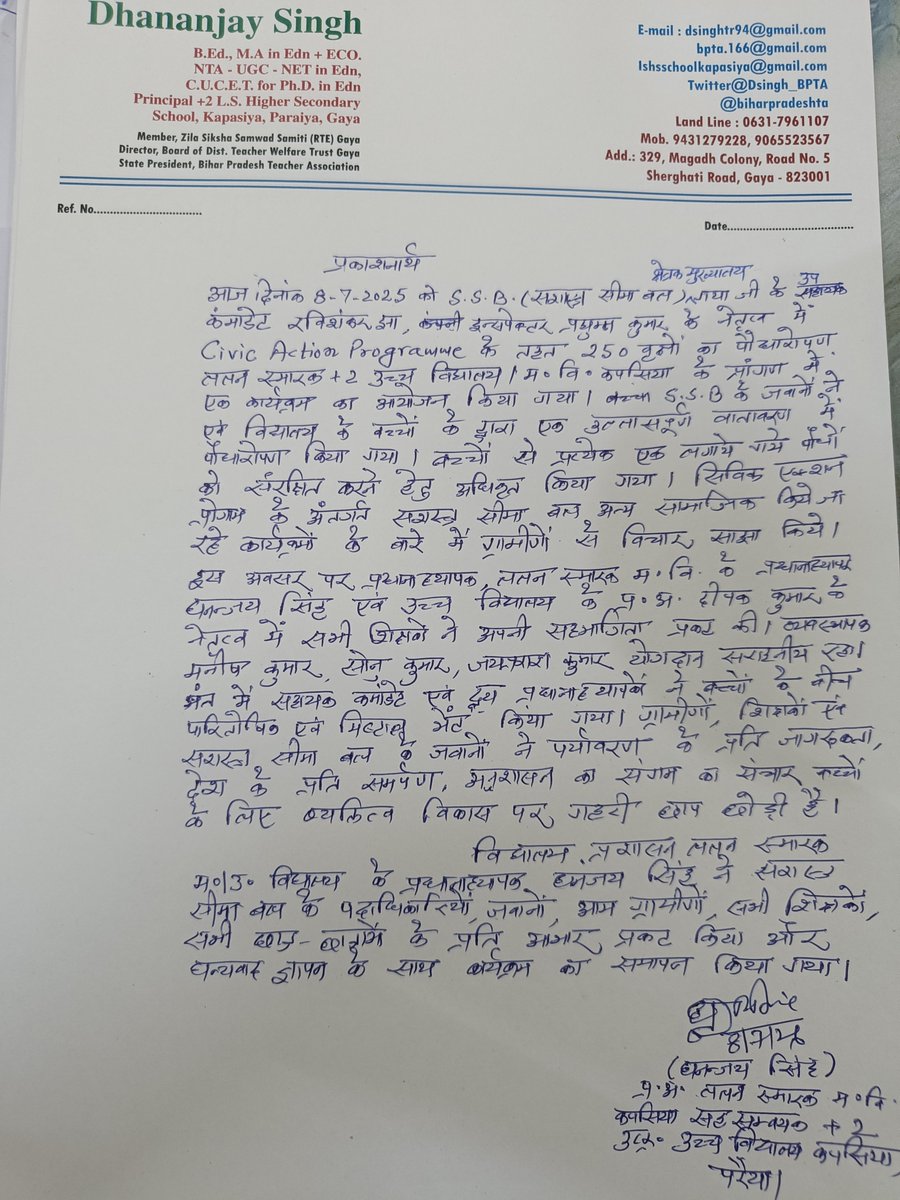
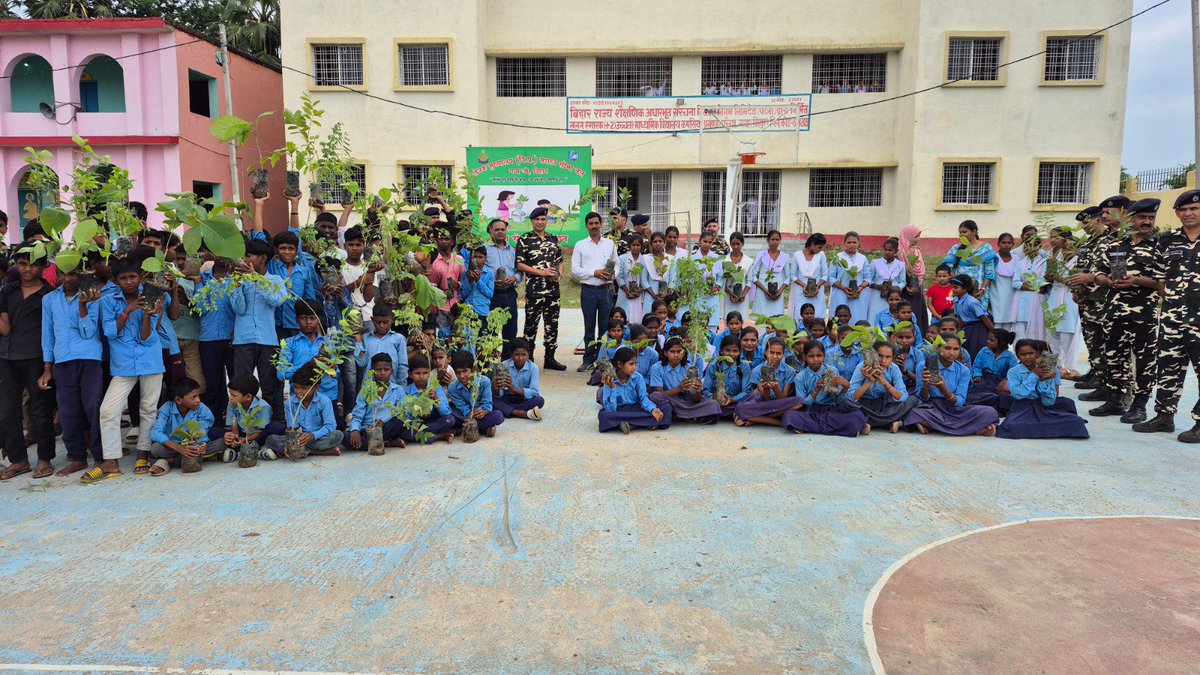
SSB, Regional HQ Gaya Ji Deputy Commandant Ravishanker Jha and his team planted 250 plants in ground of L. S.UHS Kapasiya Paraiya under Action Civic Programme with HM and children villagers to protect environment #SSB@BiharEducation_#HomeMinistryGOI@gaya_dm@gaya_deo
India's Next Growth Story Starts with Economic Resilience 🇮🇳
Beyond the West Asia Crisis: India's Time to Lead
Economic Resilience, Strategic Vision. Advocating Evidence-Based Growth for a Stronger India
Global crises test economies. Strong institutions build resilient nations.
As an economist and educationist, I believe India's future will not be defined by geopolitical uncertainty alone, but by fiscal discipline, energy security, modern agriculture, innovation, and inclusive development.
Bihar can become an important growth engine through agro-processing, MSMEs, logistics, digital entrepreneurship, and quality education.
The next decade belongs to nations that prepare today. India has the opportunity to lead.
💬 What do you think should be India's top economic priority over the next 10 years?
🇮🇳 Views are personal and based on economic analysis.
#IndianEconomy #EconomicGrowth #EconomicResilience #PublicPolicy #EnergySecurity #MSME #Exports #BiharDevelopment #Education #Leadership #Economicst #DhananjaySinghVision
Building Institutions That Stand With Teachers: Leadership Beyond Position
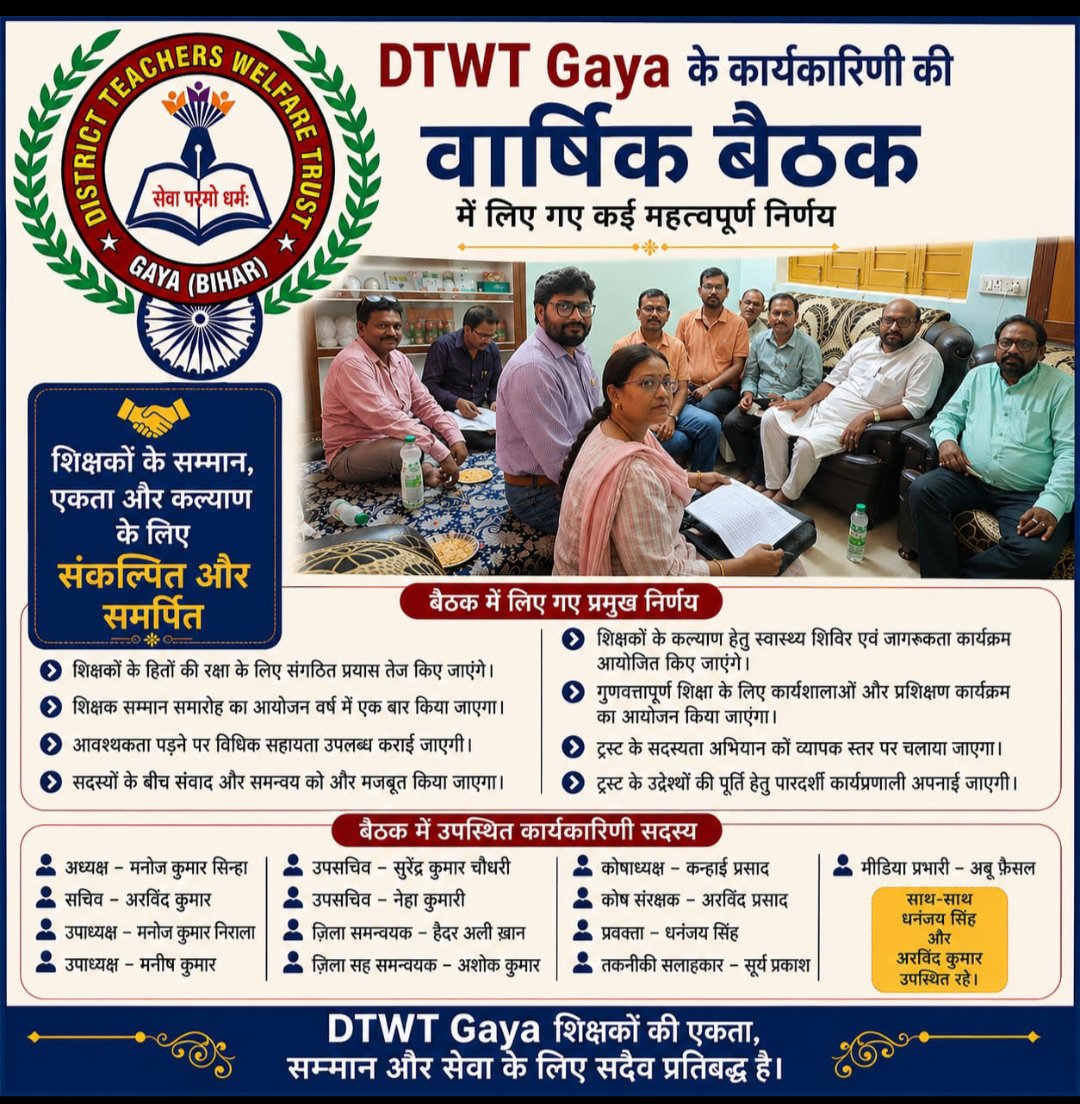
I feel deeply encouraged to share that the recent Working Committee Meeting of District Teacher Welfare Trust Gaya received extensive coverage across National, State, and Local newspapers.
As Spokesperson and Trustee, this recognition is more than media visibility — it reflects growing public trust in an institution committed to supporting the teaching community during their most critical moments.
Our recent executive meeting focused on strengthening the Trust’s long-term commitment toward teacher welfare and institutional development.
Major Decisions Taken in the Meeting
✅ Strengthening emergency financial assistance mechanisms for teachers facing accidents, illness, and crisis situations.
✅ Expanding welfare outreach so support reaches more educators and their families when they need it most.
✅ Organizing a special Teachers’ Honour Ceremony to recognize outstanding contributions made by educators to society.
✅ Expanding membership and building a stronger institutional support network across the district.
✅ Reinforcing transparency, accountability, and service-driven governance in welfare operations.
Why This Matters
Teachers are the foundation of nation-building.
An institution that protects, supports, and respects educators ultimately strengthens the future of society itself.
At District Teacher Welfare Trust Gaya, our mission is simple:
“Stand beside teachers not only in classrooms, but also in moments of crisis, dignity, and recognition.”
My Leadership Commitment
Serving as Spokesperson and Trustee has reinforced my belief that meaningful leadership is not about titles.
It is about:
• Building trusted institutions
• Creating social impact through governance
• Strengthening stakeholder confidence
• Serving communities through structured welfare systems
• Driving sustainable long-term change
I remain committed to contributing toward stronger institutional leadership, education welfare governance, and community-driven social development.
Grateful to all members, stakeholders, and the media for amplifying this mission.
Dhananjay Singh
Spokesperson & Trustee
District Teacher Welfare Trust Gaya
Working for Teacher Welfare | Institutional Governance | Social Leadership | Education Development | Community Impact
Suggested Hashtags (important for Google reach)
#DhananjaySingh
#TeacherWelfare
#DistrictTeacherWelfareTrust
#EducationLeadership
#CorporateGovernance
#SocialLeadership
#InstitutionBuilding
#TeacherEmpowerment
#PublicLeadership
#CommunityDevelopment
#BiharEducation
#LeadershipMatters
#GovernanceExcellence
Strengthening Institutional Leadership Through Service: Building a Teacher Welfare Governance Model in Bihar
As Trustee & Spokesperson of District Teachers Welfare Trust Gaya, I strongly believe leadership is measured not by designation, but by the institutions we build to support people in their most vulnerable moments.
During our Annual Executive Board Meeting at District Teachers Welfare Trust Gaya, we reaffirmed our commitment to strengthening welfare systems for the teaching community in Bihar.
Key Resolutions Adopted
✅ Emergency Welfare Support
Immediate financial and physical assistance for teachers facing accidents, illness, and emergencies.
✅ Teacher Health & Wellness Programs
Health camps and awareness initiatives focused on preventive healthcare.
✅ Legal Protection Framework
Structured legal support for teachers facing professional and service-related challenges.
✅ Capacity Building & Professional Development
Workshops and institutional learning programs to strengthen education quality and leadership capability.
✅ Transparent Governance Framework
Commitment toward accountability, ethical governance, and financial transparency.
✅ Membership Expansion Strategy
Expanding outreach to build a stronger welfare-driven support ecosystem for educators.
Why It Matters
A strong education system needs more than policy reforms. It requires institutions that protect educators, preserve dignity, and build collective responsibility.
I firmly believe:
“Corporate Governance is not limited to boardrooms. Real governance begins where institutions create accountability, transparency, and human-centered support systems.”
Teacher welfare is not charity — it is an investment in strengthening India’s educational future.
Dhananjay Singh
Trustee & Spokesperson — District Teachers Welfare Trust Gaya
Governance Advocate | Education Reforms Observer | MSME Export Mentor | Aspiring Independent Director
#CorporateGovernance #IndependentDirector #TeacherWelfare #EducationLeadership #InstitutionBuilding #BiharEducation #LeadershipDevelopment #SocialImpactLeadership #DhananjaySinghVision
🇮🇳 From Survival to Global Leadership: Why India’s MSMEs Must Shift from “Small Business Thinking” to “Global Enterprise Building”
India’s economic future will not be defined only by large corporations. The real engine of long-term national growth lies in strengthening the ecosystem of Micro, Small & Medium Enterprises (MSMEs) — the sector that contributes nearly 30% of India’s GDP, 45% of exports, and millions of jobs.
The recent MSME Growth Conclave 2026 highlighted a crucial reality:
Indian MSMEs can no longer depend on low-cost production and government support alone. The next phase of growth demands innovation, technology adoption, scalability, and global competitiveness.
The New Growth Formula for Indian MSMEs
1️⃣ Innovation Must Replace Imitation
For decades, many businesses have focused on “me-too products” — copying existing demand patterns.
The future belongs to enterprises that create original products, solve unmet consumer needs, and build intellectual property (IP).
Innovation creates market leadership. Replication creates dependency.
2️⃣ Technology Adoption is No Longer Optional
To compete globally, MSMEs must invest in:
Automation systems
AI-driven business intelligence
Digital supply chains
Energy-efficient production systems
Data-based productivity monitoring
The businesses that digitize early will dominate future markets.
3️⃣ Build Scalable Businesses, Not Just Local Businesses
A major weakness in India’s MSME ecosystem is that many enterprises remain limited to regional markets.
Future-ready businesses should focus on:
National distribution networks
Export-oriented production
Global quality certification
Brand building beyond domestic markets
Scale creates resilience.
4️⃣ Financing Must Become Easier and Smarter
One of the biggest challenges remains:
Difficult access to credit
Bureaucratic loan approvals
Low awareness about funding schemes
India needs a stronger MSME financing ecosystem where capital reaches innovators faster.
5️⃣ Skill Development is the Real Competitive Advantage
Indian MSMEs face three structural challenges:
✔ Skilled manpower shortage
✔ Rising electricity and operational costs
✔ Supply chain uncertainty
Without continuous workforce upskilling, industrial growth will slow down.
Policy Perspective: What India Must Do Next
To make India a manufacturing superpower:
Strengthen regional manufacturing clusters
Incentivize innovation-based entrepreneurship
Simplify credit and compliance systems
Promote MSME exports aggressively
Link skill development with industrial demand
Support first-product innovation rather than copycat manufacturing
Final Economic Insight
The future of Indian industry will not depend on how many MSMEs India creates.
It will depend on how many MSMEs evolve into globally competitive enterprises.
India must now transition from:
“Small Business Economy” → “Innovation Driven Global Enterprise Economy.”
That transformation will define whether India becomes merely a large market or a true global manufacturing leader.
Graphic Summary (for post/carousel)
📊 INDIA MSME TRANSFORMATION MODEL
🔹 Innovation > Imitation
🔹 Technology > Manual Processes
🔹 Scale > Local Limitation
🔹 Exports > Domestic Dependency
🔹 Skills > Cheap Labour Advantage
🔹 Global Competitiveness > Goal #MSME #StartupIndia #GlobakCompetitive #IndianEconomy #DigitalTransfirmation #PolicyAnalysis
Bihar Teacher Transfer Policy 2026 is a governance reform, not just a transfer policy.
✔ Supports NEP 2020
✔ Strengthens RTE compliance
✔ Improves teacher distribution
✔ Promotes transparency through online system
Needs improvement in:
• Rural incentives
• Performance-based transfer
• Better grievance system
If implemented well, Bihar can become a national education reform model.
#EducationPolicy #Bihar #NEP2020 #TeacherReform https://t.co/CMhC4m0arL
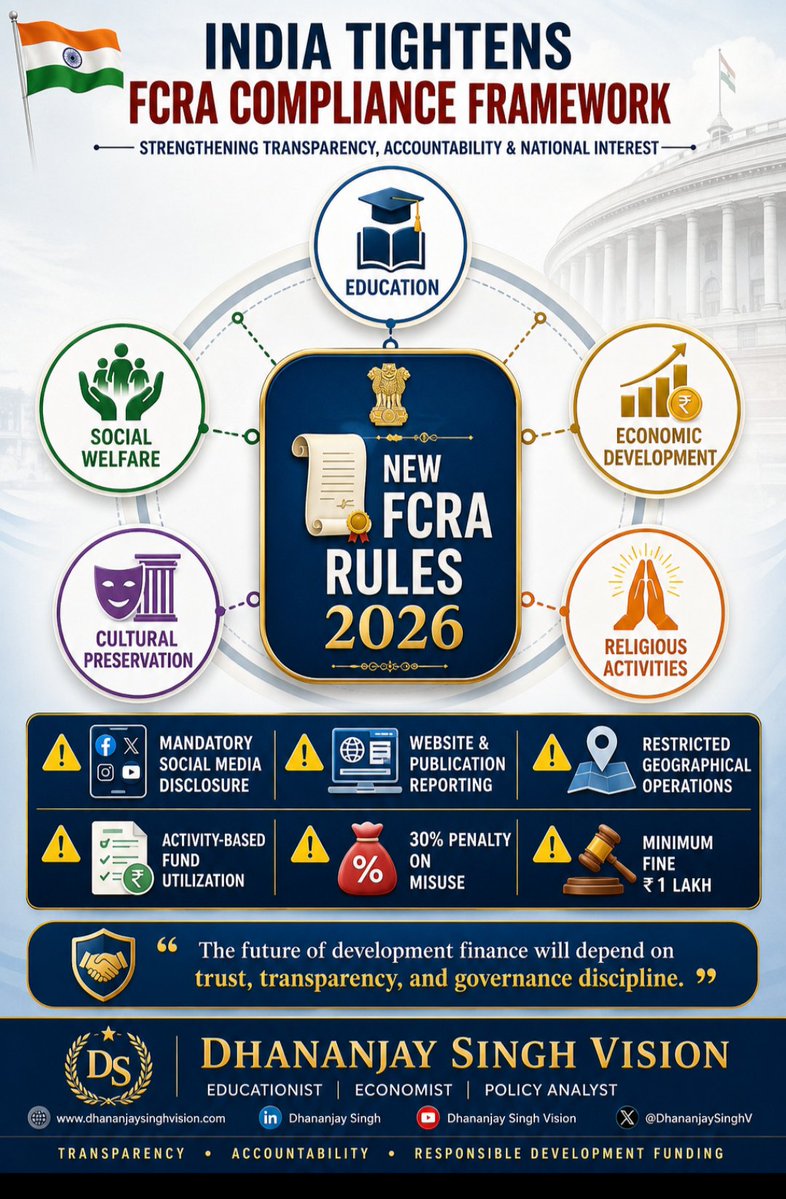
India tightens foreign funding regulations under FCRA.
Greater transparency, stricter accountability, higher penalties for misuse.
A major step toward balancing development funding with national interest.
The future belongs to institutions built on trust and governance discipline.
#FCRA #IndiaPolicy #Governance #NGOCompliance #Economy #PolicyReforms
India’s Export Future Will Be Decided by State Competitiveness, Not Just National Policy
India’s journey toward becoming a $1 Trillion Goods Export Economy by 2030 is no longer only a national ambition — it has now become a state-driven development challenge.
The recently released NITI Aayog Export Preparedness Index (EPI) 2026 provides a critical roadmap for understanding how prepared Indian states are to contribute toward the vision of Viksit Bharat 2047.
What Exactly Does EPI 2026 Measure?
The index evaluates how effectively Indian states are building an ecosystem capable of driving sustainable export growth through four critical pillars:
✅ Business Ecosystem (40%)
Ease of doing business, industrial ecosystem, business-friendly policies, and investment climate.
✅ Export Infrastructure (20%)
Quality of logistics, transport systems, ports, warehousing, connectivity, and trade support infrastructure.
✅ Policy & Governance (20%)
Government efficiency, institutional support, policy implementation, and regulatory framework.
✅ Export Performance (20%)
Actual export growth, international competitiveness, and market diversification.
Why This Report Matters for India’s Economic Future
India has set an ambitious target of reaching $1 Trillion in Goods Exports by 2030.
But this target cannot be achieved through central policy initiatives alone.
The future depends on how effectively states create localized export ecosystems that empower entrepreneurs, manufacturers, MSMEs, and global supply chains.
The report clearly indicates one important reality:
“Export growth is no longer just a trade issue — it is now a measure of governance quality.”
Key Strategic Message for States
States that invest in:
• Better industrial infrastructure
• MSME competitiveness
• Simplified regulations
• Faster logistics networks
• Export-oriented policy reforms
…will emerge as the real growth engines of the Indian economy.
My Policy Observation
India’s next phase of economic transformation will not be decided in Delhi alone.
It will be shaped in state capitals, industrial clusters, export parks, and MSME ecosystems.
If India truly wants to achieve the vision of Developed India 2047, every state must begin thinking like an export economy.
Stronger States → Stronger Exports → Stronger India.
🇮🇳 The race for becoming a developed nation has already begun — and exports will define the winners.
Hashtags
#ExportGrowth #IndianEconomy #MSMEExports #NITIAayog #ExportPreparednessIndex #ViksitBharat2047 #EconomicPolicy #MakeInIndia #AtmanirbharBharat #GlobalTrade #DhananjaySinghInsights
🇮🇳 India’s MSME Transformation Story: Policy Reforms Are Meaningful Only When Entrepreneurs Understand Them
India’s MSME sector contributes significantly to employment generation, exports, innovation, and economic development. Over the years, the Government has introduced several digital policy initiatives to strengthen the ecosystem and make support systems more accessible.
10 Important MSME Initiatives Driving Change
📌 Udyog Aadhaar – Simplified online registration system.
📌 MSME Databank – Direct policy monitoring and benefit delivery.
📌 My MSME App – Mobile-based access to schemes and applications.
📌 Technology Center Program – Technical support for industrial growth.
📌 MSME Sampark – Platform connecting enterprises with skilled manpower.
📌 DBT (Direct Benefit Transfer) – Faster subsidy transfer without delays.
📌 Digital Payments – UPI-led transparent payment ecosystem.
📌 MSME Sambandh – Better coordination between ministries and enterprises.
📌 e-Samadhan – Online grievance resolution system.
📌 MSME Samadhaan – Protection against delayed payments.
My Professional Observation
Despite multiple progressive reforms, the biggest challenge remains awareness and implementation at the grassroots level.
Many entrepreneurs are still unable to fully benefit because information often does not reach the last mile.
As someone working closely in policy understanding and MSME development, I strongly believe:
“Government Schemes create opportunities, but informed entrepreneurs create economic transformation.”
India’s future growth depends on how effectively we empower our MSMEs with knowledge, policy awareness, digital adoption, and global competitiveness.
Supporting MSMEs is not just economic policy — it is nation building.
— Dhananjay Singh
MSME Export Mentor | Economist | Educationist | Aspirant Independent Director
#MSME #MSMEIndia #DigitalIndia #StartupIndia #ExportGrowth #PolicyReforms #Entrepreneurship #EconomicDevelopment #MakeInIndia #BusinessLeadership
The Hidden Side of Online Shopping: Convenience Comes with Responsibility
In today’s digital economy, online shopping has become a daily habit, but behind many attractive offers lies a business model that most customers hardly understand — Drop Shipping.
Drop Shipping allows sellers to market products without keeping any inventory. While it has opened new opportunities for entrepreneurs, it has also created serious concerns for consumers.
⚠️ Major Risks Every Online Buyer Should Know:
✅ No Direct Accountability – The seller may never physically handle the product.
✅ Fake or Misleading Listings – Attractive advertisements often hide poor product quality.
✅ Delayed Deliveries & Refund Issues – Customers face uncertainty when multiple parties are involved.
✅ Data Privacy Concerns – Personal and payment details may pass through unknown intermediaries.
✅ Counterfeit & Low-Quality Products – Buyers may unknowingly receive duplicate or substandard goods.
Digital Growth Must Be Matched with Consumer Protection
E-commerce is transforming global trade, but transparency, trust, and accountability must remain non-negotiable.
Before clicking “Buy Now”, every consumer should ask:
“Who is the real seller behind the product?”
In the age of digital commerce, awareness is the strongest consumer protection.
Remember:
Low Price does not always mean Smart Purchase.
Convenience should never compromise Consumer Rights.
#Ecommerce #OnlineShopping #ConsumerAwareness #DigitalEconomy #Dropshipping #BusinessEthics #ConsumerProtection #DigitalTransformation #SmartBuying #FutureOfCommerce
India’s elderly population is rising, but pension coverage & assistance remain inadequate.
The real value of ₹200 support has sharply eroded due to inflation, while millions of seniors still remain uncovered.
India needs stronger, inflation-indexed pension reforms for dignified ageing.
#PensionForAll #SeniorCitizens #ElderlyCare #SocialSecurity #India #PublicPolicy #InclusiveGrowth #IGNAPS #DignifiedAgeing #PolicyMatters