@HunterBiden hey handsome, can you come to Balkans instead of those trumpy dumpy leeches, we have moonshine, good food, cheap cigs, pretty girls (myself included wink wink) and no crack in site!!! Also painting, I also like it 😂🔥
this app could be single handedly destroying my mental health and i would never fucking uninstall it because every few days The Transcendental Post will appear and for a brief fleeting moment our souls are freed from samsara as we gaze upon it in awe
pokušvam da proverim nešto tako što masturbiram pola sata svaki dan evo ima već četiri dana i mogu vam reći rezultati nikad bolji, javiću se ako izdržim nedelju (i/ili duže)
🚨 stop scrolling.. do you understand what a frozen bank account actually does to a $4 billion resort project..
because most people are watching the protest footage and missing the math..
Albania Land Development — the Qatari-owned company that holds the coastal land Affinity Partners needs to build — had its bank accounts seized by SPAK on June 2, 2026..
no bank accounts means no transactions..
no transactions means no construction financing can move.. not $1 billion.. not $100 million.. not a single wire..
you don't freeze the land vehicle for an environmental complaint.. you freeze it when prosecutors believe the underlying property titles are fraudulent and you're afraid the money moves before you can stop it..
and here's the part nobody's connecting..
the 2024 land reclassifications that made this project legally possible are now the subject of a criminal investigation.. the titles are under fraud review.. the bank accounts are frozen.. and the probe opened and the freeze landed within 24 hours of each other..
that's not a slow regulatory process.. that's prosecutors running..
Kushner announced this deal in August 2024.. visited the site with Ivanka in early 2026.. called it a vision for the Albanian coast..
the Senate was already scrutinizing Affinity's foreign deals before any of this..
a frozen land company with allegedly fraudulent titles and a widening criminal probe is not a permitting delay..
it's the structural end of the project as currently built.
I'll keep you updated. Turn on notifications. 🚨
nemoguće stvari gledam: žena iz frizerskog salona posadila čuvarkuće u neku ladovinu i sad ih prska fajtalcom, ja koja ne mogu to da gledam i vičem: neee, ubićete ih 😭😭😭
The French hate air conditioning.
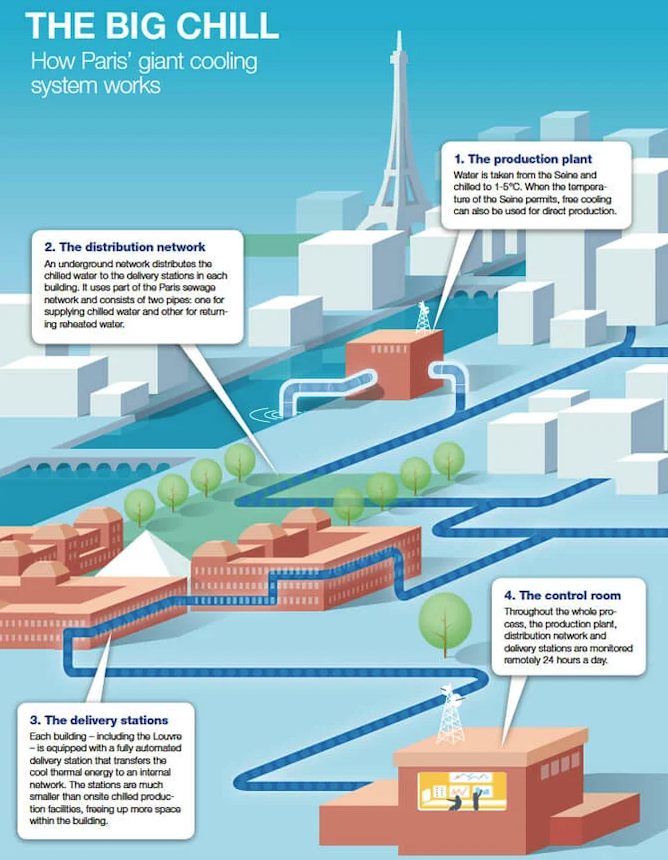
So Paris built a 120-kilometre machine under its streets for producing cold.
It’s called Fraîcheur de Paris, and it does for summer heat what district heating did for winter: centralise the problem.
Instead of every museum, office, hotel, hospital and shop bolting its own cooling plant onto the building, Paris moves cold through pipes.
The network sends water chilled to 2 to 4°C through buried supply lines. The water enters a connected building, absorbs heat through an exchange station, then returns at 12 to 14°C to be cooled again.
It essentially functions with two pipes. One carries the cold out, the other carries heat back.
The production plants cool the circuit from 12°C to 4°C. Some sites use the Seine as a heat sink. In colder periods, the system can use the river’s own temperature for free cooling, which means the machines work less and the electricity demand drops. The Seine water doesn’t become the building water. It stays separate, passing temperature across heat exchangers.
The scale is pretty strange when you see it written down though.
It's got 15 production sites, 4 storage sites, 120 km of underground network with 924 subscribers. This has resulted in 7 million square metres cooled, and 493 GWh of cooling sold.
A cold utility running beneath one of the densest cities in Europe.
The Forum des Halles has been cooled this way since 1979. The Louvre since 1986. Galeries Lafayette, Opéra Garnier, Hôtel de Ville, Station F, La Samaritaine and the National Assembly all sit on the same idea. Tourists stand in the Louvre looking at paintings while a municipal cold loop does part of the dull work below ground.
The boring part is the breakthrough.
Cold can be stored at night in chilled water or ice, then used during daytime peaks. The network is monitored from a control room with more than 125,000 control points. A delivery station inside a building takes 5 to 7 times less space than a standalone cooling installation and avoids the roof and façade clutter that turns cities into compressor farms.
That matters because conventional air conditioning solves heat by moving it somewhere nearby. In a dense city, thousands of private machines mean thousands of outdoor units rejecting heat into streets, courtyards and roofs, plus refrigerants, noise, vibration and maintenance spread across every building.
Paris’s public cooling network has a stated coefficient of performance of 4, against 3 for a wet standalone system and 2 for a dry standalone system. Against an equivalent set of autonomous installations, Fraîcheur de Paris says the network gives 100% higher energy efficiency, 35% less electricity use, 90% fewer refrigerant-fluid emissions and 50% lower CO2 emissions.
The climate backdrop is the real reason this exists.
Paris ran a full crisis exercise called “Paris at 50°C” in 2023. Météo-France’s 2050 reference trajectory for France points to heatwave days becoming five times more frequent, hot nights rising sharply in urban centres, and some local extremes around 48°C becoming possible.
The city signed a 20-year concession in 2022 with Fraîcheur de Paris, owned 85% by ENGIE and 15% by RATP. The contract is worth a projected €2.4 billion. The plan is to extend the network by 158 km by 2042, add 20 production plants and 10 storage sites, and reach more than 3,000 subscribers, including hospitals, nurseries, schools and care homes.
This is basically the infrastructure version of admitting that summer is becoming a public systems problem...