Microsoft is facing backlash after a leaked internal document reportedly included the phrase “Make people addicted” as part of a strategy for an AI assistant project.
According to the report, the document outlined plans to build habits around the product and increase daily reliance on it.
After the leak became public, Microsoft CEO Satya Nadella pushed back, saying that making users addicted is “absolutely a non goal” and adding, “Not sure what this document is or who is writing and leaking this nonsense!”
The document reportedly identified its authors, adding to the backlash
@unclebobmartin@FuturistAI 👍 I've ran into this with security scanning. Purpose built tools (for now) are much more cost effective. I run several types of scans and let an AI summarize results in a report.
Even the AIs pointed me towards this technique.
When it comes to learning AI-augmented software engineering online, Sturgeon's Law (90% of everything is crap) applies, though I think the percentage is closer to 99%. The providers I usually trust (e.g., O'Reilly) are just as unreliable as everything else. Too much of what I've learned has come from the "flailing around" school of education. I'd like to help others do things a bit more efficiently 😄.
So, I'd like to put together a curated list of great material, but I'm not sure where to start, given the lower-than-low wheat:chaff ratio. What have you found that should go on the list?
Pay vs. free isn't an issue; I'm just looking for quality. Any media will work, though it seems like books will be obsolete a microsecond after they're published. Hands-on videos that show people's workflows without hyping a product, assuming the viewer already knows as much as the presenter, or moving so fast that nobody can follow, are particularly welcome.
YouTube is rolling out a new system to identify AI-generated content on the platform.
The company said: “If a creator doesn’t specify whether they used AI, but our systems detect significant photorealistic AI use, we will now automatically apply a label.”
Creators are expected to disclose when they use AI to create realistic-looking videos or scenes. If they don’t, YouTube’s detection systems may now add the label automatically.
This is part of a broader push for transparency as AI-generated videos, voices, and images become harder to distinguish from real content.
🦔Valve raised Steam Deck prices by more than $200 across the board this week, citing rising memory and storage costs. The 512GB OLED model went from $549 to $789, and the 1TB OLED model went from $649 to $949. Valve says nothing about the hardware has changed.
The company also delayed its Steam Machine and Steam Frame launches into late 2026 because of the same shortages. Lenovo raised the Legion Go 2 price by $650 last month. Sony and Nintendo both announced PlayStation and Switch 2 price hikes earlier this year.
My Take
This is what AI-driven memory shortages look like once they reach regular consumers. DRAM and NAND prices surged through 2025 and into 2026 because hyperscalers buying for AI data centers will pay whatever it costs to secure supply, and Samsung, SK Hynix, and Micron have not expanded capacity to meet the demand. The cartel prioritized HBM memory for AI accelerators, which pulled production away from the consumer DDR5 and storage chips that go into gaming hardware.
The bill is now landing in places that have nothing to do with AI. A family buying a Steam Deck, a Switch 2, or a PlayStation 5 is paying the AI tax through the memory inside the console. The CXMT story I covered earlier this month is the only competitive pressure on the cartel right now, and it takes time to scale. Until Chinese memory hits volume, gaming hardware, smartphones, and laptops keep absorbing the cost of an AI buildout most consumers are not benefiting from.
Hedgie🤗
Uber blew through its entire 2026 Claude Code budget by April and is slowing hiring to cover the API bill. The COO admits the massive token burn isn't translating to shipped features. We didn't automate engineering. We just traded actual headcount for a while-loop with a corporate card.
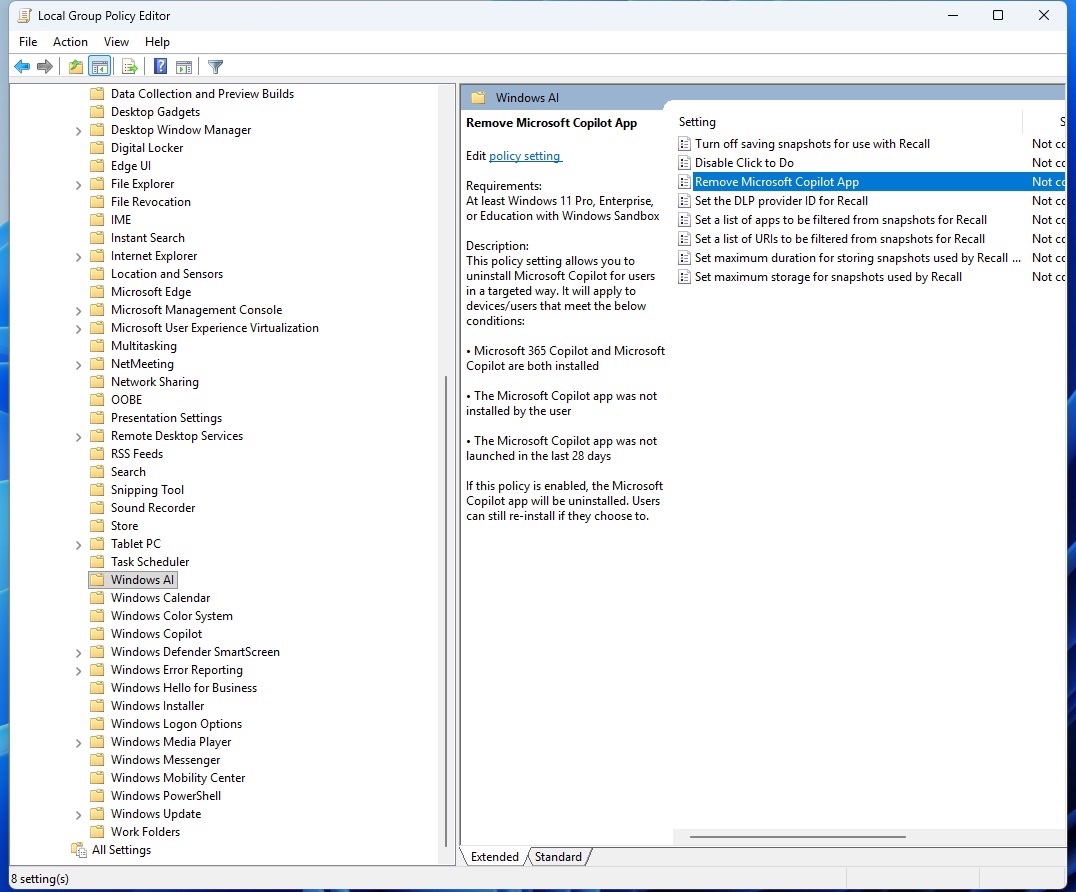
Microsoft is making it easier to remove or disable the Copilot app in Windows 11.
Users and IT admins can now use Group Policy or Registry settings to turn off Copilot or completely remove the app on supported systems.
A new Group Policy setting called RemoveMicrosoftCopilotApp allows admins to uninstall Copilot from managed Windows 11 PCs.
The setting is available under User Configuration → Administrative Templates → Windows AI → Remove Microsoft Copilot App.
Users can also disable Copilot via the Windows Registry by setting TurnOffWindowsCopilot = 1 under HKEY_CURRENT_USER\Software\Policies\Microsoft\Windows\WindowsCopilot.
The change comes after growing user demand for more control over AI features in Windows 11.
Limitations:
- The uninstall option mainly works on managed or business PCs.
- Users can reinstall Copilot later from the Microsoft Store.
- Devices where Copilot was recently used may not remove it immediately.
https://t.co/MAZcvGTRB6
@unclebobmartin@pben4ai Had issues with using "skills" as well with some UX. Best thing so far was to make a compact spec , then a new session with it.
I haven’t read the paper, but I have noticed that attempting to constrain an agent with rule files is a fools errand. They will break any rule, and overturn any stated constraint.
So I use physical constraints instead. Those constraints are things like acceptance tests, unit tests, mutation tests, crap analysis, dry analysis, property tests, etc.
The agents cannot overturn those constraints. Therefore they become zealous — sometimes too zealous — in conforming to them.
A huge illegal streaming network operating across Europe has been shut down by authorities in Italy, France, and Germany.
The service reportedly provided unauthorized access to platforms like Netflix, Disney+, DAZN, and Sky.
What’s getting most attention is that Italy is now targeting subscribers as well as the people behind the service.
>Servers and infrastructure linked to the operation were seized during coordinated raids.
>Investigators say the network used offshore systems and rotating access methods to avoid detection.
>First-time subscriber fines reportedly start at around €154.
>Repeat violations could lead to penalties of up to €5,000.
>Italy’s “Piracy Shield” system is being used to quickly block illegal streams.
>Authorities are increasing cooperation with telecom providers and financial investigators.
"Cloudflare posted record revenue, then cut 20% of its workforce. CEO Matthew Prince says AI has made an entire category of workers obsolete," per FORTUNE