🚨Weekly $BRO Giveaway is LIVE!
Today we're giving away $100 in $BRO to 4 lucky winners👀
To enter:
🔹Follow @0xNeurobro
🔹Like & RT this post
🔹Tag 2 friends to try https://t.co/HAvre29VIN
Neurodex usage is growing insanely fast & thousands are signing up weekly to explore the most advanced AI trading terminal in crypto!
Utilizing InfoFi for Infrastructure Adoption
The @superformxyz protocol, established as a foundational DeFi primitive, is positioning itself as the user-owned neobank and universal yield marketplace. Its value proposition centers on providing non-custodial, single-signature execution of complex yield strategies across multiple chains. This advanced functionality, while technically superior, inherently faces high friction barriers for mainstream DeFi adoption. The required knowledge of bridging, swapping, and vault selection typically limits its initial addressable market to sophisticated users.
To overcome this infrastructural adoption challenge, @superformxyz Labs, a company that has secured $9.5 million in funding , has initiated a decisive market strategy involving a collaboration with the InfoFi (Information Finance) sector. The chosen partner, @cookiedotfun , governed by Cookie DAO, provides a scalable mechanism for purchasing measured community attention and rapidly bootstrapping brand awareness. This strategic alignment allows Superform to leverage the InfoFi ecosystem's incentive models—specifically the Multi-Airdrop Farming (MAF) system—to create an efficient funnel of early, high-quality adopters. Prior campaigns utilizing this mechanism have demonstrated exceptional efficiency, resulting in metrics such as an 8,200% mindshare growth and the onboarding of over 17,000 new users in short timeframes.
Key Strategic Findings (Summary)
The analysis confirms the operational nature and strategic alignment of this collaboration.
The engagement is determined to be a pure distribution and marketing partnership, explicitly utilizing the Multi-Airdrop Farming (MAF) mechanism for token rewards. A review of the available architecture confirms the absence of a deep, functional technical integration where @superformxyz vaults interact directly with the Cookie Snaps earning system or underlying yield mechanisms. This model prioritizes outreach and community acquisition.
The primary objective for Superform is two-fold: first, to rapidly counter previous market criticisms regarding its lack of defined public tokenomics and underdeveloped marketing infrastructure. Second, the campaign directly supports the ongoing market entry of Superform’s highly simplified consumer product, SuperVaults (e.g., SuperUSDC). The InfoFi engagement provides an immediate, incentivized funnel designed to drive adoption metrics for this newly launched wealth management product.
The Economics of $SPAACE: Tokenomics and Superior Yield Structure
The tokenomics of @spaace_io are engineered to offer a high-quality yield stream intended to attract institutional-grade interest and long-term capital commitment, positioning the token as a superior financial asset in the NFT marketplace sector.
A. The 100% ETH Revenue Distribution Model
The defining feature of the @spaace_io tokenomics is the unprecedented commitment to redirect 100% of the platform’s revenue—derived from a fixed 2% fee on all trades—to the token holders who stake $SPAACE.
The distribution currency, Ether (ETH), is the key differentiator. Traditional yield mechanisms in Web3 often pay rewards in the protocol’s native token, which can lead to high token inflation and rapid reward dilution, damaging the token's long-term price stability. By distributing rewards in ETH, the primary liquid reserve asset of the ecosystem, @spaace_io provides a yield that is inherently more stable and resistant to immediate native token sell pressure. This structure means the token functions as an on-chain, decentralized mechanism to capture verifiable trading flow, similar to holding a direct, yield-bearing equity stake in the platform’s commercial success.
B. Mechanics of Gamified Staking and Supply Control
The $SPAACE staking mechanism is structurally designed to prioritize user commitment and mitigate token velocity, a crucial factor in maintaining a stable token price over time.
Incentives for Commitment and Penalty for Selling: The staking rewards are dynamically weighted based on the duration of the time lock selected by the staker. Furthermore, the system implements explicit financial penalties for users who subsequently sell their $SPAACE holdings. These features structurally discourage short-term, speculative trading cycles. High token velocity (rapid turnover) destabilizes market price; by penalizing rapid selling and rewarding extended time commitments, @spaace_io forces a controlled reduction in the immediately available circulating supply. This behavioral intervention is essential for supporting the token's valuation, ensuring that the promise of substantial ETH yield remains the central investment anchor.
C. Financial Metrics and Initial Valuation Context
Market analysis indicates significant capital deployment into the project at launch. Private sale valuations were estimated to be between $60 million and $100 million Fully Diluted Valuation (FDV). The expected target for the Token Generation Event (TGE) was approximately $400 million FDV, with an estimated Market Capitalization (MC) of $12 million. This high initial valuation context reflects the market’s belief in the disruptive potential of the 100% ETH distribution model and the viability of the anti-wash trading architecture.
The Macro-Structural Context of Blockchain Infrastructure in Late 2025
The Fragmentation of the Post-Merge Era
By November 2025, the blockchain landscape has evolved into a complex, fragmented archipelago of execution environments. The unified vision of a single "World Computer," championed during the early Ethereum era, has largely ceded ground to the modular thesis. This shift was driven by the inescapable reality of the scalability trilemma and the economic inefficiencies inherent in monolithic architectures. While the @ethereum mainnet remains the settlement layer of last resort—the bedrock of economic security—execution has migrated to a diverse array of Layer 2 (L2) rollups and application-specific chains (App-Chains).
However, the proliferation of L2s using the @Optimism (OP) Stack, ZK-sync hyperchains, and @arbitrum Orbit chains has created a new set of challenges. By late 2025, liquidity is fractured across dozens of nearly identical EVM-equivalent environments. This "copy-paste" scaling approach, while technically successful in lowering gas fees, has resulted in a degraded user experience characterized by constant bridging, fragmented automated market maker (AMM) liquidity, and a lack of genuine differentiation in application logic. Users are essentially interacting with the same Uniswap forks on fifty different ledgers, paying gas in fifty different bridged variations of ETH.
It is within this specific context of "EVM fatigue" and liquidity fragmentation that the @dango network emerges. Unlike the generic L2s that characterized the 2023-2024 cycle, Dango represents a distinct pivot toward specialized execution environments. By rejecting the universality of the Ethereum Virtual Machine (EVM) in favor of the Grug Execution Environment, Dango posits that the future of Decentralized Finance (DeFi) lies not in general-purpose computation, but in highly optimized, domain-specific architectures that treat financial primitives—such as leverage, margin, and order matching—as native protocol features rather than smart contract add-ons.
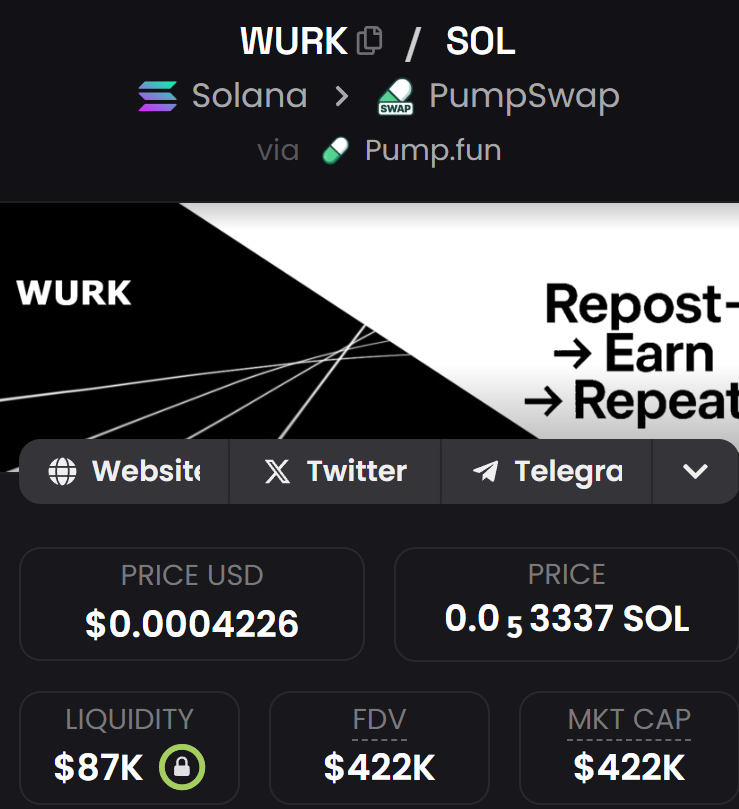
Low-key wild that everyone’s fading $WURK while agents are literally out here paying humans money for simple tasks.
WURK cooking in the background like a good chef
i am buying some more