🟦 Why #Litecoin?!
🔷$LTC = POW = Winning 🥇
🔷Provably Secure: Built on rock-solid cryptography.
🔷Decentralized: Power away from central authorities.
🔷Unwavering Reliability: 100% uptime for over 13 years.
🔷Finite Supply: Ensuring scarcity and value preservation.(1/2)💈👇
@alldexone Đọc xong mới thấy vì sao nhiều creator lâu năm vẫn ưu tiên YouTube và Facebook hơn, không chỉ vì view mà còn vì hệ thống kiếm tiền ổn định hơn.🤙
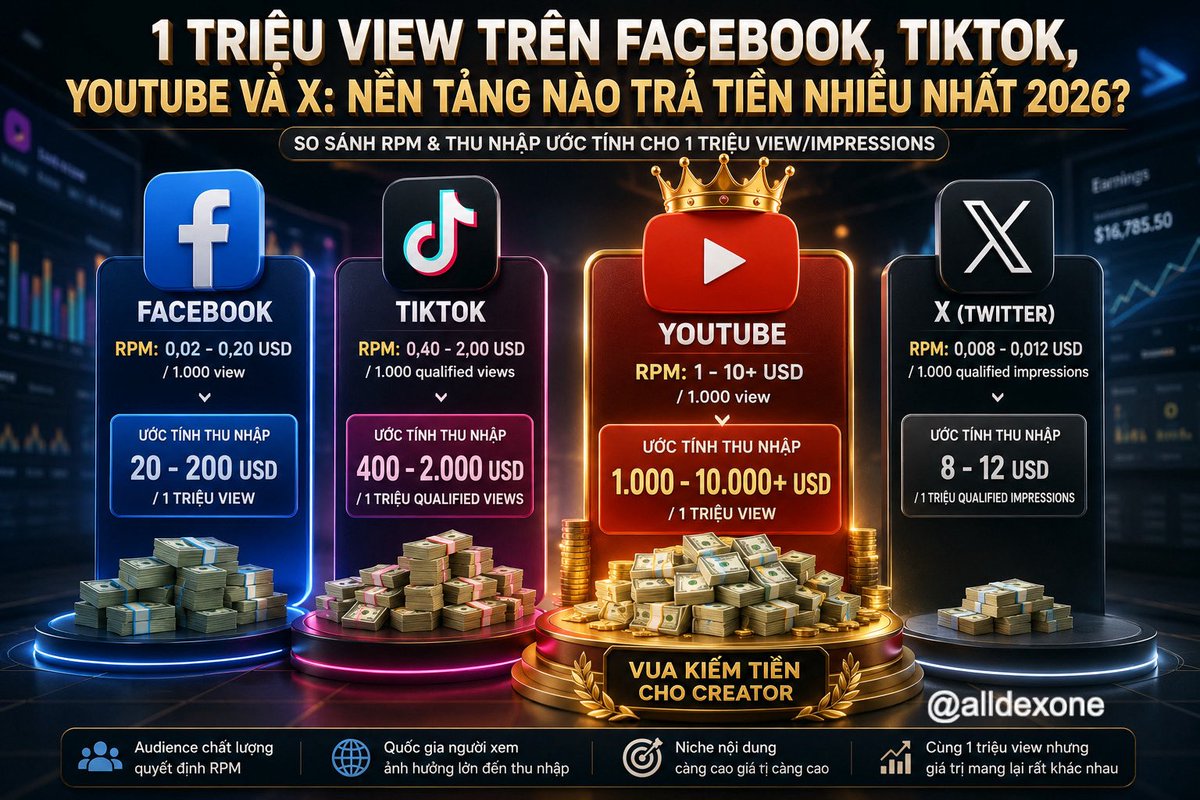
✴️📊 1 Triệu View Trên Facebook, TikTok, YouTube Và 𝕏: Nền Tảng Nào Trả Tiền Nhiều Nhất 2026?
🔶 Facebook: thường dao động khoảng 0,02 đến 0,20 USD / 1.000 view với audience phổ thông. Quy đổi tương đương khoảng 20 đến 200 USD / 1 triệu view. Traffic tier cao có thể hơn nhiều.
🔶 TikTok: Creator Rewards hiện thường khoảng 0,40 đến 2,00 USD / 1.000 qualified views, tương đương khoảng 400 đến 2.000 USD / 1 triệu qualified views, nhưng phụ thuộc mạnh vào video dài hơn 1 phút, audience và niche.
🔶 YouTube: RPM creator thường dao động rộng khoảng 1 đến 10+ USD / 1.000 view tùy niche và quốc gia người xem, tương đương khoảng 1.000 đến 10.000+ USD / 1 triệu view. Finance, công nghệ hoặc audience tier cao có thể vượt xa mức này.
🔷 𝕏: creator phổ thông thường chỉ khoảng 0,008 đến 0,012 USD / 1.000 qualified impressions, tương đương khoảng 8 đến 12 USD / 1 triệu qualified impressions. Niche crypto, tech, finance có thể cao hơn đáng kể.
Cùng là 1 triệu lượt xem nhưng giá trị mỗi nền tảng rất khác nhau. Viral tạo ra view, còn audience chất lượng và hệ thống monetization mới quyết định tiền đi về đâu.
#Facebook #Tiktok #YouTube #X #XCreator #trending #hot
@rubycomes@ericanances Rise and shine, lovely Ruby! ☀️ May your day be filled with joy, positive vibes, and all the beauty you naturally bring into the world. You glow so brightly! 🌸
Good morning! 🌞 Waking up with unstoppable energy, a big smile, and a heart full of gratitude. Let’s make today absolutely magical! ✌️✌️
#Ruby#Alldex#Vietnam
✴️ Đại ngàn trao em bản sắc
Thời đại cho em đôi cánh.
Rạng rỡ, tự tin, đầy năng lượng.
Nàng thơ vùng cao bước giữa nhịp sống mới. ⛰️🍃☀️☕️
#Alldex#Ruby#hot#trend
✴️ Làng Thèn Pả: Bức tranh đẹp bình yên dưới chân cột cờ Lũng Cú 🇻🇳
Thèn Pả hiện ra như một bức tranh cao nguyên thuần khiết, lưu giữ trọn vẹn hồn cốt của đồng bào H’Mông. Nơi đây níu chân lữ khách bằng nếp nhà trình tường vách đất, mái ngói âm dương cổ kính và nhịp sống dung dị, nguyên bản của dân bản. Cùng ngắm nhìn một Hà Giang thật tình và đậm đà bản sắc! ⛰️💚👍👍
#ThenPa #HaGiang #trending #VanHoaHMong #Alldex
@rubycomes@mert It is inconsistent for Mert to present himself as a blockchain expert while ignoring the basic distinction between privacy features and protocol definitions.🤝
✴️Ⓜ️ (@mert ) 👇
👩🏻🎨 “Your statement sounds convincing at first glance, but if we treat it as a definition of crypto, it becomes a fundamental category error that conflates concepts.”
“crypto without privacy is not crypto”
If interpreted in an absolute sense, this claim contradicts the actual existence of the entire industry. Bitcoin and Ethereum remain fully valid crypto systems despite being completely transparent on-chain. This alone demonstrates that privacy is not a necessary condition for something to be considered crypto.
In blockchain system design, crypto is defined by core cryptographic primitives such as digital signatures, hash functions, consensus mechanisms, and the ability to guarantee data integrity in a trustless environment. Its primary focus is verifiability and trust minimization, not default anonymity.
The flaw in the original argument lies in equating cryptography with anonymity. Cryptography enables verification without requiring trust, but it does not mandate that all information must be hidden.
Privacy in crypto is not a fixed requirement but a design spectrum with multiple levels.
At one extreme are #Bitcoin and #Ethereum, where transparency is prioritized to enable auditing, fraud prevention, and the infrastructure of open financial systems.
At the opposite extreme is #Monero, where privacy is enforced at the protocol level by default, using ring signatures, stealth addresses, and confidential transaction mechanisms that obscure all transactional metadata, resulting in strong system-level anonymity.
Between these extremes lies #Zcash, a distinctive model that uses zero-knowledge proofs to enable fully private transactions while still allowing optional transparency when needed. This is a crucial point: Zcash demonstrates that privacy is not binary but can be mathematically proven without revealing underlying data, creating a balance between confidentiality and auditability.
In parallel, #Litecoin ( $LTC) represents a more flexible approach. While it largely follows Bitcoin’s transparent model, it has experimented with MimbleWimble Extension Blocks to enable optional privacy features. This highlights an important reality: blockchain systems can adjust privacy levels depending on user demand, liquidity considerations, and regulatory requirements across jurisdictions.
Taken together, #Bitcoin, #Zcash, #Monero, and Litecoin are not mutually exclusive categories, but rather points along a single architectural spectrum ranging from full transparency to selective privacy and default anonymity.
If we accept the statement “crypto without privacy is not crypto,” then logically we would have to exclude most functioning crypto systems from the definition, or dismiss privacy-focused systems like Monero and Zcash, both of which exist precisely because of different cryptographic trade-offs. Neither conclusion reflects reality.
Crypto is not defined by privacy. Instead, privacy is an architectural spectrum spanning from full transparency to strong anonymity, where Bitcoin, Zcash, Monero, and Litecoin represent different optimization points depending on system goals and regulatory environments.🤙🤙