🚀 https://t.co/FwZ8X2tfmK – the new prop trading project on Bybit Futures!
✅ Get funded up to $100K
✅ Keep 90% of the profits
✅ No time limits on challenges
✅ Withdraw profits from day one
🔗 Start now: https://t.co/iw9eDEjjV9
#bybit#PropFirm#CryptoTrading
Tether is bringing USDT back to Bitcoin — natively, via the RGB protocol, riding Bitcoin and Lightning rails.
Why it matters: the world's largest stablecoin spent eight years living on other chains. Now it returns to the settlement layer it started from.
If it works, Bitcoin stops being "just an asset you hold" and quietly becomes payment infrastructure — dollars moving over the most battle-tested network in crypto.
Watch the rails, not just the price.
The Binam terminal is back online. ⚡
A recent dashboard update briefly took the trading terminal down. It's fixed — charts, order book, and demo trading are fully restored.
Jump back in: https://t.co/EUXxtjl3y8
Bitcoin's 7-day implied volatility just slid toward its lowest of the year. Quiet tape.
But quiet isn't the same as safe.
Compressed volatility is stored energy, not a resolved market. It tells you positioning is calm — not which way the release goes.
The mistake isn't being in the market during the lull. It's sizing like the lull is permanent.
When the range gets this tight, your risk plan matters more than your view.
Everyone's watching the price. Almost no one's watching the Senate.
Lawmakers are advancing crypto market-structure legislation — the rules that will define how exchanges, tokens, and ETFs actually operate.
Prices move every day. The framework a market is built on moves once in a generation. This looks like one of those times.
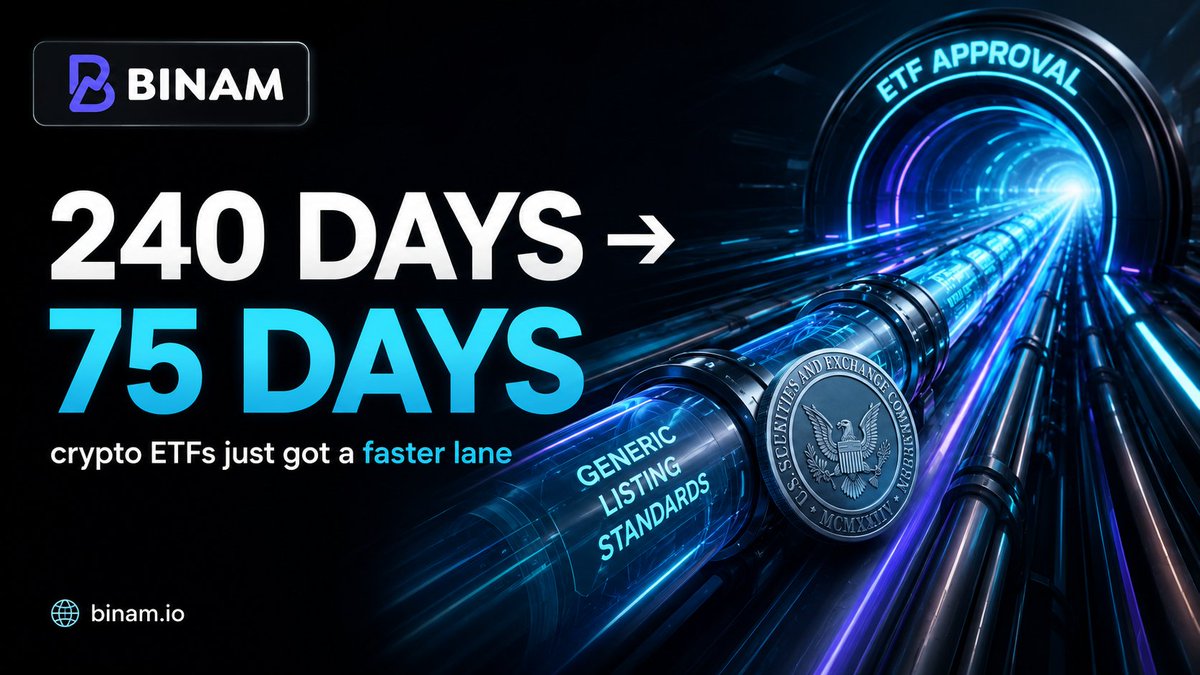
Getting a crypto ETF approved used to take up to 240 days. It can now take as few as 75.
The SEC just approved generic listing standards, letting eligible funds skip the full case-by-case review.
Access to crypto isn't just growing. The plumbing behind it is being rebuilt to move faster.
The retail crowd is at "extreme fear" — the Fear & Greed index is sitting at 15.
Meanwhile, corporate balance sheets are quietly buying. Strategy added another 520 BTC. Strive added 759.
The gap between how retail feels and how the biggest holders act is usually the whole story.
The sharpest rallies often happen in downtrends. Here's why that's not a contradiction.
When too many traders are short and price ticks up, their stops and liquidations force them to buy back — fast. That buying pushes price higher, triggering even more covering.
It's called a short squeeze. It feels like strength. Often it's just shorts running for the exit.
Everyone's waiting for altseason. The market is quietly telling you not to hold your breath.
Participation is narrow — a handful of names move while the rest bleed. That's not a broad rally, it's a fragmented one.
Altseason isn't a date on the calendar. It's breadth. And breadth isn't here yet.
Bitcoin is selling off, and it has almost nothing to do with crypto.
The yen just hit four-decade lows, the dollar is bid across the board, and risk assets are getting repriced against it.
Sometimes the most important chart for crypto isn't a crypto chart at all.
The crypto market is down about 50% over the past year. Headlines call it a collapse.
Zoom out and it looks familiar: every cycle has a winter, and every winter feels like the end while you're in it.
None of this tells you what happens next. It just tells you this has happened before — and discipline, not timing, is what carries people through.
Tether now lets you borrow against tokenized gold without selling it — the same model as borrowing against bitcoin.
Everyone watches token prices. The quieter story: crypto's real utility is becoming collateral, not speculation.
The interesting part of this market isn't what you buy. It's what you can borrow against.
Regulators just proposed treating stablecoin issuers like banks — full customer ID checks, classified as financial institutions.
Translation: the stablecoin you move in and out of trades with is quietly becoming regulated money infrastructure.
The "wild west" era is ending. The rails are being built.
Capital is easy to give. It's hard to give well.
A challenge isn't testing whether you can win once. It's testing whether you can keep what you win.
That's the whole game.
The pattern: none of this is about predicting the market.
It's about being predictable to yourself — sizing the same, following the rules, staying calm when it gets ugly.