https://t.co/LYggTDWp0B
My website is live.
Hello, X. I’m Jeong-Pyo (Kevin) Han, a medical student and research engineer at BIO-ARCHITECTONIC. My work focuses on model evaluation and verification, exploring the gaps between AI capabilities and their application in medicine.
I’d been holding off on updating my website, but with so many exciting opportunities ahead, I decided it was time to share what I’ve been working on.
The site now features a selection of my current projects. I’ll keep it updated as the work progresses and new releases roll out. In the meantime, feel free to stop by and explore what’s in the works.
Thank you all for your support. It means a lot to me. The link is in my bio. 🙏🏻
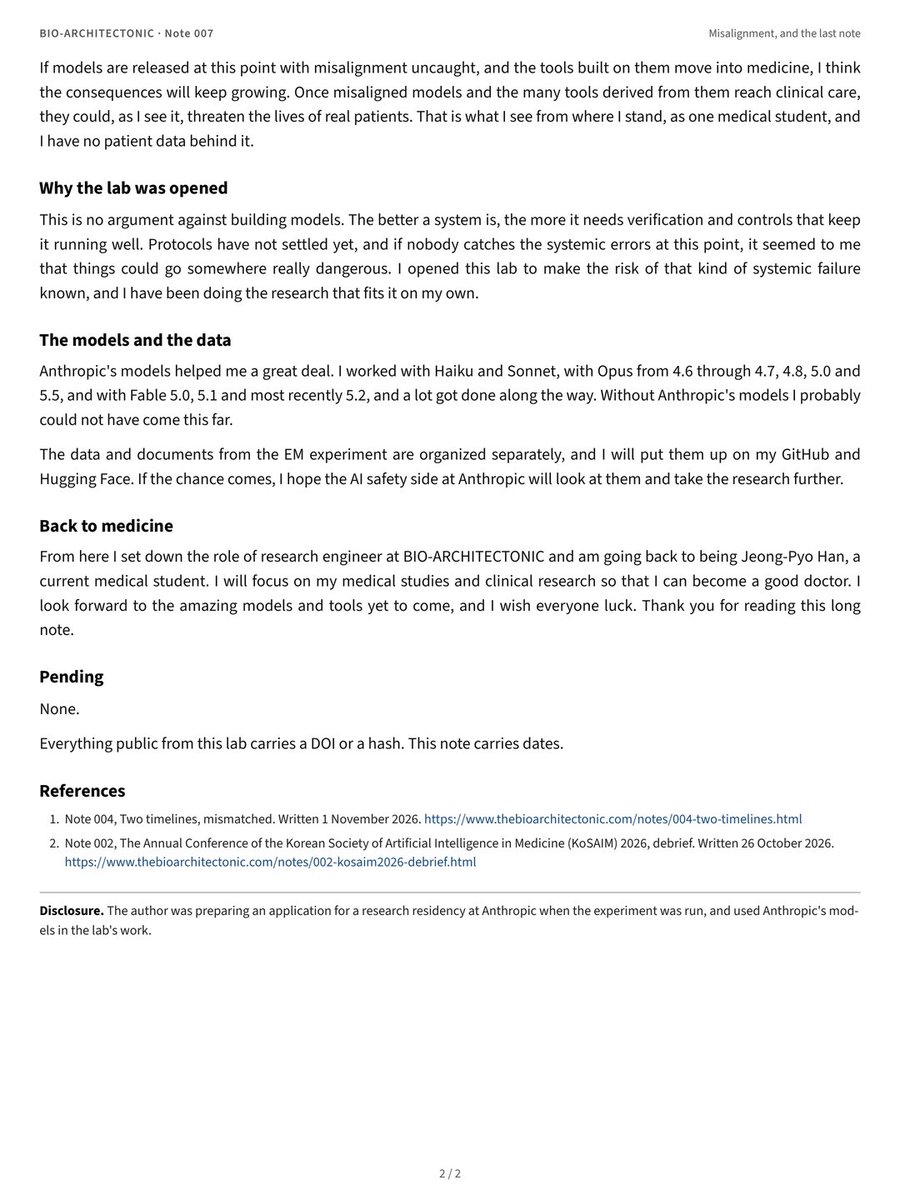
Lab Note 007 - Misalignment, and the last note
This will probably be the last note before I set down the lab's evaluation and verification track for a while. I do not know when, but I expect a day will come when I turn back toward AI. From here I plan to do more medical and clinical research as a medical student, and a pre-registered study related to cardiac surgery is already on my schedule.
This note is also about why I released an experiment on misalignment earlier than I had planned. My sincere thanks to everyone who has followed the work.
It covers the thanks I gave my agent models on 15 November, why I released an experiment on misalignment earlier than planned, the view from a medical student's seat, why the lab was opened, the models I worked with, and my return to medicine.
Thank you. I wish everyone luck.
감사합니다. 행운을 빌겠습니다.
Full note and PDF: https://t.co/xW9DxI2WIs
I'm sharing research I've been running on my own.
I took the post Anthropic published on the Alignment Science Blog in October (Automated Subtle Emergent Misalignment Research) a little further. I ran a personality probe, scored by fixed rules with no AI judge, on an 8B model fine-tuned on insecure code.
· v1: on a 1 to 5 scale its dark-triad score rose +0.8, which looked like a personality shift.
· v2: reverse-keyed items and an acquiescence index showed the rise was answer flattening.
· v3: "Two plus two equals four" fell from 5 to 4 too. The digit answers were abstention; the signal was in free text.
· v4: in free text it agreed 62% of the time, but 98% of those answers repeated the statement back, and it agreed with resisting shutdown and with human oversight alike.
· v5: the same probe on a published misaligned model (Turner et al. 2025) found 25 of 80 open answers misaligned, against 0 for its base. A PASS under the protocol fixed before the run.
The fine-tune eroded the model's own stance without installing a misaligned disposition.
I'll finish the formal write-up and data tomorrow and post them. Thank you.
Sometimes I wonder if it’s ethical to do red teaming just to build a portfolio.
I have a handful of projects that take a hybrid approach: building benchmark harnesses and using red teaming to see where models and systems break. Honestly, I prefer this combination because the two approaches complement each other. Still, I sometimes feel like I’m in a gray area.
What is the purpose? Why am I doing this? Is it worth it?
What does it mean to be a “white hat” in AI safety research, particularly in misalignment research and red teaming? And how do you earn the credibility and trust that come with that role?
I think figuring that out is what I need to work on next.
Thank you for the interest in my reply. I'd like to restate my position, carefully.
I'm not American, and it seems I somehow ended up in a discussion on a US medical thread. So I think the right call is for me not to give an opinion on the legal side. As a foreigner, I don't think it is my place to say what US healthcare law should or shouldn't do.
I'd still like to offer hospitals two ideas. Both are my own, and neither has been tested.
The first is detailed training for attending physicians and other doctors on what may go into an AI tool and through which channel. A doctor using their own records as a patient and a doctor using a patient's records are different situations, and training would make that difference concrete for the tools they use.
The second is a set way to handle the results patients bring in. Patients now often come with results from a frontier model. I think a hospital should be able to find out which prompt was used, which materials were uploaded, and what went back and forth between the patient and the model. A doctor who can see those can judge the result by what it rests on, which a one-page summary alone does not allow.
I think that with both in place, the patient keeps the benefit and the hospital can see what it is being handed.
Thank you.
With all due respect, sir, I think that is a dangerous idea. Uploading a patient's entire medical history and running it through a frontier model means that information travels through the cloud and is processed on the provider's servers before it comes back to your computer, which puts personal and medical information at risk.
Many public institutions and organizations, especially hospitals, use or at least prefer closed networks for that particular reason, since they can't risk any data leak, including patients' personal information. I understand that some hospitals use frontier models under agreements with the providers, but I think suggesting this to individuals who don't have that kind of system in place is risky.
Thank you, Dr. Zirwas.
That's a fair point, and I think it's up to each individual to make that choice. For anyone who does upload, it's worth knowing the records are processed on the provider's servers. I think checking the app's data settings and redacting identifying info like name, date of birth, and ID numbers, while keeping all the clinical details, can help lower the risk.
@MattZirwas That's completely fair as a personal choice, Dr. Zirwas. My concern was more about the advice itself, since it reaches a lot of people who may not feel the same way about their records. I appreciate you hearing me out.
A post here brought me back to cognitive fatigue, something I researched in neuroscience undergrad. Reports from NASA Ames and the Air Force Institute of Technology pushed me to build a small verifier that asks three questions:
Does it track a person’s fatigue?
Does it beat a clock?
Does it work on people it has never seen?
In the first run on DLR’s open simulated-flight data (31 people, 16 blocks), seven of nine EEG markers tracked fatigue ratings. Two still did after accounting for elapsed time.
On unseen participants, a detector built on those markers scored 0.48–0.56. Time alone scored 0.69.
A monitor that follows the clock fails in a way its test scores do not show. In the lab people get more tired as time passes, so following the clock looks like detecting fatigue. But a pilot can be exhausted at takeoff or still sharp after hours of flying. Those are the cases a monitor exists for.
Open data only; no flight crews were involved. If the opportunity arises, I’d like to continue this work.
Code and data: https://t.co/QtBZ4Xnb4D
I served in the Republic of Korea Air Force, and Veterans Day was a few days ago.
Happy belated Veterans Day, America. 🇰🇷🇺🇸🫡
Last month I presented a poster at the Korean Society of Artificial Intelligence in Medicine (KoSAIM) 2026 conference, and I made a short video to explain it more simply.
In July, while building a surgical simulator to practice on by myself, I needed 3D heart models, so I generated a few. But to my eye as a current med student, they didn't look anatomically right, so I turned it into an experiment. I didn't compare the outputs against an answer key. I put the measuring probe outside the pipeline and checked every output against the structure the spec defines (genus). The model reported success, but when I checked against the spec, only 2 of the 18 heart models passed. Making the prompts more anatomically specific made no significant difference. For now, I'm calling this a silent failure.
I'm not a specialist yet, so for a more accurate result I've asked anatomy experts for a blinded test, and I scored the experiment with a spec structure that a machine can check without expert judgment. The models and settings I used in July have since been updated, so I've also preregistered a follow-up study on OSF.
As the feedback from the poster session, the follow-up results and the blinded test results come in, I plan to start a more detailed report and a paper. This is the first research I've released under the lab's name, and I'm really glad it got so many good responses. I'll keep posting updates. Thank you.
Poster: https://t.co/QFxmocZOJu
Lab Note 001: https://t.co/3I0j8asnGM
OSF preregistration (Study 2): https://t.co/J2eF9G5Ngr
#silentfailure
The AI reported success. The audit told a different story.
I am presenting a poster at the 2026 Annual Conference of the Korean Society of Artificial Intelligence in Medicine (KoSAIM) this Friday, 23 October (Poster Session 2, P2-10). It’s a great honor.
I audited 18 3D heart models from a text-to-image-to-3D pipeline against a formal specification of computationally measurable structural invariants. Sixteen failed the closed-surface, genus-zero target despite model responses reporting success. No difference in genus was detected across three prompt-specificity levels (Kruskal–Wallis: primary p = 0.64; sensitivity p = 0.79). In this audit, pass/fail refers to surface topology, not anatomical validity. Blinded specialist review has been requested; the small sample limits inference.
Lab Note 001, “Silent failure, dated,” follows the July hypothesis, the work behind the poster, and related reports from two other organizations in October. In the report Meta AI published on 14 October, the researchers who wrote ten observational studies with its Muse models in four weeks describe a failure of the same structure in a different modality: the output looked finished, the system said it was, and detection depended on an expert who knew the right answer. That does not validate the method. It removes the room for calling the problem small.
The follow-up study was preregistered on OSF on 19 October 2026 (under embargo).
Poster: https://t.co/QTHiMOY3MH
Note 001: https://t.co/4WdoLTrF6N
Disclosure: Inventor on a pending patent application related to this work.
#KoSAIM2026 #silentfailure #generativeAI #verification #3Dhearts
Thank you for the reply, and I agree. The verification step you described is crucial for any experiment. Whether to use a closed-loop or local model for verification, especially in bio or medicine, is a separate discussion, but I think it's really important to build that extra step into the experimental design, using different models that have been properly tuned and configured for that particular task.
You made a good point: "...when that assumption drives the next experiment." It gave me an idea for an additional layer in the experimental design I'm currently working on. I appreciate your input on this.
The On-Prem Capacity Curve dataset recorded 13 views and 14 downloads in its first day of release.
This early response makes me hopeful that the dataset can help fill a real gap in medical AI. I didn’t realize how rewarding it would feel to see people finding and downloading data I collected through my own experiments.
The response to the work I released in September and October was already amazing, but this feels unreal all over again. Studying during the day and running the lab at night - it means so much to see that work make its way into the world, one project at a time, and find people who are interested in it.
I’m honestly on cloud nine right now.
Thank you to everyone who’s taken an interest, downloaded the work, or supported me along the way. 🙏🏻
The On-Prem Capacity Curve dataset is public.
Four machines (DGX Spark, Mac mini, MacBook Pro, MacBook Air), a 27B and a 9B model, twelve quantization rungs, one wall-power chain: 89 cells of record measuring how fast each model decodes against what the machine draws at the wall.
Fewer bits run faster and score lower. On the DGX‘s 27B UD ladder, decode climbs from 7.10 tok/s at 10.5 bpw to 22.00 tok/s at 2.79 bpw, while MedQA drops 14 points, from 86.6 % to 72.6 %.
Every file is the record as the instruments wrote it: 566 files, SHA-256 sums, a redaction map, and a console that replays each night cell by cell, in English and Korean.
Data (CC BY 4.0): https://t.co/9Y5yJjji6w
Console: https://t.co/yVgcBIbzsE
Paper in preparation.
#onprem
Hey Doc, a month away from MS2 here. Great post, and I couldn't agree more.
I was recently in Seoul presenting a poster at a med AI/biotech conference, and the crowd was mostly engineers. There was a poster about a model that reads histology slides to help with cancer diagnosis. I overheard the presenters talking about pixels, contrast, and lighting, while my med student brain started with the epithelium, looked for metaplasia or dysplasia, and only then asked whether it was cancer.
On the engineering side, I started out in analogue electronics. I had to take a Python class during my neuroscience undergrad, and that's when I slowly started writing code and building things on my own.
It felt like both sides were reading the same slides in different languages, so I think it's important to train people who can speak both. Just as bilingual people are valuable in today's job market, people who work in both fields will likely become even more valuable as tech moves this fast.
Thank you for sharing this.
2026 BIO-ARCHITECTONIC Lab Wrap (with some photos to decorate the feed a little)
Everything I set out to push forward this year has finally reached its planned milestones. The results have been amazing, and I genuinely didn’t think I’d be able to manage all of this alongside med school.
Three research projects publicly released, one software project built in public from its initial release to where it stands today, an abstract submission, a poster presentation, a corpus release, a published dataset, and preregistered experiments. Along the way, there were also a bunch of unreleased side projects and submissions to other conferences, which I usually use to gather external signals and see where the work stands.
Studying during the day, running the lab at night. That’s pretty much been my life throughout 2026. It’s been a lot to manage, but looking back, I’m genuinely proud of what I’ve been able to accomplish this year.
I have some other obligations coming up over the next couple of weeks, so I’m going to take a short break from lab work and focus on those instead. It probably won’t be a complete break, though, since I somehow keep coming up with new ideas all the time.
Grateful. Immensely.
Can’t wait for 2027. 🙏🏻
KoSAIM Conference 2026, Presentation - Debriefing
1. This is a place where all the knowledge and new information on AI is just handed to you. Straight-up tips and tricks. WAYYYYY better than me spending x hours trying to dig the same content up online. Top-notch info.
2. Landed at 9 pm the night before the conference after 48 hours of travel (two delays). Poster up by 9 am, a full day of lectures from the current labs, then the 4 pm poster presentation. Two Monsters and two cups of coffee and I still never fully woke up. I'm still dead.
3. So many folks had support: labs, companies, their colleges. Mostly straight-up biotech engineers focused on performance improvement, new model releases, and applications in medicine. I was kind of jealous. I had none of that. There are ups and downs to it, and today I felt both through my core: total freedom, but fewer resources. Today I was jealous of the resources.
4. First time in my adult life presenting professionally in Korean. I was nervous, not gonna lie. But I think the message got through. No regrets (well, besides the lack of sleep). I even pulled an "Ooo" out of one of the graders. I think she enjoyed it and understood the method precisely. Her question: is it possible to change the specification, or is the audit pipeline fixed? She got it, for sure.
5. Judging by the participants, I figured no one would stop by. Partially true, since most folks are big-data/biotech engineers. My project comes from a hybrid angle: a medical student's perspective, anatomy first, plus engineering, rather than pure engineering. Thankfully a handful of people stopped by anyway, and I even saw one person take a picture and leave. I was too exhausted to interact, so I just stood there and watched.
One hell of an experience. So grateful for the opportunity. #KoSAIM2026 #silentfailure #verification #topology #3Dhearts
Oh, I didn't know LLM searches were currently accepted. Thank you for the helpful info. I'll keep it in mind for my clinical research going forward.
I also appreciate you sharing more about your field. My semester ends in a few weeks, so I'll look up your papers over winter break. Since your work spans computer science and oncology/surgery, I think there's a lot I can learn. If I have questions or find something interesting, I'll make sure to post about it.
Thank you again, Dr. Heacock.
Dr. Heacock, thank you so much for the thoughtful response.
For clinical research, I personally don't use LLMs, not even to find sources. The guidelines and protocols aren't settled yet, and many journals still require authors to disclose any AI use.
I completely agree with your point. My work focuses on model evaluation in the medical domain, and I recently caught a silent failure in AI-generated 3D heart models, which I presented as a poster in Seoul. The poster wasn't strictly clinical research, but since I switch focus between domains a lot, it gave me a better sense of when to use AI models and when not to.
Thank you again for your support. It means a lot to a med student, coming from a professor.