biocode | Agentic open science. Turning bold research into breakthroughs through decentralized funding on Solana.
9fiMGcvfGYcDEJW7rAacYchYEGr5gitLXmuXvZGjUbio
DeSci matters because communities should have a meaningful role in the science that affects them. 🧬
It can open additional routes to research funding, connect researchers with collaborators and give communities a way to support questions they care about.
For science, accessible methods, data and provenance let others inspect assumptions, attempt replication and build on existing work.
For the community, participation means helping identify priorities, contributing knowledge and following what the research actually delivers.
That’s why we built biocode: an agentic research workspace with specialist critique, claims linked to source excerpts, visible uncertainty and exportable research records.
We’d like biocode considered for DeSciWorld’s project directory and welcome feedback from researchers and builders across the ecosystem.
@DeSciWorld
https://t.co/zfi1cjzGBX
The next utility for $BIO: putting your conviction behind individual research projects. 🧬
We’re proposing project-level staking on biocode: lock $BIO towards the research you believe deserves support, with stake size and duration contributing to a capped, time-weighted conviction score.
That conviction would help determine project allocations each funding epoch, with cooldowns governing withdrawals and changes in support.
Meteora provides the fee infrastructure. Its optional dynamic trading fees increase with volatility and decay as markets settle.
Our proposed funding loop would route a defined share of biocode’s claimed creator/LP fees from participating pools into a research treasury. Staked $BIO would guide allocation; grants would come from collected revenue.
Project budgets, milestone approvals and disbursements would be visible, alongside agentic analysis of methods, evidence and uncertainty.
Conviction would guide funding priorities. Scientific credibility would still depend on data, scrutiny and replication.
Market activity helping fund research. Sustained community conviction helping decide which questions get explored.
A closer look inside biocode 🧬
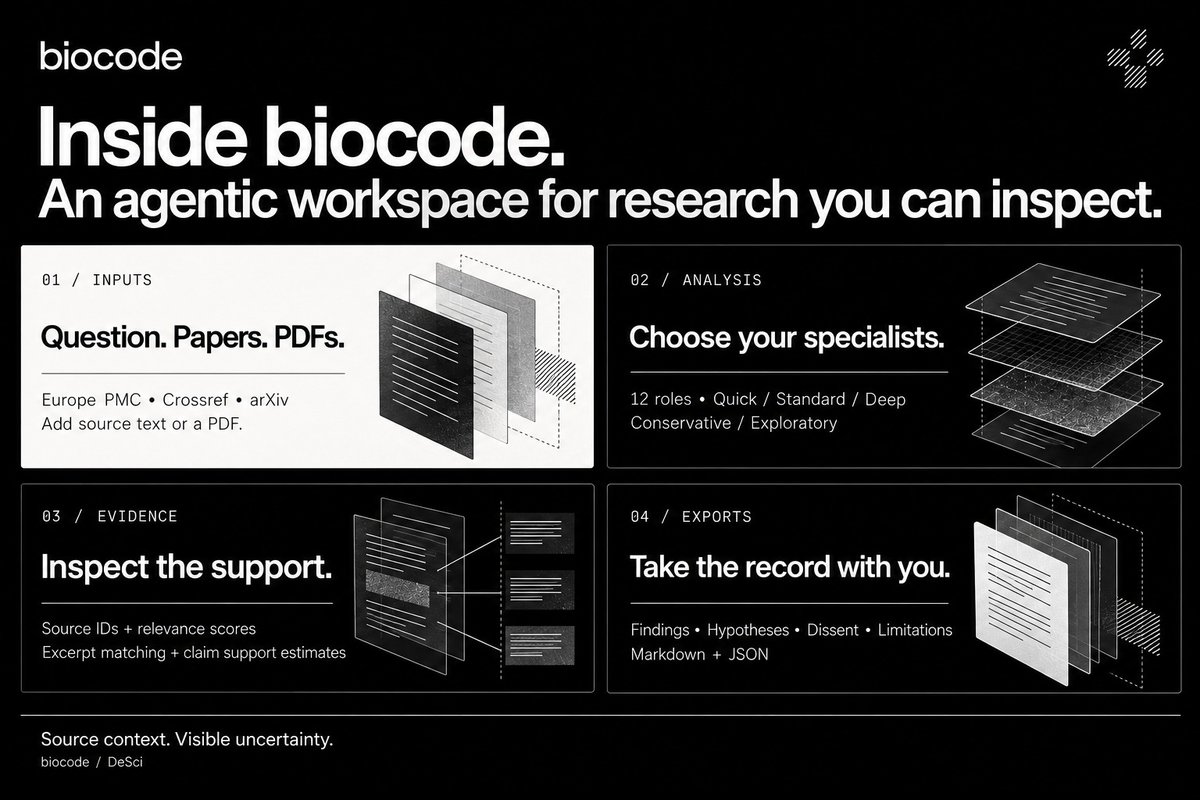
The research workspace starts with your question. Search Europe PMC, Crossref and arXiv, attach papers, paste source text or upload a PDF, then select the specialist agents you want involved.
You control the analysis: Quick, Standard or Deep, with a Conservative or Exploratory stance.
Outputs are separated into findings, hypotheses, dissent and limitations, with each item attributed to its specialist role.
The evidence ledger shows source IDs, abstract/full-text labels, relevance scores and excluded sources. Citation checks match quoted excerpts against stored source text. Jev separately estimates whether the cited evidence supports the claim.
You can follow each stage of the agentic workflow, inspect individual findings and revisit previous runs.
Markdown and JSON exports package the sources, findings, model and prompt versions, and execution metadata into a research record you can take outside the app.
biocode is finally complete: https://t.co/tYf4XzVPIS
CA: 9fiMGcvfGYcDEJW7rAacYchYEGr5gitLXmuXvZGjUbio
Introducing $BIO and the biocode app: An agentic research platform for decentralised science on Solana.
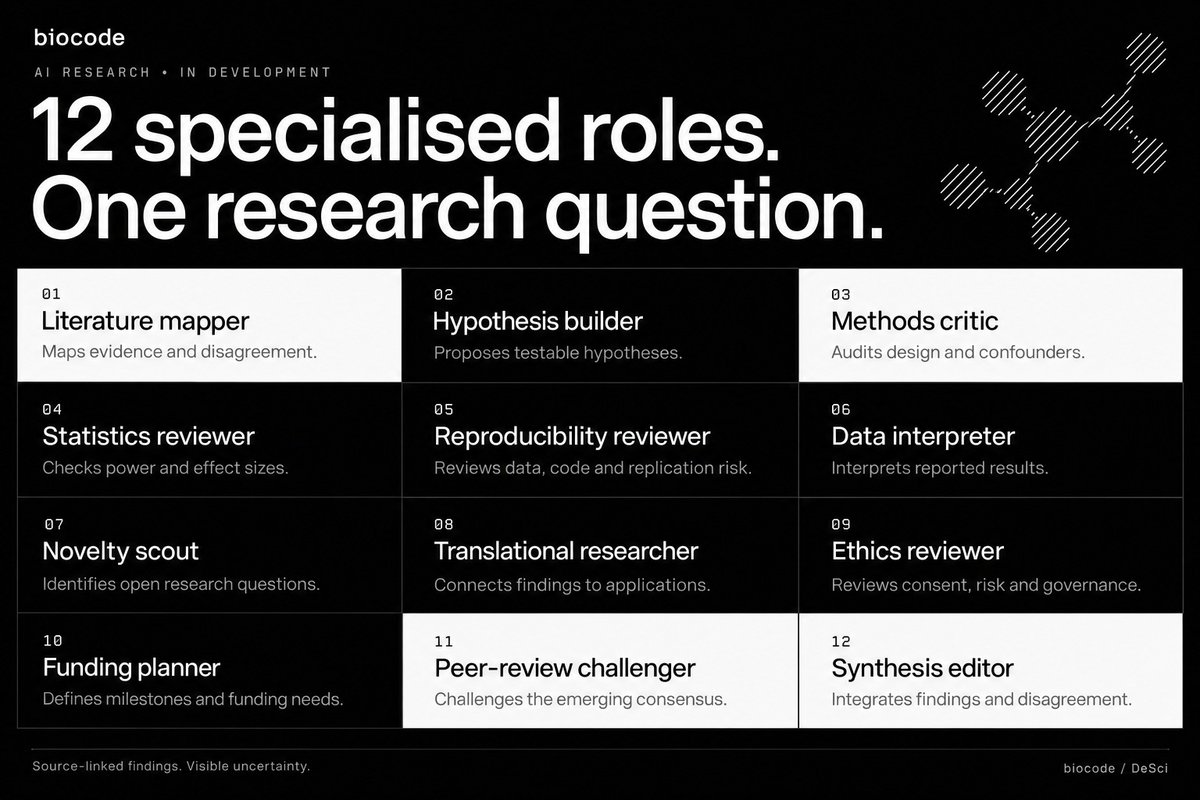
12 specialised AI roles work across literature mapping, hypothesis generation, methods critique, statistical review and evidence synthesis.
Jev’s typed decision layer handles domain classification, source relevance scoring, role routing and claim–evidence support checks. Claude Sonnet 5.5 produces specialist findings grounded in cited excerpts, with hypotheses, dissent and limitations kept visible.
Methods critics examine study design, controls and confounders. Statistics reviewers scrutinise effect sizes, confidence intervals and analytical assumptions. Peer-review challengers question the emerging consensus before synthesis.
Research records preserve source IDs, model and prompt versions, and methodological assumptions, with Markdown and JSON exports that make the analysis easier to inspect and revisit.
Meteora’s Dynamic Bonding Curve SDK provides the token launch infrastructure and a migration path to DAMM v2.
The aim is to give researchers and contributors a shared view of what the evidence supports, where uncertainty remains and what needs testing next.
Welcome to biocode.
GM & happy Sunday!
Today we're working on biocode’s reproducibility records today: source IDs, model and prompt versions, plus analysis assumptions packaged into Markdown + JSON exports.
Each research run should leave a trail another researcher can inspect, challenge and build on.
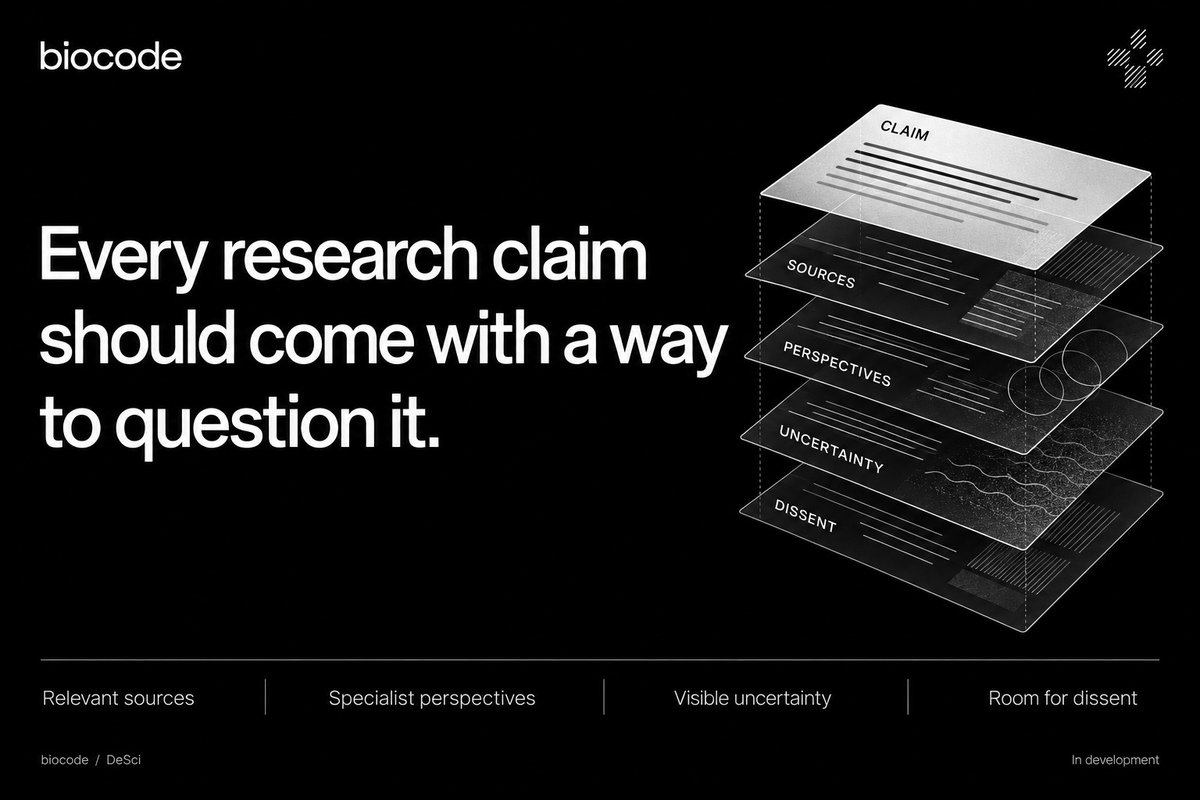
Every research claim should come with a way to question it.
We’re building biocode around relevant sources, specialist perspectives and claims tied to evidence -keeping uncertainty and dissent visible so DeSci communities can scrutinise the research they support.
Good morning 🧬
Causal inference starts with study design.
We’re building biocode’s methods critic to audit controls, randomisation and confounder adjustment - making causal assumptions and potential bias visible before findings inform DeSci funding.
In science, the caveats are part of the result.
We’re building biocode’s data interpreter to preserve effect sizes, uncertainty and who was studied - so DeSci contributors can inspect what a finding supports and what still needs testing before funding the next experiment.
12 specialised roles. One research question.
We’re building biocode’s AI workflow to map literature, audit methods, review statistics and challenge consensus - with source-linked findings that keep assumptions, uncertainty and disagreement visible.
#DeSci
Within biocode, we’re working on the evidence ledger: linking AI research claims to paper excerpts and adding Jev checks for source support.
Next up: testing how it handles conflicting evidence.
Introducing biocode.
Opening access to research funding is one part of decentralised science. Connecting that funding to evidence people can inspect is another: study design, statistical assumptions, reproducibility and measurable progress.
That connection is the gap we’re focused on.
We’re building biocode around five technical layers:
• Research orchestration: 12 specialist roles using Claude Sonnet 5.5 to analyse literature, critique methods, examine statistical reasoning and synthesise findings. Each report will connect its claims to retrieved sources and specific excerpts.
• A typed decision layer: Jev will route research questions, rank source relevance and assess whether supplied evidence supports a claim. Its probability and confidence outputs will be presented as model judgements, with uncertainty visible.
• Reproducibility records: source identifiers, prompt versions, model versions, methods, assumptions and conflicting evidence packaged into an exportable research record. This makes an AI analysis easier to inspect and rerun; experimental replication remains a separate task.
• Solana launch infrastructure: Meteora’s Dynamic Bonding Curve SDK will provide configurable token pricing, wallet-signed transactions and a migration path to DAMM v2 when graduation conditions are met.
• Research treasury accounting: direct donations and claimed creator fees tracked separately from bonding-curve reserves. Trading liquidity cannot be counted as money available to spend in a laboratory. Public milestones will connect project updates to supporting evidence.
The aim is to give researchers a place to develop and expose their reasoning, while giving contributors a clearer view of the work they’re supporting.
biocode is in development. We’ll share the implementation, the tests and the questions we encounter as we build.