USC Center for Biodemography and Population Health
@biodemcenter
A synergistic research environment for the integration and translation of research findings from a variety of disciplines to understand population health.
Still reeling from #PAA2026?
Save the date: #PAA2027 heads to Seattle, March 31–April 3, 2027.
Call for Papers opens July 2026.
Have ideas? Submit session suggestions for the Program Committee to consider. https://t.co/XgqnnyiqV3
Cognitive impairment prevalence increased 1%/year until age 91.2, then accelerated to 6%/year.
If you are interested in aging research , visit us at https://t.co/5asXANkvD0 to learn more about related research, upcoming workshops, or CBPH activities.
New study using HRS data on 7,237 adults 70+, followed for nearly 30 years, finds that centenarians preserve physical and cognitive function longer than any other group, but experience the steepest decline once deterioration begins. https://t.co/d62Jy6ZMgN
The study used joinpoint regression to identify inflection points across four health domains: physical functioning, cognition, chronic disease burden, and depression. Prior to acceleration, ADL limitations increased ~0.04 points/year; after age 93 , that rate rose to 0.34/year.
If you are interested in research on biodemographic approaches to population health and aging visit us at https://t.co/5asXANkvD0 to learn more information on related research, upcoming workshops, or CBPH activities.
New study using UK Biobank data on ~500,000 adults, ages 37–84 finds sleep duration is associated with biological aging across multiple organ systems, including brain, lungs, liver, immune system, and skin. DOI: https://t.co/0AxITjX8f1
Long sleep duration may accelerate biological aging through organ-level aging clocks, while short sleep appears to have a more direct pathway to disease, suggesting these are distinct biological processes.
GDF15 also predicts functional limitations and cognitive dysfunction across both datasets, suggesting it captures meaningful variation in health trajectories among older adults.
Preliminary results using data from the Health and Retirement Study (@hrsisr) and The Irish Longitudinal Study (@tilda_tcd ), Klopack and colleagues find that higher GDF15 levels predict mortality, with odds ratios above 1.5 for TILDA and 2.0 for HRS both cohorts.
This work was supported by seed grant funding from the Center for Aging, Context, & Health (NIA R61AG086854) and USC | UCLA Center on Biodemography and Population Health (NIA P30 AG017625).
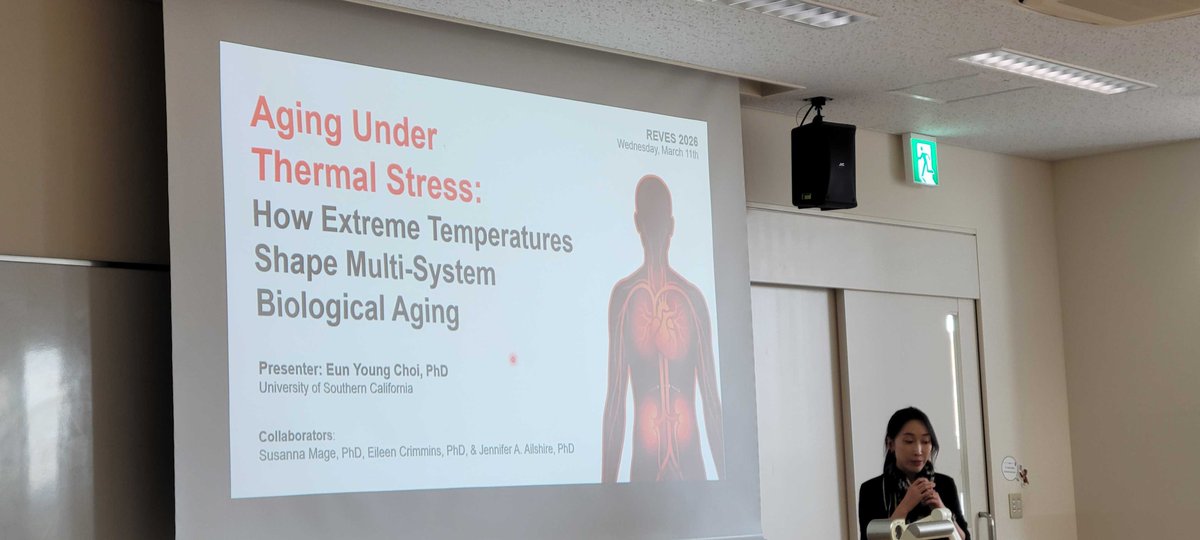
This research is important because as extreme heat events become more frequent, older adults, especially those in under-resourced communities without AC, may be bear the heaviest biological burden . #HealthDisparities
🚨Paper🚨
Research finds that shingles vaccination is associated with slower biological aging across epigenetic, transcriptomic, immune, and inflammatory markers in older adults.
🔗 https://t.co/lj2uad8zU7 @USC_CBPH
#HealthyAging#Vaccines#PopulationHealth
🚨New Paper🚨in Nature Communications identifies gene expression composite scores of cellular senescence that predict aging health outcomes in the HRS cohort.
🔗 https://t.co/8TIuk9XEjb
#AgingResearch#SocialGenomics