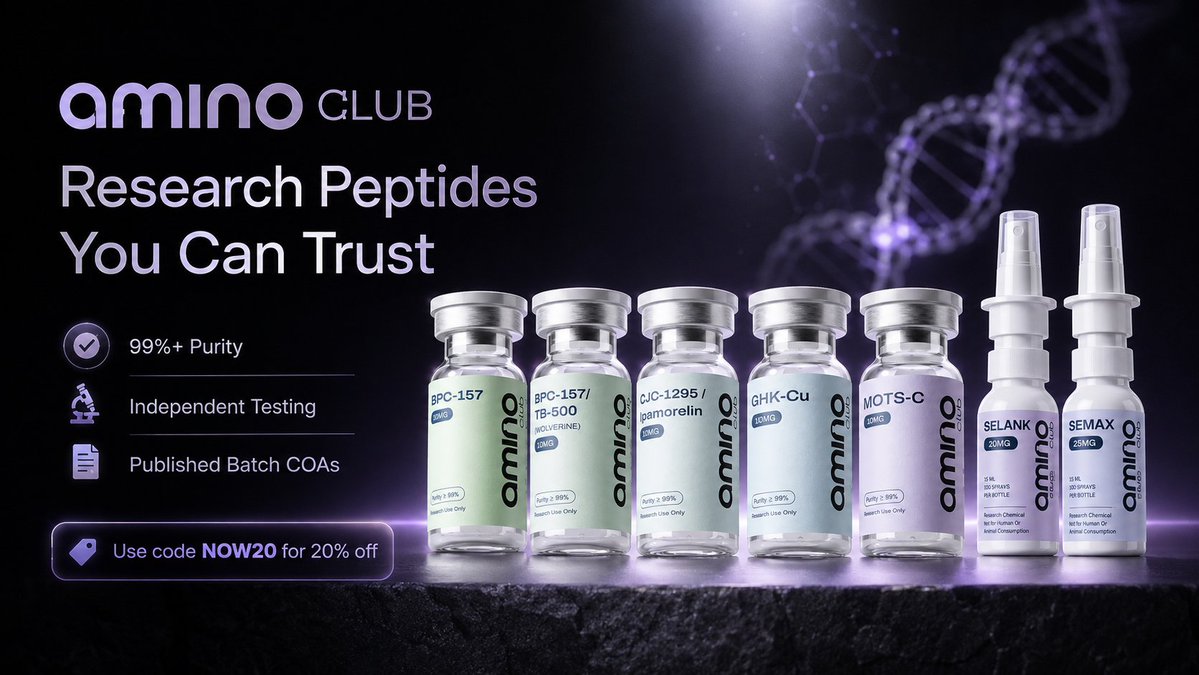
High-quality peptides, a wide selection and transparent testing.
That’s what makes Amino Club one of our preferred research sources.
Get 20% off your order with code NOW20 👇
https://t.co/w7LWe1UtXR
BPC-157, TB-500 and GHK-Cu are often grouped into one recovery stack—but not because they do the same thing.
The real rationale is that tissue repair is not one event. Cells must respond to damage, move through the repair environment, and rebuild the collagen-rich extracellular matrix that gives tissue its structure.
Each peptide is researched around a different part of that process.
BPC-157 — repair signaling and fibroblast response
In tendon-fibroblast research, BPC-157 promoted cell survival and migration through FAK–paxillin signaling, a pathway involved in cell adhesion and movement.
TB-500 — actin-linked cell movement
An analytical study identified TB-500 as containing the acetylated LKKTETQ fragment from thymosin β4. This is its actin-binding region, which is linked to cell migration. The same seven-amino-acid peptide also promoted wound repair in aged-mouse models.
GHK-Cu — collagen and matrix remodeling
In rat wound models, GHK-Cu increased collagen and other extracellular-matrix components, including type I and III collagen mRNA.
This is why the three are discussed together: not as interchangeable “healing peptides,” but as compounds researched around different parts of the same repair sequence.
Signal → movement → rebuilding.
Three different research roles. One coherent framework.
That is the foundation behind BPC-157, TB-500 and GHK-Cu.
More evidence-based peptide guides and independently tested sources are in the profile.
The real recovery problem is not always the workout.
It is the tissue stress that builds up after weeks of hard training.
That is why the Wolverine Stack,BPC-157 + TB-500 is usually discussed around long-term recovery, mobility and staying consistent through high-volume phases.
Not every SARM is researched for the same goal.
Ostarine stands out as a more straightforward and versatile option, commonly discussed for cutting or recomposition rather than aggressive mass-focused research.
That clear purpose is a major part of its appeal.
Retatrutide is no longer just a promising
Phase 2 story.
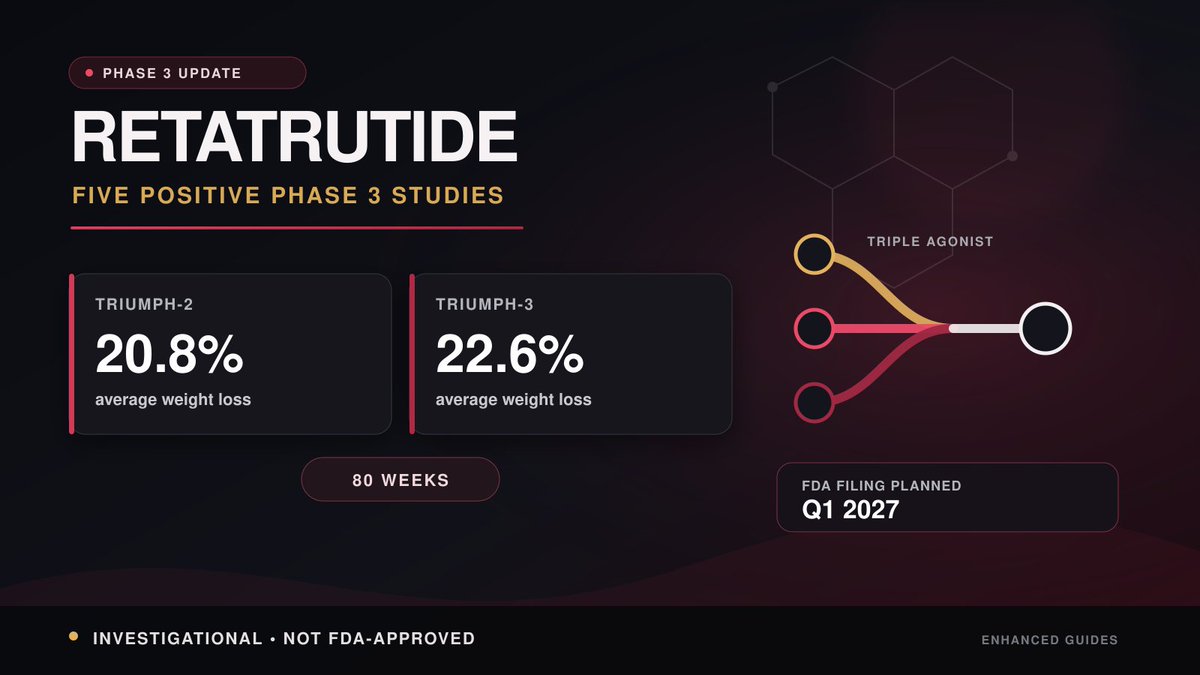
Lilly now reports five positive Phase 3 studies. In the two latest obesity trials:
• TRIUMPH-2: up to 20.8% average weight loss at 80 weeks in adults with obesity or overweight and type 2 diabetes.
• TRIUMPH-3: up to 22.6% at 80 weeks in adults with severe obesity and established cardiovascular disease.
Earlier, TRIUMPH-1 reported up to 28.3% average weight loss at 80 weeks in adults without diabetes.
The bigger development is regulatory: Lilly says it now has the clinical data package needed to support global submissions and plans to file for U.S. approval in Q1 2027.
Important context: these are topline company-reported results, detailed TRIUMPH-2 and TRIUMPH-3 data have not yet been published, and retatrutide remains investigational — not FDA-approved.
Everyone talks about BPC-157 and Retatrutide.
Almost nobody talks about PT-141 — even though it's one of the most requested peptides in private research circles.
Mechanism: acts on melanocortin receptors in the CNS, not on blood flow directly like PDE5 inhibitors do.
Completely different pathway.
Completely different conversation — one almost nobody's having publicly.