Key Points
⚡ BPC-157 stands for Body Protecting Compound 157 and is derived from a protective protein found in human gastric juice.
⚡ It has been studied mostly in animal models for tissue repair, tendon healing, ligament recovery, muscle injury, gut protection, angiogenesis, nerve support, inflammation modulation, and oxidative stress reduction.
⚡ Despite its popularity, BPC-157 has almost no robust human clinical data.
⚡ A recent Pharmaceutics review describes BPC-157 as an investigational peptide with major formulation, pharmacokinetic, regulatory, and translational barriers.
⚡ BPC-157 is unusually stable in acidic stomach-like environments, but gastric stability does not prove oral bioavailability.
⚡ Its systemic half-life appears to be under 30 minutes, yet animal studies suggest effects may last days or weeks, creating a major pharmacokinetic/pharmacodynamic mystery.
⚡ The review suggests BPC-157 may act as a transcriptional primer, briefly triggering gene and growth-factor cascades that continue after the peptide is cleared.
⚡ The evidence base is heavily skewed toward preclinical animal studies, with very limited human data.
⚡ Much of the BPC-157 literature comes from one research group at the University of Zagreb, creating a need for independent replication.
⚡ BPC-157’s native stability may make it difficult to patent, reducing pharmaceutical incentive to fund large clinical trials.
⚡ Current gray-market products are research chemicals, not FDA-approved pharmaceutical-grade human therapeutics.
⚡ Potential risks include inconsistent dosing, lack of GMP oversight, lack of long-term safety data, and theoretical concern around angiogenesis in the setting of hidden malignancy.
⚡ Dr. Mike’s view: BPC-157 has earned scientific curiosity, but not scientific certainty.
📚 Resource: Mateescu, Diana-Maria et al. “BPC-157 as an Investigational Peptide Therapeutic: Biopharmaceutical Challenges, Formulation Strategies, and Translational Development Barriers.” Pharmaceutics vol. 18,5 625. 20 May. 2026, doi:10.3390/pharmaceutics18050625
This content is for educational purposes only and is not intended as medical advice. Peptides discussed in research settings are not approved to diagnose, treat, cure, or prevent any disease.
What Are Peptides?
Peptides are short chains of amino acids — the same building blocks that make up proteins. Think of them as biological messengers that help tell your cells what to do…
Peptide research continues to expand rapidly, offering new insights into how these naturally occurring molecules may help optimize health, resilience, and longevity.
Key Points From Episode:
⚡️ Metabolic disease may involve physical disruption of ER–mitochondria contact sites (mito-ERCS), not only “slow metabolism” in a vague sense.
⚡️ The paper frames mito-ERCS as a ~20 nm bridge enabling critical ER↔mitochondria communication.
⚡️ Chronic stress is described as triggering an ATF4 → PDE4D → cAMP degradation cascade, contributing to bridge failure.
⚡️ When contact sites fail, mitochondria can fragment, contributing to an “energy crash” phenotype.
⚡️ GLP-1 receptors may assemble into localized signalosomes at mito-ERCS — targeting repair rather than broadcasting diffuse signaling.
⚡️ Local cAMP signaling can promote MFN2 upregulation, helping re-tether mitochondria back to ER at the correct distance.
⚡️ Restored contact sites may normalize calcium and lipid transfer, supporting metabolic flexibility.
⚡️ Big takeaway: GLP-1s may be cellular architects, not just appetite suppressants — raising the question of whether “contactomics” could extend into aging biology.
📚 Sources: https://t.co/xcnVwcMvZM
Key Points From Episode
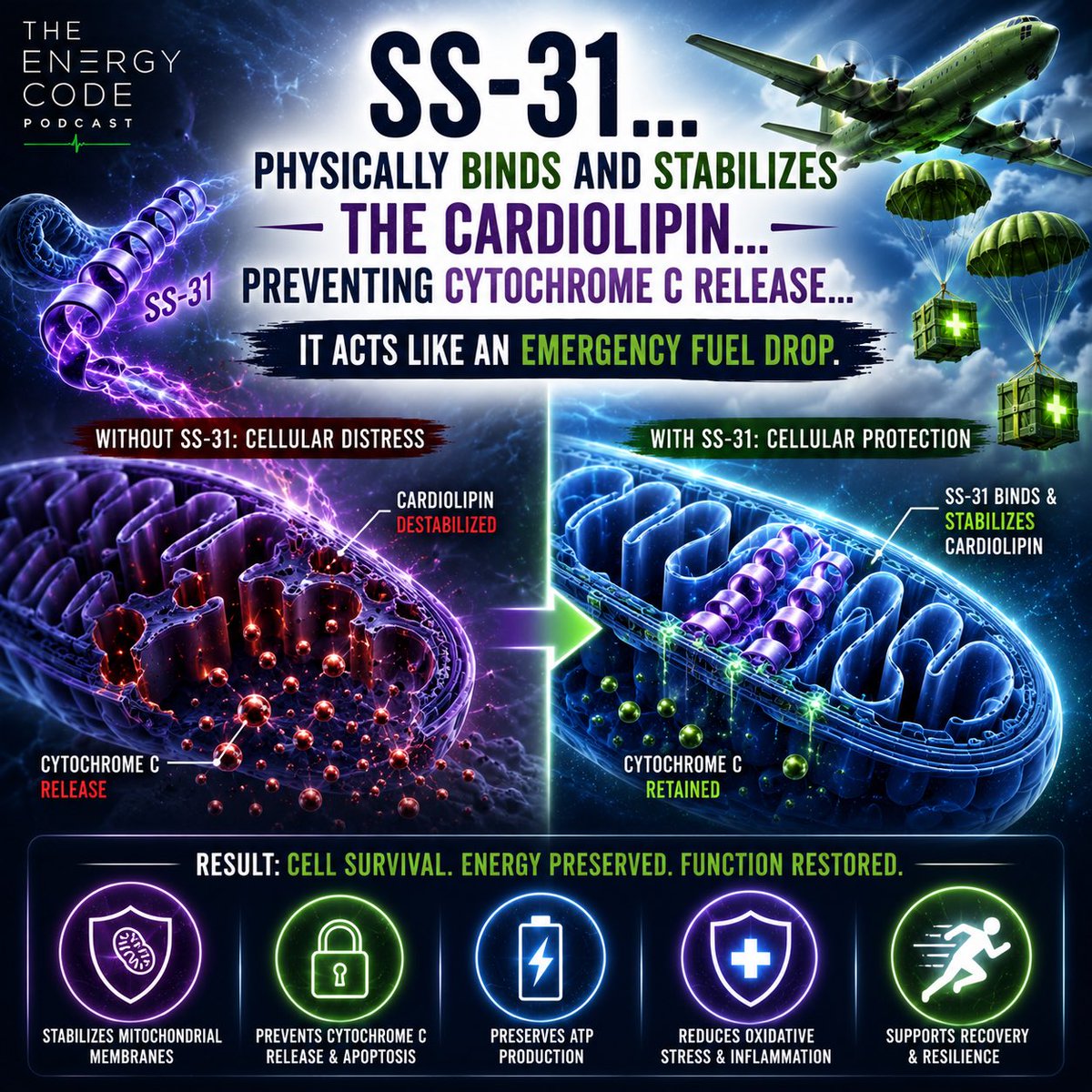
⚡️ SS-31 is framed as a mitochondria-first peptide: “restore impaired mitochondrial function” is the headline.
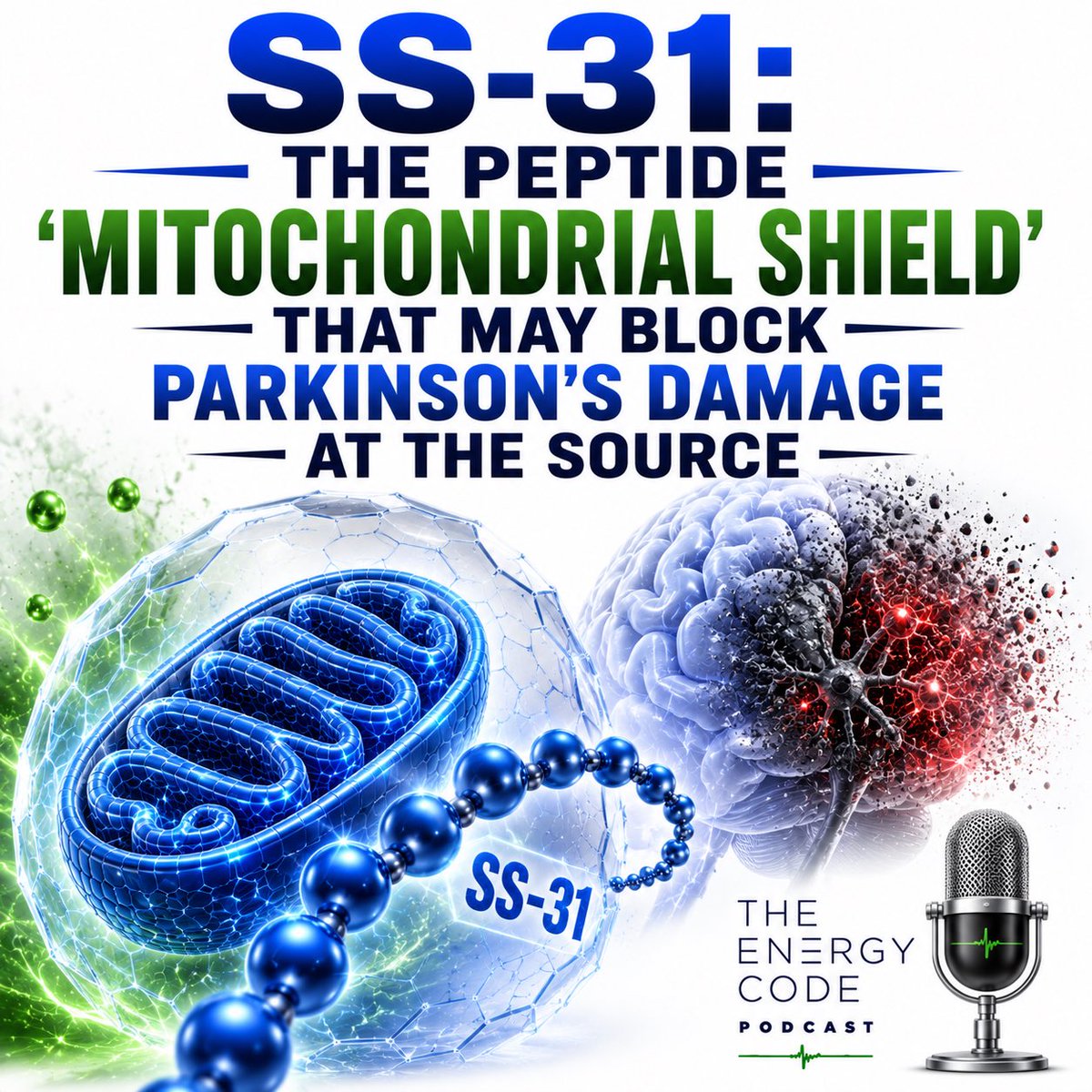
⚡️ Parkinson’s pathology is presented as a cellular power failure inside dopaminergic neurons driven by alpha-synuclein toxicity.
⚡️ SS-31 may act like a “molecular bouncer” — outcompeting alpha-synuclein for anionic lipid membranes and preventing harmful binding/folding.
⚡️ The episode highlights the real-world complication: N-terminal acetylated alpha-synuclein (common in humans) embeds deeper and is harder to displace.
⚡️ SS-31 appears to delay aggregation kinetics (longer “lag phase”) and shift aggregate morphology toward potentially less toxic off-pathway forms.
⚡️ Mitochondrial function was assessed with a Seahorse mito stress test; SS-31 is described as restoring basal/max respiration (at a cited 10 μM dose).
⚡️Mechanistically, SS-31 is explained as:
1.)Cardiolipin binding → supports OXPHOS efficiency/ATP output
2.)ROS scavenging (tyrosine residue) → reduces oxidative damage
⚡️ SS-31 may also reduce alpha-synuclein oligomer uptake by altering membrane electrostatics (less negative surface charge).
⚡️ A major warning: very high concentrations (described as >100 μM) may trigger apoptosis / reduce viability.
⚡️ Big-picture: SS-31 supports a “prevention-first” strategy — block the lipid–protein interaction upstream, rather than “cleaning up the mess” later.
Key Points From Episode
⚡️ SS-31 and MOTS-c are framed as the “top two” mitochondrial peptides (SS-31 = not mitochondrially-derived but highly mito-targeted; MOTS-c = mito-derived).
⚡️ MOTS-c is positioned as a mitochondrial optimization + metabolic flexibility peptide and an “exercise mimetic.”
⚡️ Core benefits highlighted: energy production, glucose utilization/insulin sensitivity, body composition, endurance/recovery, stress adaptation, longevity support.
⚡️ Big concept: mitochondria aren’t passive; they signal back to the nucleus. MOTS-c can translocate to the nucleus under metabolic stress and regulate gene expression.
⚡️ Mechanism highlighted: MOTS-c disrupts folate–methionine cycle → increases AICAR → activates AMPK → boosts fatty acid oxidation + insulin sensitivity.
⚡️ Review claims include: prevention of diet-induced obesity; possible cardiac protection against remodeling (NRG1–ERBB4 pathway mentioned).
⚡️ Longevity genetics angle: a mitochondrial polymorphism (noted as prevalent in Japanese population) may alter MOTS-c structure and associate with exceptional lifespan.
⚡️ Frailty/bone/muscle: MOTS-c described as inhibiting FOXO1 (muscle wasting signals), supporting myotube formation (STAT3), and reducing osteoclast differentiation (anti-osteoporosis).
⚡️ “Endogenous edge”: as a bioidentical peptide, MOTS-c is framed as potentially less immunogenic than some drugs, but oral delivery is a challenge due to peptide fragility.
⚡️ Practical close: best endogenous stimuli are mitochondrial challenges—exercise, fasting, heat/cold, hypoxia—plus circadian alignment and mitochondrial support nutrients.
📚 Resource: Gao, Yue et al. “MOTS-c Functionally Prevents Metabolic Disorders.” Metabolites vol. 13,1 125. 13 Jan. 2023, doi:10.3390/metabo13010125
This is just the beginning.
⚡ Premium Quality
⚡ Third-Party Tested
⚡ Research-Grade Purity
⚡ Mitochondrial & Longevity Focused
Welcome to the next evolution of BioLight.
BioLight Labs — Research. Innovation. Longevity.
🚨 The Wait Is Over. BioLight Labs Has Arrived. 🚨
For years, BioLight has been focused on helping you optimize your health through light, energy, and mitochondrial wellness. Today, we’re excited to take the next step in that mission…
At BioLight, we’ve always believed that energy is the foundation of health. Peptides represent one of the most promising frontiers for supporting cellular communication, resilience, repair, and optimization.