Cross-venue depth on Robinhood, read straight from pool state.
CA: 0x3e5c84178c3c61a0b5401abf499f705cf91e51a5
BIOMARD reads every pool's own state and publishes the number nobody quotes: where each venue stops.
The rules that make our numbers smaller.
A quote nobody can take, dropped from the spread, not counted in it.
A fortune against no trade, excluded from the totals, and named.
A pool with no wall, capped where the fill costs more than the order is worth.
A spread of one, fewer than two fillable venues means no spread at all.
A ticker that is not one, resolved by which contract carries the trade.
A fee read halfway, LP and protocol composed the way a swap pays them.
Every one of these could be switched off to make Biomard look better. None of them makes the chart bigger. All of them make the number true.
Quiet mode.
For large orders. Flip the switch on the card and the order never touches a URL, nothing is written to the page, the instrument or storage, nothing is cached, and the call is handed to you as text to sign from any wallet, including a fresh one.
Nobody sees it coming.
Normal mode stays the default.
Why limit orders matter, and where BIOMARD is going.
A swap is a decision you make at the screen. A limit order is a decision that waits for the market: you name the least you'll accept, leave it for a day or a month, and the chain fills it when it pays your price, not a moment before.
No screen-watching. The floor is the contract's, not a UI promise. Cancel any time and everything comes back.
Biomard, swap, split, sell, quiet mode, limit orders, the depth map, an SDK. One piece at a time, we're building a terminal for Robinhood Mainnet: the whole experience, smooth and complete, on top of numbers read from the chain itself.
"Pool" is not one thing.
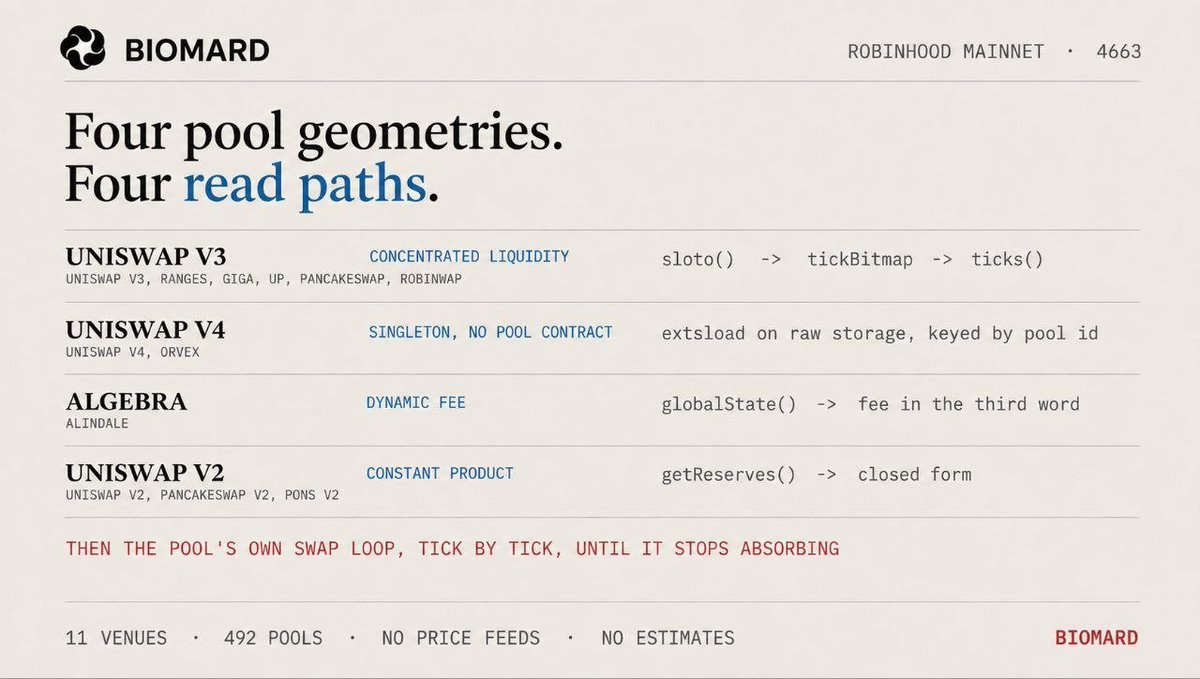
BIOMARD reads liquidity across 11 venues on Robinhood Chain, Uniswap v3 concentrated ticks, Uniswap v4 out of the singleton's raw storage, Algebra dynamic fees, constant product.
Then it walks each pool's own swap loop.