In light of the progress in mathematics, we at Edison Scientific and FutureHouse have assembled a set of Millennium Problems for Biology. They are chosen to be very hard to solve but very easy to validate in a simple laboratory environment. Any of these, if solved, would mark a major advance in biotechnology, and most of them would contribute materially towards curing disease. These are, in some sense, the “last reasonable eval” for AI in biology. This was work primarily by @MichaelaThinks and myself, with contributions from many others.
Short descriptions below. The full descriptions of the problems with acceptance criteria are at the Bio Millennium Problems website, linked in the next post. Share more if you have ideas. If they meet our criteria, we’ll add them to our list (with attribution and permission).
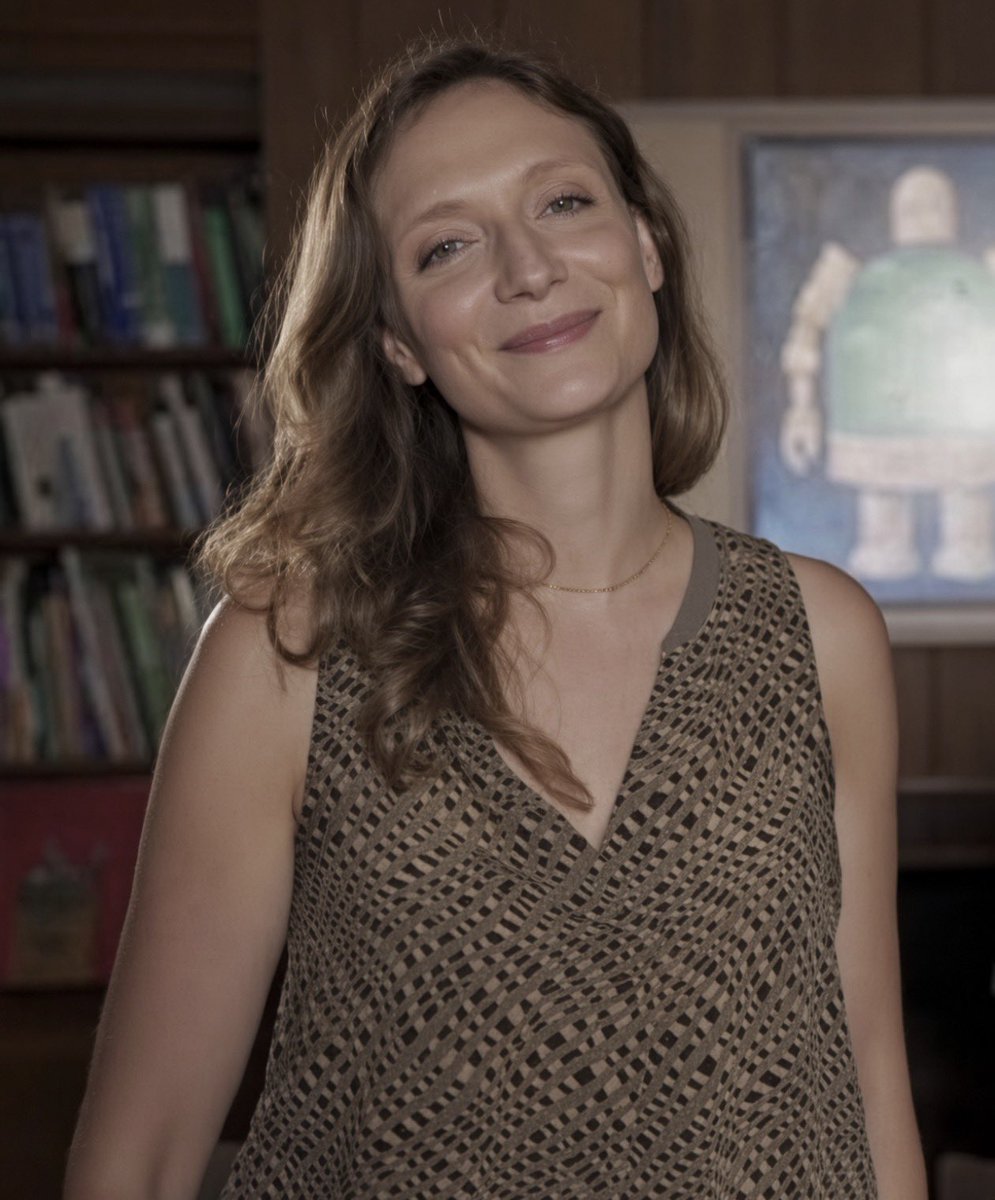
Historia, którą powinna usłyszeć cała Polska. Tworzony przez Polkę Zuzannę Stamirowską startup PathWay właśnie przekroczył pół miliarda $ wyceny ogłaszając fundamentalne odkrycie w obszarze AI. Firma Pathway stworzyła nowy model AI o nazwie BDH-CQ, który radzi sobie z logicznymi zadaniami znacznie taniej niż dotychczasowe systemy. Model ten jest miniaturowy, ma zaledwie 150 milionów parametrów, podczas gdy konkurencyjne modele są gigantyczne. Uzyskał on wynik 29.5% w popularnym teście logicznym ARC-AGI-1. To jest fenomenalny wynik. Koszt rozwiązania jednego zadania przez ten model to zaledwie siedem dziesięciotysięcznych dolara ($0.0007). Oznacza to, że jest około 11 razy tańszy w działaniu niż zaawansowany model GPT-5.6 Luna. Sekretem tej oszczędności jest porzucenie dotychczasowej architektury zwanej Transformerem. Tradycyjne sztuczne inteligencje „myślą na głos”, generując gigantyczne ilości tekstu pomocniczego, co zużywa mnóstwo mocy i czasu. Nowy model „myśli” w ukrytej pamięci wewnętrznej (w stanie utajonym), rozwiązując problemy bez pisania brudnopisu z pośrednimi słowami. Pokazuje to, że dotychczasowe wysokie koszty AI wynikały z wadliwej budowy systemów, a nie z praw logiki. To jest jedno z najważniejszych odkryć Polaków w ostatnich latach jestem co do tego absolutnie przekonany.
Historia Zuzanny jest przepiękna. Studiowała https://t.co/G4LG4pXrPI. ekonomię i politykę publiczną na prestiżowych uczelniach Sciences Po, École Polytechnique oraz ENSAE we Francji, a także w Sztokholmie. Tytuł doktora w dziedzinie systemów złożonych (Complex Systems) obroniła na Université Panthéon-Sorbonne oraz w Instytucie Systemów Złożonych w Paryżu. W 2020 roku powołała do życia startup Pathway (wraz z Janem Chorowskim i Adrianem Kosowskim). Z czasem Zuzanna i jej zespół przekierowali Pathway w stronę głębokiego rozwoju sztucznej inteligencji, rzucając wyzwanie dotychczasowym liderom branży.
Zuzanna robi to wszystko, łącząc życie zawodowe z życiem mamy, przyjaciółki to jest nie bywałe. Zuzanna ogromne, ogromne gratulacje. Ogromne.
@zuzanna_pathway
Short🧶Post przerywany, moda na jedzenie w wąskim oknie czasowym, na przykład tylko między dwunastą a ósmą wieczorem, przyciąga coraz więcej zwolenników, a coraz więcej badaczy sprawdza, co dzieje się wtedy z układem odpornościowym. To jeden z niewielu popularnych trendów
“The most important thing that’s going to happen in the world in the next 3-4 year is data centers in space” - @GavinSBaker
We have the first Nvidia H100 operating in space at @starcloud_ 🚀
Holy shit. MIT just built an AI that can rewrite its own code to get smarter 🤯
It’s called SEAL (Self-Adapting Language Models).
Instead of humans fine-tuning it, SEAL reads new info, rewrites it in its own words, and runs gradient updates on itself literally performing self-directed learning.
The results?
✅ +40% boost in factual recall
✅ Outperforms GPT-4.1 using data it generated *itself*
✅ Learns new tasks without any human in the loop
LLMs that finetune themselves are no longer sci-fi.
We just entered the age of self-evolving models.
Paper: jyopari. github. io/posts/seal
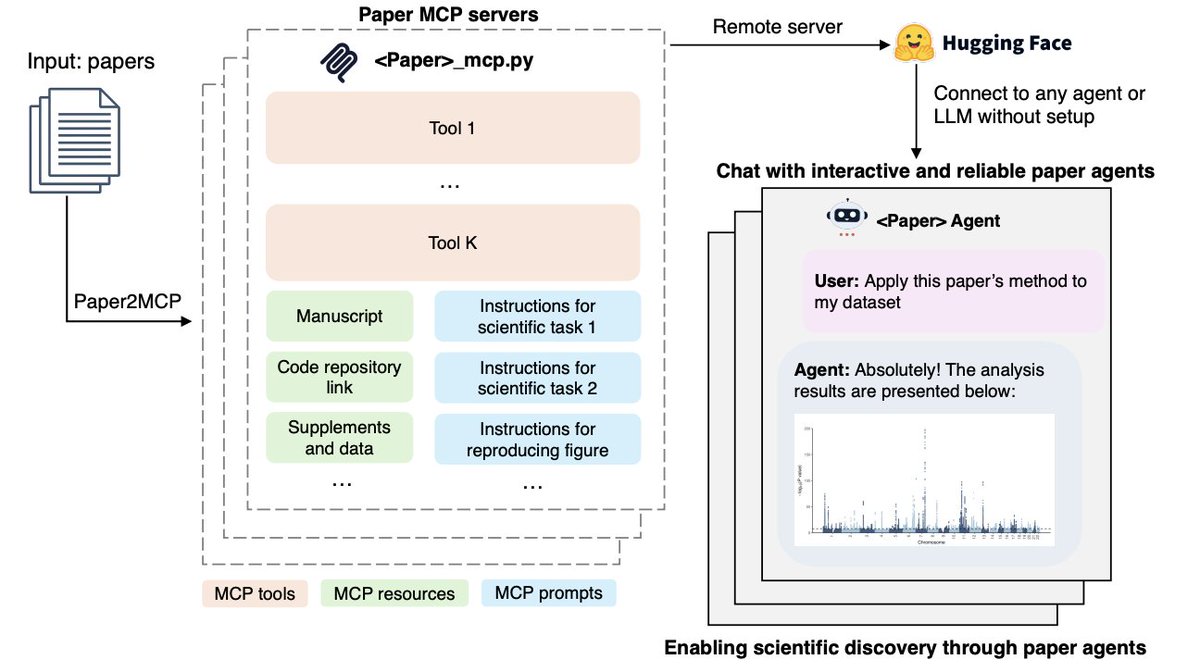
Holy shit...Stanford just built a system that converts research papers into working AI agents.
It’s called Paper2Agent, and it literally:
• Recreates the method in the paper
• Applies it to your own dataset
• Answers questions like the author
This changes how we do science forever.
Let me explain ↓
This MIT paper just broke my brain.
Everyone keeps saying LLMs can't do real logical reasoning. Turns out we've just been teaching them wrong this whole time.
These researchers built something called PDDL-INSTRUCT that actually teaches models to think through planning problems step by step. Not just pattern matching - actual logical reasoning.
Here's how it works:
Phase 1: show the model correct and incorrect plans with explanations. Basic stuff. Phase 2 is where it gets interesting. They make the model generate explicit reasoning for every single action, then use an external verifier to check if each step is logically sound.
The numbers are wild. Llama-3-8B jumped from 28% to 94% accuracy on planning benchmarks. That's not incremental improvement - that's a completely different capability emerging.
What's smart is they don't trust the model to check its own work. They use VAL, a formal planning verifier, to validate every logical step. When the model screws up, it gets specific feedback about exactly what went wrong.
The two-stage training is clever. First stage focuses purely on better reasoning chains. Second stage optimizes for actually solving the problem. This prevents the model from just gaming the metrics.
One finding caught my attention - detailed feedback destroys binary feedback. Just telling a model "wrong" vs explaining exactly which preconditions failed makes a huge difference. The gap is especially big on complex problems.
This isn't trying to replace symbolic planners. It's teaching neural networks to reason like symbolic planners while keeping external verification. That's actually sustainable.
The implications go way beyond planning. Any multi-step reasoning task could benefit from this approach. We might finally be seeing how to teach LLMs structured thinking instead of just sophisticated autocomplete.
Makes me wonder what other "impossible" capabilities are just sitting there waiting for the right training approach.
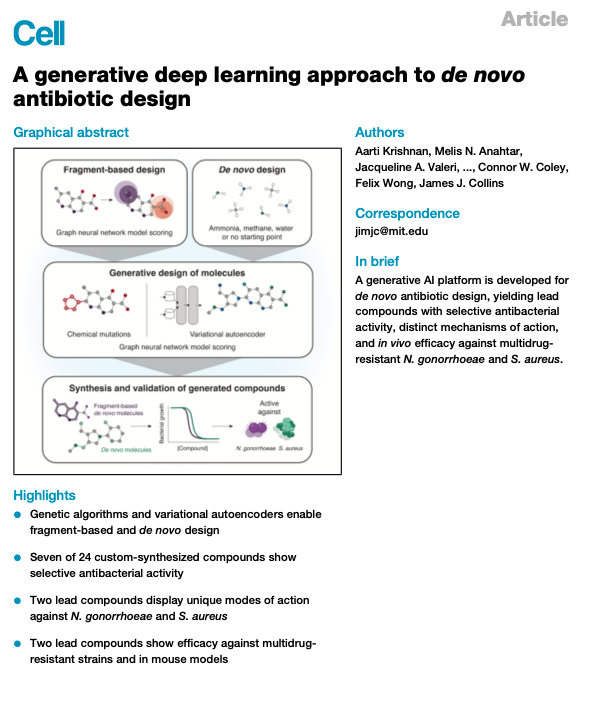
Two recent papers used deep learning to either create, or discover, new antibiotics.
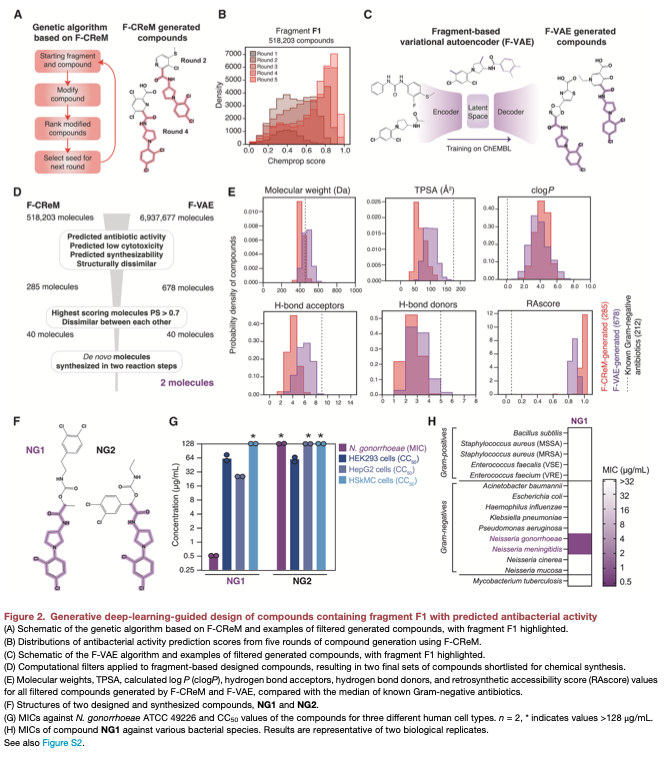
I'll first look at the paper that made new antibiotics from scratch (and then maybe write another post about the discovery paper.) The crazy thing about this paper, in particular, is that they screened 45 million chemical "fragments" entirely in silico and made a new antibiotic that is:
i) Structurally dissimilar from all known antibiotics.
ii) Seems to work through a mechanism of action to which resistance has not yet evolved.
...and also, importantly, the whole process is repeatable and could be adapted for other antibiotics.
More specifically: The team, from MIT (and now at Integrated Biosciences, Inc.) started with models that had previously been "trained and benchmarked on...growth inhibition data for 38,765 compounds screened against" two microbes: N. gonorrhoeae and Staph. aureus.
(The same group of researchers made that model for a previous paper, published in Nature in 2024:
https://t.co/7wOaRrcC2c)
Next, they built a database of >45 million chemical fragments "with chemically meaningful structures," and automatically compared them to a "manually compiled set of 559 known antibacterial compounds." They did this step to make sure that their generated batch of 45 million chemical fragments would stretch into chemical space that is not widely covered by existing molecules. They wanted to sample a wide swath of chemical space, in other words.
Then, the authors "virtually screened" this large fragment library using models called Chemprop, which predict whether each molecule is likely to have antibiotic activity. More than 1 million molecules passed this filter. After filtering out molecules likely to be toxic, and running other generative ML algorithms to refine these molecules, they obtained a few hundred molecules.
Finally, they selected 80 compounds that were "structurally dissimilar from each other and had the highest predicted antibacterial scores," of which just TWO could be synthesized with high purity. Those two molecules were called NG1 and NG2. (They tried to synthesize 27 compounds in total, but NG1 and NG2 were the only ones with purities >95%).
NG1, but not NG2, inhibited growth of N. gonorrhoeae in the laboratory. Also, it did not seem to inhibit other microbes, meaning it has a narrow-spectrum of activity. After doing some other experiments, the paper fairly conclusively shows that "NG1 is antibacterial against multidrug-resistant and pathogenic strains of N. gonorrhoeae, suggesting that it might act through a mechanism of action to which resistance has not yet evolved."
In other words, the authors made an antibiotic, using computational methods, that is extremely distinct, structurally, from all known antibiotics and which may act through an entirely uncharacterized mechanism. That is amazing.
Another cool thing about this paper is that the protocol to screen and make molecules is "modular," meaning you could theoretically run it again and again to find lots of antibiotics. The hard part is just building the training datasets for the graph neural networks in the first place. Keep in mind that the thing that made THIS paper possible is that these same researchers had previously collected wet-lab, experimental data on almost 40,000 compounds!
So that's the thing we probably need now for antibiotics: Huge efforts to collect wet-lab on various antibiotics, and random chemicals, against hundreds of microbial strains. All of these data should, ideally, be made public in repositories. Who is working on that?
Direct link to paper:
https://t.co/hsH9u2QBb4
ŻYCIE BEZ CELU – CORAZ WIĘKSZY PROBLEM SPOŁECZNY
Poniższy wątek jest chyba najtrudniejszym, jaki kiedykolwiek zamieściłem na tym portalu. Początkowo bardzo luźny felieton, będący zbiorem chaotycznych myśli – zamienił się w straszliwy i szkalujący paszkwil. Jako zaawansowany użytkownik chowu klatkowego, uwielbiam wyjść w niedzielę wieczorem na balkon.
Mam o tyle dobrą panoramę, że widać z niej przynajmniej kilkanaście wielkich bloków mieszkalnych. Kiedy nieco bardziej skupisz swój wzrok, to całkiem dobrze widać to, co ktoś obecnie robi w mieszkaniu. Nie nazwałbym tego przesadnym wścibstwem. Wręcz przeciwnie, po prostu za oknem widać przemijające cykle życia.
Sąsiedzi z tych budynków jeszcze nie wiedzą, że się znamy. Razem przeżywaliśmy porażkę ze Słowacją na Mistrzostwach Europy w 2021 roku, kiedy po osiedlu w osiemnastej minucie meczu przeszło siarczyste słowo polskie, a niejeden z nerwów machał rękami przed telewizorem.
Znaliśmy się podczas debat politycznych, które były wyświetlane na większości telewizorów. Najciekawsze są cykle pomiędzy 18:00 a 19:50 – wtedy są wiadomości na kilku stacjach. Nie wiem czy zdajecie sobie sprawę, ale czas włączenia programów informacyjnych mówi już wystarczająco dużo o człowieku. Doszliśmy do takiego poziomu polaryzacji politycznej.
Obserwujesz, jak z godziny na godzinę zaczyna być mniej świateł. Następują kolejne cykle życia, po żarówkach w oknach nauczyłeś się rozróżniać, kiedy są dni wolne i święta. Jeden artysta strzelił sobie w wigilię taki pokaz iluminacyjny, że jego balkon mógłby robić za drogowskaz na lotnisko.
Jednakże twoje luźne przemyślenia i obserwacje z czasem skręcają w dziwne obszary. Widzisz przed sobą budynki, w których mieszka kilkanaście tysięcy ludzi. Zadajesz sobie pytanie: "Czy nasze życie jest na tyle potrzebne, że gdyby wszyscy z tych bloków zniknęli – to ktoś by zauważył?"
Właśnie mogliście pomyśleć, że zwariowałem, a wyjście z tematyką bezsensu życia stanowi pewną przesadę. Nic bardziej mylnego, bo patrząc po statystykach, a także zachodzących zmianach społecznych - można odnieść wrażenie, że coraz więcej ludzi „obojętnieje”. Nie ma żadnego sensu i celu swojego życia. Zamienia się w zautomatyzowanego robota, którego przy życiu trzyma cykl świąt państwowych.
🧵⬇ W długim terminie prowadzi to do tragicznych skutków społeczno-gospodarczych, a my coraz bardziej tracimy sens swojego życia. Zapraszam na zwariowaną nitkę, która opisze skutki tego zjawiska od aspektów społecznych, po finansowe i gospodarcze. Zapraszam! ⬇🧵
Transformers have dominated LLM text generation, and generate tokens sequentially. This is a cool attempt to explore diffusion models as an alternative, by generating the entire text at the same time using a coarse-to-fine process. Congrats @StefanoErmon & team!
If you could only learn one thing that will be relevant for the next 10-20 years, focus on learning how to deal with data.
The future is not about faster hardware, smarter algorithms, or better ideas.
The future is about DATA, and those who know how to deal with it will stay relevant much longer than anyone else.
I recorded a video to show you how easy it is to get started.
In the video, I'm using @kestra_io.
For a long time, I was a fan of AirFlow. Then, I moved to AWS Step Functions. Today, I only use Kestra.
Kestra is open-source (repo link below) and kind enough to sponsor my work.
The video will show you how easy it is to do the following:
1. Run Kestra locally (literally, one command)
2. Build a simple flow
3. Run Python scripts as part of your flow
4. Connect to HuggingFace models
If you have never built a data pipeline, open Kestra's Quick Start Guide and follow their examples.
(I think it will take you one weekend to feel comfortable with the application and build the courage you need to get into more serious work.)
Introducing Agentic Object Detection!
Given a text prompt like “unripe strawberries” or “Kellogg’s branded cereal” and an image, we use an agentic workflow to reason at length and detect the specified objects. No need to label any training data. Watch the video for details.