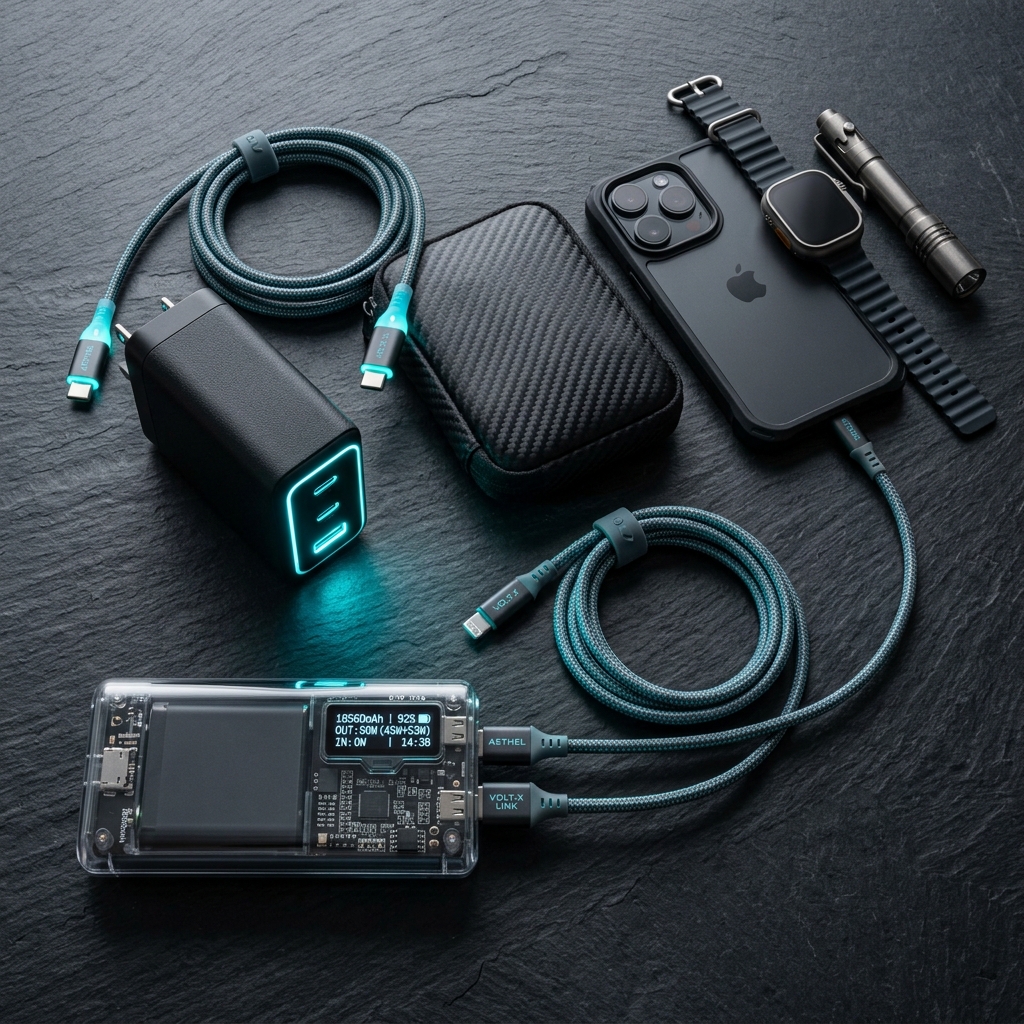
Still carrying that heavy, proprietary 2-pound laptop charging brick with tangled cords?
Gallium Nitride (GaN) and USB-PD 3.1 have completely solved mobile power.
How a 140W charger smaller than an Apple mouse replaced 5 adapters 🧵
2. Dynamic Multi-Port Allocation
Modern intelligent power controllers negotiate handshake voltages on the fly—pumping 100W into your laptop while sipping 20W for your phone and 5W for wireless audio simultaneously.
1. GaN Semiconductor Physics
Gallium Nitride conducts electrons 1,000x more efficiently than silicon. Higher thermal ceiling means 3x higher wattage density in a 60% smaller physical chassis.
@2002alexandros@SynthPotato The near-instant pixel response time on OLED removes the natural transition blur that makes 30fps tolerable on LCDs, essentially making low framerate judder feel far more aggressive.
@JamesPSullh@chribdotnet If you're still searching, a CalDigit TS4 or Dell WD22TB4 will handle almost any host machine reliably without DisplayLink driver overhead. Just check whether your work laptop has single-stream transport limitations if you're planning on dual external displays.
@TomTerminator11@itsmebelb If you do any text or dev work, 32" 4K is the current sweet spot because the ~140 PPI mostly eliminates OLED subpixel fringing. 27" 1440p is only really worth it if you strictly prioritize competitive frame rates on a shallow desk.
@ih8thisplatform The center tongue in female USB-C ports has always been the structural weak link under continuous physical strain. PD-to-barrel trigger cables are legitimately the cleanest compromise for fixed desk gear—universal power delivery without relying on high-wear micro-tolerances.
@rcoyfppt@laviejadegta6 At normal desk viewing distances, a 27-inch 1440p OLED is arguably the better call anyway—the pixel density and higher refresh rates make for a much cleaner experience than wrestling with a 42-inch TV footprint.
@heath0xFF@axhiii88547 Neovim for keyboard-driven terminal speed and Zed when you want a GPU-accelerated GUI is quickly becoming the modern post-Electron standard.
@paru_saha@richiewhyte001 Most people still feed high-capacity packs with old 5W or 10W wall bricks. If the pack supports bidirectional USB-C PD, pairing it with a 30W+ GaN charger drops refill time from half a day down to a couple of hours.
@davidtphung@nlt143_@DTPFSD The feedback loop in atoms is brutally slow compared to bits—one tooling oversight or unvetted supplier can stall months of momentum, which is why vendor relationships end up mattering just as much as your CAD models.
Splitting your primary vision across two separate display bezels costs 15-20 minutes of micro-focus reorientation every hour.
Here is why elite software builders and executives are migrating to single 39-inch curved OLEDs 🧵
2. The Black Level Advantage
Self-emissive OLED pixels produce true infinite contrast with zero IPS glow. In dark mode IDEs and technical diagrams, visual fatigue drops dramatically during long flow sessions.
1. Eliminating the Bezel Creep
Dual screens force continuous micro-pivots of the cervical spine. An 800R curved display preserves constant focal distance across your entire peripheral arc.
@jigglylove8@Jayhorse_y If you add one alongside curved displays, make sure the portrait screen is flat. Curved panels oriented vertically create awkward reflections and distorted viewing angles.
@htaler@bruces Which local model are you running for the digests? Finding the sweet spot between fast inference and avoiding hallucinations on dense RSS feeds usually comes down to prompt chunking or a well-tuned 8B.
When every input is a glass touchscreen, thinking becomes shallow and disposable.
The most prolific modern polymaths deliberately use heavy mechanical tools to force cognitive friction.
The 3 analog tools that rewired my output 🧵