Just came from a chat with one of our lead engineers and felt genuinely lucky. On our team, pair programming is not just about code quality, it is also about relationship building, and that part is easy to miss if you have never experienced good pairing. A lot of people, managers included, do not get this part, so it gets framed as two people doing one job, or it turns into this narrow productivity argument.
But the low stakes time together adds up. You build trust, shared language, and empathy, and then async work gets easier, coordination speeds up, and feedback lands better. It also helps with social isolation for some people. Remote work can be great, but it can get quiet, and having a built in way to collaborate really helps.
We try to use pairing on purpose, mix up who you pair with over time, and focus on work where two brains are actually better, debugging, tricky refactors, onboarding, and messy ambiguous problems. Counterintuitively, it can matter even more across time zones. When communication is mostly async, understanding your coworkers context and point of view gives the team that extra cohesion that people think remote work is missing.
One thing I don’t see mentioned much in the AI coding discussion is accessibility and ergonomics. After coding with help from LLMs lately, it stood out to me how helpful voice commands and dictation can be when dealing with RSI. Being able to work without your hands becoming the bottleneck makes such a big difference.
@dkirtley You currently run one of the most inspiring companies on the planet. Success or not, I really appreciate your and your team's extremely positive attitude. Thank you for that. It gives me hope for the future.
the enshittification of The Learning, Discovery, and History Channels in the last 20 years is a rarely talked about but extremely blatant sign of the collapse of civilization
This is interesting and shows that traditional numerical models still do better than ML models at forecasting record breaking weather extremes. Are we just looking at an OOD problem? https://t.co/E3X1kDTxe3
Diffusion models ≈ patch recombiners (https://t.co/BFqRllPRJE). To me, that makes some AI weather and super resolution tools look like analog forecasters in disguise: sharp at remixing history, but shaky when the atmosphere strays into gray swans and regime shifts.
https://t.co/5bKQqSH2QY
Interesting take on AI for fluid dynamics. Highly recommended read for anyone who is thinking about training models for solving PDEs.
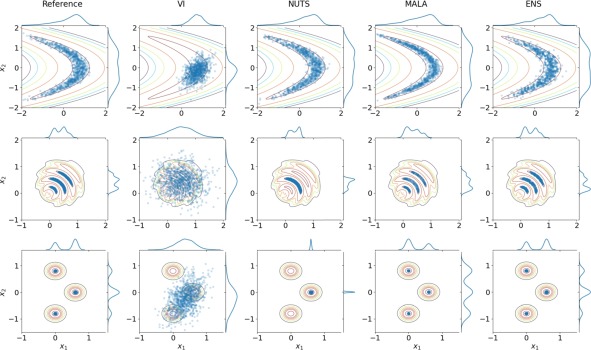
Gradients are overrated. We use score-based diffusion with particle ensembles to sample wild, non-Gaussian distributions. No gradients needed. Every day I’m sampling.
https://t.co/PKTNoy2opc
using diffusion models, we turn surface data into physically consistent maps of the ocean interior. stay tuned for applications.
https://t.co/SduCCO60Of