Many people hold Bitcoin as long term savings, believing it will grow in value over time. But there is a problem most Bitcoin holders eventually face - when you need money, Bitcoin is hard to use without giving it up.
If you need cash for expenses or an emergency you usually have two choices. You can sell your Bitcoin, which means losing future upside and possibly paying taxes. Or you can borrow against it through centralized platforms which means trusting a company to hold your Bitcoin safely
But What's the alternative way ?
MUSD was created to offer a better option.
Borrow against BTC at 1-5% FIXED
No maturity
No margin calls from humans
No centralized custodian
Pure onchain credit.
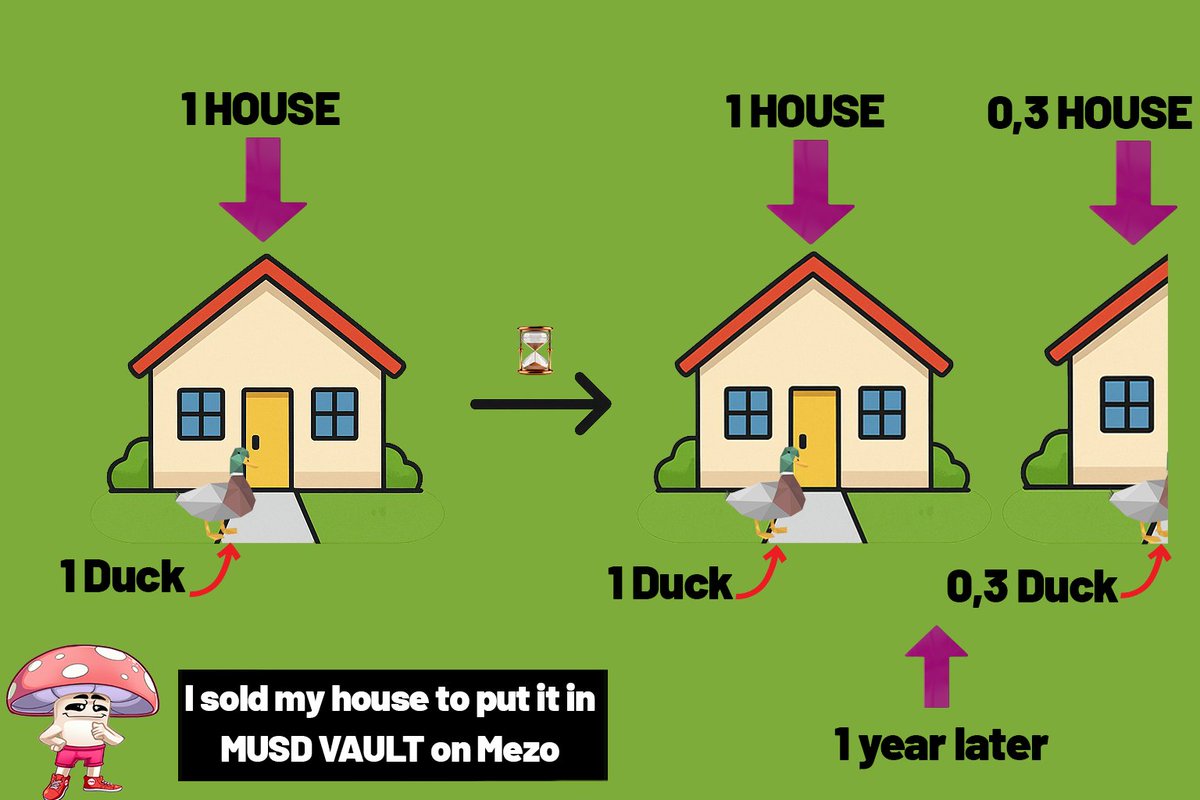
Stablecoin that is fully backed by Bitcoin. Instead of selling your Bitcoin, you can lock it into a smart contract and borrow MUSD against it. MUSD is designed to stay equal to one US dollar, so it can be used for everyday spending, savings.
MUSD is
- 100% BTC backed
- Overcollateralized (110%)
- Onchain liquidations
- No fiat, no banks
@RialoHQ Rialo is a vision taking shape
Built for innovation and community
Where technology meets purpose
Rialo stands for growth and value
The journey has just begun
What's the pendle buzz all around, and how to position for it?
Let's start by understanding -
Yield Tokenization - separates the principal and yield components of yield bearing assets into distinct, tradeable tokens. This allows users to trade the yield or principal independently, unlocking new financial strategies.
Standardized Yield Tokens - Pendle takes yield bearing assets and wraps them into a standardized format called SY. It ensures compatibility with Pendle’s AMM.
Splitting into PT and YT - Once wrapped into SY, the yield bearing asset is split into two separate tokens, Principal Token, Represents the underlying asset without its future yield.
PT holders are entitled to the principal value of the asset at a specified maturity date where you buy it at a discount and redeem it for the full principal at maturity.
Yield Token - Represents the future yield generated by the underlying asset up to the maturity date. YT holders receive the yield, as it accrues over time.
With the recent partnership between @pendle_fi and @Plasma some huge incentives to look out for 👀 ( $900k of $XPL )
What to ape and why?
1. PT -
Price rises in the short term with time
Falling implied APY
- Rising underlying asset price (and vice versa) Note that PT is always 1:1 redeemable to underlying asset at maturity date.
Why to ape PT?
-If you believe the asset will generate less APY in the future.
-If you want to hedge against falling yields.
-If you feel satisfied enough with the advertised APY.
-If you believe PT is too undervalued.
2. YT -
- yt Price rises with rising implied APY
- Rising underlying asset price
- Rising yield/reward token asset price
- Note that time works against YT as the price gradually falls over time to zero at maturity.
Why to ape YT?
- If you believe the asset will generate more APY in the future.
- If you want to hedge against rising yield.
- If you want to speculate on short-term rise of yield % or yield token prices.
If you believe YT is too undervalued.
Yields Yields and Yields
gPendle
Remember No YT caps until epoch 2
PTs wont earn caps, but YTs will in epoch 2
I'm going to flow with Ethereum’s newest darling stablecoin on Pendle.
gPendle
gCap
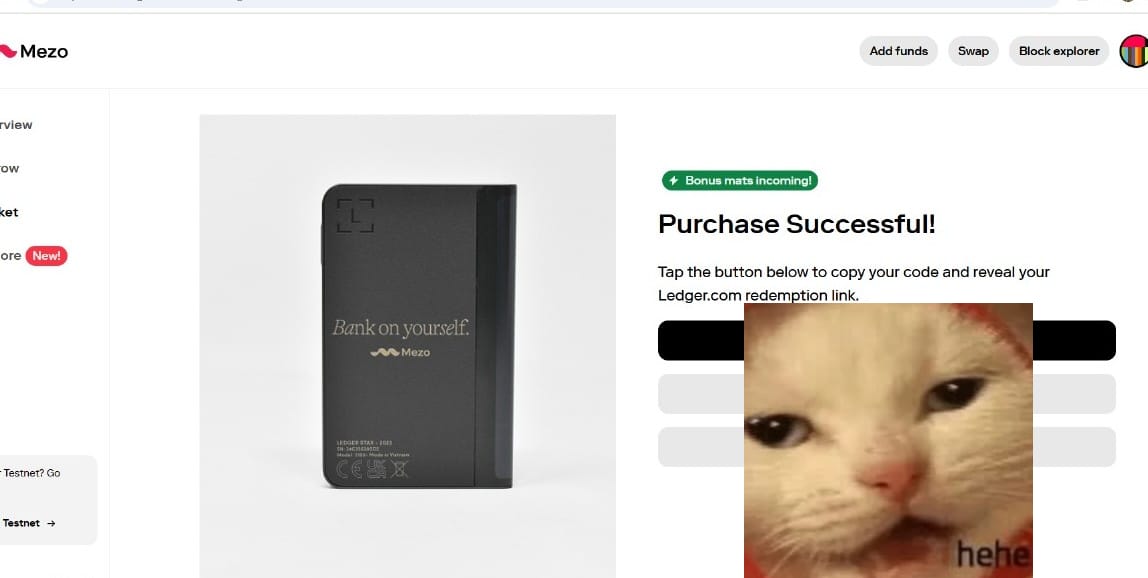
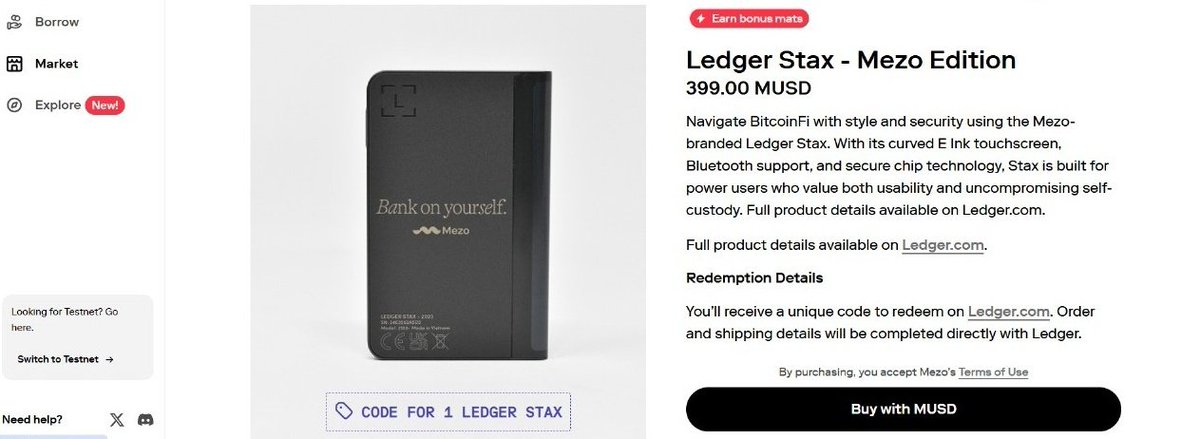
Let's explore the Mezo mainnet with me and sshhhh🤫 we will buy a Ledger Stax - Mezo Edition 🦆🍄
1. Just Jump into https://t.co/FzduK0UtBf and connect the btc wallet ex- Unisat.
Put btc on collateral.
2. Remember to minimize the liquidation risk, collateralised above 150%+ to create a buffer against the fluctuations.
3. Lock #BTC and Borrow $MUSD at fixed rates starting at 1% ,
You guys might be wondering is the stablecoin centralized?
The answer is NO, the stablecoin is fully backed by bitcoin so no centralized custody.
4. Head over to https://t.co/DfV9boTSWG to buy the item, you will get a code to redeem and boooommm you are done.
If you guys think it's too much amount to put into collateral well, I've another option for you.
1. Select evm wallet then Buy MUSD on eth chain, I'm sharing the contact below and pls cross check for safety.
Mezo USD (MUSD) - eth contract 0xdD468A1DDc392dcdbEf6db6e34E89AA338F9F186
2- Head over to https://t.co/UiSNb51Q4n
And bridge from eth MUSD to mezo MUSD , ps - please enable gas on mezo. That's it, now you can buy that Ledger stax - mezo edition.
Bank on yourself 🍄⚡
Ladies and gentlemen - BOROS { for trading funding rates on-chain}.
The launch of Boros by Pendle couldn’t have come at a better time, as the $USDe market cap crossed $10B+, they introduced a way to trade and hedge funding rates in DeFi.
A simple guide on what Boros is, how it works, and how traders, liquidity providers and institutions can maximize its potential.
1st lets dive into Funding Rates - Funding rates are periodic fees exchanged between traders holding long or short positions in perpetual futures markets.
When long positions dominate , long traders pay funding fees to short traders.
When short positions dominate, short traders pay fees to long traders.
It can impact profitability, when it comes to the volatile markets.
Boros - allows users to trade funding rate exposure for perpetual futures markets, starting with BTC/USDT and ETH/USDT from Binance.
It extends Pendle’s expertise in yield tokenization to funding rates, called Yield Units (YUs).
2nd- So what can we actually do?
- Traders can go long or short on funding rates, betting on their future direction without exposure to the underlying asset’s price movements.
- Can lock in funding rates to mitigate risks from rate fluctuations, especially useful for delta-neutral strategies.
- Boros Vaults allow LPs to supply liquidity, earning fees, $PENDLE incentives, and potential profits from rising implied yields
- It builds on Pendle’s existing $PENDLE and vePENDLE framework, with 80% of fees accruing to vePENDLE holders, enhancing value for long-term stakers.
3 - Whats next? lets Understand Yield Units-
It represent the realized funding rate yield for one unit of notional exposure (e.g., 1 ETH or 1 BTC) until maturity. similar to Pendle’s YTs but focus on funding rates rather than staking or lending yields.
Few main concepts that govern YUs -
- Underlying Yield - The annualized APR of funding rates on the perpetual futures market, reflects the actual fees traders pay or receive
- Implied Yield: The market-determined yield on Boros, driven by supply and demand for YUs. This is the price at which YUs are traded.
4 - Dynamics -
1 - Long YUs - You buy the Implied Yield to receive the Underlying Yield.
You can get profit - if the Underlying Yield exceeds the Implied Yield, increasing the YU’s value.
The Implied Yield rises due to market demand, boosting the YU’s price.
2 - Short YUs - you sell the Underlying Yield to receive the Implied Yield as a fixed APR.
Your profit if - The Implied Yield falls, reducing the YU’s price.
The Underlying Yield drops below the fixed Implied Yield you receive.
5 - How to trade here?
1 - Traders must deposit $WBTC or $WETH on Arbitrum to a Boros account
2 - Executed instantly or Executed at a specified Implied APR
3 - Up to 1.4x to 1.9x leverage is available, with liquidation risks similar to perp DEXs.
4 - Orders can be matched via an on-chain order book or Boros Vaults, which act as counterparties, providing liquidity and earning fees.
6 -
Boros Vaults - These are critical for liquidity, similarly to Uniswap V2 pools but tailored for funding rate trading.
Vaults consist of long YU and collateral (e.g. WBTC or WETH), meaning LPs take a long-biased position on YUs
- LPs earn fees from trades executed against the vault
- Pro-rata rewards based on order flow and notional filled
- LPs benefit if the Implied Yield rises, increasing the YU’s value
Risks - If Implied Yield drops, the YU’s value decreases
, LPs face losses if the YU-collateral ratio shifts unfavorably.
Had a question that Why Long-Biased Vaults?
Long YUs align with owning an appreciating asset rather than owing a liability (short YUs).
Betting on whatever PENDLE building.
Pretty excited what's @sigmadotmoney is building
Here is a simple guide -
It is a DeFi platform with an aim to put idle BNB to work in a sustainable, decentralized way.
Need a breakdown? Here it is -
bnbUSD - a fully decentralized stablecoin backed by collateral BNB It maintains a reliable 1:1 peg to the USD. It integrates seamlessly with leading BSC DeFi protocols like PancakeSwap allows users to extract liquidity from collateral and generate sustainable on-chain yield.
Core Features-
- xPOSITION Vault: Users can deposit BNB or slisBNB to mint bnbUSD This vault enables users to leverage their assets.
- Dual Stable Stability Pool : maintains bnbUSD’s peg through arbitrage and acts as a volatility buffer, while also offering yield opportunities for participants.
- Points System: Early adopters are rewarded with points, incentivizing participation and community growth during the launch phase.
With the recent partnership with pendle, they are growing pretty steadily and also some opportunities to look out 👀
Strategy 1-
Providing Liquidity on Pendle,
Choose your asset (sigmaSP, USDT, or bnbUSD).
Input the token amount to deposit as liquidity.
Liquidity provision earns high APYs and points for future airdrops.
Strategy 2- buy YT for future airdrop i.e Speculate on yield and earn points by buying Yield Tokens (YT)
Holding YT earns 6x Sigma Pendle points (0.012 points per YT).
YT lets you boosts your airdrop potential.