Two predictions that will become overwhelmingly obvious over the coming 24 months:
- Technology companies will be evaluated more like Oil and Gas/Industrial companies, where the distinguishment between growth capex and maintenance capex will be more commonly discussed in earnings calls and net income gets supressed in the short term while return on invested capital has a lag of 18 months+
- There is a warpath to who will become the first $10T company, is it the chipmaker or the infrastructure owners?
Looking at the landscape for hyperscalers right now, it’s clear that we are witnessing a fundamental shift in how the global economy’s backbone is built. While a lot of the focus is on who will be the first $10T company, the reality is that the entire cohort of hyperscalers, Alphabet, Amazon, and Meta will be engaged in a massive "land grab" for real estate to power the age of AI.
They are essentially the landlords of the future, building out the data centers and infrastructure that every other industry will have to rent just to function in an AI-driven world.
When I look at the data across these giants, the scale of capital expenditure is staggering, but it’s a mistake to view it through a traditional lens. People often panic about overspending or an "AI bubble," but when you compare operating margins and cash flow across these companies, you see a level of dominance that is historically unprecedented. Using quantitative analysis to strip away the noise shows that these aren't just tech companies anymore; they are the core utility providers of the 21st century. Whether it's Alphabet’s search dominance or Amazon’s cloud reach, the floor for these stocks feels much more solid than the "perma-bears" want to admit.
There’s a lot of skepticism in retail sentiment right now, which I actually find encouraging. Usually, when people are this hesitant or focused on short-term volatility, it means the real move hasn't even fully materialized yet. We’re looking at a decade-long trajectory where the shift in data center demand replaces older industrial cycles. It’s not just about one company winning; it’s about a handful of giants like Microsoft, Meta, and Amazon providing the essential infrastructure for everything else to run. The consistency in their earnings reports over time points to a growth story that is far from over, despite how large they already seem.
One item that continues to drive the uncertainty tho is how much will maintenance capex grow to be? It will start off small, but will it grow to 30%? 50%? And what is a sustainable growth capex environment look like - considering the supply and demand curve? All of this heavy capex will compete for the ops cash in the organizations that were previously low capital intensity with higher margins. Buybacks and dividend growth will be slowed down until company cash flow and ops cash growth certainty materializes (36 months from now).
At the moment big tech makes it seem like the returns are almost instantaneous, but are they? Are the backlogs that expansive? Or will it take 18-24 months before seeing the capex lag show up as ops income growth?
Regardless, the market views it as uncertainty pushing down the prices in the short term, as deprecation gets accelerated and a divergence shows up in ops income and net income statements over the coming 12-24 months.
Over the next 36 months, the uncertainty will wane and my prediction is the companies will experience a wave of new ops cash influx in likes we have never seen, with a ramp up to full returns on invested capital taking likely 36-48 months.
At this point how the capital frames on how these companies operate going into the 2030s will be understood and retail along with institutions will begin to give them premiums again (as the moats will be worth trillions alone).
I will explain more in a video released at 8am on my YT channel.
https://t.co/9BKS5ReexO
$GOOGL $MSFT $AMZN $META
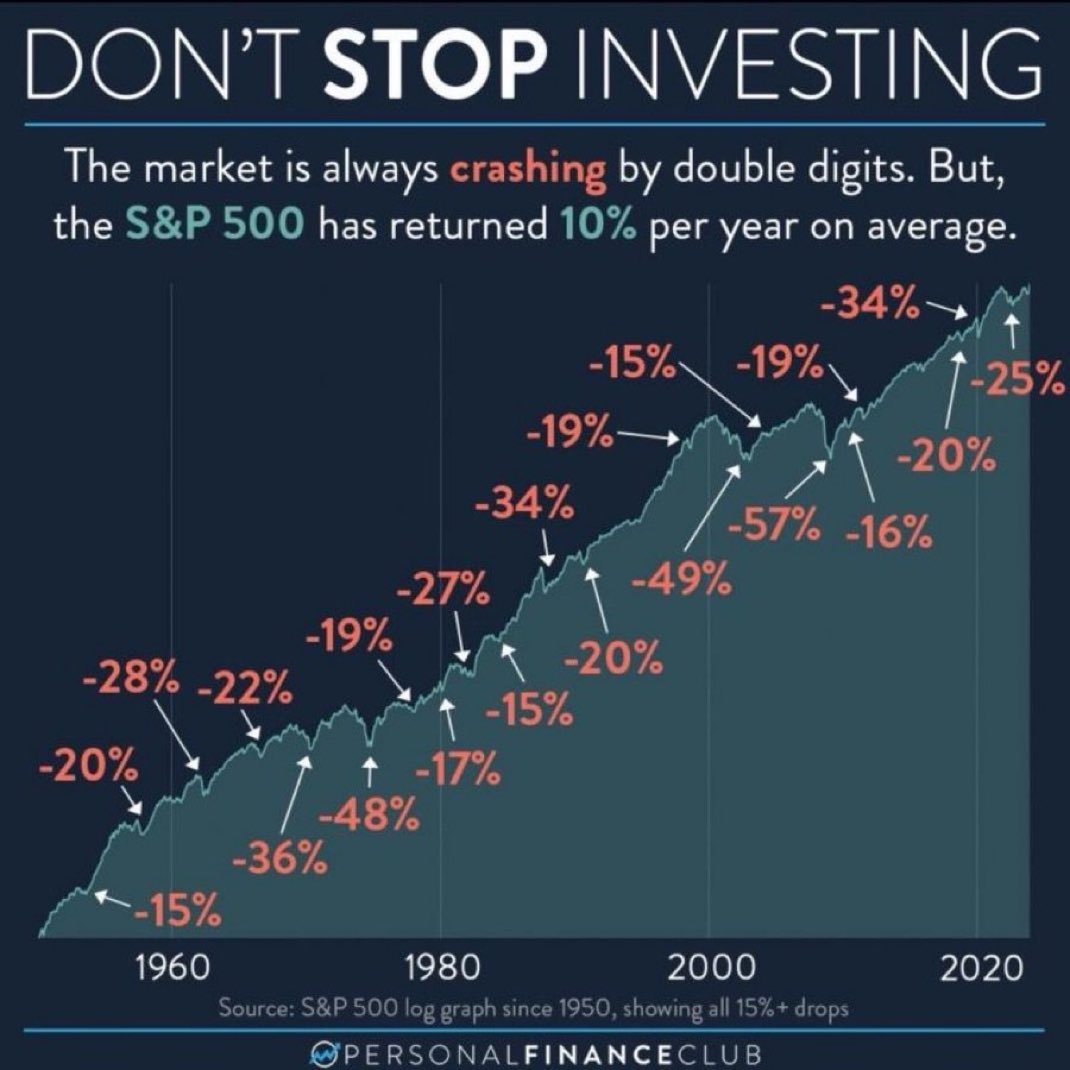
This is one of the best photos I have seen regarding investing. The reality is time in the market will always beat timing the market in the long run.
If you’re a longterm investor embrace volatility and uncertainty rather than freaking out over it.
$VOO is my favorite S&P 500 index fund but if you’re going to utilize the options market $SPY has way more chains.
I asked @DivesTech how he built a $2B company in 1 month.
With $ORBS he's chairing the Microstrategy of WorldCoin, aiming to amass 8% of supply.
"For me covering tech...[World] is one of the most underestimated technologies"
Is World the next asymmetric AI trade? Find out 👇
@amitisinvesting The this is i am worried/bearish but how am I positioned? 100% invested...so I would be interested to see if the majority of people are bearish in sentiment but 100% invested in reality
$META $MSFT
Not sure how to even react to Meta and Microsoft earnings other than realizing that AI is more real than we all could have imagined.
Two multi-trillion dollar companies moving $400B after hours? Both companies beating revenue by $3B more than expectations?
The analysts thought they understood how fast this world was moving but $META and $MSFT basically told the world that we have no clue about how serious the shift to AI in this new economy will be.
I don't own either but I am pretty heavy in $NVDA, so the fact that the street piled into Nvidia off their earnings for the sheer sympathy of realizing that it all goes back to Nvidia only further reinforces how massive those earnings were.
Not sure if they hold the pump, especially going into a historically weak August, but when you see earnings like that...
Every. Dip. Gets. Bought.