🔬 Beyond Exosomes—What’s Next for EV Research?
EVCNA welcomes submissions to our Special Topic on advances in EV biology, heterogeneity, engineering, diagnostics, therapeutics & translational applications.
📝 Original Research & Reviews welcome!
🔗 https://t.co/7XDPSNmlgo
🧬How do #EVs shape the tumor microenvironment?
This study highlights exosomal LYPLAL1-DT as a mediator of bidirectional communication between small cell #lungcancer and endothelial cells, promoting tumor progression and angiogenesis. 🧬🔬
Discover:
https://t.co/tQXwk6pKeu
📢 New Special Topic in EVCNA!
🧬 Extracellular Vesicle-Mediated Communication in the #Gut–Liver–Brain Axis
Explore how #EVs regulate peripheral inflammation, neuroinflammation, and neurological dysfunction.
👤 Guest Editor: Dr. Vicente Felipo
https://t.co/q3Q3c3Pi0a
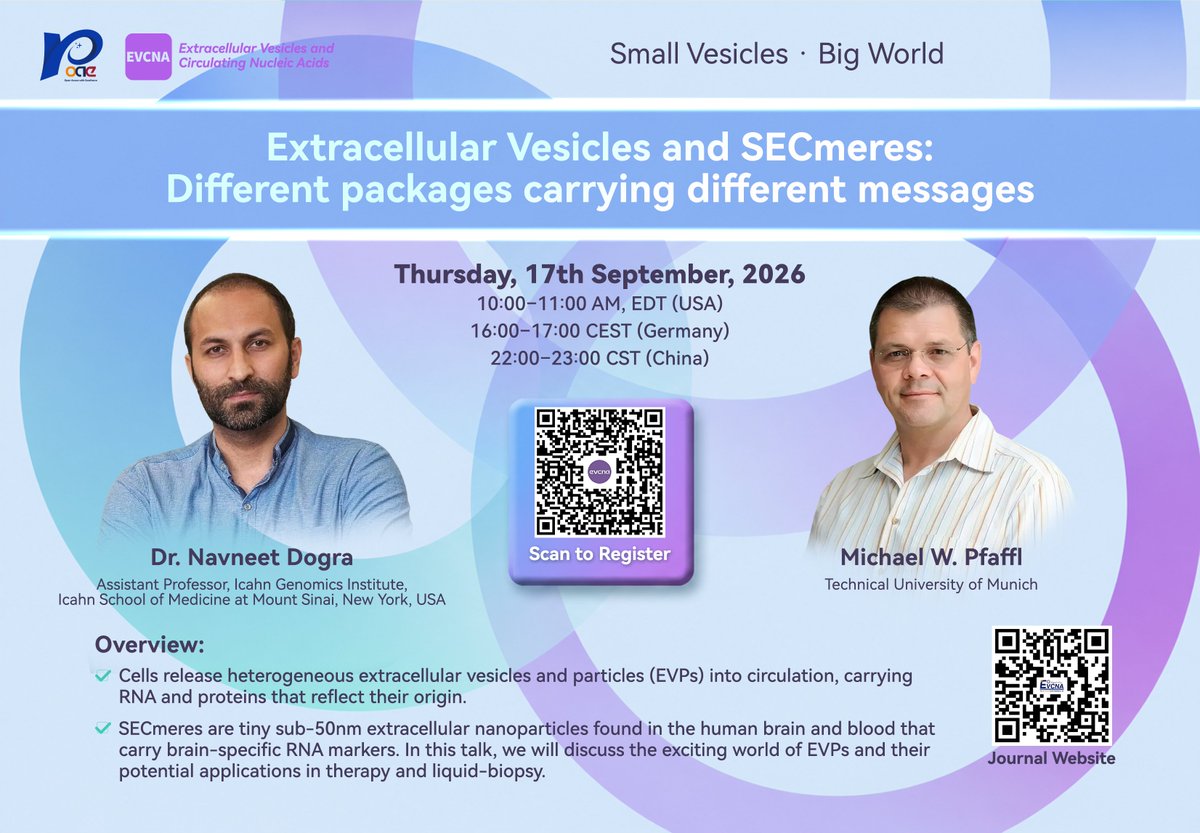
🚀 What messages do #extracellularvesicles carry?
Join the EVCNA Roundtable on Sep 17 to explore EVPs, SECmeres, brain-specific RNA markers & liquid biopsy with Dr. Navneet Dogra, moderated by Prof. Michael W. Pfaffl! 🔬
📅 Sep 17 🧬
👉 Register now!
https://t.co/aXKHDPthrp
Le nom du lac Ontario tire son origine du mot wendat « Ontari’io », qui signifie « le lac est beau, le lac est grand ».
Ce nom remonte à plus de 400 ans, bien avant la Confédération canadienne et la Déclaration d’indépendance des États-Unis d’Amérique.
Nous savons que les États-Unis sont en train de changer. Leurs relations commerciales, leur politique étrangère, leurs monuments nationaux, leurs hydronymes.
Les Canadiennes et les Canadiens savent aussi qu’il faut appeler les choses par leur nom, et ce lac se nomme Lac Ontario – aujourd’hui et pour toujours.
Extracellular vesicle secretion is closely tied to autophagy and lipid metabolism, helping determine whether cellular material is degraded or released. -@NIH https://t.co/qe6rdc3hQo