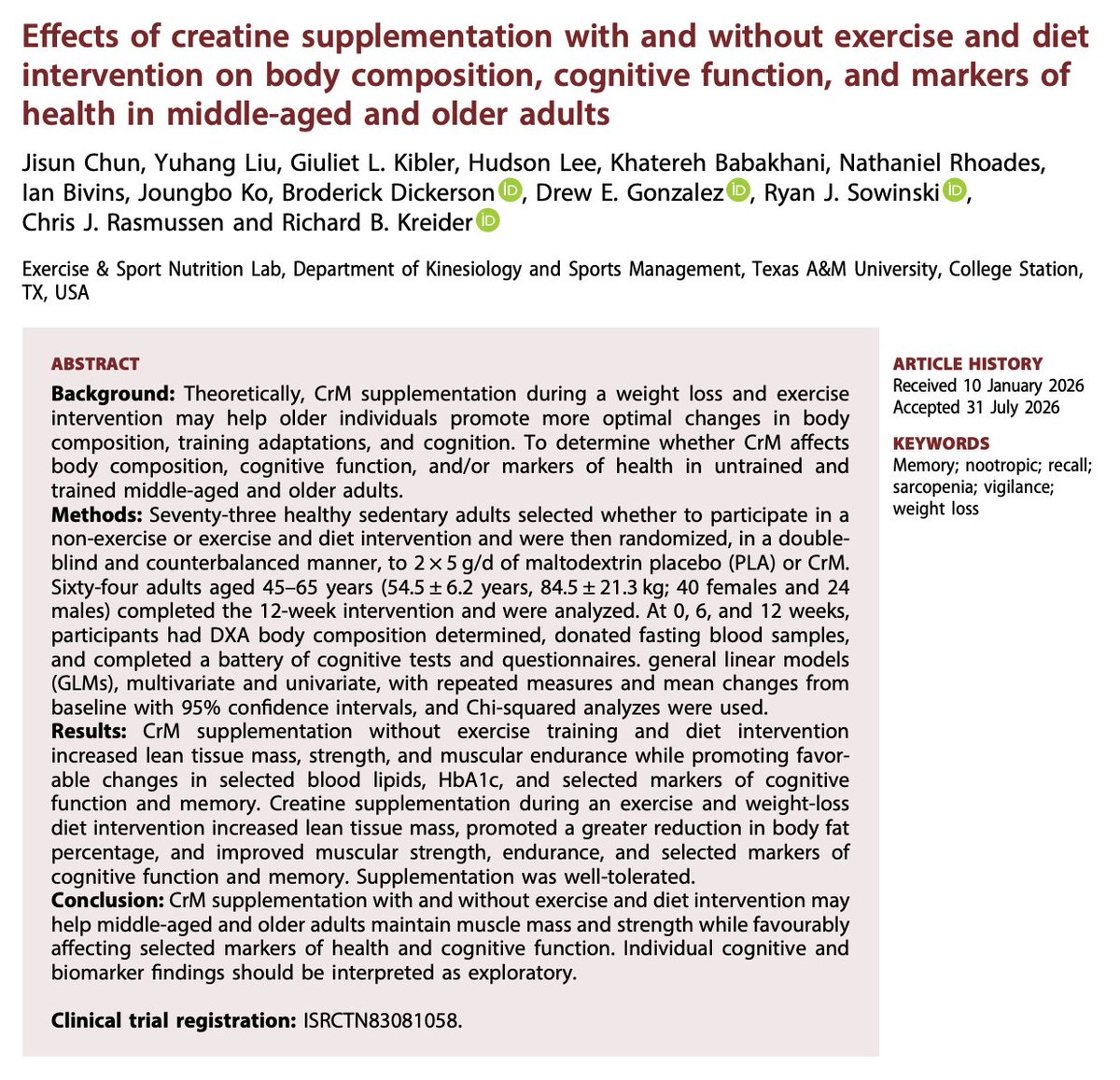
This new creatine study is insane.
People who never trained took 10g of creatine a day and gained more lean tissue (2.43 lbs) than people who were lifting 3x a week with no creatine (0.31 lbs).
Here's the breakdown: (1/18)
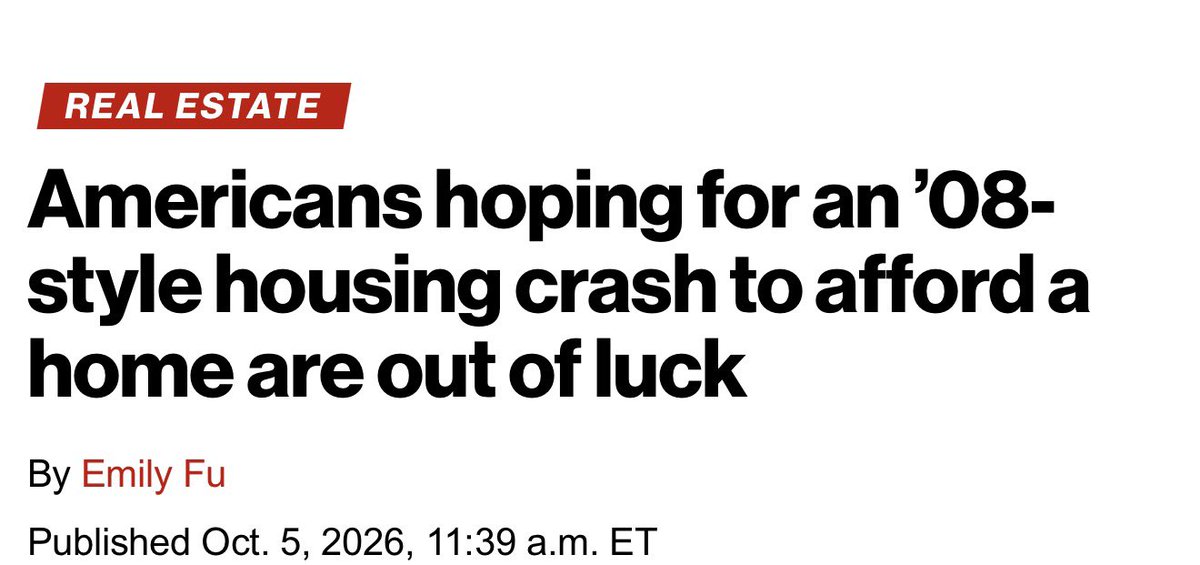
⚡️The real outcome is a housing caste system built around mortgage vintage.
People who bought before the rate shock are sitting inside subsidized financing that no longer exists. They own the asset, they own the cheap debt, and they have almost no reason to surrender either.
Everyone arriving afterward faces the same house at a radically higher monthly cost.
That freezes the market.
Sellers do not sell.
Buyers cannot buy.
Builders cannot create enough genuinely affordable supply because land, labor, materials, insurance, and financing are all expensive.
Prices therefore do not need to collapse nationally for the system to become deeply dysfunctional.
The likely path is uglier in a slower way:
transaction volume stays weak
→ affordability remains terrible
→ younger households rent longer
→ household formation gets delayed
→ existing owners keep compounding equity
→ ownership becomes increasingly inherited
→ regional markets with too much supply or investor ownership break first
→ the national median hides enormous local damage
That is the part people keep missing.
A 2008-style crash would actually clear the market faster.
This regime can lock people out for years.
And high rates make the divide worse because the owner with a 3% mortgage is protected while the entrant has to borrow at 7%+.
So the housing market increasingly rewards when you entered the system, not merely how much you earn today.
That is a profound social shift.
The next major break comes when forced sellers finally appear.
Unemployment.
Credit stress.
Investor capitulation.
Insurance shocks.
Divorce, death, relocation, refinancing pain.
Once enough owners can no longer choose to wait, inventory finally meets the market-clearing price.
That is when nominal prices fall harder.
But until forced supply becomes broad, the national housing market can remain frozen far longer than people expect.
So deep down:
The coming housing crisis is more likely to be exclusion than liquidation.
Millions of people will be able to afford life, but not entry into the asset that historically created middle-class wealth.
That changes family formation, mobility, wealth transfer, politics, and eventually the meaning of the American middle class.
A crash destroys prices.
A freeze destroys access.
And access is what is breaking now.
⚡️The real event is the collapse of the white-collar apprenticeship economy.
The junior analyst, associate, consultant, paralegal, accountant, recruiter, researcher, coder, finance professional, and coordinator were all expensive because competent cognition was scarce. AI is erasing that scarcity.
Within five years, a huge share of that work will simply stop being purchased from humans. The exact corporate mechanism will look deceptively boring: smaller incoming classes, vacancies left open, fewer backfills, one senior person running what used to require five juniors.
So the labor statistics will lag the reality.
The more important break comes afterward.
Those junior jobs were how people became senior people.
A first-year lawyer reviewed documents and drafted language until pattern recognition formed.
A banking analyst built models and decks until transactions became intuitive.
A finance analyst reconciled numbers until the business became legible.
A consultant researched industries until judgment developed.
AI consumes the training substrate.
That means the career ladder loses its bottom rungs.
Then firms start hiring fewer people at the bottom while expecting the survivors to operate much closer to senior level immediately. The funnel gets brutally narrow.
That creates a strange second-order shortage later: AI can replace junior production faster than institutions can replace human judgment formed through years of apprenticeship.
So the professional class bifurcates.
At one end: a small number of humans directing enormous machine capacity, owning decisions, relationships, capital, trust, and accountability.
At the other: millions of educated people discovering that being smart, diligent, credentialed, and competent no longer guarantees economic scarcity.
That is the real earthquake.
And it reaches universities next.
A $150,000 degree made sense when it purchased entry into a protected cognitive labor market. Once the entry jobs disappear, the degree loses part of the asset it was selling.
Then wages.
Then urban professional economies.
Then commercial real estate.
Then tax bases.
Then family formation.
Then politics.
The shock propagates far beyond employment.
The deepest shift is simpler:
For most of modern history, human cognition was capital.
A company hired people because useful thinking could only be obtained by hiring minds.
Now useful thinking can increasingly be rented by the token.
That changes the economic status of intelligence itself.
Once intelligence becomes infrastructure, the premium moves toward what remains scarce after intelligence becomes abundant:
judgment
ownership
trust
capital allocation
relationships
taste
responsibility
access
the ability to choose the right objective
The professional middle class was built on the scarcity of competent cognition.
AI is removing the scarcity beneath the class.
That is what is actually happening.
my favorite literary Westerns:
1. BLOOD MERIDIAN, McCarthy
2. DESPERADOES, Ron Hansen
3. BUTCHER’S CROSSING, John Williams
4. TRUE GRIT, Charles Portis
5. ALL THE PRETTY HORSES, McCarthy
6. THE SON, Philipp Meyer
7. WARLOCK, Oakley Hall
⚡️The strongest explanation is younger generations are accumulating colon damage earlier because the modern food and metabolic environment changed faster than human biology could adapt.
Ultra-processed food, low fiber, obesity, insulin resistance, antibiotics, and microbiome disruption are probably the core stack. They act together for decades, increasing inflammation, DNA damage, and abnormal cell turnover.
Older people are improving largely because screening removes precancerous polyps before they become cancer.
So the pattern is brutally simple:
the carcinogenic environment got worse earlier in life, while prevention got better later in life.
The exact ingredient causing the biggest share is still unresolved. The system-level cause is much clearer than the single culprit.
In this era of artificial intelligence, it is becoming urgent to distinguish human art from what machines produce. There is an ontological difference, even before an aesthetic one, between art and what a machine can generate through statistical calculation based on millions of images created by others. Algorithms lack the spark of humanity. For this reason, the Church wishes to renew an alliance with artists and cultural institutions to safeguard our humanity.
Excited to announce @SurvivorSweat as the Official Marketplace for @CircaSports Football Contests.
Our contests grew to over $38.7 million in 2026 and this partnership adds a whole new way for a customer and participant to manage their entries throughout the season.
Learn more at https://t.co/DWrlGhXRwU
Saint Michael the Archangel,
Defend us in battle.
Be our protection against the snares and wickedness of the Devil.
May God rebuke him, we humbly pray.
And do thou, oh Prince of the heavenly host, by the power of God,
Cast into hell Satan, and all evil spirits,
Prowling throughout the world,
Seeking the ruin of souls amen.
Fernando Mendoza signed a rookie contract in July worth $57.27 million. Fully guaranteed. He is 22 years old.
This week he announced what he is doing with his rookie season.
He is starting a series called Finance with Fernando to teach people his age how to handle money.
His words in the trailer.
"My true passion is fiscal responsibility."
He is not bluffing. He graduated from the Haas School of Business at Berkeley, and he is finishing a master's in business administration in December.
Here is how he got to the point where a 22 year old can say that.
All four of his grandparents left Cuba for Miami in 1960.
He grew up in Miami and played at Christopher Columbus High School. In two seasons as the starting quarterback he threw for 1,396 yards and 16 touchdowns. Total. Nobody was building a recruiting class around that.
He committed to Yale.
Then another recruit's decision opened a door at California, and he went to Berkeley instead. He redshirted in 2022. He started eight games in 2023 and eleven in 2024.
Then he hit the portal and went to Indiana, a program that had gone 9-27 in the three years before Curt Cignetti showed up.
What happened next does not really happen.
Indiana went 16-0. Mendoza threw 41 touchdown passes, a school record. They won at Oregon. They beat No. 1 Ohio State for the Big Ten title.
Rose Bowl against Alabama, he went 14 of 16 for 192 yards and three touchdowns in a 38-3 win. Peach Bowl against Oregon, five touchdowns.
Then the national championship game, against Miami. The school in his own hometown.
Indiana won 27-21. He was the offensive MVP.
First Heisman Trophy in Indiana history. First national championship in Indiana history.
Then the Raiders took him first overall. He wears number 15 for Tom Flores, who gave him his blessing to use it.
And right now he is sitting behind Kirk Cousins.
So instead of waiting around, he is finishing the MBA and starting a personal finance series for people who have never had money and are about to.
One more thing worth knowing about him. His mother Elsa lives with multiple sclerosis. He and his brother worked with restaurants to put items on the menu that raise money for MS research.
Turn on any sports broadcast in America right now and count the sportsbook ads.
The number one pick in the draft started a show about not losing your money.
Children whose parents read to them before age five develop stronger language networks in the brain. A 2018 study in Developmental Science found that children exposed to more reading at home showed greater connectivity between the brain regions that process language, even before they could read a word themselves.
The study used structural MRI to measure white matter tracts in the brains of children between ages four and six. The children whose parents read to them more frequently had stronger connections in the left-hemisphere language pathways, particularly in the arcuate fasciculus, the bundle of nerve fibres that connects the regions responsible for understanding speech and producing it.
The parents were not teaching reading. They were reading aloud, doing the voices, pointing at pictures, and answering questions. The child's brain was building the wiring that would later support independent reading, and it was building more of it in homes where the nightly story was a habit.
The effect was dose-dependent: more reading meant stronger connections. And it was independent of income and parental education after those factors were controlled for. A wealthy family that did not read to their child had weaker language pathways than a lower-income family that read every night.
The bookshelf in the bedroom is brain infrastructure. The study says every night you sit on the edge of the bed and open a book, you are laying fibre-optic cable inside a skull that has not yet learned to use it. The cable will carry every word the child ever reads, speaks, and understands. https://t.co/y8mkJjy0Qv
Children who eat dinner with their family most nights do better in school, have fewer behavioural problems, and are less likely to develop eating disorders. A 2023 umbrella review in the journal Nutrients combined the results of 57 reviews and found that family mealtimes were consistently linked to better outcomes across every domain measured.
The review found that children who ate with their families regularly had higher fruit and vegetable intake, lower rates of obesity, better academic performance, and fewer symptoms of depression and anxiety. The association held after controlling for income, parental education, and family structure.
The mechanism is not the food. It is the conversation. Family dinner is one of the few remaining settings in modern life where a child sits with adults, without a screen, and practises talking, listening, and being heard. The vocabulary exposure alone is significant: children at the dinner table hear a wider range of words than children who eat alone, and vocabulary at age five is one of the strongest predictors of academic success.
The review also found that the quality of the meal mattered less than the fact of sitting down together. A takeaway pizza eaten at the table with conversation produced similar benefits to a home-cooked meal. The key variable was the shared time, not the menu.
Nobody has time. Everybody is tired. The research says that twenty minutes at a table, phones off, food on plates, talking about nothing in particular, is doing more for your child's brain, body, and mental health than most interventions that cost money and require appointments. https://t.co/py5zRyOIcb