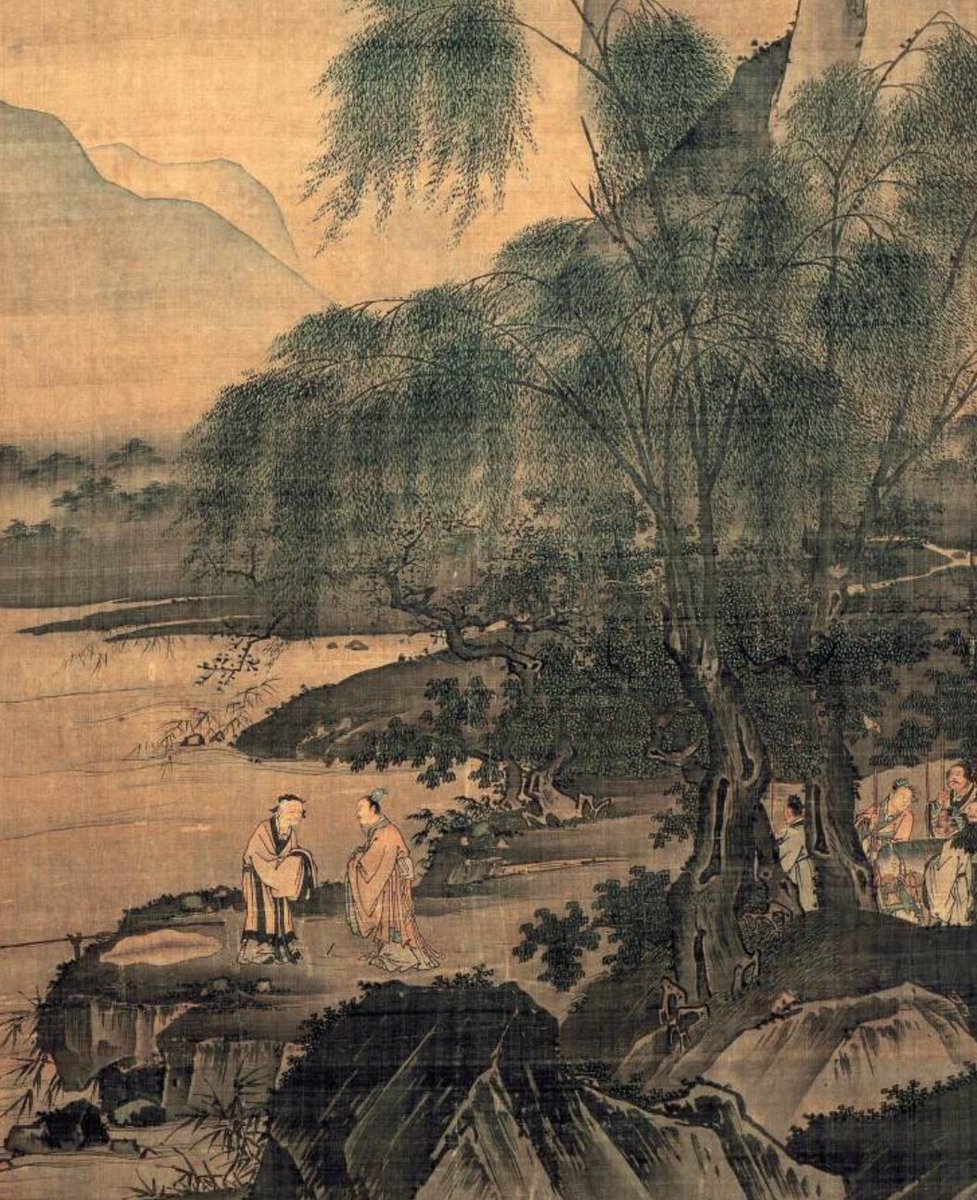
In the Ming Dynasty, painter Dai Jin (戴進, 1388–1462) captured a legendary moment in "Fishing by the Weihe River" (《渭濱垂釣圖》): King Wen of Zhou visits the recluse Jiang Ziya, who fishes with a straight hook—not for fish, but for talent to recognize him. The king invites him to serve the state. For centuries, this scene echoed the dream of scholars: to be found by a worthy ruler and called from solitude into purpose.
#painting #art
It took 28 years to build this massive statue of the Hindu god Vishnu riding a mythical bird.
Garuda Wisnu Kencana in Kuta Selatan, Bali, is Indonesia's tallest statue.
[📹 cojocaru.alexandra.gabriela]
https://t.co/S308icus4w
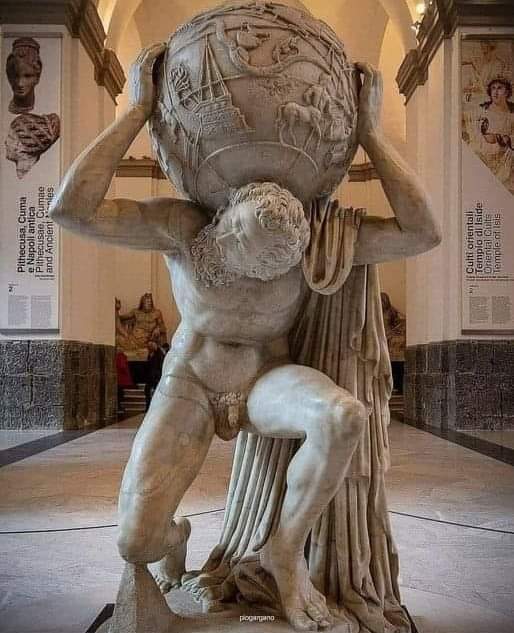
Farnese Atlas; a marble statue 1.85m high, dating back to 250 AD in the Antonine age, kept in the National Archaeological Museum of Naples.
The statue was found at the Baths of Caracalla in Rome around 1546, its author is not known. It represents a bearded man who tries with all his strength to support the celestial globe. The naked body shows its powerful muscles in extreme effort.
The equator, the ecliptic with the band of the 12 signs of the zodiac, the chlorides (2 meridian circles that pass through the poles and the points of the solstices and equinoxes), and the two polar circles are represented on the globe.
The Atlas takes on a further meaning: the Atlas is like the emperor, he supports the weight of the celestial vault just as it supports the empire.
#drthehistories
'Our Blacksmith,' was George Clausen's major exhibit at the Royal Academy exhibition of 1931 - the scene was painted in a forge in Essex where smithies were still active in the early 20thC and is arguably his most dramatic painting of human industry.
Ancient Egyptian pharaohs were not merely rulers; they were considered divine beings, the living embodiments of gods on Earth. Their names were imbued with profound significance, reflecting their divine status, their role as sovereigns, and their connection to the cosmos. The names of pharaohs were not just arbitrary labels but held immense power and symbolism, serving as a conduit between the mortal and divine realms. And it is because of this profound importance that Ancient Egyptian pharaohs had five names, and not merely one. Each name had its own special meaning and significance.
The five names of an Egyptian pharaoh encompassed different aspects of their identity and authority. These names were bestowed upon the pharaoh upon ascension to the throne and were used in various contexts, from religious rituals to official inscriptions. Each name carried specific meanings and conveyed the pharaoh's divine lineage, sovereignty, and connection to the gods.
The first name, and perhaps the most renowned, was the Horus name. This name linked the pharaoh to the falcon god Horus, symbolizing kingship, protection, and divine authority. It represented the pharaoh's role as the earthly manifestation of Horus, the god of the sky and kingship. Horus name typically appeared within a serekh, a rectangular enclosure resembling a palace façade, emphasizing the pharaoh's dominion over Egypt. For example, Pharaoh Khufu, builder of the Great Pyramid of Giza, bore the Horus name Medjedu.
Following the Horus name was the Nebty name, which highlighted the pharaoh's association with the goddesses of Upper and Lower Egypt, represented by the vulture (Nekhbet) and the cobra (Wadjet) respectively. This name reinforced the pharaoh's sovereignty over the unified kingdom of Egypt and emphasized their role as a unifier of the land. Nebty name signified the pharaoh's divine mandate to maintain harmony and balance within the kingdom. An example of a Nebty name is Nebkha, used by Pharaoh Djoser of the Third Dynasty.
The Golden Horus name, also known as the "Horus of Gold", emphasized the pharaoh's royal lineage and heritage. It typically incorporated the name of the pharaoh's dynasty or family and was accompanied by epithets denoting power, greatness, or divine favor. However, this is not entirely certain, as scholars still debate the exact meaning of this title. Nevertheless, Golden Horus name underscored the pharaoh's legitimacy and right to rule, linking them to their predecessors and ancestral lineage and emphasizing their immense power. For instance, Ramses II, one of ancient Egypt's most renowned pharaohs, bore Golden Horus name Usermaatre Setepenre.
Next was the Prenomen, or "throne name," which was adopted by the pharaoh upon ascension to the throne. This name was used in official inscriptions, royal decrees, and diplomatic correspondence. Prenomen often encapsulated the pharaoh's aspirations, achievements, or religious devotion, serving as a proclamation of their reign's defining characteristics. It was written within a cartouche, an oval-shaped enclosure symbolizing eternity and protection. For example, Tutankhamun's Prenomen was Nebkheperure, meaning “The possessor of the manifestation of Re”.
Finally, the most intimate and secretive of the pharaoh's names was Nomen, or "birth name." This was the name given to the pharaoh at birth, reflecting their individuality and personal identity. Nomen was rarely divulged to the public and was kept hidden from all but the closest confidants and family members. It was believed that knowing a person's true name granted power over them, so the Nomen was safeguarded as a closely guarded secret. An example of Nomen is Tutankhaten, birth name of the Pharaoh Tutankhamun.
#archaeohistories
In Chinese #folklore, the majesty and gaze of the tiger are treasures that can be obtained.
It is said that the tiger kills people, allowing the corpse to rise and unfasten its clothing before eating. The power of the tiger is like the character '乙', extending an inch long, found within the skin on both sides of the waist, and also at the tail's end. Wearing it benefits officials without arousing jealousy from others.
At night, a tiger sees with one eye emitting light and the other observing objects. Hunters wait to shoot it, and when the light falls to the ground, it turns into a white stone, which is believed to cure children's fears.
🎨方楚雄
The Sacred Bee - In ancient Greece, bees (mélissa), were considered sacred messengers of the gods, particularly by the Muses.
The Muses, goddesses of art, poetry and science, sent bees to mortals, ordering them to smoother their lips with honey (μέλι - méli), in order to bring them wisdom and eloquence.
In Greek mythology, Zeus’s father, Kronos, wanted to kill him even before he was born, so his mother, Rhea, switched the infant with a rock, which Kronos then swallowed whilst she spirited the infant Zeus away to a secret cave on Mt.Dikte, on the island of Crete.
There are various versions about what happened next, one version has Zeus raised in a cave full of honeybees, which he later rewarded by giving them their golden colour.
In another, the nymph Melissa (goddess of honey and beekeeping), feeds baby Zeus honey from sacred bees and gives him milk from a goat named Amaltheia, which, in yet another version is a goat-tending nymph, who reared Zeus.
Anyway, whichever version you prefer, Zeus, king of the Olympian gods, was raised on honey.
Hippocrates (466 - 377 BC), "Father of medicine", was a great believer in the power of honey as the go to remedy for soothing most ancient ailments.
Greek philosopher, Aristotle (384 - 322 BC), even wrote about the art of beekeeping in his first book, "Historia Animalium" (The History of Animals). At the time of writing his book, people believed bees did not produce their young but found them in flowers, Aristotle, however, thought they developed within honeycomb cells. He never did figure out though, how bees made honey and decided it came from the atmosphere.
Homer, author of the Iliad and the Odyssey, goes into great detail about searching for wild honey amongst the rocks. At the Olympic Games in ancient Greece, athletes drank honey water in order to regain their strength. Pythagoras, ancient mathematician, considered honey the elixir of youth, to consume it was the sure-fire way to longevity.
#archaeohistories