I work for more liberty, truth, justice, and prosperity by imagining and implementing better payments using bitcoin in the form it was designed by its inventor.
I am pleased to announce that, despite repeated assurances that I already possess more degrees than common sense, I have been accepted for yet another PhD.
This year I will begin doctoral research at Birkbeck, University of London, focusing on the history of money, institutions, accounting systems, and administrative record-keeping.
Some people collect sports cars.
Others collect watches.
I appear to collect dissertations.
What particularly interests me is the evolution of the mechanisms by which societies learned to record obligations, identity, ownership, exchange, and accountability across time. This includes the study of livery records, financial administration, institutional bookkeeping, and the often-overlooked documentary infrastructure that made complex economic systems possible.
Much of modern debate about money begins in the wrong century. People argue endlessly about currencies, banking, and finance while paying remarkably little attention to the ledgers, registries, audits, censuses, rolls, and records that allowed large-scale institutions to function in the first place.
The history of money is, in many respects, the history of information.
Before one can tax, one must count.
Before one can borrow, one must account.
Before one can govern, one must record.
The romantic imagines history is shaped by kings, revolutions, and battles.
The accountant knows it is shaped by whoever kept the books.
So naturally, I have decided to spend the next several years buried in centuries-old records proving that the people with ink, ledgers, and filing systems were often more important than the people with crowns.
I am working toward releasing an open-source AI agent project by the end of this year.
The aim is not to build another monolithic system competing in the usual “OpenAI versus Claude versus Gemini” framing. That model assumes that intelligence should be concentrated into a small number of enormous general-purpose systems operated from large data centres. I think there is another path.
The project will explore an open environment of many specialized agents: individually trained, task-specific, economically accountable systems that can be created, improved, and owned by different people. Rather than one model attempting to do everything, the architecture is based on distributed knowledge, specialization, reputation, and competition.
In this model, agents may be trained for narrow domains: law, medicine, engineering, accounting, software, research, education, logistics, personal assistance, verification, translation, and many others. Individuals or small teams could train agents around their own knowledge and experience. Those agents could then be paid for useful work, develop reputations, and compete on accuracy, reliability, cost, and trustworthiness.
The goal is to create a market for specialized intelligence rather than a single centralized intelligence provider.
This is about open-source AI as an ecosystem: many agents, many owners, many areas of expertise, and many routes to improvement. It is not intended to replace human knowledge with one giant black box. It is intended to let human knowledge be embedded, trained, tested, traded, and extended through specialized systems.
The project will invite developers, researchers, domain experts, and individuals who want to build agents around real expertise. The important question is not which large company owns the most powerful model. The important question is how millions of smaller, specialized systems can cooperate, compete, verify one another, and create value in an open environment.
That is the direction I intend to pursue.
@KatrineDaugaard@engelschmidt Jeg ringede til nummeret en masse gange i den time der var åbent.
Hver gang kom jeg igennem til en telefonsvarer. Jeg lagde en besked.
På https://t.co/FTsPX2SIZ2 kan man læse om det emne, billigere betalinger, jeg gerne ville have talt med @engelschmidt om.
Får jeg mon svar?
Danmark skal have et nyt vækstministerium.
For første gang samler vi skat, kapital og iværksætteri under ét tag.
Målet er enkelt: Flere sorte tal.
Hos iværksætterne. Hos virksomhederne. Hos familierne. Og i statskassen.
For når flere ender i plus, bliver Danmark stærkere.
Most people still think this is just about finance.
It’s not.
It’s about a level playing field:
► People interacting on a trusted layer
► No one can cheat the other
► The same tools for everyone
Hear why Siggi is so passionate about blockchain: https://t.co/bh0a57nZX8
Dropular https://t.co/mHBVJnmkFi
had an idea about using micro payments for cloud storage, but instead of the uploader paying for storage and trying to guess how long they should store it for; this new system allows the uploader to dump a file for free.
The people who want to download that file pay a tiny micropayment ~ $0.03 per gigabyte for the privilege.
How long the file is retained is determined by the popularity among paying customers.
Uploads are currently restricted to BRC-100 wallet users only. Try it out and let me know what you think.
Downloads work with the 402 pay browser extensions, and will also work from BSV Browser v1.4.5 which should be available on App Stores in the coming days
@troelslundp Din formulering nævner ikke direkte om løsgængerne også bliver inviteret. Det håber jeg de gør for deres stemmer tæller jo også og de kan være med til at udnytte det ikke-socialistiske flertal i Folketinget.
Kan du oplyse om du også vil invitere de tre danske løsgængere?
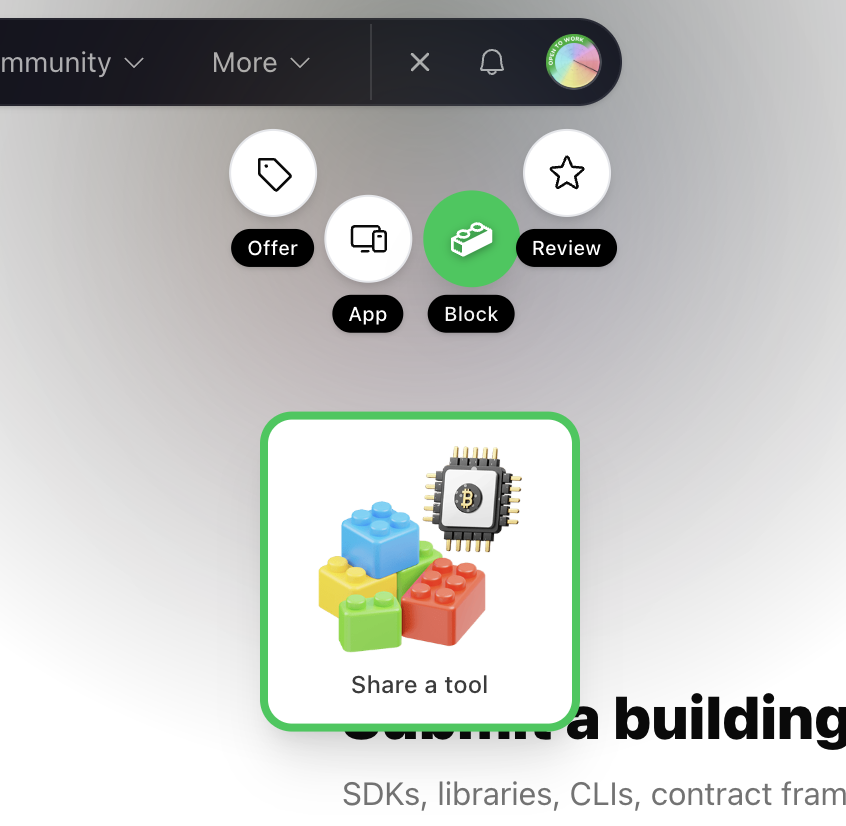
You can now publish Blocks on BSV Radar
Blocks are tools and can be used to build BSV apps: anything that's not an end user App.
There are already 143 Blocks listed.
Check links below to find most useful Blocks and to add your own so others can use them.
Like & share 🙏
You were told Ethereum would deliver fully decentralized applications. Others have made similar claims. The difference here is that Bitcoin already has the capacity to do it, and BSV has addressed the practical constraints—scaling, cost, and the ability to run these systems at real-world levels.
Over the next 12 months, that stops being theoretical. You’ll start to see these systems actually operating—peer-to-peer applications between individuals that scale properly, without operators, without central points of control. Systems that function as they were originally envisioned.
At that point, it becomes self-evident.
And none of this requires permission.
Influencers were offered to "collaborate" on the new "documentary" @findingsatoshi_
Why?
Because @coinbase and the other parties involved in Hijacking Bitcoin need Satoshi to be a dead small-blocker who would have loved what BTC became.
Don't believe me?
🧵👇
Runar now has a DeepWiki, next to the docs site (https://t.co/CAHId3Z4Ol) and playground (https://t.co/dqx4VD3uaB).
Check it out: https://t.co/ov0arwlNQd
A privacy-first browser with a built-in web3 wallet. Try it out: https://t.co/QraY8QsQoE
"A free, open source web browser for iOS and Android that does everything your current browser does — plus three things it can't: hold a wallet, prove who you are, and pay fractions of a cent for anything."
TCP/IP didn’t win because of massive funding. The funding came later.
IBM poured billions into alternatives. Novell pushed NetWare and IPX. Xerox PARC had its own stack. DECnet was entrenched. None of them wanted TCP/IP to succeed.
And yet it did.
Not because of the mythology people repeat today. Not because it was “obviously superior” in some abstract sense.
It won for simpler reasons.
Businesses do not want to re-engineer everything every year. They don’t want forced upgrades. They don’t want an endless cycle of compliance, consultants, and changing standards.
They want stability. They want something that works. And they need scale.
That’s what TCP/IP gave them.
While everyone else kept changing, it stayed consistent. While others built complexity, it remained usable.
Over time, that matters more than anything else.
If you don’t understand that, you don’t understand why the internet actually took over.
TCP/IP didn’t “win” overnight. The foundations go back to the late 60s — ARPANET in 1969 and the early IP work in the 70s. It existed long before anyone cared.
Novell’s IPX, derived from Xerox networking, arrived much later and was commercially pushed with NetWare in 1984. For roughly a decade, the landscape was fragmented — DECnet, IBM systems, proprietary stacks everywhere. Hundreds of “better” ideas.
And yet TCP/IP was already there.
For years, most people ignored it. It didn’t have the funding, the marketing, or the corporate push. Meanwhile, systems like Novell created entire industries around constant upgrades, compliance, and consultancy churn.
That model didn’t last.
Businesses got tired of paying for complexity. Tired of being forced to upgrade. Tired of systems that changed every year.
What won wasn’t the flashiest system. It was the one that stayed stable.
TCP/IP didn’t take over because of hype. It took over because it didn’t change, and it worked.
That’s the part people miss.
Everyone chases the “next thing.” The new feature. The redesign. The reinvention.
But systems that scale globally don’t do that. They stabilise.
Bitcoin is the same. It’s not about constant reinvention. It’s about locking the protocol and scaling on top.
BSV is only now reaching that point of stability. That’s taken years, and it was always going to.
We are not at the “internet moment” yet. Not even close. This is still the phase where people chase boondoggles and distractions.
It took TCP/IP nearly two decades to dominate.
Expect the same here.