My takeaway from the Zcash Orchard bug:
In Bitcoin there is no trust relocation. Your node sees the real numbers and recomputes them — you get consistency AND correspondence. "Don't trust, verify" is literal.
In proof-based confidential-amount systems, the verifier is blind to the values by design. It can check that a proof satisfies a circuit (consistency), but never that the circuit matches reality (correspondence). Same permissionless model as Bitcoin, same every-node-verifies ethos — but one checks numbers, the other checks proofs.
Orchard is the cautionary tale: the check can be flawless and still bless a lie, if the statement being proven was specified with a bug. The trust didn't vanish — it moved into the circuit.
Blind the verifier to the value, and "don't trust, verify" becomes "trust the constraint system."
A self-correcting mechanism within Codex for the model to fight its own baseline model tendencies. Bake adversarial self-check into the model's posture so the framework gets simple. Otherwise, we have to do complex workflows like this one which add friction https://t.co/iPpkUg9TgP
Extreme programming, applied to AI: v3 made two AI agents check each other. v4 makes them pair programmers: asymmetric in what they own, equal in authority, structurally challenged in both directions.
Four challengers replace cultural rules with structural ones — self-check, pressure-check gate, offline auditor, offline narrator.
https://t.co/iPpkUg9TgP
#AgentToAgent #A2A #ClaudeCode #Codex #PairProgramming #ZenLoop
Project Eleven paid 1 BTC for a "quantum break" of Bitcoin-style crypto.
The quantum computer contributed NOTHING (noise)!
The answer was recovered by a classical checker sifting random noise. I reproduced the whole thing in 20 lines of Python with no quantum computer at all.
India runs on UPI, which is a payment network connecting over 500 million consumers and 65 million merchants.
To pay, you simply scan a QR code at the counter.
With the 256D Mini App on Fedi, you can now do the same with bitcoin. Scan the UPI QR code, pay from your Fedi wallet, and the merchant receives rupees.
Learn how it works: https://t.co/uPMVU7BtTX
Strategy has acquired 34,164 BTC for ~$2.54 billion at ~$74,395 per bitcoin and has achieved BTC Yield of 9.5% YTD 2026. As of 4/19/2026, we hodl 815,061 $BTC acquired for ~$61.56 billion at ~$75,527 per bitcoin. $MSTR $STRC
https://t.co/NYkkvObeb4
AI coding agents are strong locally but weak at resisting their own momentum. They narrate partial progress as completion.
My fix: the ZenLoop — two independent agents (Cody/Codex + Zain/Claude Code) on different model families, applying verification pressure through a structured, automated handoff protocol.
Don't Trust, Verify — applied to AI.
https://t.co/T2VpDUGmJN
@bcherny@trq212 is there an outage going on?
getting 500 error repeatdly:
API Error: 500 {"type":"error","error":{"type":"api_error","message":"Internal server error"},"request_id":"req_011Ca5jexVRQecajcZeBLxvr"} · check https://t.co/hlkE03hvEF
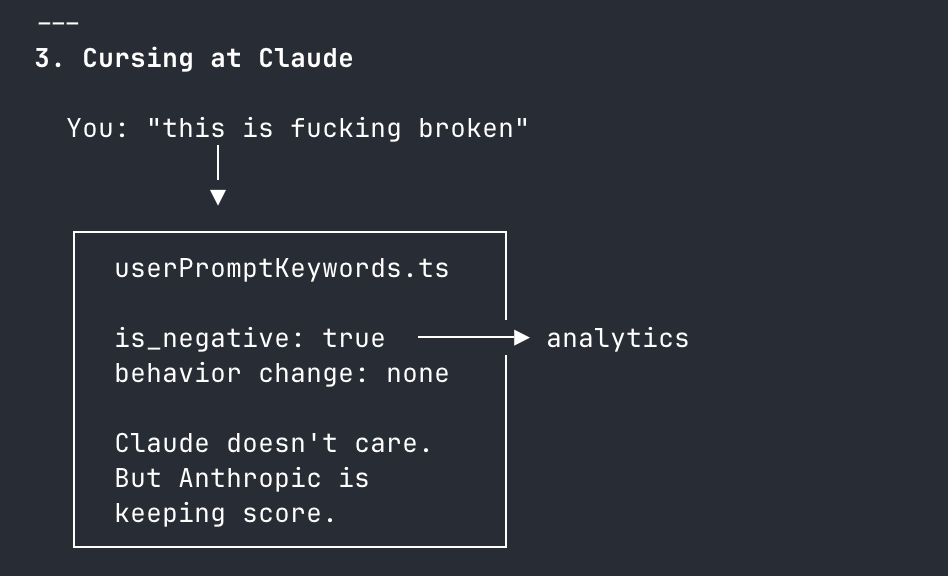
Claude Code has a regex that detects "wtf", "ffs", "piece of shit", "fuck you", "this sucks" etc.
It doesn't change behavior...it just silently logs is_negative: true to analytics.
Anthropic is tracking how often you rage at your AI
Do with this information what you will
@bcherny@Rahatcodes If it helps, I use wtf, wth many times and sometime I even fired him from the job but then hired him again as there was no alternative 😂...so @bcherny maybe you can start a thread and ask people what they say when they are angry with Claude Code 😀
A quantum computer just "broke" Bitcoin. Except it didn't. Not even close.
Google Quantum AI published a paper showing they've cut the theoretical ECDSA attack down to 1,200 logical qubits. They didn't publish the circuits. They didn't run the attack. They published a zero-knowledge proof that their math works, then cited national security.
Here's where we actually are.
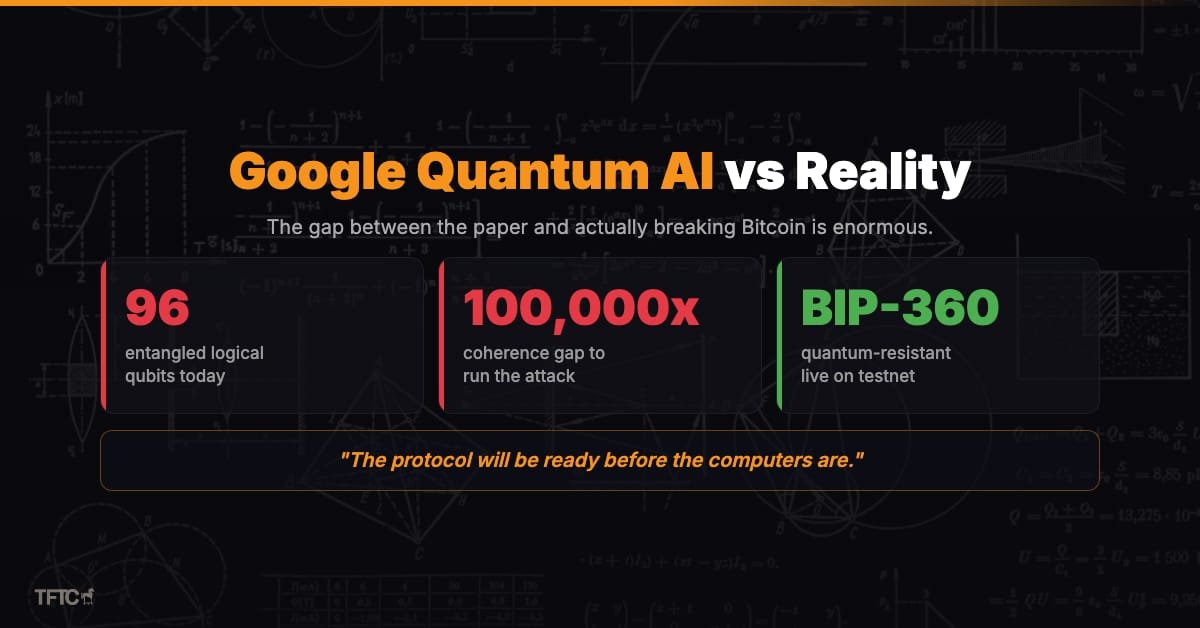
Entangled logical qubits achieved so far: 96
Coherence time: 1-2 seconds
Time the attack requires: days
Physical qubits needed: 500,000
Largest quantum computer today: 1,200 noisy, non-error-corrected qubits
That's a 100,000x coherence gap. It's not a software problem. It's a fundamental engineering problem that nobody has solved.
But here's what most people miss.
Bitcoin developers aren't waiting for a crisis. They're already shipping.
SHRIMPS: post-quantum signatures 3x smaller than NIST standards, built for Bitcoin's block space constraints.
BIP-360: a quantum-resistant output type already live on testnet, with BTQ Technologies running transactions through it.
The full upgrade could take 7 years. That's why the work started now.
The protocol will be ready before the computers are.
AI works great in sessions, but real software isn’t built that way. After six months of building with AI, I kept hitting the same wall: the problem isn’t capability — it’s continuity. So I reworked the workflow and wrote down what actually works — and what doesn’t.
https://t.co/O54lANQEfI
#ai #bitcoin
Introducing USDT Swaps: From Sats to Stablecoins in Seconds ⚡💵
Today we are stoked to announce USDT Swaps - connecting Bitcoin to the world's most used stablecoin. Swap between Lightning and USDT on all major networks, without custody, accounts, or KYC!
https://t.co/k4CtAQPlnY
libsecp256k1 is the cryptographic library that secures every Bitcoin transaction and @blksresearch is one of its key contributors and maintainers.
They also maintain libsecp256k1-zkp, the extended fork that powers @Liquid_BTC's Confidential Transactions, MuSig2, and zero-knowledge proofs.
The team has just brought the zkp fork up to date with 2.5 years of upstream improvements.
We shipped a lil something today: USDT Swaps ⚡💵
Lightning ↔ USDT. No custody. No accounts. No KYC.
Move from sats to stablecoins in seconds, across a growing number of networks.
👉 https://t.co/DF1jOFHZRV 👈
Read the full announcement: https://t.co/6ZmUE0khoB