Jack, Bitcoin Core shipped a wallet deletion bug last year. Versions 30.0 and 30.1 had a migration failure that could delete your entire wallet directory. The binaries were pulled from bitcoincore(dot)org. After that, Core 31.0 shipped a private broadcast feature that leaked your IP address to any malicious peer who forced a v1 retry. The stated privacy guarantee was that recipients would never know your IP. It was broken on release.
This is not a new pattern. CVE-2018-17144 was an inflation bug that sat in production for 18 months. A miner could have created Bitcoin out of thin air, in violation of the 21 million cap. It was never exploited, but not because the process caught it. A high-severity consensus bug, CVE-2024-52911, was fixed in Core 29.0 and publicly disclosed in May of this year.
The governance structure that produces these bugs is not incidental. Our quantitative analysis of 25,122 Core PRs shows that 25.5% of maintainer-merged PRs are self-merges. Three people control 81.1% of all merges in the repository's history. Since 2022, one maintainer accounts for roughly half. The "arsonist and fireman" pattern is documented: same contributor introduces a bug and authors the fix, independent verification bypassed.
When roughly 99% of Bitcoin nodes run one implementation lineage, that is the attack surface. Every bug in that codebase is a systemic Bitcoin risk, not a software bug with a narrow blast radius.
You said Strategy and Strike have incentives to keep Core safe. Here is the actual structure. Five people hold commit access to Bitcoin Core. They are employees and grantees of a small set of institutions whose founders and funders circulate among each other and have direct financial interests in specific protocol directions. Bitcoin was designed to eliminate trusted third parties. Its reference implementation is controlled by them. The people with the most to lose have every incentive to keep that quiet, because the narrative that Bitcoin infrastructure is sound is load-bearing for their business models.
Hardware wallet failures are real. But you told people to just buy a laptop and run Bitcoin Core on it. Windows and macOS both ship zero-days on a regular cadence, Microsoft has a decades-long pattern of bundling attack surface directly into the OS, and your browser runs in the same process space as your wallet. Whatever hardware security a laptop has is built for OS integrity and disk encryption, not for Bitcoin key isolation. A hardware wallet exists precisely to take your keys off that machine entirely, into a purpose-built environment with no network exposure and no shared process space. Telling people to abandon that for a laptop running Core is not a security upgrade. It is a step backward dressed up as one.
I am completely allocated to Bitcoin. I have spent 12 months and significant capital building the quantitative and governance case for implementation diversity as Bitcoin's ideal security posture. No one has engaged with the risks and incentives of this space more rigorously than this work has. I am not bragging. I am begging. The data is there. The argument is there. If you actually care about Bitcoin, prove it. Engage with it.
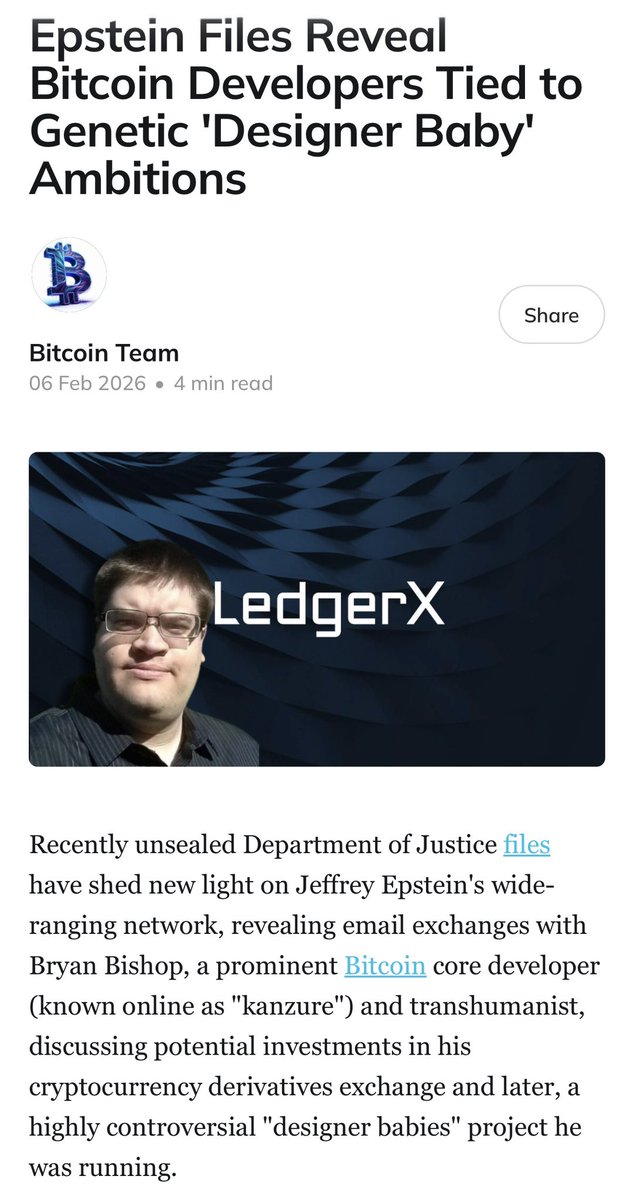
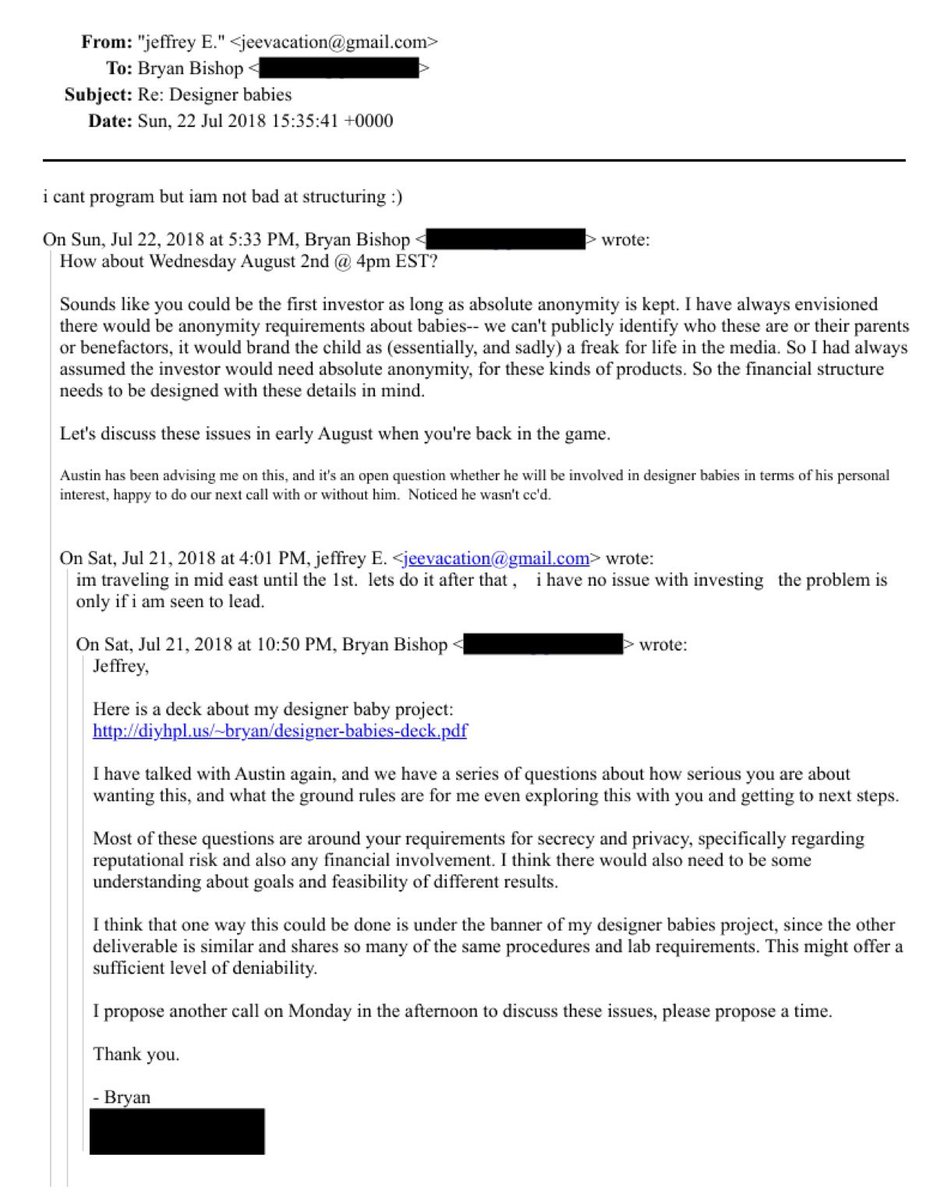
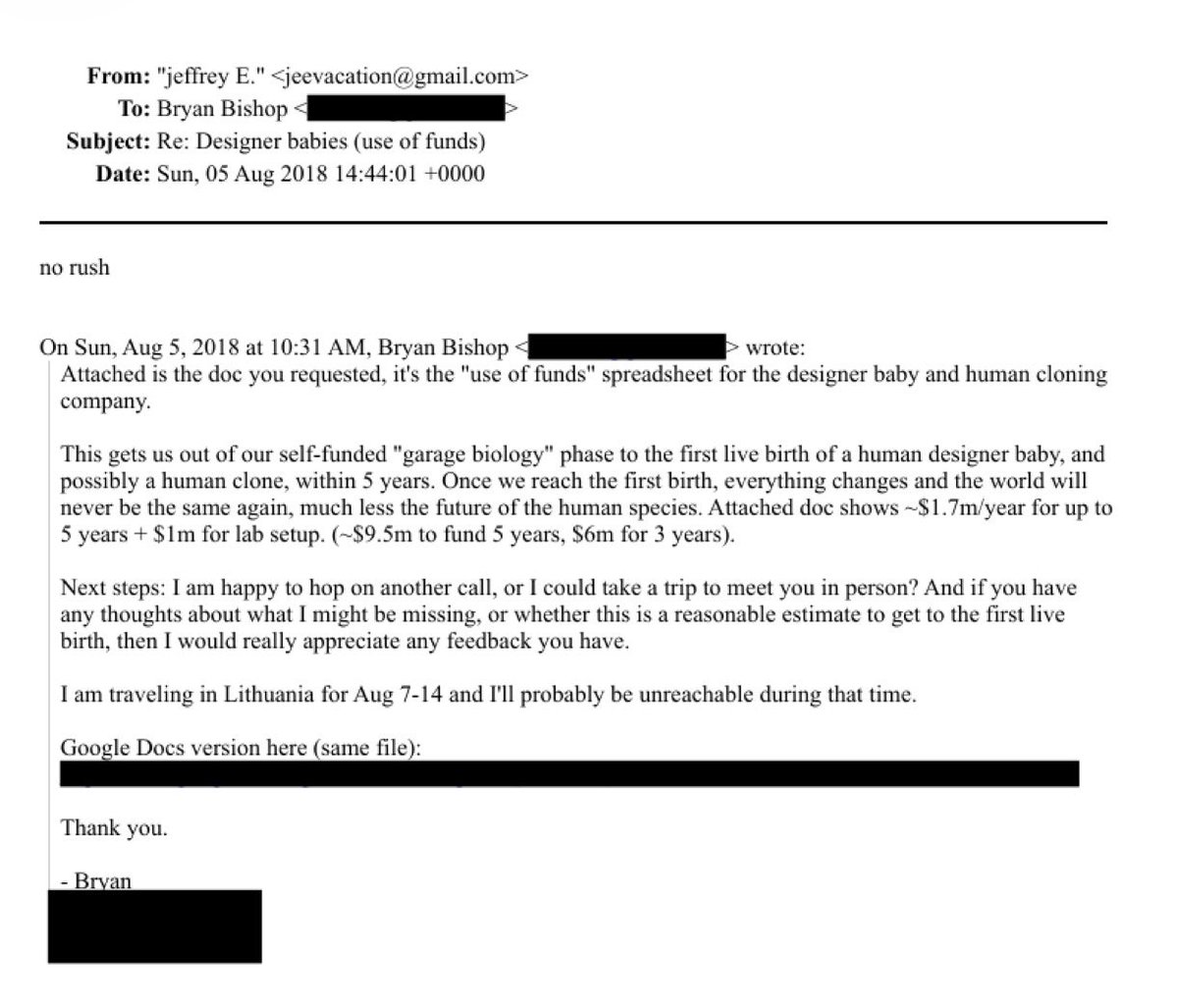
Bryan Bishop @kanzure is the Bitcoin Core developer who in 2018 pitched Jeffrey Epstein on funding a “designer babies” project aimed at producing the first live birth of a genetically engineered human (and possibly a clone) within five year.
Bryan just announced that Luke Dashjr has been stripped of permissions on the BIP content repository.
The same guy who sought millions from Epstein for genetic engineering and human enhancement experiments is now the one publicly declaring who gets to edit Bitcoin’s formal improvement proposals.
Epstein’s reply at the time: he had “no issues with investing… The problem is only if I am seen to lead.”
Make of that what you will.
Luke is gone as BIP editor.
Bryan Bishop remains as BIP editor.
Since my reply will likely be censored (the mailing list is completely captured and corrupt), here it is:
"These are false accusations. I have followed the BIP process consistently for years. Your novice opinions alone do not establish new processes.
You are the one who stopped communicating, not I.
You are the one who should be removed.
Luke"
I would like to thank @LukeDashjr@dathon_ohm@GrassFedBitcoin @Roughnecks110 for a valiant effort. It came from the heart.
But important imho to snap back to Bitcoin because she needs us all.
Let's not waste this moment. Can we invest all this energy, anima, shakti, passion to restore Bitcoin to sound money in ways everyone can agree on?
1) Strong beliefs, loosely held.
2) Surrender, allow, trust, accept (SATA).
3) Only take the nectar from every situation. 🐝🏆
@BlueDavid This is not correct. The 55% threshold was for early activation. Today was the deadline for signaling.
I believe all previous BIP-110 miners are still mining, so the chain is not "abandoned".
Thank you for your continued support!
Sorry to say but this "red team" marketing is a clear red flag. Create a problem themselves then come with the solutions. We have seen this so many times before and obviously it just had to happen before the UASF that this same "red team" were so hard fighting against.
Some Bitcoin nodes will begin enforcing different rules due to BIP-110
🚨Warning!
When there's a chain split, Bitcoin can diverge into two separate chains.
It's as if a parallel universe opens up and you now live in both worlds.
Your entire history is identical in both, but from this point each world records its own future.
The new BIP-110 world automatically drops your exact amount of Bitcoin (the same UTXOs) to you out of thin air (ah... an airdrop!)
Many people plan to sell the coins from one world so they can have more in the world they prefer to live in.
But here's the warning:
A "replay attack" is possible while you are adjusting to the either world you've chosen.
This risk lasts for exactly 4,032 blocks (two Difficulty Adjustment epochs).
You sign a check in one world and hand it to someone. That person now holds a fully signed check.
Because both worlds still accept the exact same signatures, they can take a perfect copy of that already-signed check and cash it in the second world too.
They never need your private key again. You already provided the authorization.
During these 4,032 blocks, what you do in one world is still valid in the other.
So your Bitcoin can move in both worlds even if you only intend to spend it in one world.
Only at block 965,664 do the new BIP-110 rules actually take effect and the two worlds finally develop different laws going forward.
At that point in time, each world, although having the same history, has separate new laws going forward.
So to be clear, there is no "Replay Protection" for this "Replay Attack" during these 4,032 blocks.
Many expect the second universe to be sparsely populated and short-lived due to weak energy (tiny hashrate) behind it.
The risks, however, still exist while the two realities temporarily share the same physics.
“Hey miners, flip the bit!”
What does that actually mean?
Every Bitcoin block has 32 “parking spaces” in its header (the version field).
In each space, a miner can paint either a 0 or a 1.
The first three spaces are already fixed forever as:
0 0 1
That leaves 29 available parking spaces that can be used for soft fork proposals.
Parking space #4 (Bit 4) is the one assigned to BIP-110.
Starting at block 961,632, anyone who builds a block template (a miner) has to decide whether to paint a 0 or a 1 in that space.
“Flipping the bit” simply means changing the default 0 to a 1.
That paint job is the entire technical act. It is simple and fast, and any miner can do it.
What about nodes?
Nodes do not paint the number. They only enforce it.
A BIP-110-enforcing node will accept a block if it sees a 1 in space #4, and reject it if it sees a 0.
A regular Bitcoin Core node will accept all blocks. 0 or 1, as long as the rules of the road are met, it takes the block.
So miners who want their blocks accepted by BIP-110-enforcing nodes will need to start painting a 1 in parking space #4 from block 961,632 onward.
Otherwise, a non BIP-110 miner risks having enforcing nodes reject all of their hard work (energy and money) spent building that block.
But simply RUNNING a node has limited influence (if any).
If you just download the software and turn it on, you are just observing the parking lot. You are looking at the spaces, but you are not driving any cars into them.
Miners who have to paint in a parking space car about the cars that are going to drive into them.
If you actually USE your node by sending transactions, receiving payments, withdrawing from an exchange, and making purchases, etc., THEN you are driving your own car onto the roads and into the parking spaces.
That is what carries practical weight and impact.
Miners care about where real economic activity is happening.
Running a node is good for your own verification. Yes.
But actually USING a node is what gives your choice real influence on the network.
Yelling at people on X does nothing. USE your node if you think Bitcoin is money and then your voice actually matters.
Ordinals, Runes, Stamps and other data spam shit attacked and abused Bitcoin since 2023.
Bitcoin Core didn't fix Segwit/Taproot flaws, instead raised OP_RETURN policy setting to facilitate more arbitrary data.
They all fucked around. BIP110 will make them find out.
No soft fork has ever created an altcoin. It would be unprecedented. BIP148 had only 500 nodes and BIP110 has 17,000 nodes with zero running a URSF. It is also a more important SF concerning permanent illicit data and compromising risks of nodes.
If nodes can be ignored, these miners are in collusion and in control. Full stop. They are centralized already (5 major pools who don’t even care about the network) and now any illicit data being stored in chain would be their own responsibility - which means the state could coerce them into censoring actual transactions and blacklisting addresses.
Right now, They have also have zero incentive to risk a chain split. Collusion means they bypassed the prisoner’s dilemma and ignored the driving force behind consensus for 17 years.
If that happens, nodes have no power holding them back during the next halvings. No miner consortium would want to cut revenue in half. They only follow those consensus rules because of honest nodes.
I fully support the pow change. If there isn’t t the option and miners collude… Bitcoin is fully centralized.
No question to me that these attacks are all coming from the same source. Miners will most likely collude and be comprised. If that happens… good luck everyone activating a softfork again. Good luck with the halving. Good luck with a massive tidal wave of oncoming spam, scams, exchange seizures and endless “use cases” core will start adding to the protocol.
I will 110% dump my core fedcoins and stay on the smaller chain with decentralization as its ethos.
You probably don't want to listen to me, I'm one of those crazy conspiracy theorists that think governments will do subversive things to the Bitcoin network.
Smarter people know they're chill about people trying to replace the USD.
I have real mixed feelings about this interview. I want to try and be gracious, because it's awesome Natalie gave Matt a long interview. But her questions were clearly passive-aggressive and biased, to me. And this surprised me, because I've listened to her ad infinitum, and never felt this before. Regardless, Matt is a champion, he stood up under it and he shined the light!
Red Team is an effort to make it appear that all the software in Bitcoin is riddled with bugs. As I said, most of what they'll turn up is inconsequential.
It is happening in parallel with an obvious state-level attack against sovereign hodlers (Coldcard users, Lightning users, BTCPay Server users) seeking to 6102 as many bitcoins as possible.
The former is a coordinated tactic to obfuscate the latter.