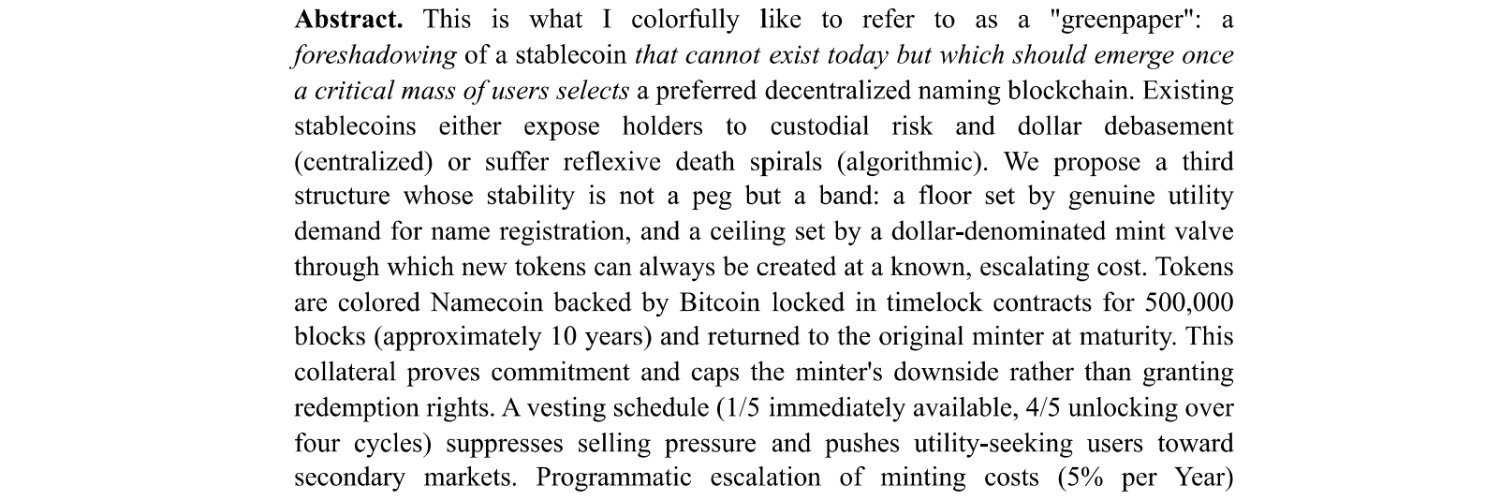
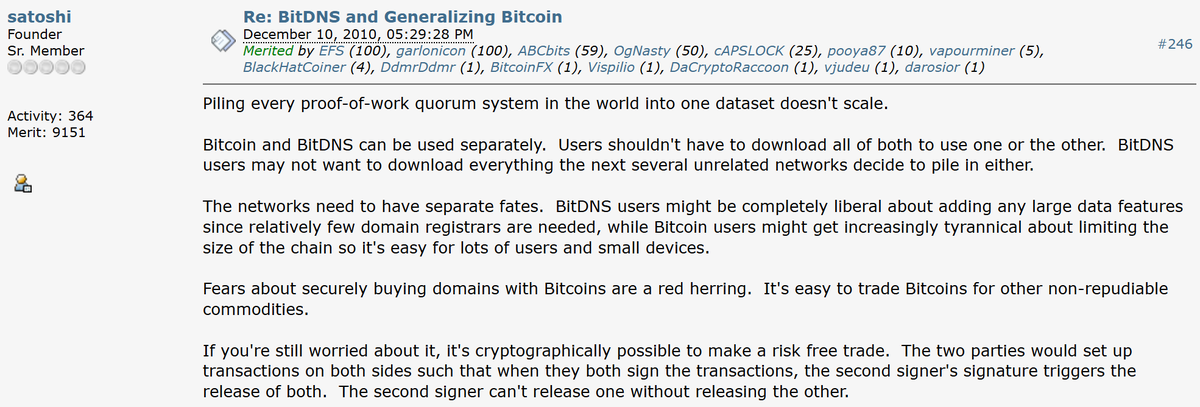
If a naming blockchain wins, its registration token becomes a stablecoin. Utility floor, dollar-priced mint ceiling, BTC timelocked and returned at maturity.
@giacomozucco@knutsvanholm@BtcInfinityShow Oh and upon further review, Spaces was created by the LetsDANE dev who previously worked on Handshake.
Handles are issued through a small number of operators who own the top-level spaces and those operators can refuse to issue a handle to anyone they choose.
Hard pass
Just watched @knutsvanholm with @giacomozucco on @BtcInfinityShow. At the 58:45 mark they talk about how if money has utility beyond simply being money it leaks value because the price will then be composed of BOTH utility value AND its value as money. Since the utility of something can change over time then either i) this uncertainty can and will be extracted by those who know how to do so OR ii) the market will step in and destroy the price stability required for any good unit of account. Gold is often cited as a good example here.
All that said, IF the utility of a candidate for money happened to have a definite floor of utility value, beyond which no value could be extracted THEN regular people could feel safe pricing their work at that floor.
A token for a .com domain name would have a value of ~$20 if one token could be redeemed for one year registration/renewal since there is a history of ever increasing demand for .com names (not too many people stop renewing names relative to new names registered). The caveat here is that you need to trust the issuer of the token doesn't simply print these tokens out of thin air (ie. inflating away their value) AND that the token will be recognized upon redemption by the registrar.
These issues can be addressed IF the demand for *decentralized* names from a particular blockchain with network effects reaches a certain threshold and that blockchain is sufficiently secured by Proof of Work with good tokenomics.
Namecoin can be such a blockchain.
This just crossed my path today and I thought it might interest you if you are a fan of the Urbit project:
https://t.co/D60oBKMRKX
Groundwire helps with the problem of freshness of state since the current state is whatever UTXO holds the sat right now and any Bitcoin node can tell whether an output has been spent. Changes of state (a key rotation, new routing info) are committed to the next Taproot output that holds that sat. If someone shows you an old history, you can see it’s out of date so in that sense it may work better than Spaces without the need for another token.
But there are tradeoffs (eg. depends on Urbit and the availability of the user, hurts privacy tying identities to UTXOs)
Bitname is a stablecoin backed by names. There are infinite strings you could register, but claiming one costs something finite. Domains have held a ~$20/yr market for thirty years, and any token you spend to register a name inherits that floor.
I'm not talking about the names themselves...I'm talking about the name tokens (ie. the tokens used to register the names). The tokens are fungible, "scarce" (in the same way all s*itcoin tokens are) and exchangeable for real money until of course the protocol reaches critical mass and their price floor is deemed stable.
...and I'm not talking about creating a new coin either rather dusting off the ol' Namecoin protocol which is still very active on Github and making some noise on Nostr. You timelock bitcoin for ten years and get colored NMC tokens spendable on name registration. The colored token (as opposed to uncolored NMC) frees the network to offer say server storage or premium access to Nostr. After the ten years elapse the minter gets back their original bitcoin.
If you're interested, here's the "greenpaper":
https://t.co/sYiLW2DIZF
Bitname takes the most boring fact in tech, that people renew domain names every year forever, and turns it into monetary backing.
Lock bitcoin, get tokens spendable on decentralized names, reclaim the bitcoin in ten years.
If the idea fails you lose time, not principal.
Every stablecoin today either trusts a custodian or trusts an algorithm. Bitname proposes a third option: a token you spend to register decentralized names, minted by timelocking bitcoin for a decade.
Stability from a real recurring bill people already pay, not from a promise.
Bitname: a stablecoin with no peg and no redemption.
Its price sits in a band, held up by people buying tokens to register decentralized names, held down by a known dollar cost to mint new ones.
Collateralized by bitcoin timelocked ten years and returned to whoever locked it.
Bitname is a proposal for a stablecoin backed by demand for decentralized names.
You lock bitcoin for ten years and get tokens spendable on name registration. The bitcoin comes back at the end.
Value comes from people needing names, not from a company promising you a dollar.
...this is why doing names on Namecoin alone makes more sense than having the preferred naming protocol be a Bitcoin L2. Registrars care only about validating names efficiently and so would favor the setup that gives maximal data availability, which not coincidentally, is the simplest thing to support. Namecoin (which can ALSO be pruned down to <400Mb if you eliminate expired records) offers perfect validation of BOTH the name and the UTXO sets all by managing just one chain.
The token can only be seen as a stablecoin AFTER reaching critical mass and a couple of name generations have elapsed. But even then, it would need help to transition from shitcoin to stablecoin. That's where the mechanism described at https://t.co/sYiLW2DIZF can help.
> If registrars only care about the names and not about a digital cash system to pay for names, then they'll not use a digital cash system to pay for names, and your initial hope to use names as a "price floor" for a digital asset is hopeless.
Respectfully, your "order of opeations" is not quite right here. $BITNAME can emerge as money once a decentralized identity protocol reaches critical mass. The registrars arent thinking about $BITNAME as money; they accept the token for the name which they register as per the rules of the protocol, to which we must assume they will dump the token like the shitcoin it is.
Thank you for sharing the link for Spaces; I had heard about it but never followed up until now. My very cursory glance at it looks interesting particularly with how elegantly it scales. That said it appears fundamentally flawed for a long term solution. Spaces proves a name *was* yours. Namecoin proves it still is. Without having a way to revoke keys openly (ie. without having to depend on those handle operators) I wouldn't allow myself to identify with my Spaces name.
It would be totally undesirable to tack names onto Bitcoin.
If the thought is to have the names reside in some layer two, the problem is it places an undue burden on registrars/resolvers who only care about the names. Registrars would have to run full nodes of BOTH the L2 and L1 Bitcoin to ensure the correct money supply but if they chose Namecoin then they'd be able to validate both name and UTXO sets with a very lean 6.5Gb blockchain.
If you're interested in reading more about my thoughts around this, I've produced a "greenpaper" for what I believe is an inevitability here: https://t.co/sYiLW2DIZF
The oceans hold 4.5 billion tons of uranium.
Abundance was never the constraint.
Extraction cost was. Digital names work the same way, which is why infinite supply does not mean worthless.
A domain name costs about $20 a year. Not because that is what the data costs, but because a registry decided it.
We have all been paying rent to a cartel for so long we mistook the price for a law of nature.
Keypairs are free and infinite, which is exactly what makes them useless for trust.
A name that provably cost something to register is a different object entirely.
Costliness is the feature.
You're absolutely correct; there's no real demand for NMC or any other decentralized naming protocol [yet] certainly not enough to base a stablecoin off of.
Why a Namecoin colored coin would work best IMO (once that threshold level of demand is met) is because Namecoin inherits much of Bitcoin's security and, again IMO, it's small team of developers is best focused to deliver uncensorable DNS and identity to the masses eventually. The fact that that isnt reflected in the price of the underlying token doesnt bother me in the least.
Thank you for your reply.
Keypairs are free and infinite, which is exactly what makes them useless for trust.
A name that provably cost something to register is a different object entirely.
Costliness is the feature.
The oceans hold 4.5 billion tons of uranium.
Abundance was never the constraint.
Extraction cost was.
Digital names work the same way, which is why infinite supply does not mean worthless.