Network gets you the intro. Expertise closes the deal.
The rooms that matter are built on both.
Every member makes every other member stronger.
That's not just a community. That's an unfair advantage.
Backing the next generation. Most value-added DAO.
https://t.co/NEmB0N6a4T
🧵 The Insider Feedback Loop
Every person giving you product feedback owns your token.
Your Discord mods. Your governance voters. Your advisors. Your most active users. All financially exposed to your success, all incentivized to tell you the roadmap is great.
TLDR:
- Roughly 60% of crypto secondary supply is offered at a discount, averaging -40% to -46% against spot.
- The discount isn't just compensation for lockup. It's a conviction reading. EigenLayer, Scroll & Berachain once traded near-zero discount despite long vesting. That conviction is rebasing.
- Off-chain OTC sales mean the vesting dashboard you're reading is fiction. Tokens change hands long before they unlock.
- The exchange price is what the story is worth. The OTC price is what the asset is worth.
There’s an arms race forming between Robinhood, Base, Binance and Solana around stock tokens and they’re leaning hard into the recent meme + stock token meta because it’s one of the fastest ways to bootstrap holders, attention, liquidity and distribution across the board.
Now you could argue they can all win because they each own the end user in some shape and can just push their own version of the stock token. That’s true of course.
But I think owning centralized front ends becomes less defensible over time as more activity/users moves onchain.
The power will eventually move to onchain front ends and defi infra like Phantom, Pump, Fomo or Uniswap, Meteora, PancakeSwap
Once that happens, onchain front ends will optimize for UX and likely abstract away all of the spacex tickers that you’re seeing and will only route to tickers internally with the best execution, liquidity or exclusive kickbacks
That means the real competition eventually becomes liquidity, reg setup, distribution and crypto alchemy like stock/meme pairs
The end state of tokenized stocks will be what we’re starting to see with stablecoins as one ticker or usd balance while wallets/routers decide which underlying stock ticker wins the order flow/placement
There’s an arms race forming between Robinhood, Base, Binance and Solana around stock tokens and they’re leaning hard into the recent meme + stock token meta because it’s one of the fastest ways to bootstrap holders, attention, liquidity and distribution across the board.
Now you could argue they can all win because they each own the end user in some shape and can just push their own version of the stock token. That’s true of course.
But I think owning centralized front ends becomes less defensible over time as more activity/users moves onchain.
The power will eventually move to onchain front ends and defi infra like Phantom, Pump, Fomo or Uniswap, Meteora, PancakeSwap
Once that happens, onchain front ends will optimize for UX and likely abstract away all of the spacex tickers that you’re seeing and will only route to tickers internally with the best execution, liquidity or exclusive kickbacks
That means the real competition eventually becomes liquidity, reg setup, distribution and crypto alchemy like stock/meme pairs
The end state of tokenized stocks will be what we’re starting to see with stablecoins as one ticker or usd balance while wallets/routers decide which underlying stock ticker wins the order flow/placement
🧵 The Regulatory Moat
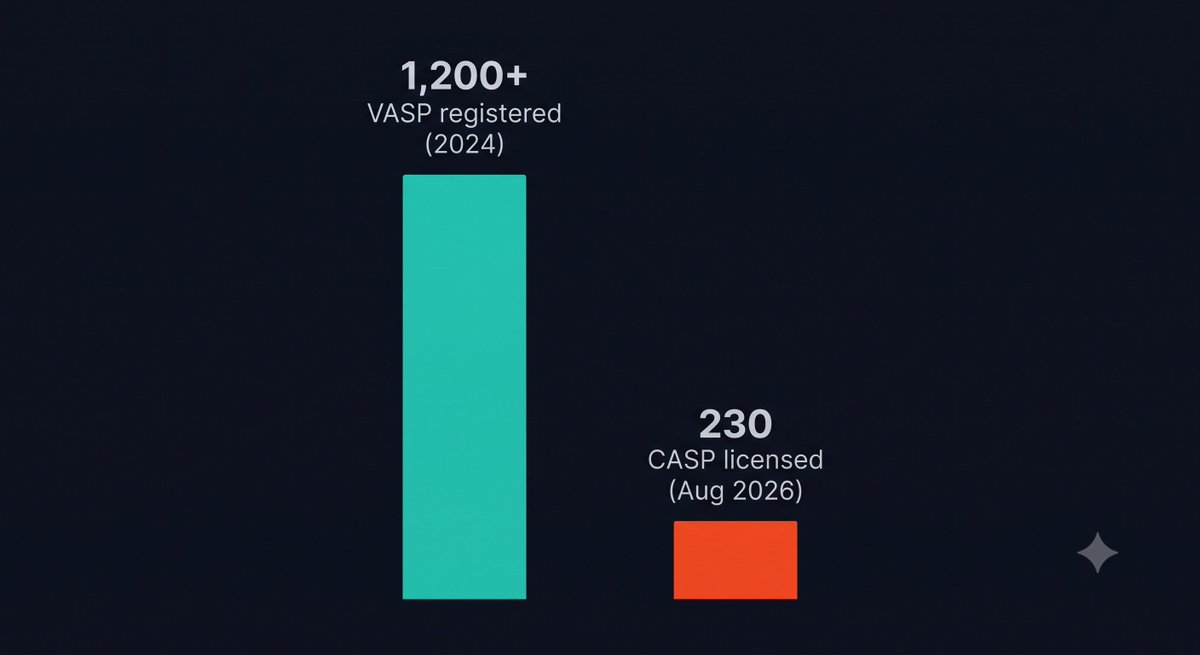
On July 1st, 80% of Europe's crypto firms lost the legal right to serve their own market.
1,200+ held national registrations. Roughly 230 hold MiCA licenses today. The rest are gone.
The consolidation everyone predicted already happened.
TLDR:
- You're not pitching a firm. You're pitching against a specific fund's remaining allocation, deployment timeline, and portfolio gaps.
- Recently closed fund (6-18 months): actively deploying, motivated. Year 5+: mostly follow-on capital. Between funds: distracted and resource-constrained.
- Founders who target active VCs based on deal patterns see 3x higher meeting conversion than those pitching cold from static lists.
- The seasons are real too. Mid-January to mid-May and post-Labor Day to Thanksgiving are when capital actually moves.
VCs screen you
make sure to screen your VCs before accepting their money
small actions might tell a lot about someone
and i say this because i have heard it many times from founders who have raised multiple millions :
not all money is good money, always know your money 🤞
The physics of a business are determined by the market it enters and the technology it harnesses.
Markets exert different gravitational forces. Smaller markets are often lighter, and larger ones are often weighed down by regulation, large incumbents, switching costs, etc.
Technologies provide different amounts of propulsion; the more differentiated the technology, the more thrust a company has to overcome those forces.
A great business is built when the available propulsion is strong enough to overcome the market’s gravity.
Two weeks ago, Ethereum researchers met in Berlin to continue charting the protocol's long-term trajectory, following along discussions with client teams in Svalbard in April.
The updated strawmap is at https://t.co/9e2AQ6rhz6, and I attached a picture of it to this post.
My own high-level takeaways:
* "Lean Ethereum" is not a single one-shot upgrade, it is a collection of improvements that will come online to the Ethereum network over the course of three or four years. But make no mistake, this IS the third major iteration of Ethereum in the same way that the Merge was the second. Almost every major piece of the protocol will be replaced:
- Verification through recursive STARKs, rather than direct re-execution. Recursive STARKs become an enshrined first-class core component of the protocol
- Replacing everything quantum-vulnerable with quantum-safe alternatives
- Consensus: decoupled available chain and finality, one or two-round finality. Theoretically optimal security properties, simpler than today, and faster than today
- Multidimensional gas
- State: not just tree structure, but what *types* of state are available
- Changes to client architecture
...
At the same time, simplification, cleanup and future-proofing. And this will all be done in a way that minimizes disruption to existing application. We've done this before (the Merge), we can do it again.
* H-star (aka Hegota) is probably Ethereum's last thematically "pre-Lean" fork. Starting from I-star, most of everything we do will have a very strong "Lean" feel to it in one way or another.
* Privacy is no longer an afterthought, it is a first class goal. When designing Frames, the mempool, additions to the state tree, we explicitly ask the question "okay, how do quantum-safe, intermediary-free privacy protocol transactions go through this, and what is the overhead?"
* Formal verification of everything for security.
* FV also makes us much more comfortable with canonicalization (having pieces of the protocol that are directly defined as a piece of bytecode expressed in some language). evm-asm is being written in part to become a canonical proof system for the EVM.
* Quantum safety has shifted up a LOT in priority. This adds a lot of work (eg. finalizing a quantum-safe blobs design has become urgent; this work has already been ongoing for months)
* Probably the single most disruptive part of the plan is the changes to state. There is growing consensus around leaving present-day-style "dynamic state" mostly unchanged, but scaling it only a medium amount, and adding new types of state that are more scalability-friendly (eg. no need for builders to sync/store all of it) but more restrictive, and that will scale a large amount.
eg. possible Ethereum in 2030: 2 TB of present-day-style (dynamic) state, and 100 TB of new-style (scalable but restrictive) state
This "new-style" state would work very well for ERC20s, NFTs, many defi use cases, but not eg. highly "central" objects like Uniswap contracts, or onchain order books, or other complex things (which are crucial for Ethereum but which only take up a small percentage of state)
Hence, it will not be *necessary* to rewrite any apps, but it will be *very cost-effective* to eg. rewrite an ERC20 token into a newer design that uses a new type of UTXO storage that is currently being explored, so that it will have >10x lower txfees.
Design of these new state types (current ideas: keyed nonces, ring buffers, UTXOs, statically accessible state, temp state) is an area where we will need a lot of feedback from application developers (incl. privacy-friendly application developers) and probably several rounds of rethinking and iteration.
* In the context of a much larger total state size, we need to figure out the incentive issues around who stores this state and what motivates them to. Even saying "each node stores 1%" is not good enough - why do they store that 1% and why are they willing to serve it? This is being elevated as a first-class research area.
* Ethereum will need to have a "VM" other than EVM in one form or another - at the very least, we need something like leanISA for recursive STARKs - and the gains are large in exposing it to users so that we support programmable privacy and better scalability. Right now, the most likely contenders are leanISA and RISC-V.
My own ideal is that in this world, we adjust the protocol so that the EVM becomes a high-level-language compiler-level feature, and the protocol only "sees" RISC-V / leanISA directly. But this is still far away.
* Gas limit increases, blob increases and slot time decreases will happen many times over the next ~5 years. We expect a large gas limit increase with Glasterdam. Each step of increased scale or decreased slot time is a matter of getting to the point where it is safe to do it, which comes from a combination of client optimization and protocol changes.
Ethereum is CROPS.
Ethereum is scaling.
Ethereum is reinventing itself.
Onward.
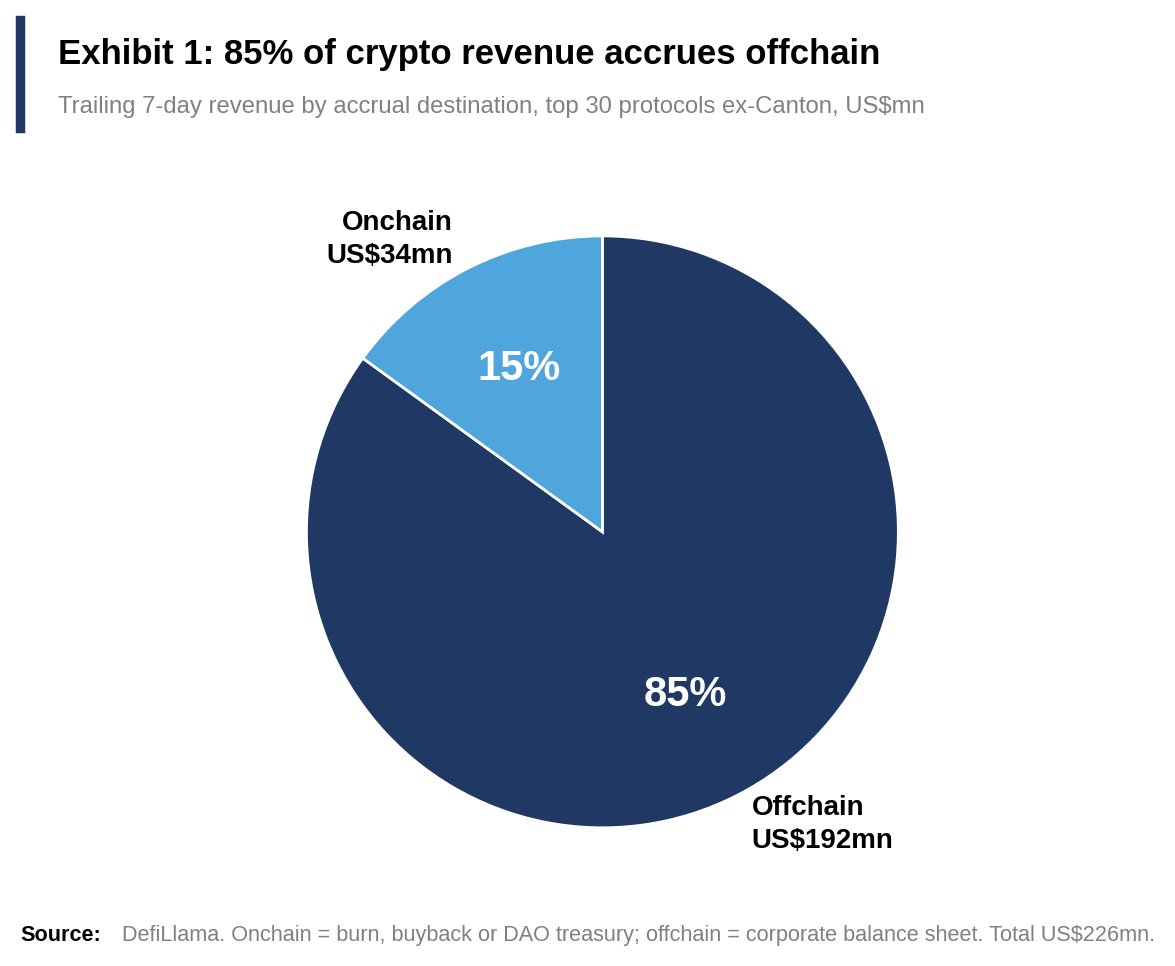
Tether alone did $5.2B in revenue in 2025, 41.9% of all protocol revenue across 168 protocols.
The revenue is real and concentrated in projects that actually capture it.
Stablecoin issuers took 65.7%.
Network gets you the intro. Expertise closes the deal.
The rooms that matter are built on both.
Every member makes every other member stronger.
That's not just a community. That's an unfair advantage.
Backing the next generation. Most value-added DAO.
https://t.co/NEmB0N6a4T
🧵 The Talent Exodus
Crypto doesn't have a hiring problem. It has a keeping problem.
The best operators leave after 2-3 years. Not because they lost conviction.
Because the compensation structure broke its promise and nobody will say it out loud.
Everyone thinks there's a hackpocalypse going on in crypto right now. But if you dig into the data, the story is not that simple.
Narrative violation: total dollars hacked in 2026 actually looks pretty normal so far.
Check the chart below for raw data. What's grown is not the amount hacked, but rather the NUMBER of incidents.
Case in point: April was a brutal month for $$ hacked, but May was actually way below average in terms of $$ hacked (1/10th hacked compared to April). And yet by number of incidents, May was actually the highest in crypto history.
So what could explain the number of hacks going crazy, but the amount stolen staying flat?
Here's what I think is going on: for large protocols, using AI for cybersecurity is balanced between offense/defense. If you're Uniswap, AI makes it easier to harden your protocol, just as much as it makes it easier for randos to attack you.
But for the tens of $10M TVL DeFi protocols, there's no one running AI hardening at all. So attackers are looting unattended stores. Over time that will push TVL toward the larger protocols that can actually afford to defend their gates (and eventually, formally verify their code).
Analogy: In a high crime city, the Wal-Mart stays open, but the family owned corner store that can't afford security shuts down. Over time, the equilibrium is that more and more people will end up doing their shopping at Wal-Mart.
TLDR:
- Seed valuations now sit at $20M-$50M. These are Series A numbers wearing a seed label. The celebration at close becomes the constraint at A.
- Average seed-to-Series A has stretched to 616 days. That's 18 months to prove 3x growth in a market where Series A volume dropped 18%.
- Down rounds aren't just dilutive. They're narrative poison. The signal damage lasts longer than the dilution.
- The best seed rounds aren't the biggest. They're the ones that set up a Series A the company can actually close.
An individual with exceptional depth in understanding how a system works has no incentive to discuss it with a peer until the person can sharpen their understanding.
By extension, it means all the secrets that build things remain hidden.
Europe is missing on Hyperliquid.
No EURO STOXX, no DAX, no FTSE - while US indices dominate flow.
Just proposed EURO STOXX 50 (FESX).
Deep liquidity. Pure macro exposure.
This is the next obvious index perp.