One of the simplest things for humans, but incredibly complex for machines, is anticipating the unpredictability of children.
Here FSD rolls up in direct sun, spots the kid way before I did, and applies the brakes. But what came after stunned me. Another bike, and another, then a gap, and another bike (and a bonus scooter). At no time did FSD attempt to jump the gap between the children (even when it could have). There was no jitter or indecision. FSD just patiently waited until they all came around the corner and crossed the street.
It stayed perfectly still so as not to scare the children. Just like a human would.
I’ve seen a lot of amazing things with FSD, but this one really impressed me on a deeper level.
As a father, I’m happy knowing more people are using Tesla FSD to keep their own kids safe and to ensure the safety of the kids on the road.
One of the most detailed views of a spiral galaxy ever from Hubble, the stunning Pinwheel Galaxy (M101), located 25 million light-years from Earth and containing an estimated 1 trillion stars.
📸: ESA/Hubble & NASA
Science doesn’t change its mind because it lied.
It changes its mind because it learned something new.
A belief that never changes isn’t science. It’s ideology.
Once you go Tesla FSD, it’s honestly almost impossible to go back to anything else.
You start noticing how much mental energy normal driving takes. With FSD handling the driving, I can actually enjoy the scenery, have real conversations with my family, listen to podcasts without constantly scanning every mirror, and arrive feeling more relaxed instead of mentally drained.
The biggest difference, though, is the stress… which believe it or not takes a major toll on your health over time.
Long road trips that used to leave me exhausted now feel peaceful. Stop-and-go traffic isn’t something I dread anymore. It just becomes part of the ride.
And from a safety perspective, I think this is where the technology matters most. Tesla’s FSD is always paying attention. It doesn’t get tired, distracted by a phone, or drive under the influence. It uses cameras and AI to monitor everything around the car at the same time, hundreds of times every second. That’s a huge reason why I believe this technology will prevent countless accidents over time.
I’ve been using Tesla FSD every day since the beta launch in 2020, and seeing how far it’s come has been incredible. Every major update has made it feel more natural, more confident, and more capable.
Once you experience it for yourself, you start thinking differently of all the possibilities of what driving really means… I genuinely believe this is one of the most consequential technologies of our time.
FSD is priceless.
Traded my Range Rover for a @Tesla Model Y and picked it up two weeks ago. Turned on FSD today after the 14.3.3 update.
If you don’t believe in magic, I don’t know what to tell you. I’ve always been fascinated by technology for as long as I can remember, but this is something else entirely.
La plupart des grandes boîtes sont des organisations zombies. Voici pourquoi.
Dans League of Legends, ton rang n'est pas un titre. C'est une mesure continue. Tu es Master parce que tu joues comme un Master cette semaine. Si tu arrêtes de bosser, tu redescends. Diamond. Platine. Gold. Le système ne te doit rien : ton rang reflète ta compétence à l'instant T, pas celle d'il y a trois ans.
Maintenant regarde une entreprise classique du S&P 500. Un type devient VP parce qu'il a été excellent à 35 ans. À 50 ans, il est toujours VP. Entre-temps, il a peut-être arrêté de produire, arrêté d'apprendre, arrêté de challenger ses modèles mentaux. Aucune importance : le titre est acquis. La hiérarchie pyramidale fonctionne comme un cliquet — tu montes, tu ne redescends pas. Ton elo organisationnel est gelé au pic de ta carrière.
C'est une aberration darwinienne. Ces structures distribuent l'autorité selon la compétence passée, et la compétence passée est un très mauvais prédicteur de la compétence présente — surtout dans un monde qui change vite.
Les jeux compétitifs ont résolu ce problème il y a vingt ans. Le elo se recalcule à chaque partie. La hiérarchie reflète la performance réelle, pas le souvenir d'une performance. C'est brutal, et c'est précisément pour ça que ça marche : les meilleurs joueurs sont vraiment les meilleurs joueurs, pas ceux qui ont été bons en 2008.
L'IA rend cette aberration létale. Quand une équipe de 12 personnes avec les bons outils peut produire ce que produisait un département de 200, le coût d'un VP qui ne produit plus n'est plus seulement son salaire — c'est le delta entre ce qu'il bloque et ce qu'une organisation méritocratique débloquerait. Ce delta explose chaque mois.
Regardez le marché. Le S&P 500 n'existe plus vraiment. Il y a le S&P 7 (Nvidia, Microsoft, Apple, Google, Amazon, Meta, Tesla) qui capte la quasi-totalité de la création de valeur, et 493 zombies qui maintiennent leur cap par inertie comptable. Les zombies partagent une caractéristique : la compétence n'y circule pas. Elle s'y cristallise en titres, en territoires, en process de protection.
Les boîtes qui vont émerger dans les dix prochaines années auront une propriété structurelle nouvelle : l'autorité y sera révocable en continu. La compétence présente sera la seule monnaie. Plus de rentes de titre. Plus de comités. Plus de "j'ai mérité ma position en 2015". Tu produis maintenant ou tu sors du ladder.
C'est pas une question d'idéologie. C'est juste que dans un environnement où l'IA divise par 50 le coût d'exécution, les organisations qui protègent l'incompétence acquise se font oblitérer par celles qui ne la protègent pas.
Tout est à réinventer. Et c'est exactement ce qui rend le moment fascinant.
Elon Musk just measured your existence by how many times your atoms have been inside a dying star.
Musk: “How many times have your atoms been at the center of a star? I think it’s like on average three or four times.”
Every atom in your body has already survived the core of a star.
Multiple times.
Crushed under pressures that would flatten planets.
Superheated to millions of degrees.
Blown apart in explosions so violent they forged new elements.
Then gravity pulled those scattered pieces back together.
New stars formed.
And the cycle repeated.
For 13.8 billion years, your atoms have been fuel for the most violent process in the universe.
And they are not done.
Musk: “In terms of existence as measured by the number of times your atoms will be at the center of a star, we seem to be roughly halfway.”
Halfway.
Your atoms have been through the furnace three or four times.
They will go through three or four more.
But right now, in this impossibly thin sliver between cycles, those atoms are doing something they have never done before.
They are conscious.
For billions of years before you, they burned through stellar cores with no awareness.
No memory.
No sense of what they were or where they had been.
After you, they will return to that state.
Unconscious matter drifting through space until the next star claims them.
This is the only moment in their entire journey where they can look back at the stars that made them and understand.
Musk: “If you want to look at the big picture… that’s the really big picture.”
The big picture is not that we are small.
Everyone already knows that.
The big picture is that we are temporary witnesses to a process that does not need witnesses.
Stars do not need observers to burn.
Atoms do not need anyone to understand where they have been.
The universe ran for billions of years with no one in it.
It will run for billions more after the last conscious thing disappears.
But right now, matter is examining itself.
That has never happened before in 13.8 billion years.
You are not a person who happens to contain ancient atoms.
You are ancient atoms that briefly figured out how to think.
The universe did not design consciousness.
It designed stars.
Consciousness was the accident.
And the accident is half over.
People completely miss the most important thing about Tesla FSD
It’s not just about convenience. It’s not a "cool self-parking trick."
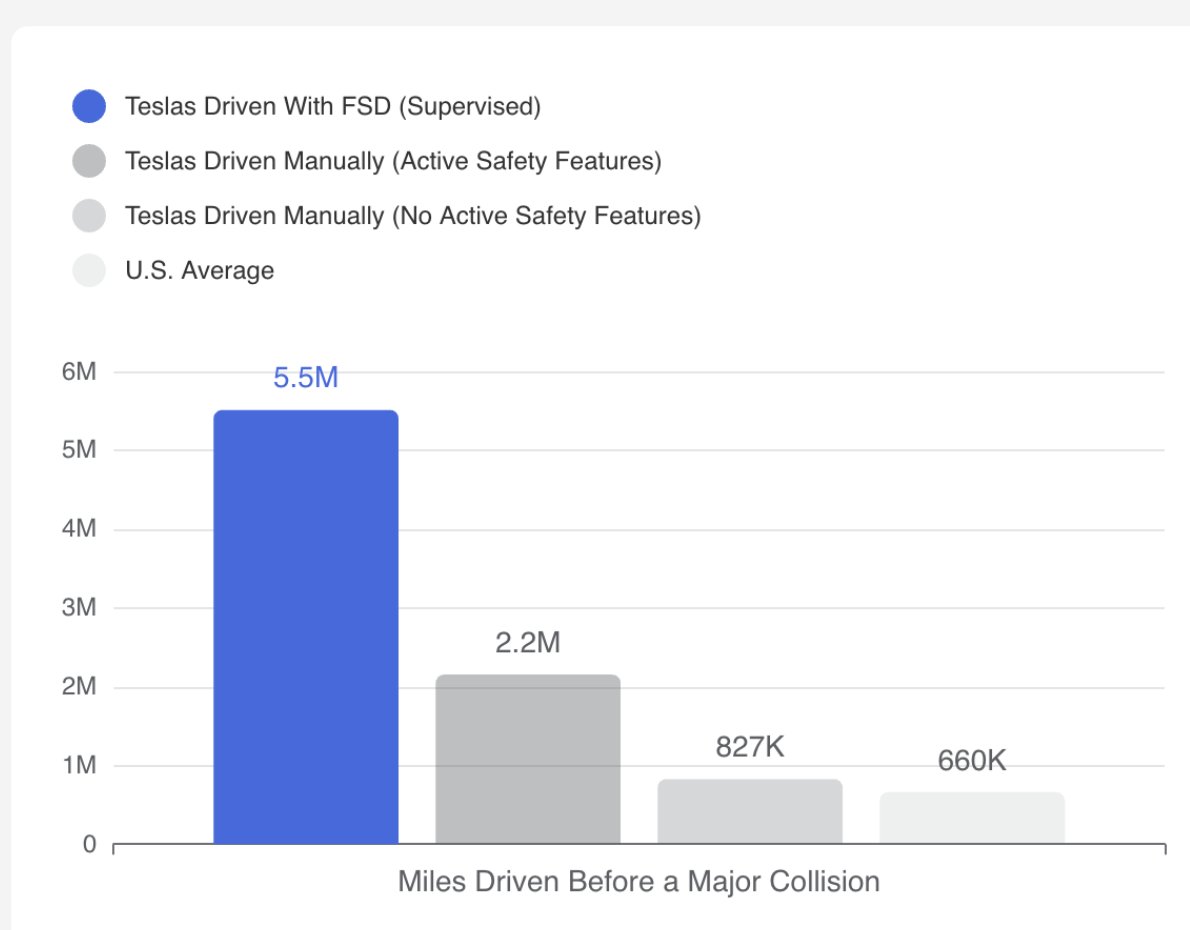
It’s about the fact that car crashes are the #1 killer of healthy people aged 5-29 globally and one company has gathered over 10 billion miles of real-world data to actually solve it
Look at the recent data: Tesla just became the FIRST vehicle to pass NHTSA's new ADAS safety tests. Not the first EV. The first vehicle. Period.
The reality is harsh but simple. Countries that approve FSD get safer roads overnight. Countries that delay will literally watch their citizens die in preventable crashes while bureaucrats sit in meeting rooms debating "safety."
The "safety" argument against FSD is officially dead
NEWS: OpenAI hit with Class-Action Privacy Lawsuit for Sharing ChatGPT Data with Google and Meta.
Sam Altman's OpenAI secretly embedded Meta’s Facebook Pixel and Google Analytics into ChatGPT, turning your most private conversations about health, finances, legal issues, and confidential company data into ad-targeting data sent straight to Meta and Google without consent.
This violates federal wiretap laws. OpenAI enabled surveillance for profit.
Pedestrian Mayhem in Amsterdam 🇳🇱
Final bossfight for FSD (Supervised)
The RDW nerf makes it too scared of pedestrians and cyclists
It feels artificial and as if FSD could do more but its hands are tied
Watch out for more content from my day with @robotinreallife
Finally. After 18 months of patience, FSD is officially approved and live in the Netherlands.
I’ve been driving with it for 2 days now.
And the experience is on another level.
It feels like the future unfolding in real time.
The precision.
The intelligence.
The confidence of the system.
This is not incremental progress.
This is a clear step forward in how mobility works.
Huge thanks to Elon Musk and the entire AI team at Tesla.
From a professional perspective, this shows what is possible when software, data, and real-world deployment come together at scale.
The question is no longer if this will take over.
The question is how fast it will expand.
This is a turning point.
@elonmusk