For my first post, I’m sharing a letter @NVIDIA signed on why open models matter.
AI will transform every industry, power every company, and be built by every country.
Open models strengthen safety and cybersecurity, accelerate innovation and diffusion, and enable sovereignty.
The world needs both frontier closed models and frontier open models.
https://t.co/AUKzoQ5Ikb
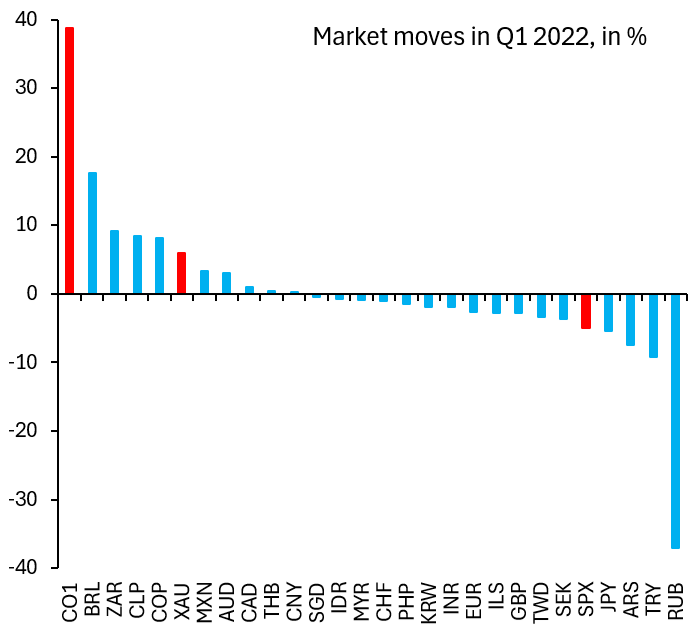
When markets open tonight, oil prices will spike, which will help oil exporters and hurt oil importers. In Q1 '22, oil prices spiked almost 40%. Single biggest beneficiary - by far - was Brazil's Real, which rose 20%. Turkish Lira was the biggest loser...
https://t.co/AOkYSZgAuL
5 Chunking Strategies for RAG, explained in one frame 🧩
Before embeddings, break large documents into smaller chunks.
Better chunking = better retrieval = better answers.
The 5 common approaches:
• Fixed-size
• Semantic
• Recursive
• Document-structure based
• LLM-based
Each has tradeoffs between simplicity, accuracy & compute.
Which chunking strategy do you use most for RAG? 👇
When we look at the Brazilian economy and wonder why growth has been so low for so long, an uncomfortable part of the answer lies in the private sect itself. Brazil is a notorious breeding ground for zombie companies. These are firms that cannot generate enough profit even to pay the interest on their own debt, but remain in existence because the financial system allows for the constant rollover of this liability. They do not innovate, they do not grow, they do not increase productivity.
According to an article by Granzotto et al. (2025) in the Brazilian Review of Finance, which compares companies in various emerging markets, on average 7.6% of firms are "static zombies" (firms with EBITDA/Financial Expenses < 1) and 5.5% are "dynamic zombies" (EBITDA/Financial Expenses >/= 1) in these markets.
In the Brazilian case, 16.75% of companies are classified as static zombies and 13.94% as dynamic zombies! In other words, more than double the average for emerging markets. The authors themselves bluntly state that Brazil is the "heart of the zombie economy" among emerging markets, about 2.3 times above the international standard.
To clarify what this means: we are talking about companies that cannot generate enough profit to cover their financial costs, meaning that investors will have to wait longer to recover their principal, and that workers will be employed in firms without the capacity to invest in new technologies and processes that could improve their human capital and productivity.
The article shows that this mass of zombie companies distorts capital allocation, reduces aggregate productivity, and weakens investment dynamics. Credit, labor, and resources are trapped in financially fragile firms, while more productive companies face a hostile financing environment. And this, of course, has a cost in terms of potential economic growth.
As long as the Brazilian government does not address the problem of reforming the business environment and its capital markets, these types of inefficiencies will continue to persist and condemn workers and investors to remain trapped in firms that should be defunct.
SOURCE: https://t.co/a8MPL6y7xz
#Economía #econtwitter #Economics #Finance #Brazil
Is there an AI bubble? With the massive number of dollars going into AI infrastructure such as OpenAI’s $1.4 trillion plan and Nvidia briefly reaching a $5 trillion market cap, many have asked if speculation and hype have driven the values of AI investments above sustainable values. However, AI isn’t monolithic, and different areas look bubbly to different degrees.
- AI application layer: There is underinvestment. The potential is still much greater than most realize.
- AI infrastructure for inference: This still needs significant investment.
- AI infrastructure for model training: I’m still cautiously optimistic about this sector, but there could also be a bubble.
Caveat: I am absolutely not giving investment advice!
AI application layer. There are many applications yet to be built over the coming decade using new AI technology. Almost by definition, applications that are built on top of AI infrastructure/technology (such as LLM APIs) have to be more valuable than the infrastructure, since we need them to be able to pay the infrastructure and technology providers.
I am seeing many green shoots across many businesses that are applying agentic workflows, and am confident this will grow. I have also spoken with many Venture Capital investors who hesitate to invest in AI applications because they feel they don’t know how to pick winners, whereas the recipe for deploying $1B to build AI infrastructure is better understood. Some have also bought into the hype that almost all AI applications will be wiped out merely by frontier LLM companies improving their foundation models. Overall, I believe there is significant underinvestment in AI applications. This area remains a huge focus for my venture studio, AI Fund.
AI infrastructure for inference. Despite AI’s low penetration today, infrastructure providers are already struggling to fulfill demand for processing power to generate tokens. Several of my teams are worried about whether we can get enough inference capacity, and both cost and inference throughput are limiting our ability to use even more. It is a good problem to have that businesses are supply-constrained rather than demand-constrained. The latter is a much more common problem, when not enough people want your product. But insufficient supply is nonetheless a problem, which is why I am glad our industry is investing significantly in scaling up inference capacity.
As one concrete example of high demand for token generation, highly agentic coders are progressing rapidly. I’ve long been a fan of Claude Code; OpenAI Codex also improved dramatically with the release of GPT-5; and Gemini 3 has made Google CLI very competitive. As these tools improve, their adoption will grow. At the same time, overall market penetration is still low, and many developers are still using older generations of coding tools (and some aren’t even using any agentic coding tools). As market penetration grows — I’m confident it will, given how useful these tools are — aggregate demand for token generation will grow.
I predicted early last year that we’d need more inference capacity, partly because of agentic workflows. Since then, the need has become more acute. As a society, we need more capacity for AI inference.
Having said that, I’m not saying it’s impossible to lose money investing in this sector. If we end up overbuilding — and I don’t currently know if we will — then providers may end up having to sell capacity at a loss or at low returns. I hope investors in this space do well financially. The good news, however, is that even if we overbuild, this capacity will get used, and it will be good for application builders!
AI infrastructure for model training. I am happy to see the investments going into training bigger models. But, of the three buckets of investments, this seems the riskiest. If open-source/open-weight models continue to grow in market share, then some companies that are pouring billions into training models might not see an attractive financial return on their investment.
Additionally, algorithmic and hardware improvements are making it cheaper each year to train models of a given level of capability, so the “technology moat” for training frontier models is weak. (That said, ChatGPT has become a strong consumer brand, and so it enjoys a strong brand moat, while Gemini, assisted by Google's massive distribution advantage, is also making a strong showing.)
I remain bullish about AI investments broadly. But what is the downside scenario — that is, is there a bubble that will pop? One scenario that worries me: If part of the AI stack (perhaps in training infra) suffers from overinvestment and collapses, it could lead to negative market sentiment around AI more broadly and an irrational outflow of interest away from investing in AI, despite the field overall having strong fundamentals. I don’t think this will happen, but if it does, it would be unfortunate since there’s still a lot of work in AI that I consider highly deserving of much more investment.
Warren Buffett popularized Benjamin Graham’s quote, “In the short run, the market is a voting machine, but in the long run, it is a weighing machine.” He meant that in the short term, stock prices are driven by investor sentiment and speculation; but in the long term, they are driven by fundamental, intrinsic value. I find it hard to forecast sentiment and speculation, but am very confident about the long-term health of AI’s fundamentals. So my plan is just to keep building!
[Original text: https://t.co/psPlIFRJsi ]
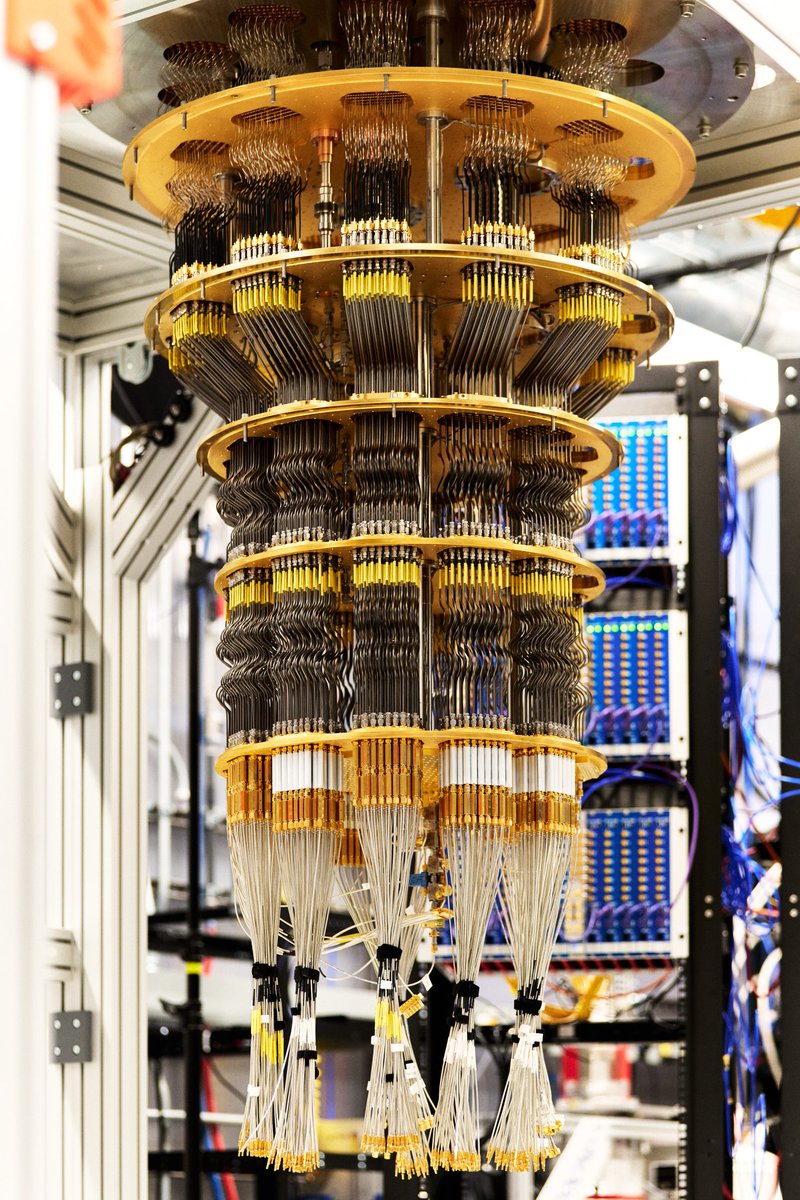
New breakthrough quantum algorithm published in @Nature today: Our Willow chip has achieved the first-ever verifiable quantum advantage.
Willow ran the algorithm - which we’ve named Quantum Echoes - 13,000x faster than the best classical algorithm on one of the world's fastest supercomputers. This new algorithm can explain interactions between atoms in a molecule using nuclear magnetic resonance, paving a path towards potential future uses in drug discovery and materials science.
And the result is verifiable, meaning its outcome can be repeated by other quantum computers or confirmed by experiments.
This breakthrough is a significant step toward the first real-world application of quantum computing, and we're excited to see where it leads.
This MIT paper just broke my brain.
Everyone keeps saying LLMs can't do real logical reasoning. Turns out we've just been teaching them wrong this whole time.
These researchers built something called PDDL-INSTRUCT that actually teaches models to think through planning problems step by step. Not just pattern matching - actual logical reasoning.
Here's how it works:
Phase 1: show the model correct and incorrect plans with explanations. Basic stuff. Phase 2 is where it gets interesting. They make the model generate explicit reasoning for every single action, then use an external verifier to check if each step is logically sound.
The numbers are wild. Llama-3-8B jumped from 28% to 94% accuracy on planning benchmarks. That's not incremental improvement - that's a completely different capability emerging.
What's smart is they don't trust the model to check its own work. They use VAL, a formal planning verifier, to validate every logical step. When the model screws up, it gets specific feedback about exactly what went wrong.
The two-stage training is clever. First stage focuses purely on better reasoning chains. Second stage optimizes for actually solving the problem. This prevents the model from just gaming the metrics.
One finding caught my attention - detailed feedback destroys binary feedback. Just telling a model "wrong" vs explaining exactly which preconditions failed makes a huge difference. The gap is especially big on complex problems.
This isn't trying to replace symbolic planners. It's teaching neural networks to reason like symbolic planners while keeping external verification. That's actually sustainable.
The implications go way beyond planning. Any multi-step reasoning task could benefit from this approach. We might finally be seeing how to teach LLMs structured thinking instead of just sophisticated autocomplete.
Makes me wonder what other "impossible" capabilities are just sitting there waiting for the right training approach.