Author of 'Best Things First', 'False Alarm', and 'Skeptical Environmentalist', President Copenhagen Consensus: smart solutions through economic prioritization
Yeah! Best Things First just named
one of 2023 Best Books
How do most good in world:
For $35bn/yr
save 4.2 million lives
& make the poorer world $1.1 trillion richer—every year!
Maybe a Christmas present? Audiobook, paperback, kindle, and hardback https://t.co/VbgsMQ7am5
The vast majority of future emissions come from China, India, Africa, and other non-rich countries
The West obsesses about cutting its own CO₂
But a successful climate policy is really about innovating green energy to become so cheap that everyone can afford it
Data: NGFS phase 5, REMIND-MAgPIE 3.3-4.8 Current Policies, https://t.co/88qhA6UamR
You can see all the references in my Twitter thread:
https://t.co/r86NvtDWir
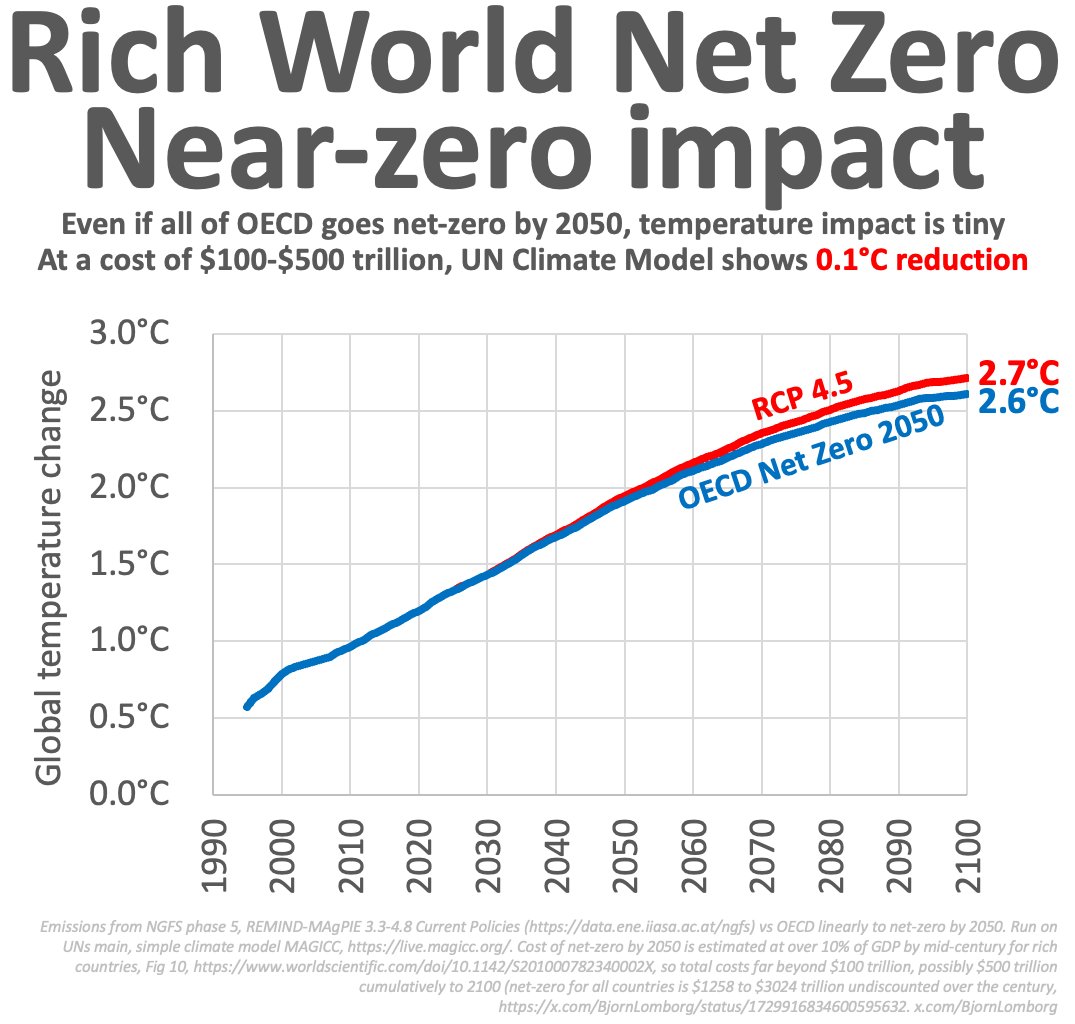
Rich World Net Zero has a tiny impact
Even if the US, EU, UK, Australia, Canada, Japan, and the rest of the rich world go Net Zero by 2050
it will only reduce global temperatures by 0.10°C (0.18°F) in 2100
Still, it will cost $100s of trillions
https://t.co/88qhA6UIcp, https://t.co/1ey8ZacGPB, https://t.co/FwQYq8ri6H
Rich World Net Zero has a tiny impact
Even if the US, EU, UK, Australia, Canada, Japan, and the rest of the rich world go Net Zero by 2050
it will only reduce global temperatures by 0.10°C (0.18°F) in 2100
Still, it will cost $100s of trillions
https://t.co/88qhA6UamR, , https://t.co/FwQYq8ri6H
You can see all the references in my Twitter thread:
https://t.co/r86NvtDWir
Rich World Net Zero has a tiny impact
Even if the US, EU, UK, Australia, Canada, Japan, and the rest of the rich world go Net Zero by 2050
it will only reduce global temperatures by 0.10°C (0.18°F) in 2100
Still, it will cost $100s of trillions
https://t.co/88qhA6UIcp, https://t.co/1ey8ZacGPB, https://t.co/FwQYq8ri6H
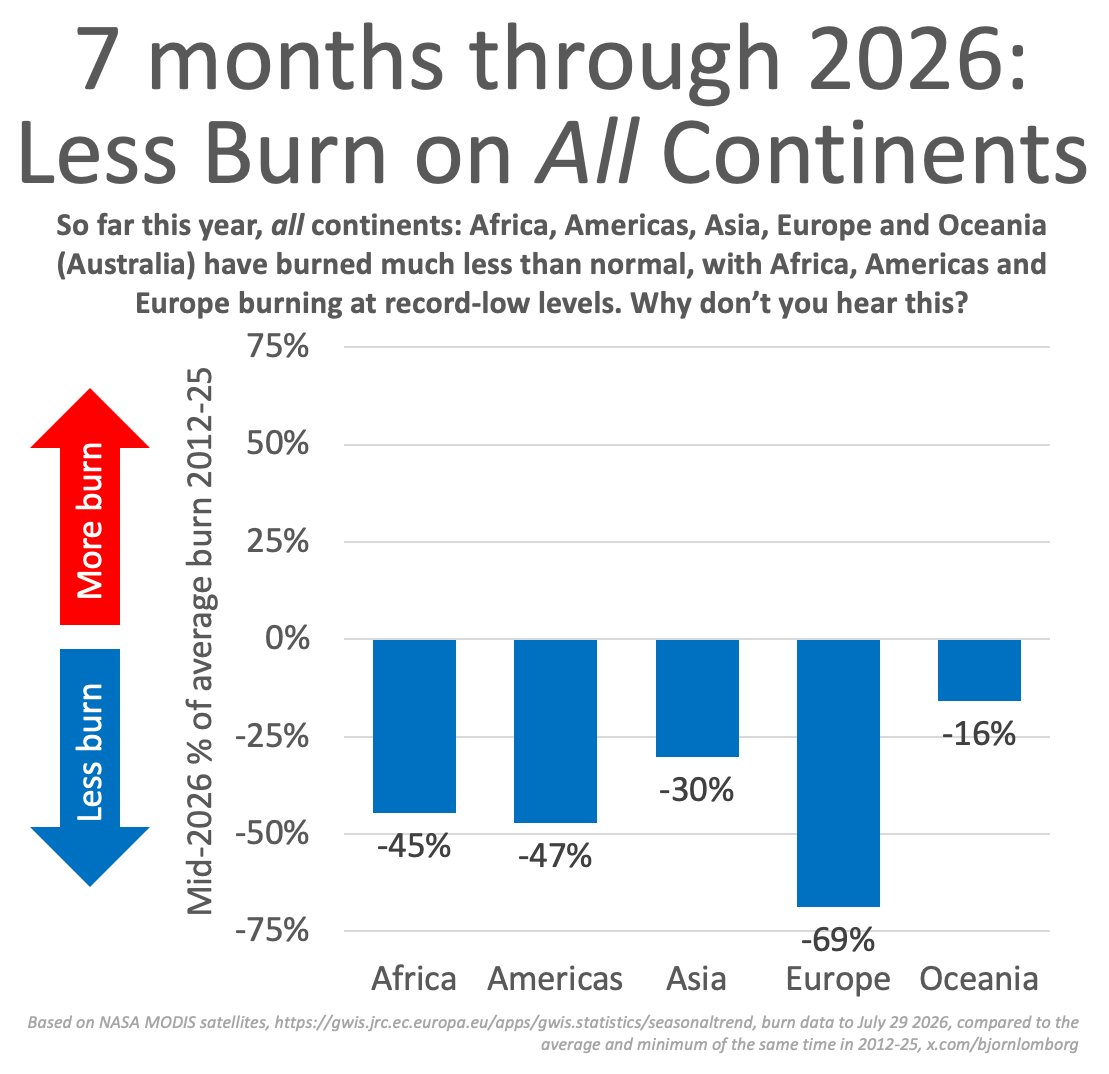
Less Global Fire
7 months through 2026:
Every continent is below average, and Africa, Americas, and Europe are at record lows
Yet, all you see is Canada (below average) and Europe (record-below average)
You are being badly informed on climate change
https://t.co/iDqlYckvRT
The most ridiculously climate-alarmist headline?
"Canada is on fire, underwater and overheating"
Reality: 1) Canada fire is below average
2) Canada has lost 0.002% of land over past 30 yrs
3) Warming saved many more Canadians from cold deaths than added deaths from heat
Refs: 1) https://t.co/J7DeHOr46z
2) https://t.co/I4lfHtabQW
3) https://t.co/ho7zYDCNUC
https://t.co/7r38X2EWsH
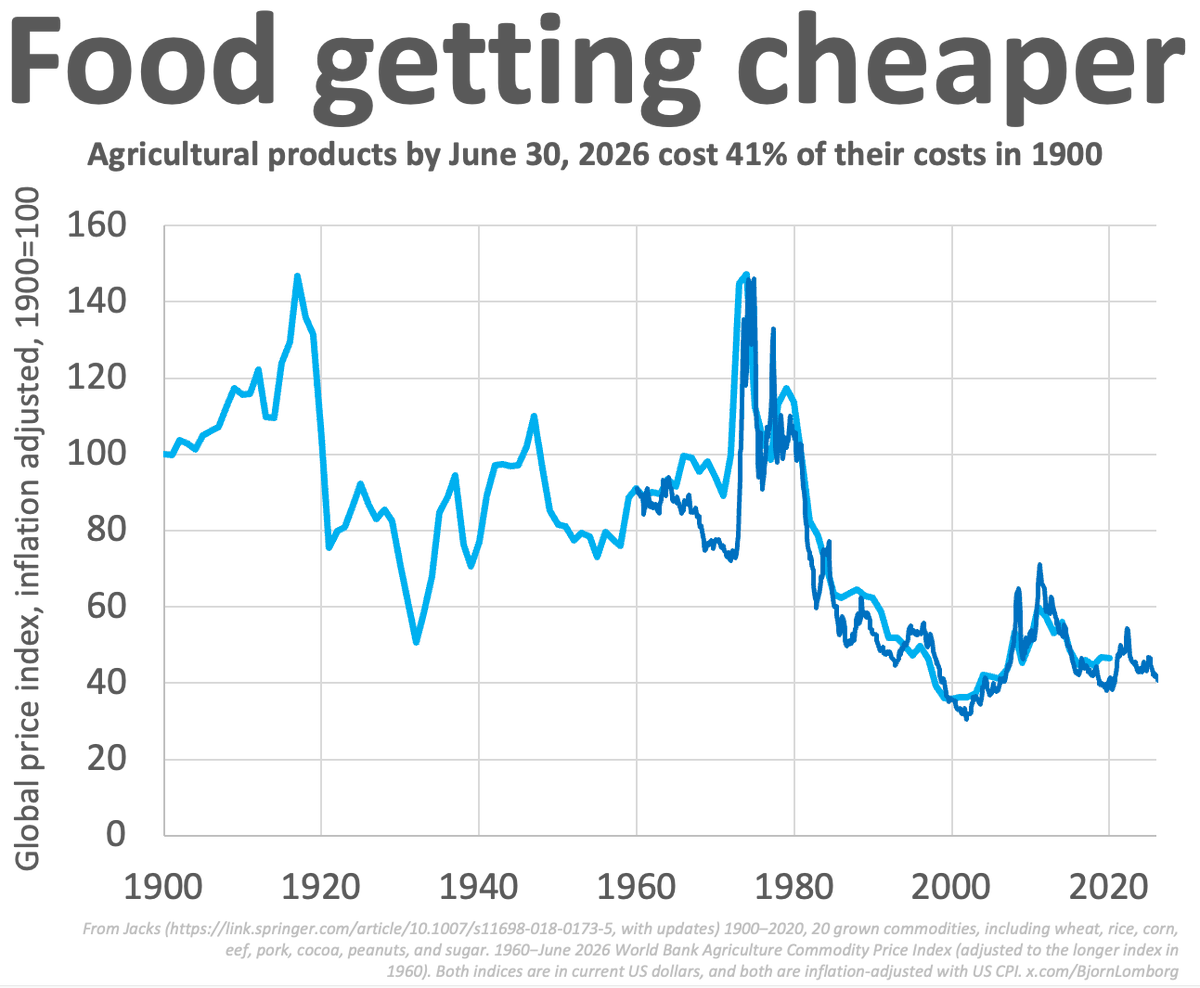
Globally, food has become cheaper since 1900, especially since the Green Revolution started in the 1960s
Broken by war and increasing costs of fertilizer/fossil fuel in the 1970s and again in the 2000s
https://t.co/gWDNl4L4fA
World Bank from https://t.co/IxOfkrt3CY CMWXAGM
https://t.co/Kb7iuwvafH
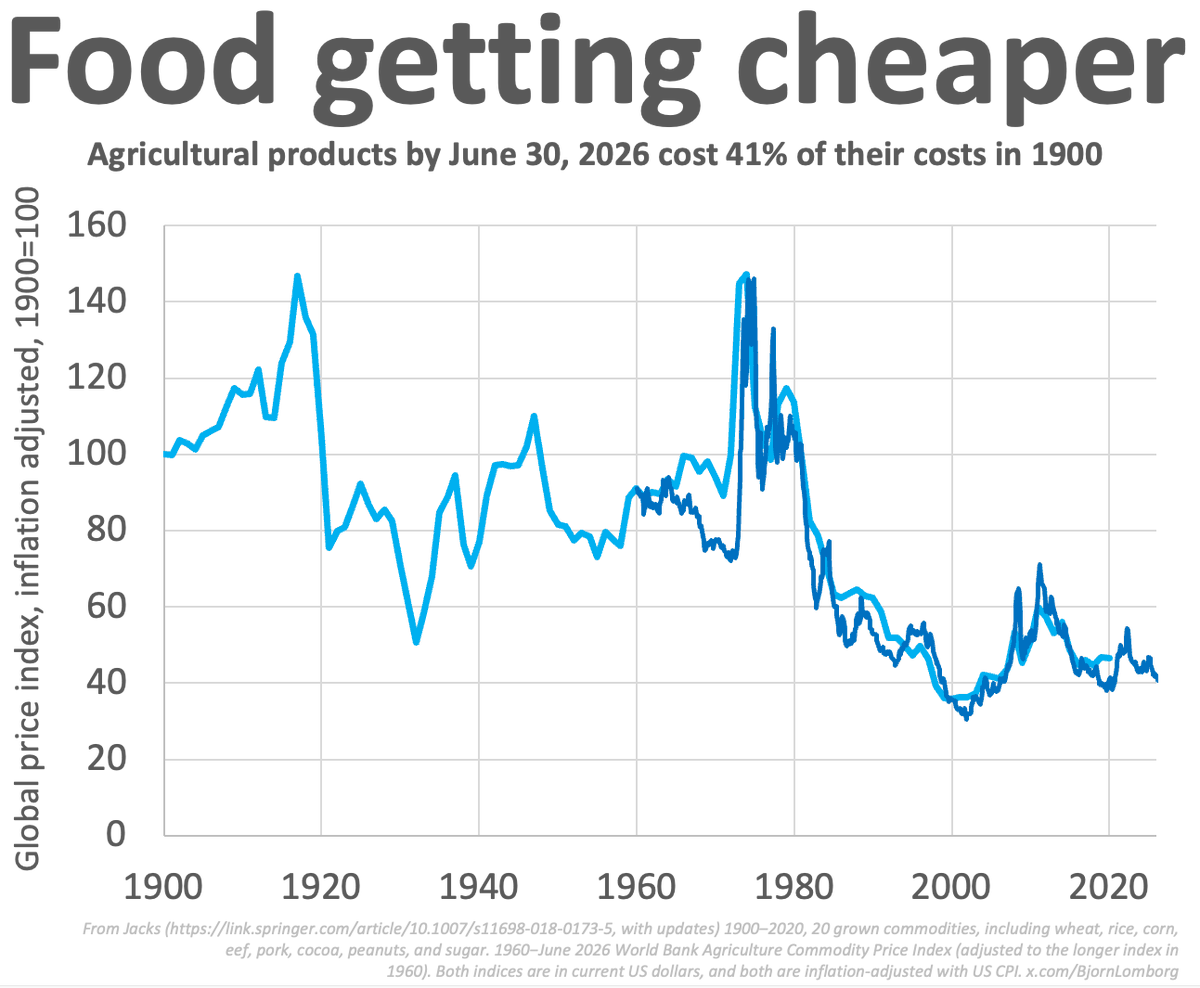
Globally, food has become cheaper since 1900, especially since the Green Revolution started in the 1960s
Broken by war and increasing costs of fertilizer/fossil fuel in the 1970s and again in the 2000s
https://t.co/qbRQ41VCg6
World Bank from https://t.co/vdKY5PPkxm CMWXAGM
@wetbulb_schizo Pls keep your comments civil (and constructive)
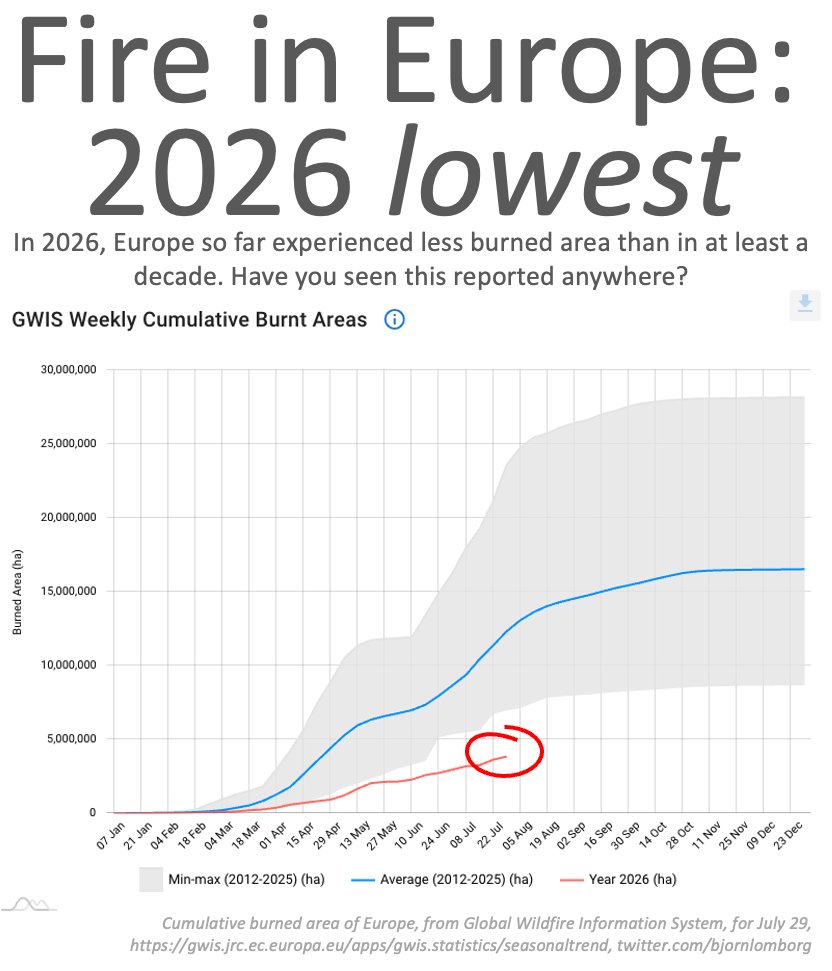
Here is the actual Europe data, which is now far below average): https://t.co/ZVoFO1HWCy
2026 Fire in Europe at record lows
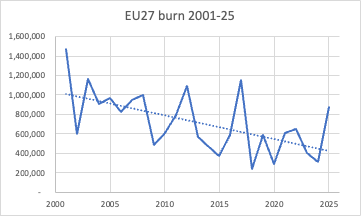
7 months through 2026, Europe has burned less than in any year 2012-25
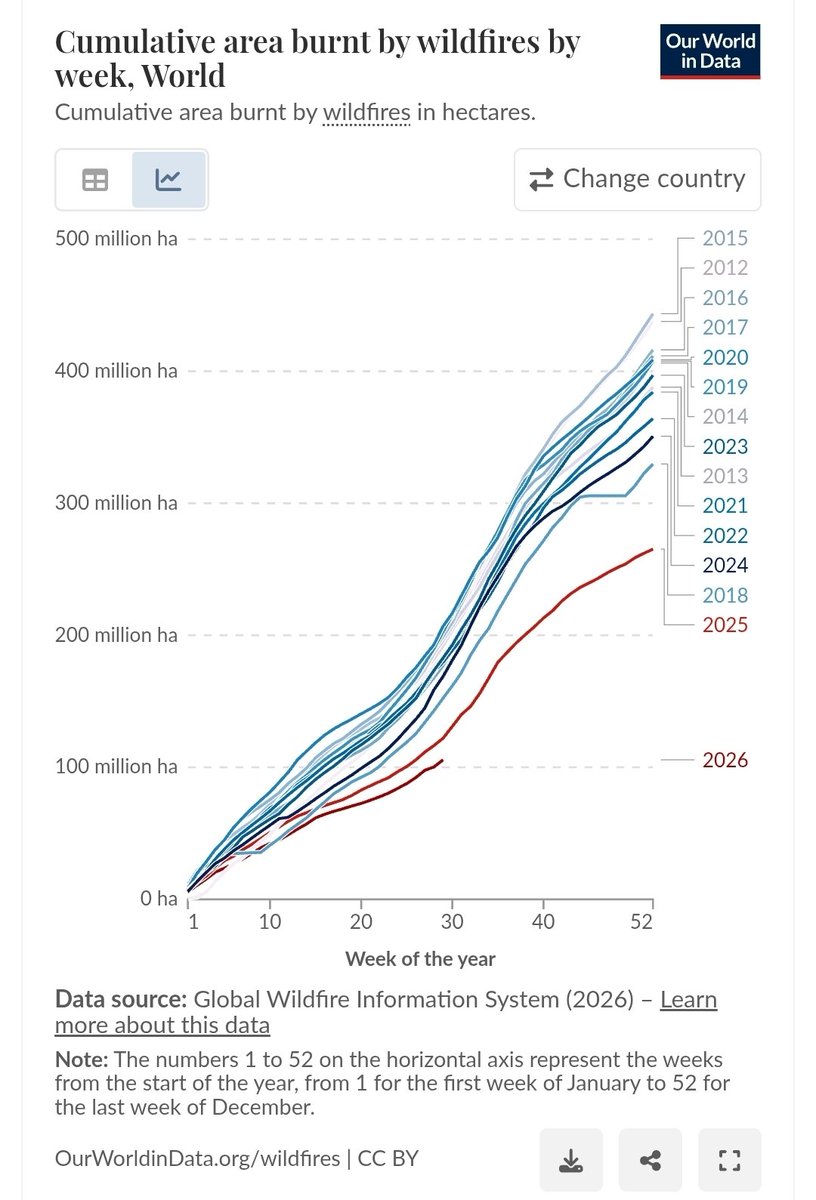
Every continent is below average, and Africa and the Americas are at record lows
Media only showing stuff burning leaves us badly informed
https://t.co/iDqlYckvRT
Less Global Fire
7 months through 2026:
Every continent is below average, and Africa, Americas, and Europe are at record lows
Yet, all you see is Canada (below average) and Europe (record-below average)
You are being badly informed on climate change
https://t.co/iDqlYckvRT
Less Global Fire
7 months through 2026:
Every continent is below average, and Africa, Americas, and Europe are at record lows
Yet, all you see is Canada (below average) and Europe (record-below average)
You are being badly informed on climate change
https://t.co/iDqlYckvRT
The fires in France and Spain are tragic, and I hope they're brought under control quickly with minimal loss of life, homes, and livelihoods.
But climate change is a global hypothesis, so it should be evaluated using global data. According to the Global Wildfire Information System, 2026 is tracking as one of the slowest global wildfire years on record. Focusing on a handful of European fires while ignoring the worldwide picture is the very definition of cherry-picking.
Individual disasters make headlines. Global trends test hypotheses. And right now, the global data simply do not support claims that climate change is increasing wildfires... In fact, it's the exact opposite.
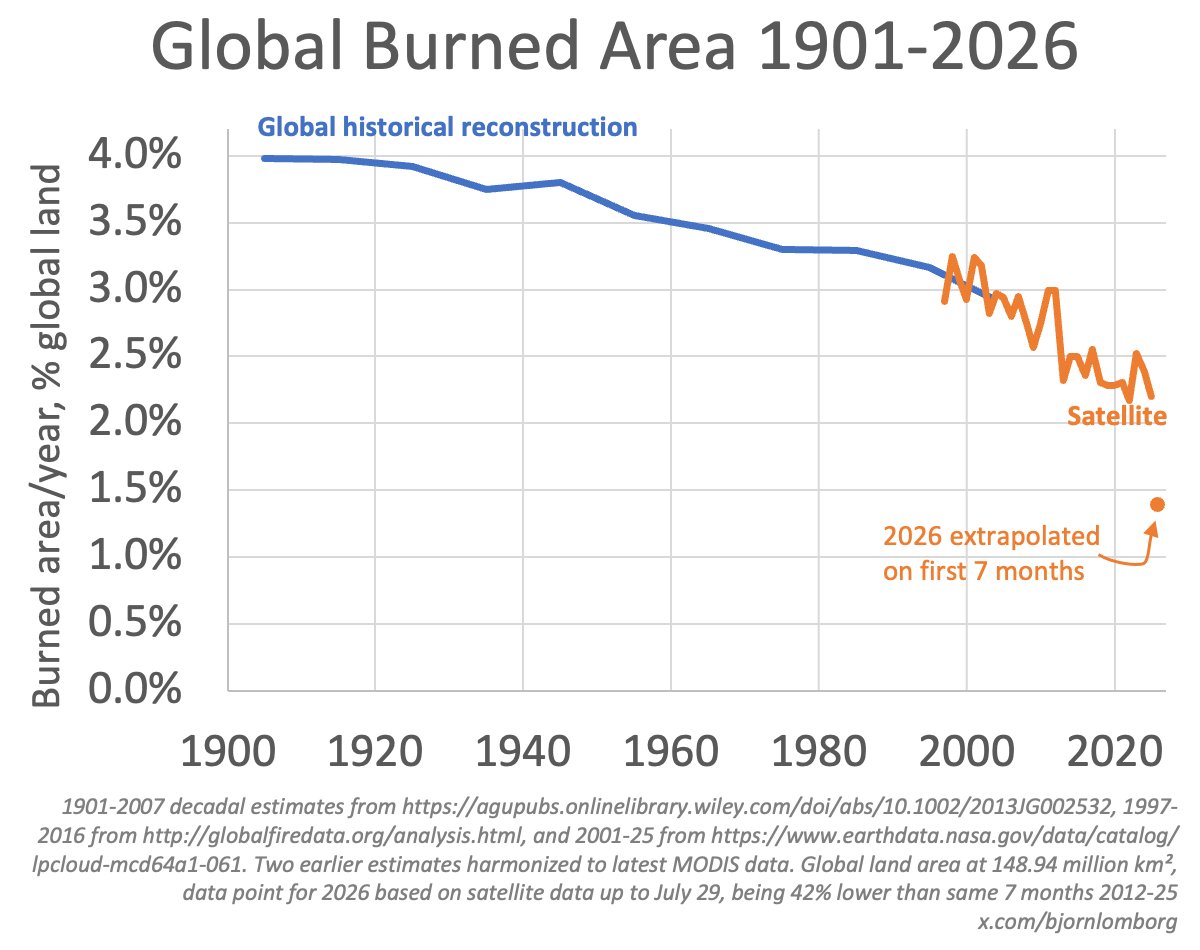
The world is burning less
Despite breathless climate reporting of ever-more fire
Total area burned across the world has declined over past 125 years
This year, world has burned 42% less than normal (2012-25). We don't know the next five months, but extrapolating from the current 7 months, 2026 is on track to burn historically little
The century-long reduction is entirely uncontroversial, mostly because more people (humans don't want fire near their houses) and more agriculture (farmers don't want their crops on fire) https://t.co/wDu9oa90Q5, https://t.co/MGFIDIHAvN
2025 global wildfire had lowest emissions in the satellite era
That's contrary to the climate narrative
2025 saw lowest emissions in Africa and South America, and 2nd-lowest in Asia, leading to lowest-ever global emissions
Ironically, the very science outfit reporting this obviously downwards-trending data
summarizes 2025 as an “intense wildfire year in the Northern Hemisphere” Unbelievably misleading (but of course, it gets funded by climate-alarmed EU) https://t.co/LuCF3ZOead
(notice the graph, but not downloadable data, has been updated to end-of-2025, as is also seen here https://t.co/nkUN1bTRJf)
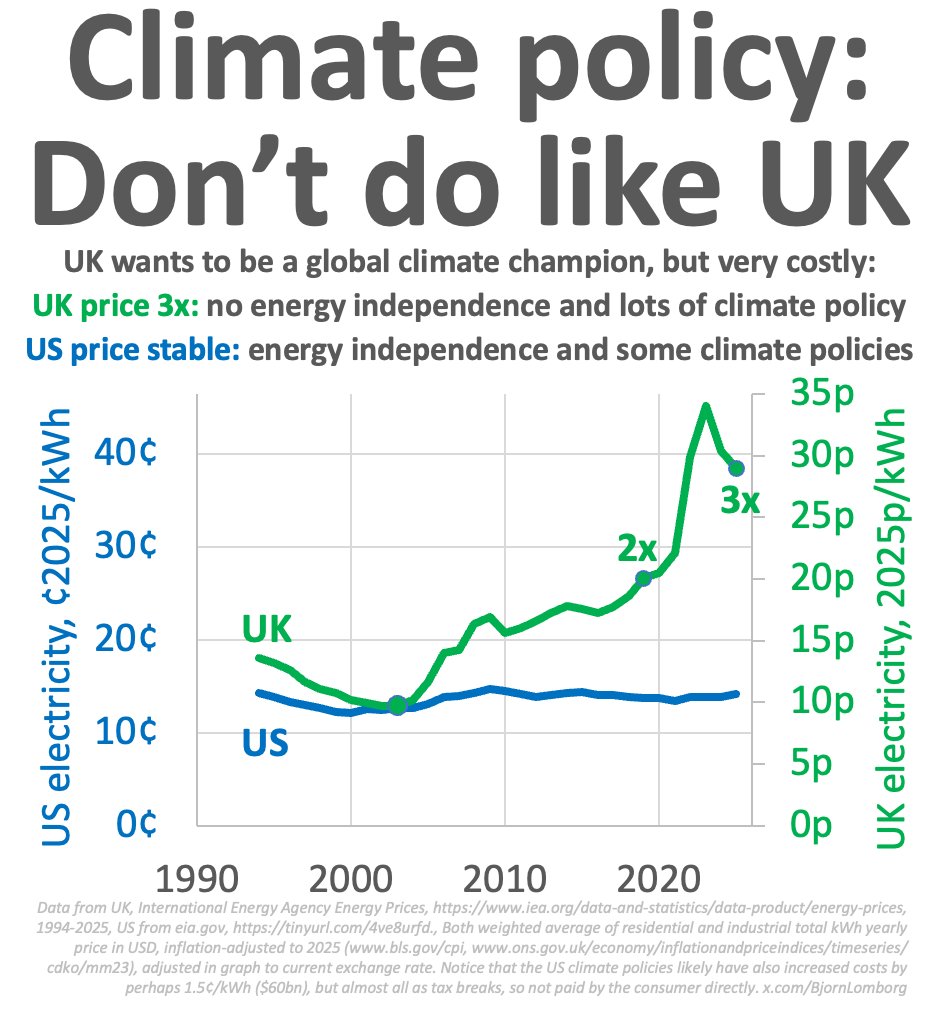
The enormous cost of green policies
UK electricity price tripled since 2003, mostly because of climate policies
Unlike US electricity prices
Prices 1994-2025, weighted averages of electricity costs for industry and households, inflation-adjusted to 2025
chttps://twitter.com/BjornLomborg/status/2073716133106974775u
https://t.co/gdcf3BxHhk
The enormous cost of green policies
UK electricity price tripled since 2003, mostly because of climate policies
Unlike US electricity prices
Prices 1994-2025, weighted averages of electricity costs for industry and households, inflation-adjusted to 2025
https://t.co/1Mzgv50ipc
https://t.co/KsxDtMFCLu