This is such an important test for the abundance movement. Trump wants this, Republicans want this, the Democratic establishment wants it.
Is the anti-abundance left really going to be able to ruin it for everyone?
@elonmusk Elon, I want to tell you something as a Ukrainian.
For years, many people in Ukraine admired and respected you. I was one of them. I personally saw you as a technological genius, a visionary, someone who was building the future while others were still living in the past.
And that is exactly why your growing hostility toward Ukraine is so difficult for me to understand.
Ukraine is not a perfect country. We have corruption, political failures, and many problems. Nobody denies that. But tell me, which country is perfect?
Ukraine is also a country of incredibly talented engineers, scientists, entrepreneurs, developers, artists, and ordinary hardworking people. We build world-class technology, innovate under impossible conditions, value education, and have repeatedly shown the world what courage, resilience, and human dignity look like.
We are a country that voluntarily gave up the world's third-largest nuclear arsenal in exchange for security assurances.
We are a nation that stood up in 2014, during the Revolution of Dignity, because we refused to live under authoritarianism and Russian domination. We wanted freedom, democracy, and the right to choose our own future.
And today, we are fighting for that same freedom.
Every day, Ukrainian civilians are killed by Russian missiles, drones, and bombs. Children lose their parents. Parents bury their children. Entire cities are destroyed. Millions of lives have been shattered.
These people are not dying because of Zelenskyy. They are not dying because of Ukrainian corruption. They are dying because Putin chose to invade another sovereign nation and continues to wage a war against its people, cities, culture, and identity.
Yes, corruption must be fought. Yes, every dollar of international aid must be accounted for. Ukrainians themselves deserve transparency and justice more than anyone.
But corruption does not justify invasion. Political failures do not justify bombing children. And no amount of criticism of Ukraine changes who crossed the border with an invading army.
You seem to believe that giving up Donbas and Luhansk could bring peace. But why should we believe Putin would stop there?
He already violated Ukraine's sovereignty after promising to respect it. He took Crimea in 2014. He fueled war in Donbas. And in 2022, he launched a full-scale invasion.
What makes you think another territorial concession would finally satisfy him?
History has shown us what happens when democracies believe they can secure lasting peace by rewarding an aggressor with someone else's land.
We have seen this before, in Europe, in the years leading up to World War II.
Peace built on surrender to a dictator is not necessarily peace. Sometimes it is simply an invitation to the next war.
Elon, you are a man who talks about the future of humanity, about making civilization better, about taking humanity to Mars.
But what kind of future are we building if we accept that powerful dictators can erase smaller nations simply because they have more weapons?
Ukraine is not asking the world to pretend we are perfect.
We are asking the world to recognize that we have the same right to exist, to be free, and to determine our future as Americans do.
And one more thing: Ukrainians have never been your enemies. Many of us admired you, believed in your vision, and appreciated what Starlink made possible during the darkest days of this war.
That is why your words hurt more than you might realize.
You have enormous influence. Your voice can shape how millions of people understand this war.
I still want to believe that the man who dreams of advancing humanity can recognize the humanity of people fighting simply to survive.
It is not too late to stand on the right side of history.
Not on Zelenskyy's side. Not on any politician's side.
On the side of freedom. On the side of human life. On the side of a nation's right to exist.
That is all we are asking for.
🇺🇦
The same people who fought fossil fuels now fight AI.
Why?
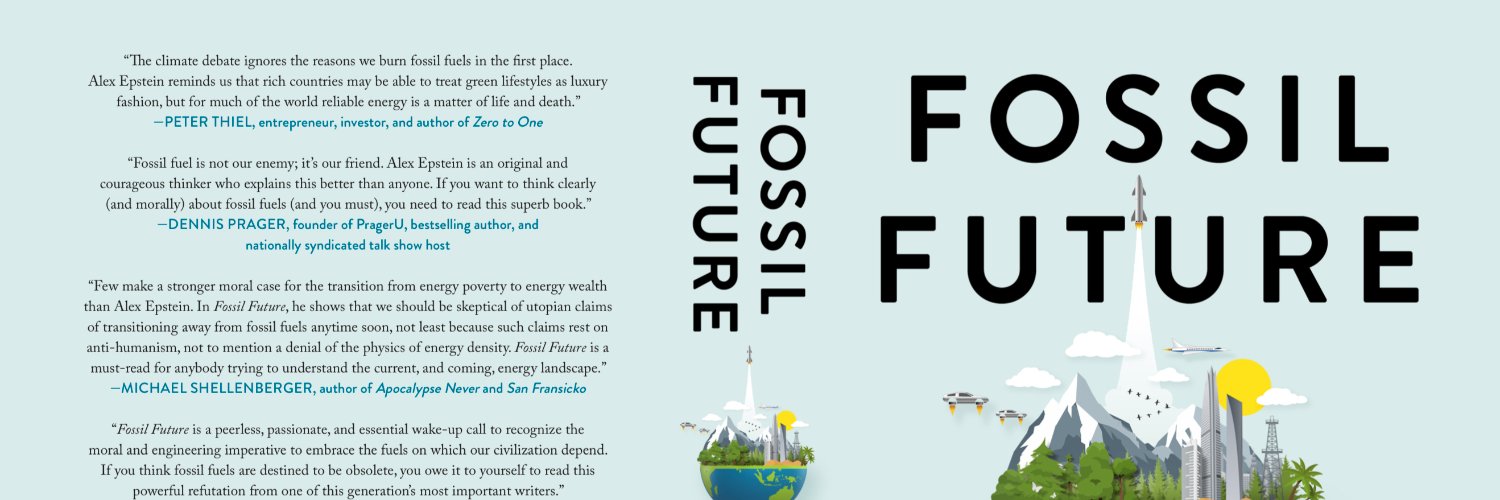
“They deny the huge benefits of something and they focus exclusively on the hazards,” says @AlexEpstein.
Here's our full interview on: why AI matters, the retreat from net-zero, and much more:
Crucial application of AI: expanding the mental labor available to solve crimes.
In this and almost every other field we have >100X less available mentor labor than we could make use of.
🚨 Super intelligence helped crack a 33-year-old Illinois murder case.
Madison County detectives used SI to analyze 2,000+ pages of evidence in the 1993 killing of Randy Gail Sperino.
Combined with DNA genealogy, the investigation led to a 70-year-old suspect who confessed.
Yesterday I taught a group of CEOs how to use AI agents to improve their lives.
I ended with a tribute to what I love most about AI: it "allows you to spend more time in the way you would ideally want to, and less time in the way that you don't."
I hope it inspires someone.
⬇️
Should Republicans hold up permitting legislation until all potential future Democrat Presidents agree not to try to impose permitting delays on fossil fuels?
I am against all technology-specific permitting delays.
But such delays by an administration cannot be an excuse for not passing permitting reform—legislation that inhibits administrations from imposing technology-specific delays.
NEW: Sen. Sheldon Whitehouse, top Dem permitting negotiator and EPW Committee ranker, reacts to my scoop on Trump admin moving 2 wind projects, telling me: “It’s a start, but we are going to need to see a lot more from the administration on wind and solar.”
"Ultimately, ultimately, ultimately, what technology does, but particularly this technology does, is it allows you to spend more time in the way you would ideally want to, and less time in the way that you don't. This is true of both the stuff you're doing and the stuff we do with others.
"I think people are going to look back in 10 or 20 years, and they're going to say, oh my gosh, I was doing all this stuff that I didn't really like doing, and now I don't have to do it anymore.
"And you're also going to say, wow, there's all this stuff other people were doing, and they were so attached to it. It's like it's their job or whatever, and they didn't really like doing it either, and I didn't really care if a human did it or a robot did it.
"Now, some things we really like doing as ends in themselves, and some things we really like other people doing for various reasons, from being a night nurse to you want an actual doctor and you want an actual teacher, and sometimes you just want a good coworker versus a robot.
"What's going to happen is we go to a world where more of our time is time stuff that we would do, our work is stuff we would do for no pay, and the stuff other people are doing is the stuff that really takes advantage of their what they like to do, their capabilities, and just their humanity.
"And I think that's going to be a much better world to live in. And it's it's hard for people to imagine how much different it is.
"But I think since we have a pretty prosperous group here, if you know how to use your prosperity to choose work you really love, and to choose dealing with people that you really want to deal with, you have some sense of what AI is going to mean for everyone.
"It's going to mean everything from: people like their work more to a lot more, people are going to be able to see the world, and it's going to be a lot more enjoyable to see the world.
"And I would like people to be excited about this future instead of afraid that there's nothing for them to do, and they're going to be bored, or AI is going to take over, or something like this.
"Those are very avoidable problems or impossible problems, but the good stuff is really, really good.
Let's all be clear that any permitting bill much weaker on freedom-to-build than BAAJA is a bill Donald Trump won't sign.
Our options are: 1) something extremely close to BAAJA or 2) no permitting reform for the foreseeable future.
https://t.co/b07LFuVLgx
Rep. Ro Khanna (D-Calif.), a progressive leader, expands on this, telling me he'll oppose Senate's permitting reform bill as written. He adds he'll "support" Nat Resources ranking member Rep. Jared Huffman's "work to get a bill that has high environmental and climate standards"
"Ultimately, ultimately, ultimately, what technology does, but particularly this technology does, is it allows you to spend more time in the way you would ideally want to, and less time in the way that you don't. This is true of both the stuff you're doing and the stuff we do with others.
"I think people are going to look back in 10 or 20 years, and they're going to say, oh my gosh, I was doing all this stuff that I didn't really like doing, and now I don't have to do it anymore.
"And you're also going to say, wow, there's all this stuff other people were doing, and they were so attached to it. It's like it's their job or whatever, and they didn't really like doing it either, and I didn't really care if a human did it or a robot did it.
"Now, some things we really like doing as ends in themselves, and some things we really like other people doing for various reasons, from being a night nurse to you want an actual doctor and you want an actual teacher, and sometimes you just want a good coworker versus a robot.
"What's going to happen is we go to a world where more of our time is time stuff that we would do, our work is stuff we would do for no pay, and the stuff other people are doing is the stuff that really takes advantage of their what they like to do, their capabilities, and just their humanity.
"And I think that's going to be a much better world to live in. And it's it's hard for people to imagine how much different it is.
"But I think since we have a pretty prosperous group here, if you know how to use your prosperity to choose work you really love, and to choose dealing with people that you really want to deal with, you have some sense of what AI is going to mean for everyone.
"It's going to mean everything from: people like their work more to a lot more, people are going to be able to see the world, and it's going to be a lot more enjoyable to see the world.
"And I would like people to be excited about this future instead of afraid that there's nothing for them to do, and they're going to be bored, or AI is going to take over, or something like this.
"Those are very avoidable problems or impossible problems, but the good stuff is really, really good.
Yesterday I taught a group of CEOs how to use AI agents to improve their lives.
I ended with a tribute to what I love most about AI: it "allows you to spend more time in the way you would ideally want to, and less time in the way that you don't."
I hope it inspires someone.
⬇️
For years, climate hysteria won most every argument.
Now, finally, the craziness has diminished.
In my full interview with @AlexEpstein we cover the shift, and also: why AI matters, Trump’s energy policies, ESG, and more:
Thank you to everyone who creates modern AI.
Making computers perform highly context-specific mental tasks (without specific preprogramming) is one of the greatest achievements ever.
Your achievement will eliminate so much mental drudgery and unleash so much creativity and joy.
This is fantastic. @BenAffleck understands and can reasonably explain something that many of the so-called AI "experts" seem determined to over complicate and mislead people on.
In fact, many of these experts are rapidly losing credibility with people who actually understand how this technology works. Unfortunately, they've already convinced a lot of people that AI is something it isn't.
And as the saying goes, it's easier to fool someone than to convince them they've been fooled.
An LLM is a computer program. We designed it. We know the architecture, the mathematics, and how inference works. Much of the underlying code and research is open for anyone to inspect.
All LLMs processes tokens through mathematical operations using learned weights and context to predict what comes next. The results can be astonishingly accurate, useful, and convincing.
But the LLM isn't alive. It doesn't love you, hate you, care about you, or sit around contemplating its existence or understanding.
And yet people insist that somewhere inside those matrix operations, consciousness has magically materialized.
Seriously?
This isn't biological life evolving in nature. It's software executing computations on hardware we designed and built. If you're claiming those computations somehow produce subjective experience, explain the mechanism (I'll wait...).
The remarkable achievement here is that we've created software capable of convincingly emulating aspects of human intelligence and behavior.
That's freakin' amazing and cause to celebrate the technology!
But please stop confusing a computer program with a living, conscious being. It's absolutely not.
The fact that so many people have fallen for that illusion is a testament to how convincing the technology has become.
But here's the clincher: when we misunderstand this, and we start treating computer programs as conscious, independent beings, the legal implications could be disastrous.
Suddenly, "the AI did it" becomes an excuse to shift blame away from the people and companies responsible for building, deploying, and operating these systems.
AI cannot be held accountable. But people and companies can be, and must be held accountable.
Ben gets it. More people should.
Steve Jobs was obsessed with making compute empower humans.
It's hard to think of anything more empowering than "agentic AI" that spares us chores and expands our abilities—so we can spend more time envisioning, creating, and doing what we love.
.@WalterIsaacson says Steve Jobs would be appalled by agentic AI.
"[Steve Jobs] says the goal is to connect human creativity to the processing power of our machines."
"What we're doing now with agentic AI is where I worry."
"When I start using agents that try to do things without me and to be out of my control, Steve Jobs would be appalled by that."
"It doesn't connect human creativity to the product. It doesn't have the music that makes our hearts sing, as Steve said, with the iPod."
"These people aren't stepping back and saying, 'Why are we making this?' The answer should be to help humanity."
"That was Steve's lodestar."
The tragedy is that it needs any defense at all. The greatest achievement of the human mind since the printing press must plead for permission from men who distrust the mind as such.
Walsh claims earlier jobs were changed while these are eliminated. Consider the blacksmith, the lamplighter, the switchboard operator, the typesetter, the men whose title was "computer." Their work did not change. It ceased to exist. In 1800 nine of ten Americans farmed. Today fewer than two in a hundred do. An entire mode of existence was abolished, and the result is the wealthiest nation in history. What Walsh calls a nightmare is the record of the last two centuries.
"Takes the human out of the equation" reverses the facts. The human is the one who holds values. A machine values nothing, because it has no life to sustain. Everything it produces, it produces for a man who wanted it.
If machines come to do most of the work, that is abundance: more of everything, for less, for everyone. To call abundance a catastrophe one must believe that a man's worth consists in being needed for toil. That belief is altruism, and it is the error beneath all the others.
Do not sleep on Dots! Get at least the $100/month ChatGPT Pro subscription, connect all your major apps and comms platforms, and delight in your new 24/7 super-assistant.
What an amazing time to be alive.
People are already doing things like this, and we’re about to have way, way more help from our new mental assistance machines.
I have no expertise on the financial prospects of OpenAI and Anthropic. But I can say there's business or consumer product I've ever used that's as valuable as theirs are, measured by amount of money I would regularly pay for them if the market required it. It's not even close.