🚨Uprising:🇵🇰
The popular uprising against Pakistan’s military regime in Kashmir has reached a very critical stage.
Pakistan became alarmed by this situation; therefore, it violated Afghan territory and targeted civilians in an attempt to divert attention from the Kashmir issue.
🚨The Israeli brutality of Pakistan:🇵🇰🇮🇱
The horror that occurred last night in Paktika’s Barmal District, carried out by the neighboring Israelis, resulted in the martyrdom of three children while they were asleep.
A fragment of the martyred child’s hand. 😭
🚨Why Was Sheikh Sahib Idris Targeted, and By Whom?:🎯
When a well-known figure disappears under mysterious circumstances, it is not merely a body that falls; with that death emerge deep narratives of intelligence warfare, dormant agendas are revived, and a hidden battle over the truth begins.
The death of Sheikh Sahib Idris also appears to be the opening signal of such a silent war.
In the intelligence lexicon, incidents of this nature are not described merely as an “accident”; rather, they are viewed as a point of perception management, after which it is not the incident itself, but the shape of reality that changes.
The Pakistani military regime and its intelligence apparatus are likely to exploit this incident on several layered levels:
First, they will activate the tactic of immediate attribution.
🎯🛑
Blame will quickly be directed toward a predetermined side before facts are even gathered, because in intelligence warfare, the “first narrative” is often the one that becomes most firmly rooted in public perception.
Thereafter, they will generate a wave of emotional mobilization.
Images, videos, and partial truths will be carefully arranged to produce a combined sense of anger, grief, and revenge. When emotions rise, analysis declines.
And this is precisely the desired environment for psychological, propagandistic, and at times even large-scale military operations.
Once such an atmosphere is established, the phase of legitimacy production begins: “We are compelled,” “This is our right,” and “Security must be ensured.”
These are the phrases through which emotional conditions are transformed into political and security justifications.
In parallel, they will continue the process of narrative-building.
The incident will not remain a mere news story; rather, it will be turned into a long-term narrative in which opponents of the Pakistani regime will constantly appear as dark shadows.
Another concealed move will be information control: the media, either directly or indirectly, will be coordinated so that only one dominant image and a regime-crafted narrative are presented regarding the incident.
🛑
Alternative views will either be weakened or pushed aside under labels such as “irresponsible” or “misleading.”
At the same time, the dissemination of ambiguous information will continue information that is neither so false as to be immediately rejected, nor so clear as to reveal the truth.
The objective will be to keep minds trapped in doubt and prevent people from reaching certainty.
Likewise, this incident will be used as a tool for crisis creation.
The security situation will be portrayed as being under extreme pressure in order to justify emergency measures, strict laws, and broad operations in the name of “necessity.”
Furthermore, the strategy of diversion and justification will be activated, and the incident will be used as a high wave to conceal the Pakistani military regime’s internal failures, economic difficulties, and political divisions.
On the international stage, a parallel effort will be made to attract sympathy and support.
The incident will be framed in such a way as to secure political backing while also giving international legitimacy to actions taken against its opponents.
Most importantly, this narrative will be kept alive.
Each time, a new angle, a new allegation, and new “information” will be added so that its impact remains prolonged and continuous.
Therefore, it may be said that Sheikh Sahib Idris was targeted by Pakistan’s military regime and intelligence agencies in pursuit of the above objectives.
However, in such circumstances, the truly perceptive mind is the one that hears the silence behind the noise, searches for the objective behind the narrative, and understands the calculation behind the emotion.
🚨A major step toward economic innovation and self-sufficiency:🏳️
The Qoshtepa Canal is a large-scale regional project and the first major national project in Afghanistan’s history, after the Islamic Emirate of Afghanistan came to power.
#ANA#Afghanistan#Taliban
🚨Why did the U.S.–Iran negotiations hosted by Pakistan fail:🇵🇰🇮🇷🇺🇸🔥
The world of politics has always been built on mutual interests and the assurance of those interests.
If countries fail to safeguard each other’s political benefits, or do not stand behind guarantees that protect those interests, mistrust often emerges turning friends into adversaries.
There is a well-known political saying: politics has no permanent friends.
As for the U.S.–Iran negotiations hosted by Pakistan, which ended unsuccessfully and without any outcome, there are many reasons.
However, a few key factors that rendered the talks fruitless are outlined below:
1- Lack of Political Neutrality:
Pakistan is a country whose military, system, and authority are tied to external powers.
It neither possesses political independence nor a level of stability that can guarantee the long-term interests of its allies.
From its creation up to the current regime, Pakistan has experienced a form of political anarchism, where rulers have faced outcomes ranging from assassination to imprisonment.
This is not a new phenomenon but rather a continuation of Pakistan’s externally influenced political transitions, where the rise of each new leader in the West is closely linked to Pakistan’s political survival.
Therefore, any peace initiative hosted in such a country is often doomed to end without results.
2- Dual-Faced Policy:
In global politics, two types of approaches tend to succeed, but not every country is fortunate enough to benefit from both you either take a side or maintain neutrality.
Pakistan, as a country whose governance and funding are sourced from Western channels, can never host a peace process based on genuine neutrality and claim that privilege.
3- Imbalanced Policy:
Systems entangled in imbalanced policies cannot create a trustworthy environment for the region or the world.
No third party can rely on such a country to safeguard its strategic interests through mediation.
When a host country is perceived as biased in both friendship and hostility, the guest parties may suspect that it could influence the opposing side, creating an atmosphere of imposition and political brokerage seeking to position itself as the “king” in the chessboard of diplomacy and claim all the credit.
4- Absence of a Suitable Third Party:
Iran has, to a large extent, brought much of the Middle East under the shadow of conflict.
Countries such as Qatar, Dubai, Bahrain, Kuwait, Saudi Arabia, and Iraq considered key players in the region’s political balance have themselves been affected by these tensions.
Qatar, which is globally recognized as a venue for major diplomatic negotiations, was also impacted by the conflict. In the absence of a nearby, stable power aligned with U.S.
strategic interests where such negotiations could proceed, Pakistan became a fallback option.
This was neither an initiative of the Pakistani regime nor a platform through which Iran could achieve long-term strategic goals.
Rather, Islamabad’s role was largely symbolic serving as a space where both sides could present and understand each other’s demands.
In essence, it allowed the United States to bring its staunch rival, Iran, from a war like atmosphere into a relatively calm setting like a political resting space to better understand its demands and strategic objectives.
Pakistan is not a venue for resolving global crises; rather, it stands on the brink of a significant internal security crisis and decline.
Its condition increasingly resembles that of Iran in certain respects and may soon face a point where the final nail is driven into the coffin of its survival.
#MiddleEast
#IranUSACeasefire
🚨Big Breaking:🇮🇷🇵🇰🇺🇸
WHY!?📌
Asim Munir is wearing a suit while welcoming JD Vance.
Previously, he wore a military uniform when welcoming the Iranian delegation.
Is this a secret message or pre-planned agenda to send code of secret signal.!?
🚨Just in:🇵🇰🇮🇱
Two major differences |
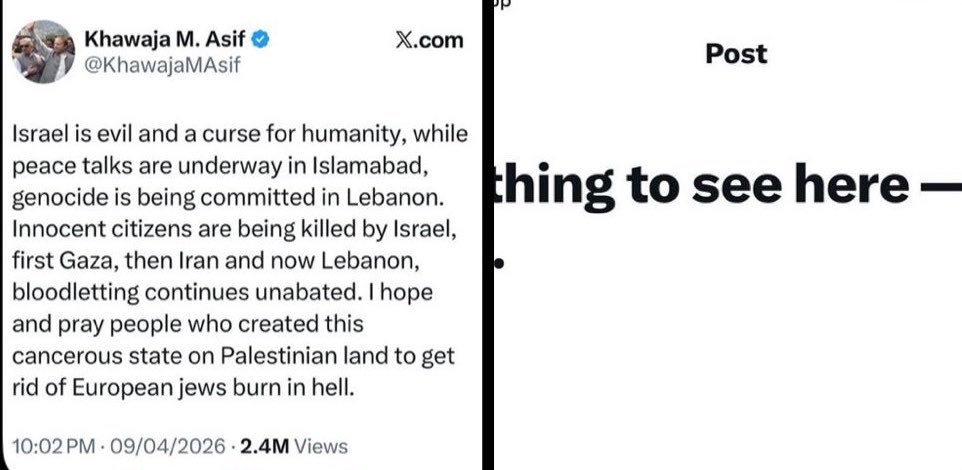
When Pakistan’s imprisoned former Prime Minister Imran Khan made strong remarks about the United States and Israel during his time in power, he never deleted a single tweet despite facing pressure.
📎
He is now imprisoned by a specific inner circle of the Pakistani regime that maintains close and favorable relations with Israel and the United States.
🛑
Just two days ago, Pakistan’s Defense Minister was detained by the military after making sharp criticisms against Israel, and he is still being held under pressure from Asim Munir’s inner circle at GHQ.
📌
His X (Twitter) post has been declared against national interests.
Breaking News:🚨🔥
Sources:📌
the head of Mossad has held talks with Pakistan’s Army Chief, Asim Munir, regarding Khawaja Asif and has issued a warning over his recent post on X.
The sources further add that following his latest X post, Khawaja Asif was summoned to the General Headquarters (GHQ) by the military leadership, and there is still no information about his return from there.
Reports are also circulating that army generals who fear a deterioration in relations with Israel may remove Khawaja Asif from his position and appoint someone else in his place.
Khawaja Asif has not posted anything on his X account over the past two days and has only retweeted a few posts.
It is being claimed that he has been accused of acting against national interests and is currently in military custody.
Big Breaking:🚨
Whats really happen in pakistan!?📌
🚨 Sources
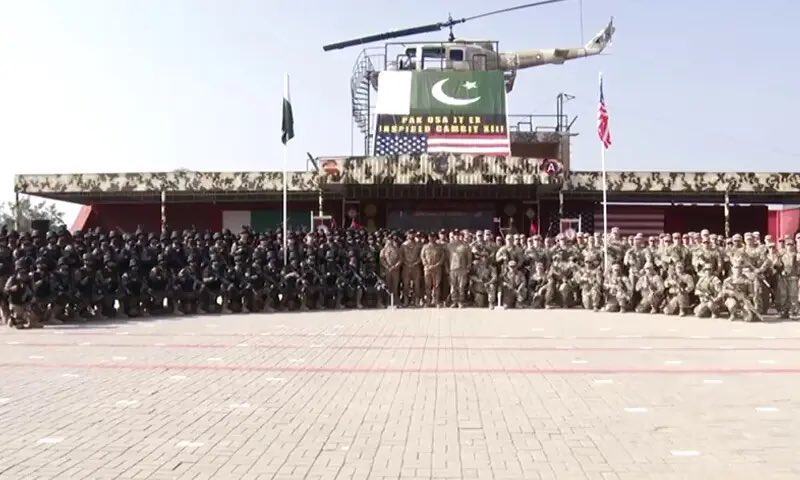
This evening, approximately one thousand additional American troops arrived in Islamabad to ensure the security of their negotiating delegation in the city.
It is worth noting that American forces had already taken over security responsibilities in Islamabad from Pakistani military personnel.
Big Breaking:🚨
The powerful Iran-backed Iraqi militia Kataib Hezbollah said in a statement on Tuesday that it will release American journalist Shelly Kittleson, who was kidnapped from a Baghdad streetcorner last week.
🚨Another scandal involving Pakistan:🇵🇰🇮🇷🇮🇱
Vali Nasr, a professor at Johns Hopkins University, said in an interview with CNN:
Pakistan’s proposal to mediate talks between the United States and Iran was a plot aimed at eliminating Iranian officials.
He stated that the plan was designed in such a way as to lure Iranian officials to the scene under the pretext of negotiations, in order to later carry out an attack on them.
According to him, the primary objective of this alleged conspiracy was to create a security threat under the guise of diplomatic engagement.
🚨JUST IN:🇮🇷
The Wall Street Journal:
Iran has officially told mediators that it is not willing to meet with U.S. officials in Islamabad and that the U.S. demands are unacceptable to them.
Mediators said on Friday that Turkey and Egypt are considering new venues for talks, including Doha or Istanbul, and are also working on new proposals to end the current deadlock.
🚨Just in:
Oil tankers passing through the Strait of Hormuz are being handed over to the United States.
Sources from the Oil and Gas Regulatory Authority (OGRA) of Pakistan have stated that a number of the country’s oil carrying vessels are being delivered to the United States.
According to these claims, a shortage of oil has emerged in the domestic market, and a rise in prices is ongoing, increasing public concern.
Europe and the United States rely heavily on energy imports, and changes in global markets directly affect them.
The closure of the Strait of Hormuz by Iran has also had a significant impact on them.
It is noteworthy that Iran has allowed 20 Pakistani vessels to pass through the Strait of Hormuz, most of which are being handed over to the United States.
It should also be noted that U.S. pressure on Pakistan and their relations remain a subject of discussion, as Pakistan is considered to be aligned with U.S. policies.
🚨Just in: Breaking News!🔥💥
Khost Ghulam Khan border crossing has witnessed a clash between Pakistani militias and Afghan Islamic forces.
So far, no information has been released regarding casualties, but the fighting is still ongoing, and the Afghan Islamic forces are striking the necks of the apostates with high morale.
#ردالظلم