Made the Inc. 5000 again this year. Back to back. Last year we came in at #427 and number one in South Dakota. This year's rank drops in August. Proud of it. Not satisfied by it. In my head we haven't come close to what we're chasing. Back to work.
This is concerning. For the first time, a Chinese model Kimi K3 has taken #1 on the Frontend Code Arena and is scoring at or near the frontier on other benchmarks.
Meanwhile America is tying itself in knots: politicians and bureaucrats are banning new data centers, piling on state regulations, and pushing for new federal agencies to pre-approve frontier models.
This is how you lose the AI race. The rest of the world won’t play by our rules if we bog ourselves down. Permissionless innovation is how America won the internet and became the technological envy of the world. We can do it again with AI -- while addressing risks in a targeted way -- or we’ll watch our lead evaporate.
Hey @elonmusk I need you to fix FSD navigation at the I-90 and Brandon, SD exit. It keeps wanting to exit, do a U-turn, and then get right back in the interstate. Does it in my Cybertruck and Model Y. This is very important. Thank you for your attention to this matter!
And I think about my own life. I’m still that same kid from the horse ranch. I didn’t make the NFL. I tried. I chased it as far as I could.
And when that dream ended, eventually I found another one. Today, I own a payments company in an industry I didn’t even know existed when I was growing up.
Think about how crazy that is.
A kid from a horse ranch. A graduating class of 12. No family history in payments. No childhood dream of fintech. I didn’t even know the industry existed.
And somehow, in America, I got the opportunity to walk into it, learn it, start a company, get my ass kicked a few times, keep going, and build something I’m incredibly proud of.
We’ve had a taste of success. But I’m still grinding every day because, in my mind, I haven’t come close to what I’m chasing.
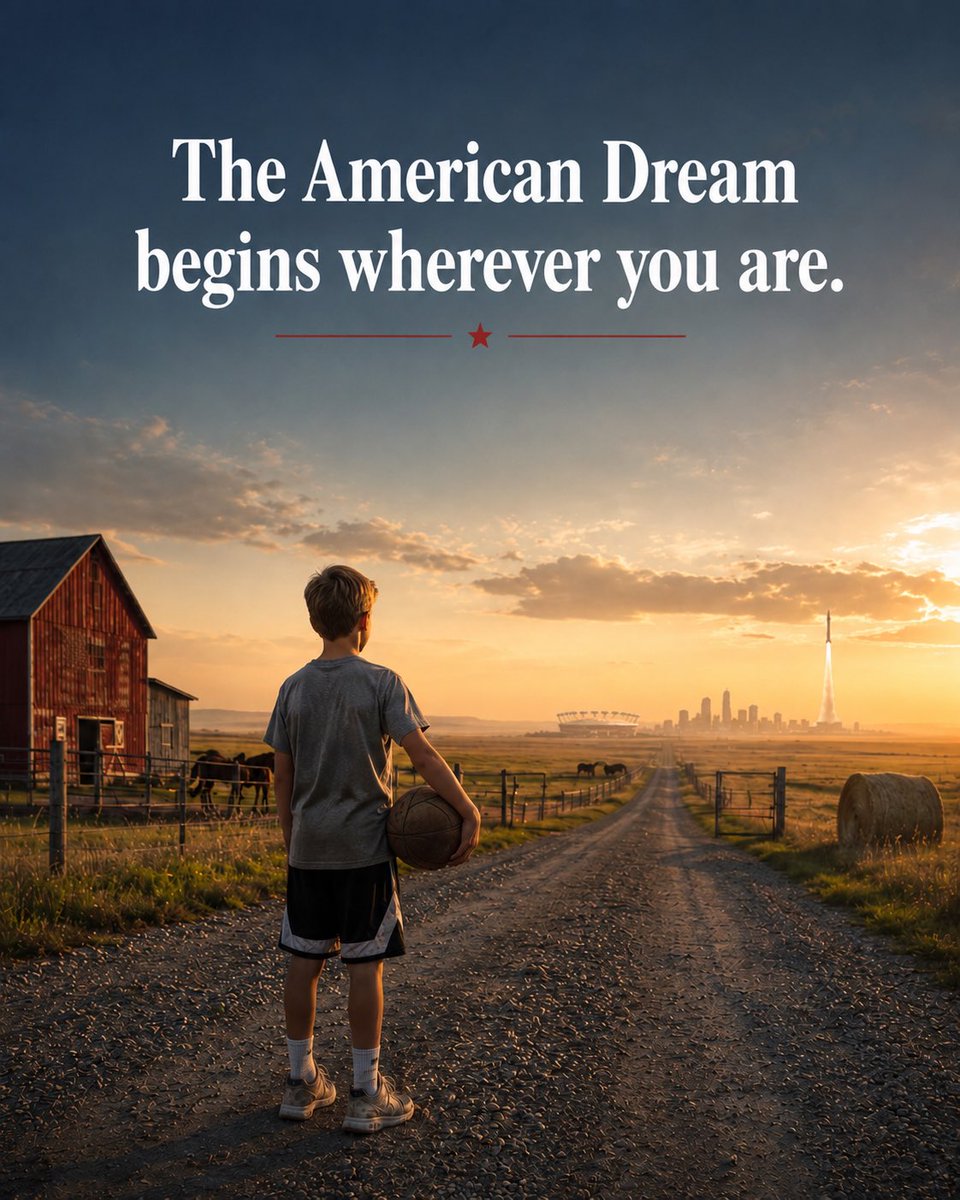
And that, to me, is the American Dream.
A kid can grow up in the middle of nowhere. Look up to people who look nothing like him. Dream something ridiculous. Fail at it. Find another dream. Start over. Build. Lose. Win. Get knocked down. Get back up.
And never be too old, too unknown, too inexperienced, or from too small of a place to take another swing.
I hope we get back to celebrating that.
I hope kids still look at the greatest athletes in the world and want to train like them.
I hope they look at the greatest entrepreneurs and want to build like them.
I hope a white kid from South Dakota can idolize three Black athletes without anyone thinking twice about it.
I hope an immigrant can come to America, build something extraordinary, become wildly successful, and inspire the next generation to try something even bigger.
I hope we stop teaching people to resent greatness and start teaching them to chase it.
Because 250 years later, I still believe this is the greatest country in the world.
Not because it guarantees success.
Because it gives ordinary people permission to attempt extraordinary things.
I’m still attempting mine.
Happy 250th, America. 🇺🇸
I still believe your best days are ahead.
Happy 250th birthday to the greatest country in the world. 🇺🇸
I’m proud to be an American.
Always have been.
I grew up on a horse ranch in the middle of nowhere South Dakota. I graduated with 12 kids.
And when I was young, I had one dream: I wanted to be a professional athlete.
I don’t understand it.
Think about Elon’s story. An immigrant from South Africa comes to America.
Builds companies.
Makes a fortune.
And then instead of taking his money and disappearing onto a beach somewhere, he risks enormous amounts of it again.
On electric cars. On rockets. On ideas most people thought were insane.
Tesla nearly failed. SpaceX nearly failed.
He kept going.
You don’t have to agree with every opinion he has. You don’t have to like every decision he makes.
But how did we become a country that can look at an immigrant coming to America, helping build revolutionary companies, risking fortunes, launching rockets into space, and somehow decide the thing we should feel is resentment?
That story should sound familiar. Because that story is America.
This AI just exposed the BIGGEST legal insider trading operation in America.
A platform called GovGreed built a seven-layer machine learning system that cross-references every stock trade disclosed by every sitting politician against the bills their committees control, the campaign donations they receive, and the companies their votes directly impact.
It scored all 540 politicians currently in Congress. And the numbers are crazy:
56% of every stock purchase made by Congress in the last 16 months was on a stock directly affected by a bill the buyer later voted on. That is 6,170 out of 11,016 total purchases.
More than HALF of all congressional stock buys are on companies whose fate that same politician is about to decide.
343 of 540 Congress members actively trade stocks while holding access to nonpublic legislative information.
That is 63.8% of the entire legislature making market bets with an informational edge that would put any hedge fund manager in prison.
The AI identified 752 active "Triple Signals" in the current Congress. A Triple Signal fires when three conditions line up at once:
The politician sits on the committee controlling a bill, they traded stock in a company affected by that bill, AND they received campaign contributions from that same industry.
Bills carrying these insider indicators pass at 5.4 TIMES the normal rate.
Now look at the individual leaderboard:
- Nancy Pelosi's estimated portfolio sits at $194 million with a Greediness score of 98.1 out of 100
- Ro Khanna made 13,231 trades across 800+ different tickers
- Michael McCaul made 32,302 trades and filed 6,670 of them late
- Thomas Suozzi filed 86.4% of his trades late with an average delay of 396 days, meaning his disclosures landed over a YEAR after he made the trade
And then there is Lisa McClain, the fourth-ranking Republican in the House. She has made 1,443 trades in three years, more than 98% of all politicians tracked.
She violated the STOCK Act twice in a single year, disclosing up to $900,000 in trades months after the legal deadline. Her husband bought up to $250,000 in Elon Musk's xAI, which quietly converted into SpaceX equity before last Friday's $2 trillion IPO.
The penalty for all of this? A $200 fine.
The number of Congress members ever prosecuted under the STOCK Act since it passed in 2012? Zero.
And the cruelest part is this:
A bill to ban congressional stock trading was introduced in January 2026. It has bipartisan support. Over 80% of American voters want it passed.
But Congress is sitting on it, because the people who would have to vote yes are the same people making millions from the system staying exactly the way it is.
They write the insider trading laws, they exempt themselves from enforcement, they trade on the information those laws generate, and when they get caught, they pay a fine that is basically nothing.
The AI didn't discover anything Congress was hiding. It just organized what was already public into a pattern so obvious that nobody can pretend it isn't there anymore.
A man who worked at SpaceX for 10 years moved to the US from Mexico in 2015 and took a welding contract at SpaceX for $28 an hour. He's now a supervisor.
He received $10,000 in stock plus payroll deductions to buy more, and he did exactly that. Despite achieving the American Dream, he says he isn't going to stop.
He's one of 4,400 SpaceX employees who became overnight millionaires with the IPO.
Elon just created 4,400 millionaires in a single day.
400 of them are now worth over $100 million.
These aren't VCs. They're SpaceX employees, and the list includes welders, technicians, and cafeteria staff, because for two decades the company paid every level of the workforce in stock instead of higher salaries.
Juan Hernandez immigrated from Mexico and took a $28 an hour contractor welding job in 2015. He says he didn't even know what SpaceX was. The company gave him a $10,000 equity grant and let him buy more shares through payroll deductions. That stake is now worth $880,000.
Trevor Hise's parents wanted him to take a stable job at General Electric. He picked SpaceX instead, stayed 12 years, and accumulated over 100,000 shares. At the $135 listing price that's $13.5 million. He's 37 and semiretired. His words: "The magnitude of this has been ridiculous."
The most telling detail came before the listing. Over 100 employees quietly banded together and negotiated a group wealth management deal covering up to $5 billion, because none of them had ever needed a wealth manager before.
Software IPOs have minted millionaires for 30 years. This is the first one where the money went to the factory floor.
Don't build a lifestyle that fits your salary. Build an income that fits your lifestyle.
A successful entrepreneur once told me he refused to squeeze his dreams into a fixed paycheck. Instead, he built income streams that matched the life he wanted.
That mindset shift changed everything for me.
Right out of college, I quit my salaried job and jumped into 100% commission merchant services, a world I knew nothing about before the interview.
Terrifying? Yes. But the residuals changed the game.
Sell an account → they process → you get paid monthly... for as long as they are your customer.
It stacks. Your baseline grows every month without starting from zero.
No more grinding for 15 new deals just to hit quota.
Now as an entrepreneur (and dad to 3 spoiled competitive cheer daughters with a bougie wife 😂), almost no salary could fund our lifestyle.
But that's the beauty: Commission (and smart residuals) gave us freedom. Dream big, do the math, build the plan, and then go execute.
It's not always easy, but it's always worth it.
If you're ready to bet on yourself, break free from salary handcuffs, and build real recurring income in payments...
DM me or comment your goals. Happy to walk you through how Phase 3 Payments could make it happen.
@jasonlk@buccocapital Disrupting Toast from a software standpoint, maybe… but duplicating their hardware, implementation, service, and training for restaurant environment will be extremely hard.