Some comparable valuations:
COMP:
EV $5.1B Revs $6.3B EV/Revs 0.8x
COMP is buying HOUS
HOUS:
EV $3.8B Revs $5.7B EV/Revs 0.7x
OPEN: (adjusted to be comparable)
EV: $8.7B Revs $0.4B EV/Revs 22x
Which one is not like the other one?
@ericjackson is guilty of analytical malpractice and misleading investors with his idiotic $CVNA comparison.
The $OPEN “Army” knows where you
Live!!
$TLT, the popular long-term Treasury ETF, is now down 15% so far this year. That's on top of its 37% decline in 2022 and its 6% decline in 2021. From its 2020 peak, TLT is now down 53%. Many investors bought TLT under the false impression it was low-risk. The risk remains high!
That would be a great suggestion if you could assure that the industry you were representing wasn’t completely captured by heartless monsters who have a history of some of the biggest criminal fines in human history because their deception has cost hundreds of thousands of people their lives. It would be a great suggestion if the industry you were defending didn’t occasionally look at human beings as an opportunity to generate insane wealth regardless of the tragic consequences. But you can’t do that, so… maybe it would be a good idea to have a fucking debate.
@POTUS I'll Community Note this for you
Very misleading:
In March of 2020 the US was locked down due to COVID. Unemployment skyrocketed & many lost their jobs.
When Biden came into office, lockdowns were ending & everyone got their jobs back.
Biden calls this 'job creation'
3/3
What prompts the Fed to stop hiking? In each of the cases shown above, the Fed went too far and something in the markets/economy broke:
The Fed ended a hiking campaign on May 16, 2000, at 6.50%. This was two months after the NASDAQ bubble burst and tech stocks were imploding.
The Fed ended a hiking campaign on June 29, 2006, at 5.25%. The Case-Shiller housing index peaked two months later, leading to a massive collapse and the Great Recession.
The Fed ended a hiking campaign on December 19, 2018, at 2.375%. Initially, the stock market broke following this meeting, leading to the “Powell Pivot” in January 2019. That September, the repo market broke.
If today marks the last hike, a strong case can be made that it was influenced by the problems in small and regional banks, as they are potentially breaking.
Implications for the S&P 500
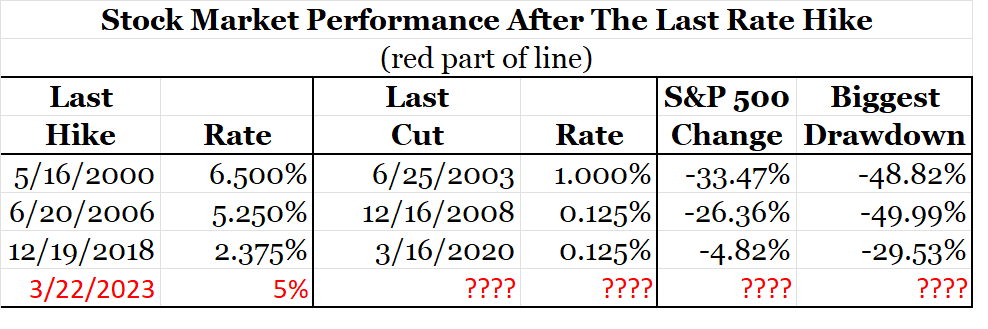
The table below shows the S&P 500’s performance during these previous peaks, pauses, and pivots.
Buying the end of the rate hike campaign and holding until the rate cutting campaign was over (red part of the line above) would have been a disastrous time to own stocks.
Equity bulls have been praying for a Fed pivot for a year. They might want to be careful what they wish for.
On 28 people saw this response which I believe is good old negative Tesla story repression. Not that I am important but my tweets tend to get more than 28 views and a like or two after an hour.
@elonmusk@all_in_tok@DavidSacks Or perhaps make your businesses adapt to changing conditions with higher rates and inflation? Is it a coincidence that banks catering to high end customers that benefited most from zero interest rates are the ones blowing up?
This time it's different. When the 2008 Financial Crisis started the dollar rose and #gold fell. This time it's the reverse, with gold surging $60 so far today. That's because investors are realizing the high #inflation that should've hit ten years ago will hit even harder now!
BREAKING: Gavin Newsom failed to disclose personal ties including his bank accounts at Silicon Valley Bank while lobbying for their bailout.
This is illegal.