Neural networks are circuits, too.
The recent MIT post on language models reading and writing neural-network weights got a lot of attention. I think part of the surprise comes from treating neural networks as fundamentally different from conventional software.
We explored this connection through a few experiments:
→ A playable DOS game written directly as executable bytes.
→ A 123-neuron calculator generated without training.
→ Compiled executables translated into equivalent neural networks.
→ A compact specification expanded into 110,594 neurons computing SHA-256 for two-byte inputs.
The fact that neural networks can implement these computations isn’t new. What’s impressive is how well language models can work with these different representations.
We’ve put together an interactive blog post where you can play the game, test the networks and inspect the circuits.
Check it out: https://t.co/kC3rGKvcfo
Our CTO and co-founder Jack Fitzsimons caught up with @p_e to talk about how Blatent and Struct came to life, what we’re building, and why it matters.
They first met at a programming competition in Bremen in 2012. Plenty to catch up on!
Read the interview below 👇
Had the pleasure of catching up with @p_e last week. We first met when he crushed a competitive programming competition in Bremen, Germany (circa 2012) and I've always been impressed by his work ever since.
So, needless to say it was a privilege to answer some questions for his substack: https://t.co/XzpL3p10Fx
If you're interested in playing around with Struct yourself check out https://t.co/DcDA4ofCFI
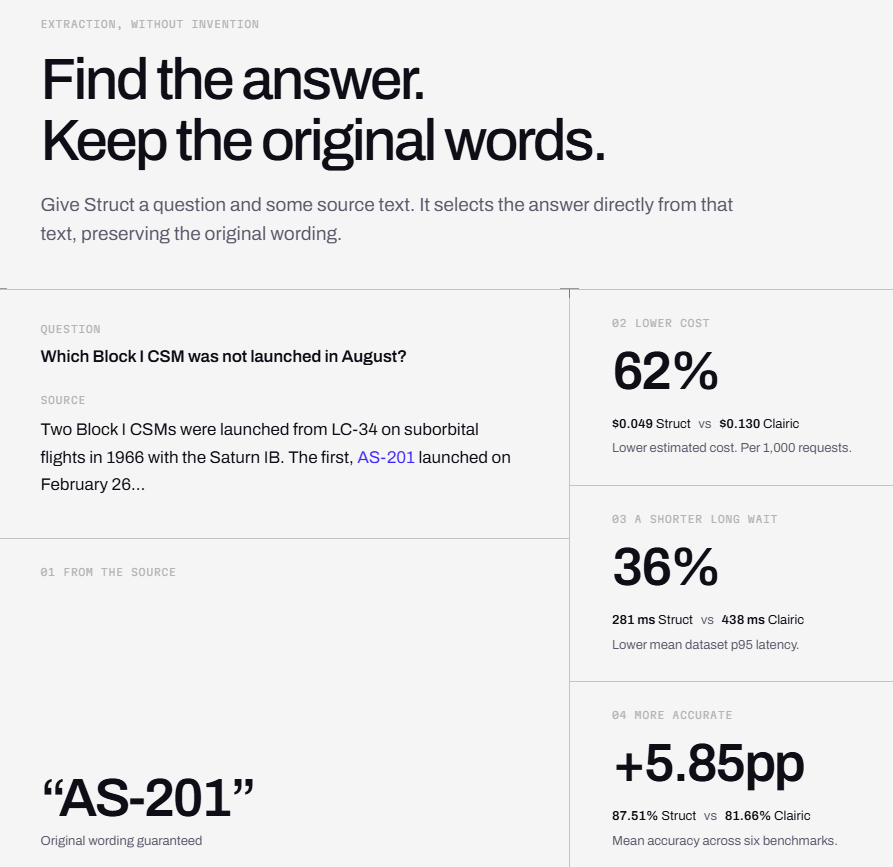
Getting an LLM to quote text exactly when answering a question is harder than it sounds.
Very few fast models can guarantee this. We compared Struct with Cloudflare’s Clairic across 6 benchmarks: 32% fewer errors, at 62% lower estimated cost.
https://t.co/uGlb5AmjeP
Looking forward to heading back to Bengaluru at the end of the month. I'll be speaking at WeAreDevelopers Conference on the 25–26 November about fun and games with evals and some of the risks involved when fine tuning.
If you are at the event or in town let me know!
https://t.co/vvPg0sPzFZ
What if you could program an LLM instead of just prompting it? That’s what we’ve built with Blatent Struct.
Structured outputs are just the beginning. Struct lets developers define decision trees, supply application context and enforce business rules during inference.
And the performance backs it up: 85.09% average score across 20 benchmarks, with 145 ms median latency.
AI you can program, not just prompt.
Try Struct: https://t.co/OTdjkH83tc — sign up to receive instructions by email and get 100 million tokens to experiment with.
Very excited to finally share what we've been building!
Today, we are launching Blatent Struct, our first language model. 🚀
One thing that's always bothered us about building with LLMs is how much engineering you need around the model. Getting an answer is one thing. Making sure it follows the right decision path, returns everything your application needs and doesn't break your business rules is another.
We wanted to change that.
Struct brings programmability to language models.
You can define complex, cascading decisions, conditional dependencies and exactly what each outcome must satisfy. You can also enforce business rules and permissions during inference.
And rather than stitching together multiple model calls, Struct can handle the whole decision tree in a single run.
We also spent a lot of time making sure this doesn't come at the expense of performance.
In our benchmarks, Struct achieves comparable accuracy to Claude Sonnet 5.5, at 11× the speed and over 100× lower estimated cost.
It's also over 2× faster than Jev, with higher average accuracy across 20 benchmarks. And on source-grounded extraction, it outperforms Cloudflare Clairic (87.5% vs. 81.7% across six benchmarks), at 62% lower estimated cost.
For me, the exciting part is what this enables: everything from document processing and customer support to agents that can make complex decisions while respecting the rules you've set.
This is just our first model, and there's a lot more to come.
I'd love for you to give it a try and tell us what you think. We're especially keen to hear what works, what doesn't and what you'd like us to build next.
🚀 Get started for free (up to 100m input tokens are on us) : https://t.co/iwEo6Cybo2