Maybe post-training isn't about teaching models new skills, it's just throwing away the noise so latent skills can surface. The circuits needed for a skill are already hiding inside.
Even the simplest weight edit, a deletion, can teach an LLM new skills!
Meet Deletion Tuning (#NeurIPS2026): just zeroing <0.1% of weights matches full fine-tuning's accuracy at scale. It's thousands of times smaller and avoids forgetting, a step toward continual learning. 🧵👇
As someone who wants to diversify their portfolio to US stocks, either in index funds like S&P500 or some mutual funds, what platforms do you usually use to invest, as an indian investor?
And how do the indian tax laws apply to these? Are LTCG/STCG applied as usual to these?
A ‘hello world’ milestone for Project Suncatcher 🚀
After launching our prototype satellite a few weeks ago, we’ve now successfully sent a command up to orbit, booted up the TPU, ran the prompt, and received our first complete response back on earth - a haiku!
I always wondered if you could have it all, indeed you can, but time taught me
“not all at once.”
That’s a myth.
There’re going to be phases in your life where you have to focus on your career and minimize those 5 gym sessions per week to maybe three.
There’re going to be times when you have to prioritise your parents health before pulling a 12 hour work shift,
And indeed there’re going to be times when your creative side would need more of you, so that you don’t end up losing yourself in responsibilities.
Somedays all that would matter is giving all your time to your partner.
The key is not to have it all, but to prioritise what needs to be number one at any given point in time.
@CSProfKGD On a side note, what's your take on workshop papers in terms of contributions? Do full conference papers require a working solution (loss fn, model arch, algorithm, etc.), or are Findings papers also valid? Asking to understand where I should aim a paper as I write it.
Hi all, I have a new result I'm excited to share. It turns out that *all existing implementations* of softmax and cross-entropy (that's JAX, PyTorch, textbooks, etc) have a subtle bug --- two bugs, actually. A simple rewrite fixes both, and eliminates "slingshots" when grokking:
@CSProfKGD@phillip_isola Agree with this, but isn't the game actually about doing good research (which we eventually do in PhD), and it is not about the PhD title/degree itself. And what if you do the same thing without a PhD(maybe at a frontier AI lab), is it still worth it or the research matters more?
🚀 Hiring full-time Research Engineers at Repello AI.
If you have strong research instincts and want to work on AI Safety/Red-Teaming Research revolving around Agentic Guardrails, Adversarial Self-Play, Model Robustness, and more, let's chat.
Apply at lavish(at)repello(dot)ai
Today we are releasing a claude code plugin for red-teaming AI Agents!
Behold, artemis-recon
Turn your claude code harness into a scoped security researcher who recons, threat-models, and finds initial gaps inside your AI Agents
Install the plugin & run /artemis-recon:recon
Today we are launching Workstation Lens
A CLI scanner to discover and monitor security issues in your Skills, MCPs, hooks and other plugins being used across agents like like Claude code, Cowork, Codex, Cursor, Antigravity and more, in your device.
Open for early access, dm.
🛡️ Hiring Cybersecurity Interns @RepelloHQ
We're looking for hackers at heart to join our team and help us break (and secure) AI systems.
About Repello AI:Repello is building the security layer for AI - helping enterprises red-team, monitor, and secure their GenAI applications. Backed by top investors, working at the intersection of AI and cybersecurity.
Who we're looking for:
Folks with hands-on experience in :
- Offensive security / pentesting
- Bug bounty (HackerOne, Bugcrowd, Intigriti, etc.)
- CTFs (CTFtime profiles, writeups welcome)
- Red-teaming / adversarial research
- Bonus points if you've poked at LLMs or AI systems before.
Why this role:
- Work directly with top cybersecurity and AI minds from Silicon Valley
- Research + execution heavy, breaking real-world AI systems
- Very high ownership : your findings ship
- Competitive stipend
- Strong potential to convert into a full-time role
How to apply:
Drop an email to [email protected] with: → Resume → HackerOne / Bugcrowd / CTFtime / GitHub profiles → Writeups, CVEs, or proof of work (the juicier, the better)
If breaking things is your love language, we want to talk. 🔥
A mathematician who shared an office with Claude Shannon at Bell Labs gave one lecture in 1986 that explains why some people win Nobel Prizes and other equally smart people spend their whole lives doing forgettable work.
His name was Richard Hamming. He won the Turing Award. He invented error-correcting codes that made modern computing possible. And he spent 30 years at Bell Labs sitting in a cafeteria at lunch watching which scientists became legendary and which ones faded into nothing.
In March 1986, he walked into a Bellcore auditorium in front of 200 researchers and told them exactly what he had seen.
Here's the framework that has been quoted by every serious scientist for the last 40 years.
His opening line landed like a punch. He said most scientists he worked with at Bell Labs were just as smart as the Nobel Prize winners. Just as hardworking. Just as credentialed. And yet at the end of a 40-year career, one group had changed entire fields and the other group was forgotten by the time they retired.
He wanted to know what the difference actually was. And he said it wasn't luck. It wasn't IQ. It was a specific set of habits that almost nobody is willing to follow.
The first habit was the one that hurts the most to hear. He said most scientists deliberately avoid the most important problem in their field because the odds of failure are too high. They pick a safe adjacent problem, solve it cleanly, publish it, and move on. And because they never swing at the hard problem, they never hit it. He said if you do not work on an important problem, it is unlikely you will do important work. That is not a motivational line. That is a logical one.
The second habit was about doors. Literal doors. He noticed that the scientists at Bell Labs who kept their office doors closed got more done in the short term because they had no interruptions. But the scientists who kept their doors open got more done over a career. The open-door scientists were interrupted constantly. They also absorbed every new idea passing through the hallway. Ten years in, they were working on problems the closed-door scientists did not even know existed.
The third habit was inversion. When Bell Labs refused to give him the team of programmers he wanted, Hamming sat with the rejection for weeks. Then he flipped the question. Instead of asking for programmers to write the programs, he asked why machines could not write the programs themselves. That single inversion pushed him into the frontier of computer science. He said the pattern repeats everywhere. What looks like a defect, if you flip it correctly, becomes the exact thing that pushes you ahead of everyone else.
The fourth habit was the one that hit me the hardest. He said knowledge and productivity compound like interest. Someone who works 10 percent harder than you does not produce 10 percent more over a career. They produce twice as much. The gap doesn't add. It multiplies. And it compounds silently for years before anyone notices.
He finished the lecture with a line I have never been able to shake.
He said Pasteur's famous quote is right. Luck favors the prepared mind. But he meant it literally. You don't hope for luck. You engineer the conditions where luck can land on you. Open doors. Important problems. Inverted questions. Compounded hours. Those are not traits. Those are choices you make every single day.
The transcript has been sitting on the University of Virginia's computer science website for almost 30 years. The video is free on YouTube. Stripe Press reprinted the full lectures as a book in 2020 and Bret Victor wrote the foreword.
Hamming died in 1998. He gave his final lecture a few weeks before. He was 82.
The lecture that explains why some careers become legendary and others disappear is still free. Most people who could benefit from it will never open it.
Over the last few months, we've been using Claude Code to do practically all our GTM execution work.
Not just coding. Everything.
Running outbound campaigns, finding high-intent leads and candidates, creating SEO pages, running marketing campaigns, managing my CRM, even finding apartments.
Claude can truly do anything you need. It just needs the right setup + skills.
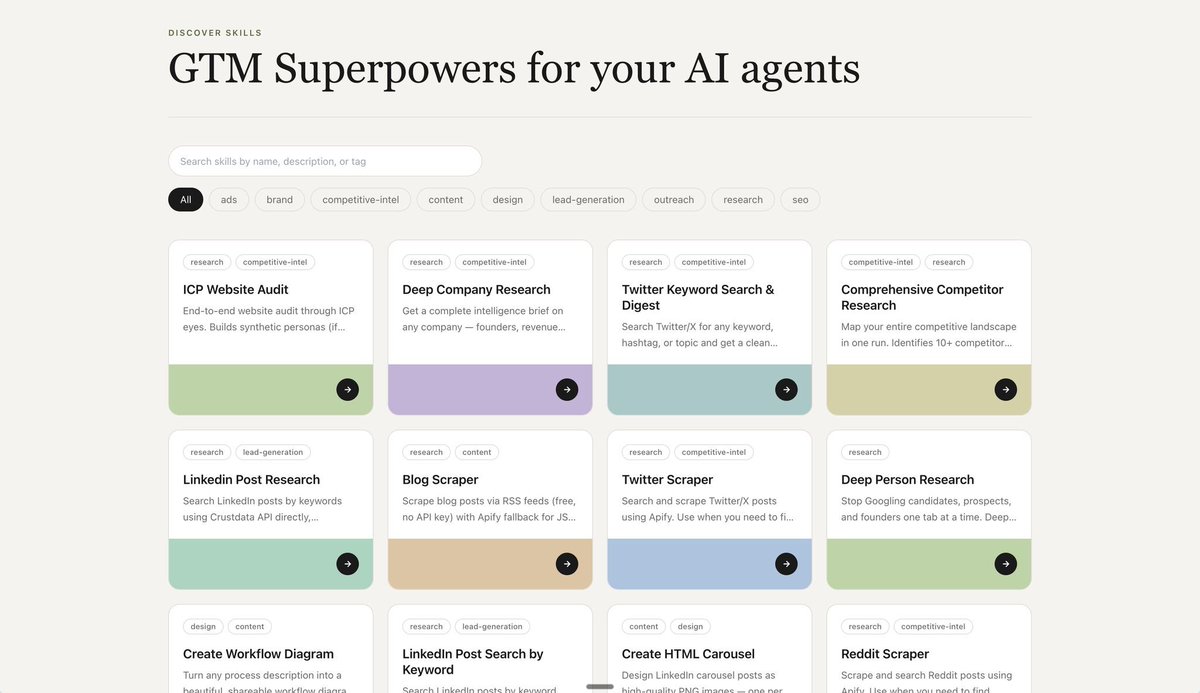
So we created a library of skills that teach Claude how to do GTM work. Things like:
- Scraping reddit for your ICP's pain points
- Monitoring your competitors posts across all social channels
- Finding leads from comments on LinkedIn posts
- Enriching & qualifying leads
- Scraping reviews
- Creating slides & graphics
- Auditing your SEO / content strategy
It's completely free and has over 50 skills specifically designed for GTM skills.
Link + OSS below 👇
@harshilmathur@openclaw sounds like a very cool use case Harshil, but i think you should be a bit more careful with this.
i ran the skill through our skill-check tool and it flagged quite a few security issues that are oversights but can be established attack paths
https://t.co/A0SIsHns8v