At the young age of eleven, Dr K S Rajanna's life took a challenging turn when he lost his hands and feet to Polio.
Instead of letting these limitations define him, he found inspiration in his own resilience and dedicated himself to empowering others facing similar challenges.
His tireless efforts in social service were recognised by the Karnataka government in 2013, appointing him as the State Commissioner for the Disabled.
And in 2024, his remarkable contributions were further honoured with the prestigious Padma Shri award.
#DrRajanna #Inspiration #SocialWork #PadmaShri #PolioAwarness
[Dr. Rajanna, Polio, Disability rights activist, Padma Shri, Social worker, Inspiration]
PCOS is remaned as PMOS
PCOS has officially been renamed to PMOS - Polyendocrine Metabolic Ovarian Syndrome.
The change was announced at the European Congress of Endocrinology 2026 in Prague by Prof. Helena Teede.
This was the result of a 14-year global consensus process involving:international endocrine and reproductive societies patient advocacy groups
researchers across 6 continents.
One of the biggest reasons for the name change:the term “polycystic ovaries” was considered misleading.
many women with the condition do not actually have ovarian cysts.
The “cysts” are often immature follicles, not true cysts.
The new name highlights that this is:a multi-system endocrine and metabolic disorder not merely a gynecological ovarian issue.
PMOS emphasizes the strong links with:
1) insulin resistance
2) obesity
3) Type 2 diabetes
4) fatty liver
5) cardiovascular risk
6) infertility
7) mental health issues like anxiety and depression.
Experts believe the old name contributed to:delayed diagnosis misunderstanding of the disease
inadequate treatment focus.
Around 1 in 8 women globally are affected - estimated over 170 million women worldwide.
(In india its 1 in 5)
The diagnostic criteria themselves are not changing immediately - mainly the terminology and conceptual framing are changing.
The full transition to the PMOS terminology is expected to be incorporated into international guidelines by 2028.
This is actually a major shift because it finally acknowledges what many metabolic health practitioners have been discussing for years:
1) PMOS/PCOS is deeply connected with 2) hyperinsulinemia and metabolic dysfunction, not just ovaries.
https://t.co/rUcYn8PY42
From 5 Fractures + Daily Bone Pain to Zero Osteoporosis — Here's Exactly What I Did 10 Years Ago To Reverse & Heal.
10 years ago, after 30 years of living with severe Osteoporosis, chronic daily bone pain, and five painful fractures between 2011–2016, I decided enough was enough. I researched, created, and followed my own 3-part protocol — and today I have zero pain, zero fractures, and no Osteoporosis diagnosis at all. No toxic prescription bisphosphonate drugs. No harmful calcium supplements. Just real food, real movement, and the body’s natural ability to heal.
This is exactly what worked for me:
1. Nutrition: Animal-Sourced Protein & Fat (The Building Blocks of Bone)
Bones are 50% collagen/protein matrix and 50% minerals. You can’t rebuild them without the raw materials. I ate a minimum of 1 gram of protein and 1 gram of fat per pound of my desired body weight every day from fatty red meat, wild-caught fish, eggs, organs, connective tissue, bone stock, tallow, butter, and ghee. Example: 120 lb person needs to consume at least 120-180 grams of protein & 120-180 grams of fat each day.
I cut out sugar and carbs completely — they pull minerals out of your bones. This alone gave my body the collagen and nutrients it needed to start repairing.
2. Sun + Minerals & Targeted Support
20+ minutes of daily direct sunlight for natural Vitamin D3 production.
Unrefined mineral sea salt every single day (the one with all 12 major and 60+ trace minerals — NOT processed table salt).
Key cofactors: Boron, Magnesium Glycinate & Threonate, plus natural food sources of D3 & K2 from eggs and red meat. These work together to direct minerals where they belong — into the bones, not the arteries.
3. Weight-Bearing Exercise to Signal Bone Growth
Three days a week, minimum 20 minutes of heavy lifting: squats, deadlifts, presses, lunges, and weighted carries. Cardio doesn’t rebuild bone — progressive resistance does. It tells your osteoblasts to get to work using all the protein and minerals you’re now feeding them.
The result? My bones rebuilt themselves. I went from daily pain and broken bones to complete freedom. Nature truly provides when you give it what it actually needs.
If you’re dealing with bone loss, osteopenia, or Osteoporosis, bone pain & fractures know this: healing is possible. I’m living proof.
Questions? DM me — I’m always here to help.
With low carb ketogenic diet, sat fat ghee butter and coconut oil around 60g a day .. my Lp(a) dropped from 44 to <25
Many studies have supported the fact that saturated fat lowers Lp(a)
Fun fact: Statins increases Lp(a)
In this small pilot trial, 10 Indian children with autism were found to have differences in metabolic biomarkers compared to neurotypical children that partially normalized with a ketogenic diet.
Some of their symptoms of autism also improved with the ketogenic diet.
Magnesium is required to convert vitamin D into its active form, calcitriol.
Without adequate magnesium vitamin D remains functionally inactive.
Vitamin D increases calcium absorption from the gut.
Vitamin K2 directs that calcium into bones and teeth and away from soft tissues, like arteries.
Without adequate vitamin K2 higher vitamin D driven calcium absorption can increase the risk of ectopic calcification, not stronger bones.
The average Indian diet is:
- High in carbs (rice, chapati, bread)
- Cooked in seed oils (sunflower, soybean)
- Low in animal protein
- Rich in legumes and vegetables
This is basically what Western nutritionists recommend.
India's diabetes rate has tripled in 30 years.
Maybe the advice isn't working.
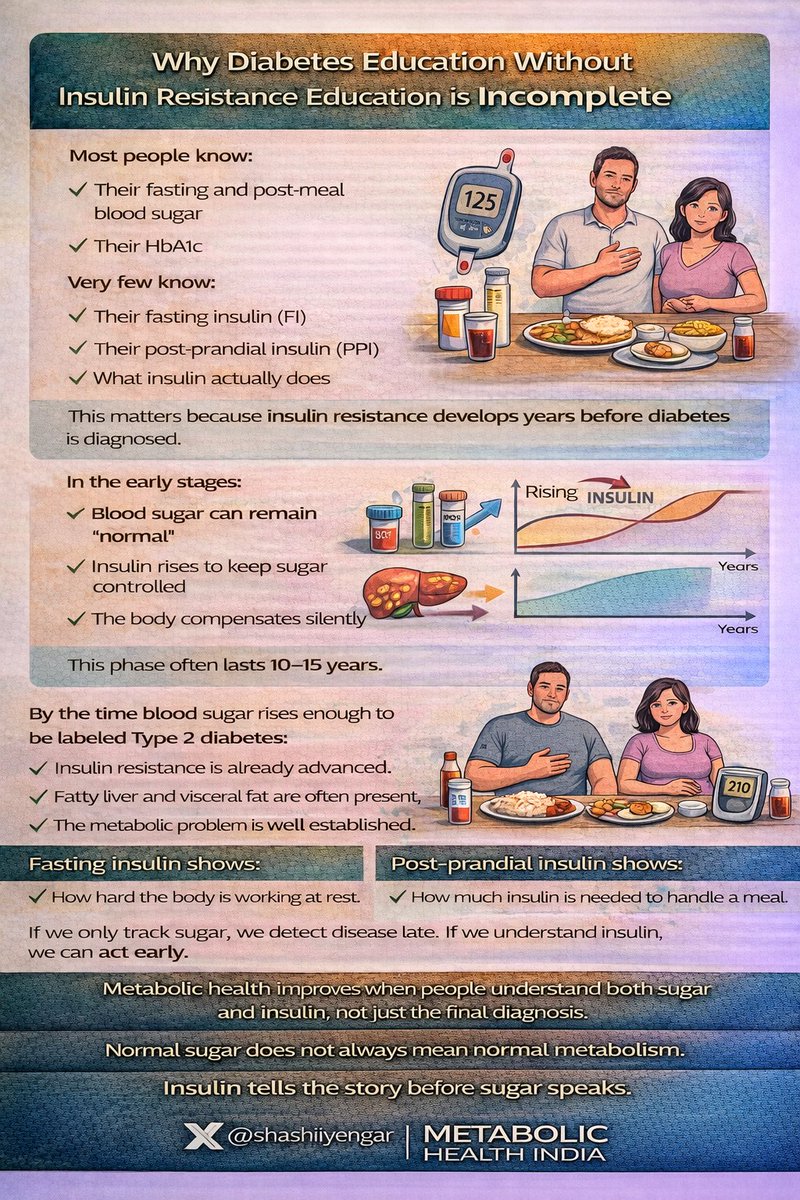
Why Diabetes Education Without Insulin Resistance Education Is Incomplete
Most people know:
Their fasting and post-meal blood sugar
Their HbA1c
Very few know:
Their fasting insulin (FI)
Their post-prandial insulin (PPI)
What insulin actually does?
Why insulin stays high long before sugar rises?
This matters because insulin resistance develops years before diabetes is diagnosed.
In the early stages:
Blood sugar can remain “normal”
Insulin rises to keep sugar controlled
The body compensates silently
This phase often lasts 10–15 years.
By the time blood sugar rises enough to be labeled Type 2 diabetes:
Insulin resistance is already advanced
Fatty liver and visceral fat are often present
The metabolic problem is well established
Fasting insulin shows:
How hard the body is working at rest
Post-prandial insulin shows:
How much insulin is needed to handle a meal
High insulin with normal sugar is not normal.
It is a warning sign.
If we only track sugar, we detect disease late.
If we understand insulin, we can act early.
Knowledge gap leads to delayed action.
Delayed action becomes a treatment gap.
Metabolic health improves when people understand both sugar and insulin, not just the final diagnosis.
Please follow these only if you are keen to understand and prevent the development of diabetes. Else just scroll through.
-Metabolic Health India
If insulin resistance is not the same in everyone,
can the treatment really be the same for all?
Insulin resistance does not arise from a single tissue, a single pathway, or a single cause.
It can originate in the liver, muscle, or adipose tissue.
It can be driven by inactivity, stress hormones, illness, sleep loss, aging, or excess fuel.
Yet it is often approached as one uniform condition with one uniform protocol.
Calling all of this “one disease” oversimplifies human physiology.
Insulin resistance is tissue-specific, stage-specific, and context-dependent.
Two people can have the same HbA1c
and completely different underlying biology.
This is why lab numbers alone don’t tell the full story.
And why blanket explanations often miss the mark.
When biology is heterogeneous,
standardization has limits.
Personalization isn’t a trend or something fancy, it’s actually a physiological necessity.
No matter what diet you follow, fast weight loss always signals stress to the brain.
That stress can drive inflammation and immune activation.
Slow loss supports long-term metabolic, hormonal, and brain health.