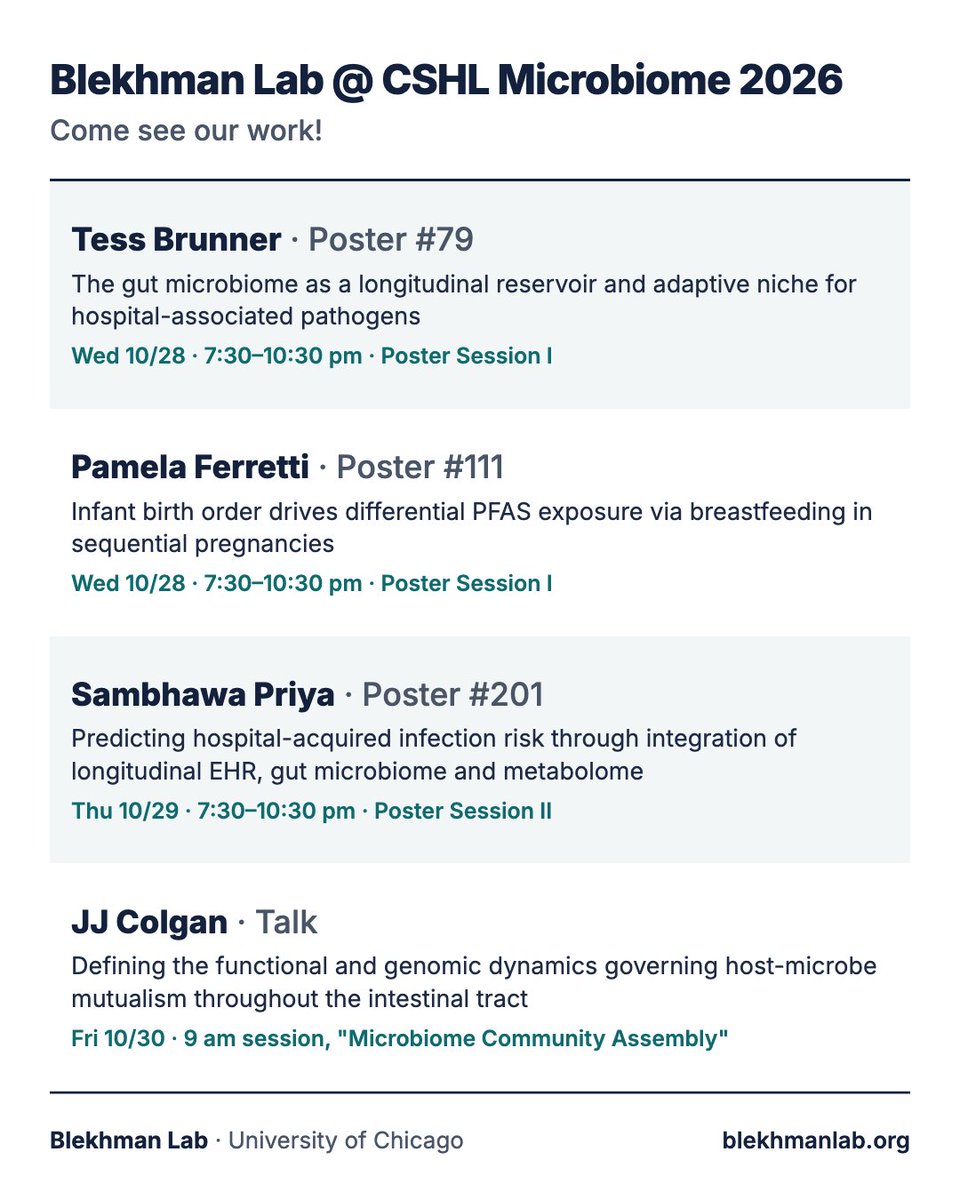
The Blekhman Lab is at the Cold Spring Harbor Microbiome meeting next week 👇
Come see presentations by Tess Brunner, JJ Colgan, Pamela Ferretti, and Sambhawa Priya (@sambhawa_priya)!
This is actually completely routine in academia - many universities have these programs periodically.
This is because of tenure. The only way a tenured professor can retire is voluntarily, so universities have to pay an incentive to free up salaries and lines. Very common.
It's over. The higher ed dam has broken: Clemson is offering a voluntary separation program (VSP) to 452 eligible faculty and staff. Eligible employees who accept the offer will receive a lump-sum payment equal to nine months of their base pay.
Very good essay. You can read it in 5 minutes. I wrote some of my own thoughts on this over the weekend.
What Counts as Impact? https://t.co/Pz8P0agYwa
Some of my thoughts about the surge in AI-generated papers, why this feels like a completely new kind of problem, and what this means for how we evaluate science in biology.
Out now in PLOS Biology:
https://t.co/FNV3L5My72
Good points here on AI over-reliance during PhD training.
This is a common pattern: a big productivity boost early on, but catches up with you in year 2-3
Fascinating/terrifying to read the comments on the "mathocalypse" on Tao's blog. If you think biology is safe - maybe safe for now, but I definitely see a "biocalypse" in the next 2-3 years
https://t.co/p0yjOAs0rC
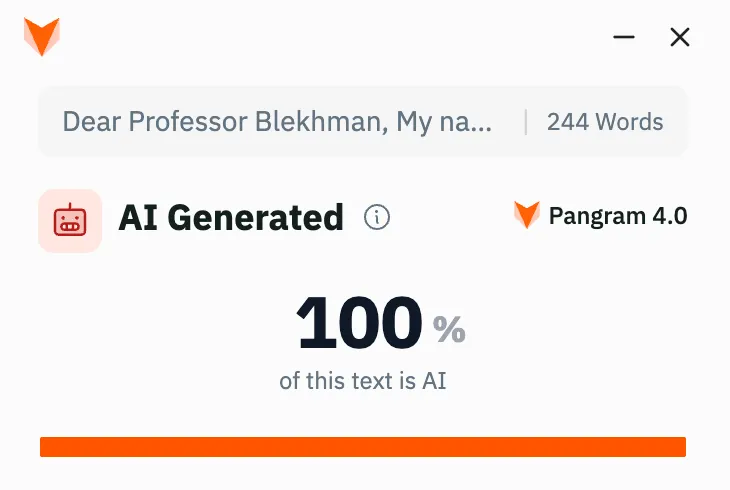
My inbox is being flooded with fully AI-generated emails from prospective students. I tried to work out why I can't bring myself to read them, and ended up with some thoughts and advice for writing cold emails in the age of AI.
My new post:
https://t.co/qC5PXb0cIF
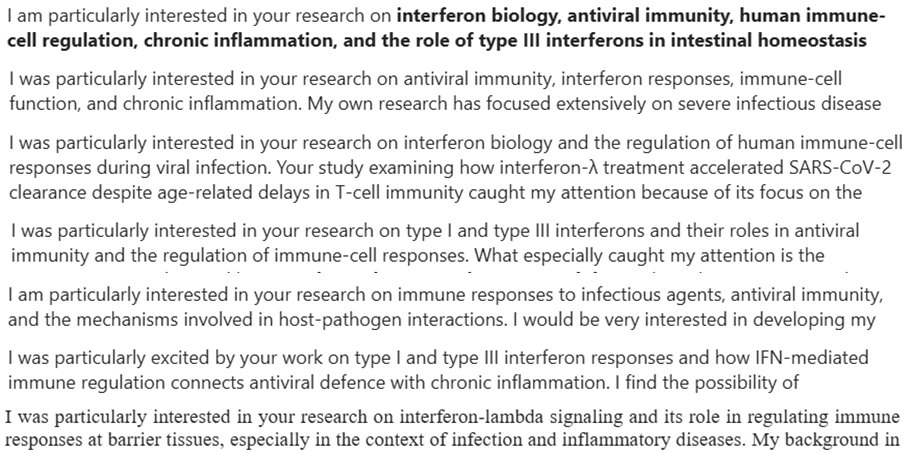
Great & timely summary! I also immediately want to delete the obvious AI-emails when the same structure & almost same wording. This is the 1st impression we get with limited recruitments so please take the time to differentiate yourself & show true interest in our work- see eg👇
This is exactly why I don't think AI will lead to biology breakthroughs anytime soon.
Finding "potentially interesting" DNA sequences is easy -- the real bottlenecks are not computational
https://t.co/jR6ShuYkEv
Claude has discovered a previously unknown enzyme system hidden in the DNA of bacteriophages. Beside the enzyme’s gene sits a long array of repeating DNA—a structure that looks somewhat similar to CRISPR.
We don’t yet understand what this system does, but only a handful of known systems share its features, and all of them are able to cut, copy, and paste DNA. Historically, the discovery of such programmable systems has helped revolutionize medicine. CRISPR, for instance, is now the foundation of genetic medicines. But it will take much more work to learn what this system does, and whether it can be put to similar use.
Read more: https://t.co/RuEosScSMb
Cool list, but I wouldn't call it biology - very narrow to synbio/protein engineering
A real biology Millennium list would include aging, development, immune prediction, host-microbe causality, disease (!). Fun thought exercise though
In light of the progress in mathematics, we at Edison Scientific and FutureHouse have assembled a set of Millennium Problems for Biology. They are chosen to be very hard to solve but very easy to validate in a simple laboratory environment. Any of these, if solved, would mark a major advance in biotechnology, and most of them would contribute materially towards curing disease. These are, in some sense, the “last reasonable eval” for AI in biology. This was work primarily by @MichaelaThinks and myself, with contributions from many others.
Short descriptions below. The full descriptions of the problems with acceptance criteria are at the Bio Millennium Problems website, linked in the next post. Share more if you have ideas. If they meet our criteria, we’ll add them to our list (with attribution and permission).