Hey guys. I have a friend who is desperately in need right now. She's just left her abuser, and any help you could give is appreciated.
I am a good friend of hers and I swear this is true. I had permission to post this.
Please share this to help out.
https://t.co/NNkHpAca2r
THIS IS ALL TRUE
Before a single Mormon missionary set foot on African soil, the Lord had already gone ahead of His servants and prepared a people in secret.
In the late 1960s, in eastern Nigeria, a schoolteacher named Anthony Obinna lay down to sleep and was carried in vision into a beautiful building he had never seen.
A tall man walked him room by room through its shining halls. Years passed. Then, confined to his home during the violence of the Nigerian Civil War, Obinna opened a tattered copy of Reader’s Digest and froze.
There, in an article about a people called the Mormons, stood the very building from his dream: the Salt Lake Temple. He had never heard the word before. “From the time I finished reading the story,” he said, “I had no rest of mind any longer.”
He wrote to Salt Lake City and was told plainly that no missionaries were coming. He kept writing anyway. The Spirit would not let him stop.
He raised a chapel with his own hands, painted “Nigerian Latter day Saints” near its roof in blue letters, and gathered a congregation to a church that did not yet know they existed.
When the senior missionaries finally found his nameless street in 1978, Obinna met them at the door and said the words he had waited a lifetime to speak: “You have come at last.”
A thousand miles west, in Ghana, the same fire was burning.
One morning in March of 1964, as Joseph William Billy Johnson rose to begin his daily work, the Spirit of the Lord fell upon him and he heard his own name spoken three times out of the air: “Johnson, Johnson, Johnson. If you will take up my work as I will command you, I will bless you and bless your land.”
Trembling and weeping, he answered yes, and from that hour he could not be stopped. He walked fifty miles in a day and counted it nothing, telling himself he was following the pioneers who had died in the snow.
Persecution came.
Newspapers mocked him.
Landlords threw him into the street.
And still the gifts of God rested on him so plainly that the missionaries who came later called him the Saint Paul of Ghana, a man of healing and prophecy and dreams.
When his own faith faltered in the long silence, his deceased brother appeared to him in the night and told him not to leave, for he had chosen the only true Church, and to prove it the brother sang him a hymn Johnson had never once heard in his life: Come, Come, Ye Saints.
By the time the elders arrived, Johnson had baptized no one, held no priesthood, owned no authority anyone in Utah recognized. He had only ten congregations and a thousand souls standing ready in the rain, waiting to be brought into the waters.
This is the truth that the dreams of West Africa thunder back at us, and we forget it at the peril of our own souls.
The Restoration is a living flame, and the flame belongs to God, and God lets it fall wherever He pleases.
He answered a farm boy in a grove in New York.
He answered an african schoolteacher in a war and a metal clerk on a Ghana morning, and He did not love one of them less than another.
He spoke to them in the only language He needed: the dream, the burning chest, the voice that calls a man three times before dawn.
I'm a clockmaker.
I show up to a service call and ring the doorbell. Nothing. I call the customer.
Her: Hello?
Me: Hi, it's [Name]. I'm here for your service call. I'm at your front door.
Her: Well I'm not home. I waited until 4:15 and you never showed so I left.
Me: You waited until 4:15?
Her: Yes. The appointment was at 3. I gave you over an hour.
Me: Ma'am the appointment window was between 3 and 5, not at 3 exactly. Also it's currently 3:20.
Her: What do you mean 3:20?
Me: The time. It is 3:20 in the afternoon right now.
Her: That's not what my clock said.
Me: (pause)
Me: Which clock were you looking at?
Her: The one in the living room.
Me: (longer pause)
Me: By any chance is that the clock I was coming to fix?
Her: (silence)
Her: ...Yes.
Me: (standing on her porch)
Me: (staring at nothing)
Me: (I am a clockmaker)
Me: (I was called to fix a broken clock)
Me: (the customer used the broken clock to decide I was late)
Me: (and left)
Me: (I have been doing this job for eleven years)
Me: (this is a new one)
Great news! Chris, who started reading the Book of Mormon over a year ago, has decided to be baptized and become a member of The Church of Jesus Christ of Latter-day Saints!
My high school math teacher Mr D was known for one thing.
He reused the same exam questions every year. Just changed the numbers. Everyone knew it. He also made a very big deal of collecting every paper back after we reviewed our scores so nobody could pass them to the next year's class.
Of course some of my classmates got their hands on a full set of tests from the previous year.
Within a week everyone had a copy.
Before every exam we'd sit together and work through every problem on the old test until we could solve them in our sleep. When the real exam landed the numbers were different but the logic was identical.
We thought we were geniuses.
Years later I became a teacher myself. Ran into Mr D at a funeral.
Me: I have to confess something.
Me: We had a copy of your old tests the whole time.
Me: Full set. Every exam.
Him: (smirked)
Him: Who do you think leaked them?
Me: (stared at him)
Him: Kids won't study if a teacher tells them to.
Him: But if they think they're getting away with something?
Him: (shrugged)
Him: They study all night.
Me: (stood there)
Me: (replayed four years of feeling clever)
Me: (we were never clever)
Me: (he played us perfectly)
Me: (I became a teacher and I still got played)
Me: (Mr D was built different)
If there is one thing I'm happy that motherhood blessed me with, it's a nice pair LOL.
All joking aside, I'm sorry you got modesty shamed. It happened to me more than once too.
Eastern Catholics (I used to be one) have a phrase they follow in regard to religious practice: "Keep your eyes on your own plate."
Definitely something we all can take a lesson from, regardless of our faith upbringing.
To recap my "Mormon boobs" scandal. My WEDDING DRESS, has a tiny bit of cleavage and some exmos decided to say my "boobs don't look Mormon"
My boobs and cleavage are some of God's greatest work. My boobs were baptized with me and go to church with me and received my endowments with me. My boobs are proud members of the Church of Jesus Christ of Latter Day Saints.
Y'all can quit modesty policing me, because at no time other than exercise, sex, shower, and swimming are my garments off.
Why is it normal for young people to dress in robes, sit apart from family, receive formal instruction, wear square hats modeled after a mason’s mortarboard, line up ceremonially, ascend to a stage, receive hand grasps, and then return with a new status and identity...
But a similar temple ritual is “cultish”?
Society normalizes theatrical rituals of academia because it is secular.
But mock the temple.
Hugh Nibley once called graduation robes the “black robes of a false priesthood,” a medieval, worldly imitation that celebrates human ambition instead of divine truth.
Perhaps temple worship isn't strange?
Maybe modern people only respect ritual when God has been removed from it.
Went on a date with an Argentinian girl last night.
She mentioned she lived in America for a year and asked why the food was "so spicy"
I asked where?…She said…Boston
I’m like, WTF could you have eaten in Boston that was spicy?!
Broad looked at me and said…Kentucky Fried Chicken. 😂
Never in my life have I heard someone describe KFC as spicy.
For nearly 200 years, critics have claimed Joseph Smith ���wrote” the Book of Mormon.
Okay.
Then prove it.
Not with assumptions. Not with ridicule. Not with recycled anti-LDS theories that collapse every few decades.
Actually prove HOW he did it.
Show the drafts. Show the outline. Show the research notes. Show the source manuscript. Show the co-authors. Show the revision process.
Because what we DO know is this:
A 23-year-old frontier farm boy dictated ~500 pages in roughly 60 working days with: • no formal education • no manuscript in front of him • no rewrites • no library surrounding him • no modern editing tools
And somehow produced: • complex narrative arcs • hundreds of interconnected names • intricate Hebraic literary structures like chiasmus • ancient Near Eastern themes • internally consistent geography, politics, theology, and chronology
Critics have proposed dozens of theories: • Spaulding theory • plagiarism theory • conspiracy theory • “he was a genius” theory
And when those fail, some even claim: “The devil did it.”
But that creates an even bigger problem.
The Book of Mormon testifies of Jesus Christ constantly. In fact, the name “Jesus Christ” appears more frequently in the Book of Mormon than in the Bible when adjusted for length. Its entire stated purpose is to bring people unto Christ, teach repentance, condemn sin, strengthen faith in the Savior, and testify that Jesus is the Son of God and Redeemer of the world.
So the argument becomes:
Satan inspired a book whose entire purpose is to convince people to follow Jesus Christ?
That completely contradicts scripture itself:
“Satan divideth against himself and against none else.��� (3 Nephi 18:20)
The Book of Mormon leads millions to: • pray more • repent more • worship Christ more • read scripture more • strengthen families • abandon addictions • serve others • seek holiness
That is the exact opposite of the fruits Christ warned us about when describing false spirits.
Critics have spent nearly 200 years attacking Joseph Smith, yet they still cannot explain where the Book of Mormon actually came from.
At some point, dismissing Joseph Smith requires more faith than listening to him.
Because if he didn’t translate it…
Where exactly did the Book of Mormon come from?
One thing critics rarely acknowledge:
The Book of Mormon is not just “about Jesus Christ.”
It is saturated with Him.
Jesus Christ is referenced 3,925 times in the Book of Mormon — roughly once every 1.7 verses.
And that matters because some critics literally claim: “The devil inspired the Book of Mormon.”
Think about that for a second.
The same book that: • teaches faith in Jesus Christ • teaches repentance • condemns sin • calls people to baptism • strengthens families • teaches charity • testifies of Christ’s atonement • invites people to pray • repeatedly declares Jesus is the Son of God
…is supposedly satanic?
That argument collapses under its own weight.
Critics still cannot explain how Joseph Smith produced the Book of Mormon naturally: • no drafts • no outline • no manuscript • no formal education • dictated in roughly 60 working days • deeply Hebraic literary patterns • internally consistent narrative structure
So when natural explanations fail, some jump to: “Well maybe Satan did it.”
But Christ Himself taught: “A kingdom divided against itself cannot stand.”
Why would Satan inspire a book whose entire purpose is bringing people TO Jesus Christ?
At some point, critics have to do more than mock Joseph Smith.
They need to explain the Book of Mormon itself.
Years ago in SLC, I walked by a guy who handed me some anti literature.
I looked at him and said, "You don't seem too excited about your job."
He responded that he was an out-of-work construction worker from the Midwest and they flew him to SLC and were paying him $15/hour to had out the flyers. He said that I was the first to take one.
He then asked what the big deal was with the temple. He said his new employer told him he can't go inside to see what they do.
I told him, "Well, that's not true at all. Anyone can go inside."
His eyes got really big, and so I explained to him that he could go talk to the sister missionaries (I pointed towards the entrance to the Temple Square Visitor's Center) and they could tell him what he needs to do to enter the temple.
His entire countenance changed. He got a big smile and told me when his shift was over, he'd go talk to the sister missionaries.
We never exchanged any contact information, but something told me that this man was about to embark on a positive, life-changing, Christ-oriented journey.
My son on a mission in southern Mexico fought for the soul of a young convert over the weekend. He had been working for several weeks with a 19-year-old young man, and the young man had committed to baptism on Sunday evening. But on Sunday morning he called saying he had changed his mind and would not come to church.
My son and his companion hurried over to the young man's house and encouraged him to at least come to church, and the young man reluctantly agreed. My son was scheduled to give a talk. He got up and was suddenly filled with the Spirit. He talked about taking the Sacrament to an older member when he was a priest, and how grateful that older member was, and how he was one of the last people to see that man before he passed away. My son talked about his love of the Savior and cried on the pulpit, and afterwards, the young man who was scheduled to get baptized came up and said he was now ready, and a few hours later he was baptized in front of the whole ward. The Spirit filled the building.
How great is the Miracle of the Gospel.
"The dead are watching. This is doctrine, not sentiment. Joseph taught it plainly. The Saints who went before are not gone. They are engaged in the same work, on the other side of a veil that is thinner than we admit.
Your grandfather who held the priesthood, your grandmother who taught Primary for forty years, the pioneer ancestor whose name you carry, they are not finished with you.
They are praying for you. They are pleading with the Father on your behalf. They are waiting to see what you will do with what they handed you.
Live as though they are in the room. Because they are.
And one day you will join them, and you will be asked what you did with the inheritance, not by a stern judge, but by your own people, the ones who paid for it, who want to know if it was worth what it cost them." -- your pioneer ancestor
Why did early Christians have temple-like worship that included:
• ordinances or “mysteries”
• purification
• creation, the Garden, and the Fall
• saving ordinances
• ritual garments
• prayer circles
• what is “within the veil”
• the road back to God
The Pistis Sophia is an early Egyptian Christian apocryphal text. It claims that during Christ’s 40-day ministry after the Resurrection, he taught his disciples about the "mysteries."
This is not Latter-Day Saint scripture. It it's a 3rd-century Christian text, preserved in a Coptic manuscript. Scholars believe that this record compiled from several earlier sources and traditions.
The Pistis Sophia describes people people being robed in linen garments, standing in prayer circles, gathered around an altar, repeating prayers given by Jesus, and receiving instruction connected with heavenly ascent and salvation.
Even if this record contains falsehoods and was written by "heretics" it is clear evidence that ancient Christians did have temple-like worship.
So if Joseph Smith just stole the Temple from Freemasonry, how do temple patterns appear in a text 1400 years older than modern Freemasonry?
Or did Joseph Smith copy the Pistis Sophia to invent the temple ceremonies?
If so, how did he get it when it wasn't published into English until 1896, more than 50 years after his murder?
Could it be that Joseph Smith was actually restoring something from ancient Christianity that modern Christianity had lost?
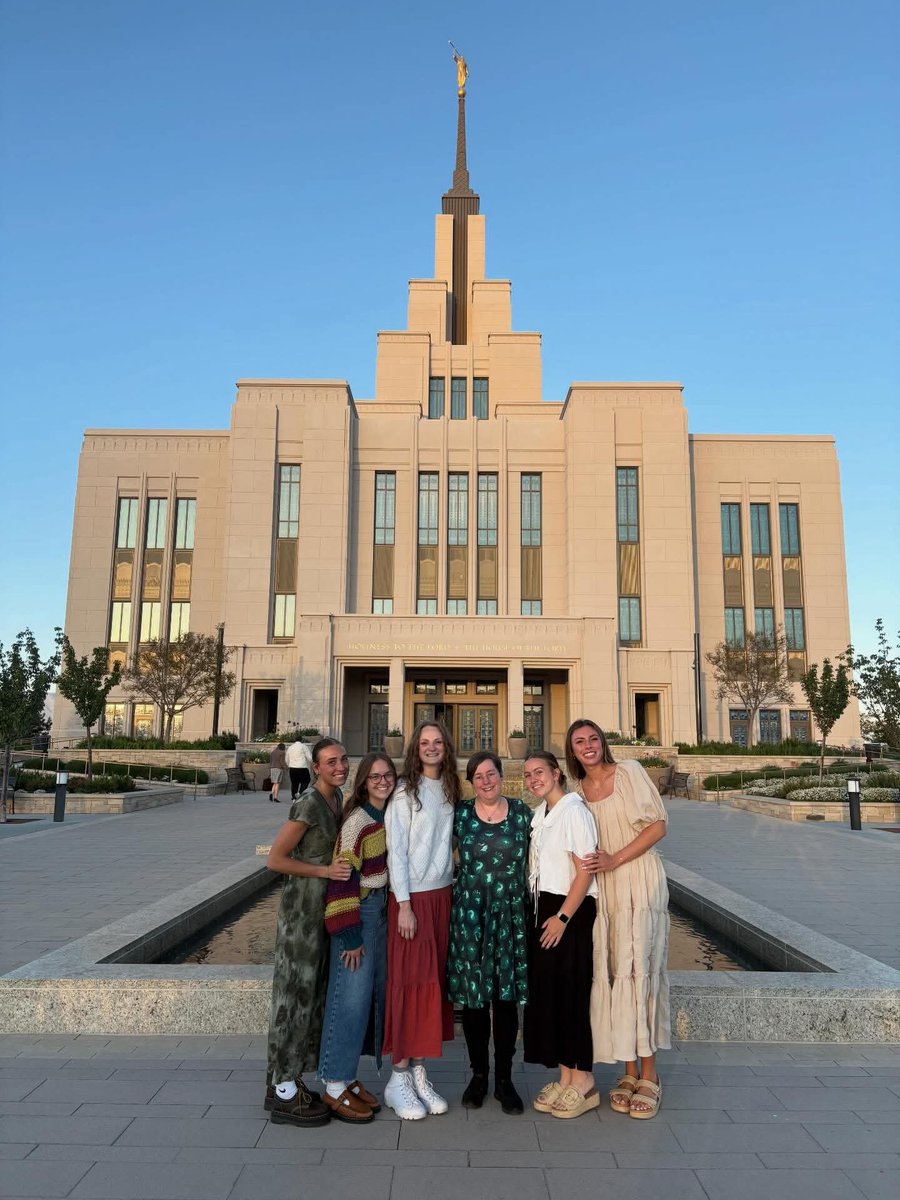
Yesterday, I was sealed to my parents at the Saratoga Springs Temple.
Mom, Dad, I love you and miss you. I'll see you again one day, and we can spend eternity with each other.
Big thank you to all four of my original missionary sisters (plus another) who were able to be there! #SaintsOnX
Well, here's another first... I lost my rental car in the Payson UT Temple parking lot.
Thank the lord for the nice lady that let me hop in her car and drove me around watching for flashing lights as I clicked my key fob. #SaintsOnX
I’ll never forget this statement from Thomas S. Monson:
“My beloved brothers and sisters, how pleased I am to welcome you to this worldwide conference of The Church of Jesus Christ of Latter-day Saints. We are gathered together as a great family, more than 15 million strong,”
At the time, I was in the middle of something difficult, watching friends and family step away from the Church. I was working with them, trying to help, trying to understand. That effort hasn’t stopped.
15 million strong, I pondered this statement, over and over again…
I’m not naive. I know many are inactive.
I know many don’t attend church.
I know others struggle quietly and don’t feel strong.
I also know there’s far too much judgment and many feel others aren’t “strong.”
But I’ve come to believe President Monson wasn’t being overly optimistic when he said “15 million strong.”
I think he meant it.
Because strength isn’t always visible.
I’ve seen people who appear inactive but carry real faith in their hearts.
I’ve seen people step away, even criticize the Church, and yet still choose to keep their names on the records.
That raises a real question:
Why hold on at all, unless something inside is still holding on?
Even if it’s small.
Even if it’s quiet.
Maybe it’s a memory.
Maybe it’s a covenant.
Maybe it’s a flicker of belief they’re not ready to let go of.
And maybe that matters more than we think.
So I’ve come to see it this way:
Those who have made covenants…
Those whose names remain on the records…
Those who hold on, even just a little…
There is strength there.
Not always visible.
Not always expressed the way we expect.
But real.
And I believe that’s the kind of strength President Monson saw.
With this perspective, there’s more understanding, more hope, more love.
Stop focusing on our frailties and focus on our strengths.
I add my testimony to his.
We are now 18 million strong!